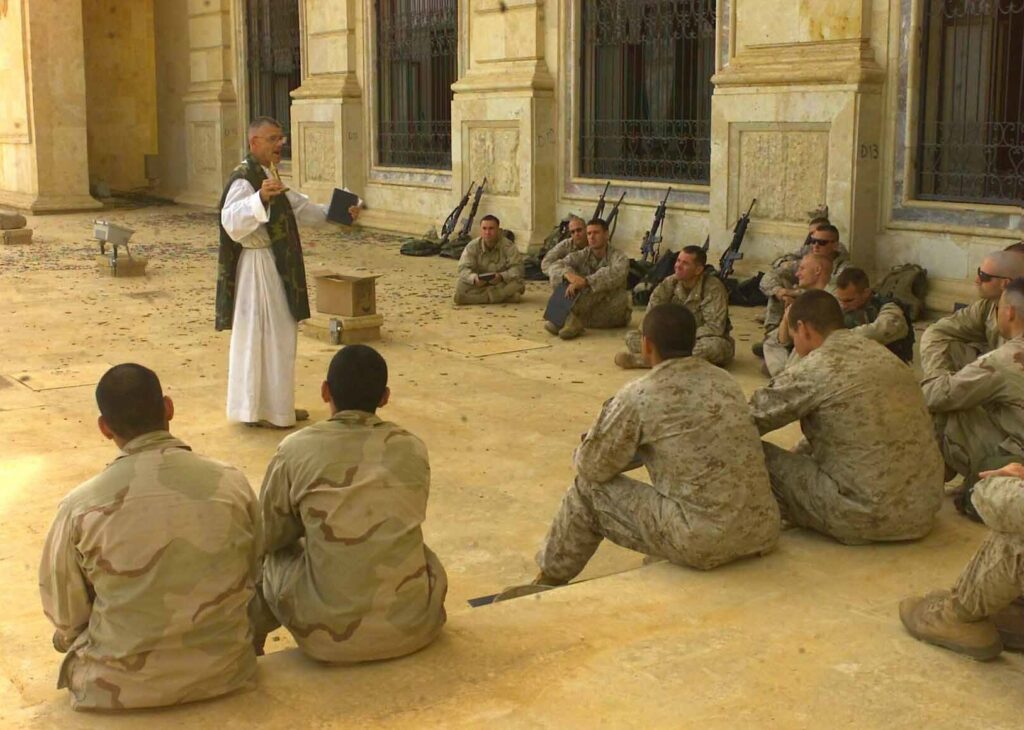

In a video address delivered in December, Defense Secretary Pete Hegseth ordered an overhaul of the Chaplain Corps by restoring its focus on religious ministry. Once considered the “spiritual and moral backbone of our nation’s forces,” chaplains, the secretary laments, have been minimized, reduced to being “therapists instead of ministers.”
In illustration, Hegseth railed against the Army Spiritual Fitness Guide, released last August, in which “faith and virtue have been traded for self-help.” The guide, Hegseth said, “mentions God one time—that’s it. It mentions feelings eleven times. It even mentions playfulness … nine times.” There are zero mentions of virtue. In response, he insists, “there will be a top-down cultural shift, putting spiritual wellbeing on the same footing as mental and physical health, as a first step toward creating a supportive environment for our warriors and their souls.”
The secretary’s address comes in the context of a comprehensive, military-wide focus on preparing for possible conflict with China. By placing spiritual wellbeing alongside mental and physical health, Hegseth is signaling that he considers spiritual health an essential element of combat readiness.
He’s not the first.
Continue reading at WORLD here.
Marc LiVecche is the McDonald Distinguished Scholar of Ethics, War, and Public Life at Providence: A Journal of Christianity & American Foreign Policy. He is also a non-resident research fellow at the U.S. Naval War College in the College of Leadership & Ethics. He is the author of The Good Kill: Just War and Moral Injury.




Comment by Salvatore Anthony Luiso on January 16, 2026 at 2:07 am
I don’t know enough about the Army Spiritual Fitness Guide to have an opinion on it.
But I do know enough about Secretary of Defense Pete Hegseth to have the opinion that, despite his office, he is unqualified to speak about the importance of faith and virtue in the United States Department of Defense.
I also have the opinion that George C. Marshall’s remarks on those subjects are worthy of attention and consideration.
Comment by Qohelet on January 16, 2026 at 2:47 pm
Marshall had an advantage that future commanders and chaplains didn’t have: his Army was pretty clearly the good guys.
We talked a lot earlier this week about Allied war crimes, but WWII was started by Nazi Germany and Japan, and even before the extent of the Holocaust was known, they clearly cared little for human rights.
Since then? I think you can argue that two post WWII wars, Korea and the 1st Gulf War, had any positive benefit. All other uses of the US military have been for ill-defined political reasons. They also largely accomplished nothing. “Onward Christian Soldiers” and “the Battle Hymn of the Republic” could mean something for someone at the Battle of the Bulge. They could believe they were doing God’s work. How could a soldier at Khe Sanh or Fallujah get the same spiritual comfort, regardless of how good the chaplain was? What greater purpose were they a part of?
None of this is to attack veterans, who did their best. Our politicians didn’t, and our chaplains couldn’t and can’t fix that spiritual hole.
Comment by Glenn Wheeler on January 16, 2026 at 11:04 pm
Tribal religion always believes “God is on our side” and always invokes the deity in efforts to destroy the “infidels.”
Hegseth is only saying out loud what used to be lurking under the surface and left unsaid.
Comment by David on January 18, 2026 at 8:07 am
Since the 17th century, Prussian troops had belt buckles emblazoned with “Gott mit uns,” (“God with us,” or “God is on our side”). This continued under the Nazis and even until around 1970 in West Germany.
Comment by Jason on January 20, 2026 at 2:46 pm
“Those who pray do more for the world than those who fight; and if the world goes from bad to worse, it is because there are more battles than prayers. ‘Hands lifted up,’ said Bosuet, ‘smash more battalions than hands that strike.’ Gideon of Bible fame was least in his father’s house. He came from Israel’s smallest tribe. But he was a mighty man of valor. His strength lay not in his military might, but in his recognition of God’s proper claims upon his life. He reduced his Army from thirty-two thousand to three hundred men lest the people of Israel would think that their valor had saved them. We have no intention to reduce our vast striking force. But we must urge, instruct, and indoctrinate every fighting man to pray as well as fight. In Gideon’s day, and in our own, spiritually alert minorities carry the burdens and bring the victories.”
-General Patton Third Army Commander