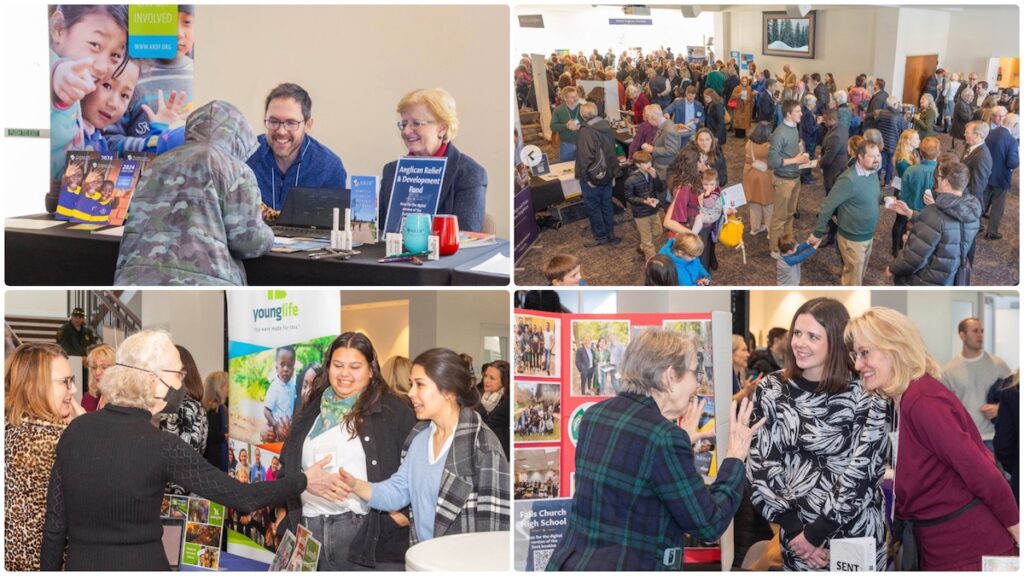
This past Sunday my parish held its missions fair, an opportunity to visit with those from various ministries that we are engaged in, as well as get a sense of how the gospel message is being carried outside of our church walls.
The annual event also serves to be a “reality check” for me: in a time in which online fury (not all of it misplaced) and institutional struggle command my attention, I’m glad to see the work of God’s Kingdom is continuing among Anglicans.
Do not interpret this piece as downplaying the seriousness of matters before the Anglican Church in North America (ACNA) and the College of Bishops as they gather this week in Florida. Informal groups of clergy and laity are praying and fasting all this week for a reason.
As I’ve reported, people whom I greatly respect stress that multiple allegations being brought against Archbishop Steve Wood are presented by credible persons, and a panel of inquiry has found that there is probable cause to present the Archbishop for trial. Additionally, the yearlong revision of the church’s disciplinary canons is widely understood to be necessary. The Rev. David Roseberry writing at The Anglican has a helpful writeup on that here (as a side note, the third draft of those revisions is set to be made public in early February for further review ahead of the June Provincial Council in Tulsa).
All this said, as I chatted with people from mission sending organizations, volunteers tutoring and mentoring students at two local high schools, and parachurch ministries serving international students, I’ve been given context for what ministries we are conducting.
In short: the provincial level is not, in itself, the ACNA. It is intended to serve our dioceses, which are intended to serve our local churches, which are the primary mission outposts for sharing the gospel and transforming lives. Acknowledgment of this is not a form of congregationalism (the episcopacy matters) but it can help us to remain rooted and as Archbishop Bob Duncan once advised, “keep the main thing the main thing” even as those charged with governing the provincial level of our church address their necessary work.
This has been an extraordinary season of ministry for our local churches (nearly all of the 40+ congregations in my own Diocese of the Mid-Atlantic reported growth in 2024, several of which posted substantial increases) and nearly all of our dioceses similarly grew. Just as important, I’m encountering increased scope and depth of our ministries. More people are volunteering to serve at a pro bono legal assistance ministry launched out of one of our local Anglican churches. The mission sending organization I serve with, Anglican Frontier Missions, is sending more workers abroad than ever before in an answer to prayer, to minister among people groups who otherwise might not hear the message of the gospel.
Lastly, I now see fruit in my own small sphere of influence. Last year I briefly spoke with my rector about my own struggle to summon evangelistic effort. He encouraged me with the story of another parishioner who did not feel he had the gift of evangelism but invited one friend to church. That relational connection is what mattered, and the friend accepted the invitation. As Archbishop Foley Beach once said, we should allow our friends to decide upon our invitation for themselves, not decide for them that they would be unwilling or uninterested.
This autumn I invited a good friend and fellow road cyclist who is without a church community to visit The Falls Church Anglican. I also asked another friend and fellow parishioner to pray with me in making this invitation.
My cyclist friend said yes and came on Christmas Eve (I wasn’t even there due to holiday travel!) He invited his son, who also came. His son invited his girlfriend, who joined us this past Sunday. As we conversed after the service about the winter sermon series, reflecting on how law is an expression of love, and how amidst a culture of autonomy people still seek rules, I was glad to benefit from what they heard (yes, Jordan Peterson came up).
I’ve issued other invitations that have gone unanswered, and I do not know where the figurative seeds that I have sown will take root. But I do want to share that God can use us, broken vessels, as willing partners in his providence. As we pray this week for the ACNA College of Bishops, let’s ask for the Holy Spirit to move and change us.
More from IRD:
Matthew Barrett and the Baptist-to-Anglican Pipeline

Comment by Qohelet on January 12, 2026 at 6:20 pm
My little bit of evangelism for the year has been to post a photo of the best hymn we sing each Sunday on social media in a way that invites friends to comment on if they know the hymn and when they’ve sung it. The idea is to get a fun public discussion going in a world that sometimes forgets people do love their churches.
Comment by David Gingrich on January 13, 2026 at 8:02 am
Wonderful article, full of truth. Thank you.
Comment by Tim Mc on January 13, 2026 at 8:27 am
Quote: “As Archbishop Foley Beach once said, we should allow our friends to decide upon our invitation for themselves, not decide for them that they would be unwilling or uninterested.”
This is a great quote, and how true it is. Our job is to invite and sow seeds everywhere. Those seeds fall on all types of soil and hearts.
Comment by Dennis Crowley on January 16, 2026 at 12:38 pm
Fantastic article- Thanks for writing.