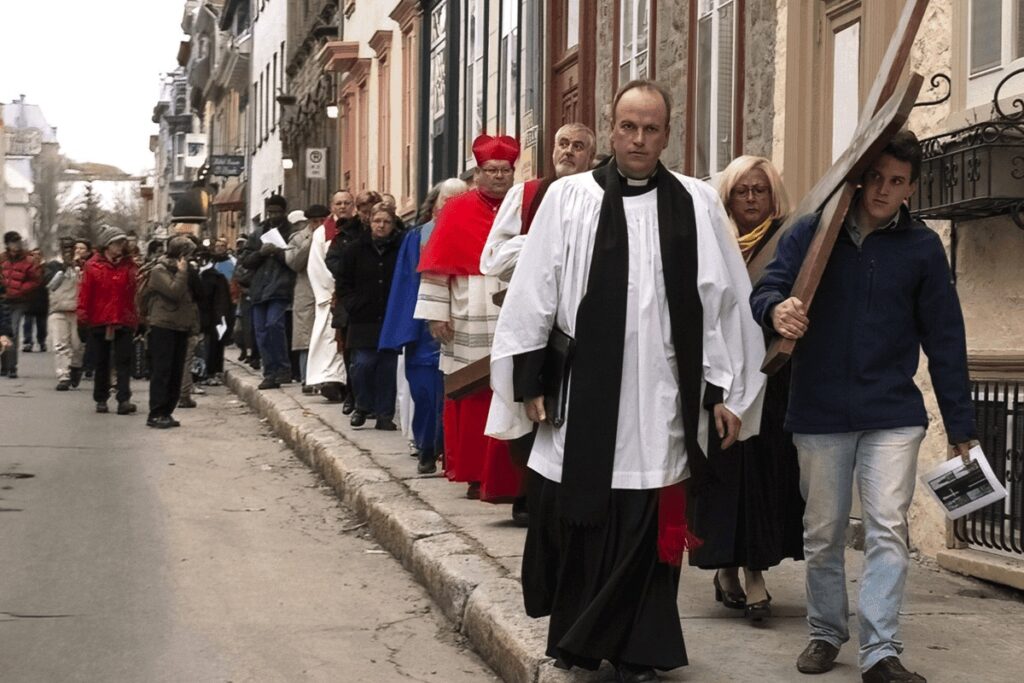
The prohibition against public prayer looms on the horizon in the struggle over religious freedom in the Western world. In Quebec it may be expanded by secularists from bubbles around abortion facilities to public places generally. This general prohibition seems likely to be enacted soon in the province. The proposed Quebec Bill 9 in the Quebec National Assembly, which has been introduced by the ruling Coalition Avenir Québec (CAQ) party, prohibits public prayer in streets, parks, universities, and government funded (which need not be public) institutions.
A Radical Reduction of Space for Religious Practice
Earlier, Quebec’s Bill 21 in 2019 prohibited public officials and teachers in public schools from wearing religious symbols while on duty. Bill 9 currently being considered would also prohibit the wearing of religious symbols by any school employee or student, employees in daycare centers, and prohibit “collective religious practices” (in particular prayer) in public spaces, and as well as prayer rooms in universities or other public institutions, as Paul Marshall of the Hudson Institute pointed out in the linked article. It would seem that this might prohibit street preaching, since if anyone listens, would be a “collective religious practice.”
Indeed, quite a lot of religious practice will be prohibited, as the Canadian Centre for Christian Charities listed at the beginning of December. Notably, the offering of prayer will be prohibited (even individual private prayer in schools, according to Decree 707-2023, noted below) in public institutions (or private institutions receiving state funding), in accredited private schools, and daycare centers receiving public funding. Religious institutions that serve the public, such as hospitals, cannot offer only food based on their own religious requirements. They must offer food the general public consumes as well. In general, it seems that a public square consisting of spaces outdoors, public institutions, and private institutions receiving government funding will be swept bare of any evidence of religion. Only private religious schools receiving no public funding will be free of the ban on religious activities.
Islamic Practices at the Frontline of the Struggle
The proposed law seems aimed particularly at Muslims, not historically part of Quebec. Quebec’s Muslim population has dramatically increased from 2001 to 2021 from 108,620 to 421,710, and in Canada from 479,640 to 1,775,715 They are now a very visible presence, conducting public prayer on streets and other outdoor public places. The prohibition of prayer rooms in universities and other public or publicly funded institutions is particularly severe for Muslims, since they are required to pray five times daily, and outdoor prayer as well as prayer rooms are prohibited.
Collective prayer on the street can obstruct traffic, but otherwise, the real objection seems to be that the ruling secularists find it offensive. “Seeing people praying in the streets, in public parks, is not something we want in Quebec” Quebec Premier François Legault has said in connection with the legislation. As Marshall observes, confining the practice of religion to houses of worship misunderstands religious commitment, which must cover all of life. No one is inconvenienced, although they might be offended at collective prayer in a park. There ought to be applicable laws prohibiting obstruction of traffic.
The immediate precipitating cause of Bill 9 and the related Bill 94 seems to have been reports of a school in Montreal in which several North African teachers were introducing Islamic values in their authoritarian manner of education, rarely touching on science or sex education in instruction, and preventing girls from playing soccer. This “Bedford affair” – referring to the Bedford School where the Muslim teachers were located – along with the greater Muslim presence in Canada and open air group prayer in public places becoming a noticeable occurrence seems to have given the stridently secularist CAQ government the justification it felt it needed to move against all public religious activity.
Shrinking Corporate Religious Life
Another part of the law would effectively require that religious schools become secular over the next three years if they wish to continue to receive government funding. The law also specifies that religious schools cannot hire and retain only people of their own faith if they choose to receive government funding. Nor can there be religious instruction in the school, so the school would effectively be secular.
Although the law is framed as expanding secularism or strengthening secularism, it in fact amounts to shrinking the areas in which there may be free exercise of religion. Legal appeal cannot be made to fundamental rights on this issue, since unlike the United States, Canada has a “notwithstanding clause” in the Canadian Charter of Rights and Freedoms, which allows the national or a provincial legislature to override rights guaranteed in the charter. The one restraint on this, Marshall noted, is that the legislature must specify that the notwithstanding clause applies in each act which the legislature wants to make immune from judicial review, and the “notwithstanding” immunity must be renewed by the legislature every five years.
The Canadian Civil Liberties Association, which might be expected to favor secularism, regards Bill 9 as an infringement on the freedoms of a liberal democratic society. The secularism that the CCLA favors requires separation of church and state, not the exclusion of religious expression from the public square. The CCLA maintains that the government should not have the power “to suppress manifestations of religion in public spaces.”
As LifeSiteNews.com notes, the underlying hostility of the secularist push was apparent from the statement of Quebec’s Secularism Minister, Jean-François Roberge, who declared that Quebecers had ‘advanced” since the enactment of Bill 21 in 2019, which had simply prohibited the wearing of religious symbols by public officials. That Quebec has a government minister charged with formulating policies promoting secularism (or laïcité, as it is officially called) speaks volumes about the ideological orientation of the province.
One “advance” that was made was Bill 94, tabled in the provincial legislature on March 30 but not yet enacted, which would expand the ban on the wearing of religious symbols in school from teachers and principals to all school staff, including, as the linked article notes, “volunteers, including parent volunteers, lunch and after-school monitors and secretaries and librarians. Even parents picking up their children from school could not wear face veils if they so choose, and the bill bans full-face coverings among girls in schools.” Quebec Education Minister Bernard Drainville, who pushed the bill, has said that “it’s a question of principle. In Quebec, we cannot accept that students have their faces covered in a classroom” The ultimate justification of Bill 94, he said, was to protect the “values of Quebec.” They are evidently entirely secular (although Quebec’s population is not entirely secular). But he said that “we made the decision that state and religion are separate. And today we say the public schools are separate from religion.” But again, it is the religious expression of individuals, not the state or public schools, which is being prohibited.
While Muslims praying in public is likely the precipitating cause (or excuse) for Bill 9, Quebec’s secularist CAQ government can use and likely will use the opportunity to strike at traditional religion generally. One group that will be significantly affected is the pro-life movement. The Campaign Life Coalition’s Jack Fonseca has warned, “I suspect the real goal … is probably to drive Christianity out of Quebec society once and for all, and essentially, to make the public expression of belief in Jesus Christ illegal. After all, a law banning all public prayer would also criminalize Good Friday processions, traditional Corpus Christi processions and public rosary events.” Fonseca also noted that the pro-life movement would be targeted, indeed it is repeatedly mentioned in the committee report leading up to the legislation as “anti-choice.” 40 Days for Life processions would be banned under a ban of public prayer. “So, the pro-life movement is also a target.”
Secularist Social Engineering
Thus, the real concern of the CAQ government is cultural. This was made clear earlier this year with the passage of Bill 84, which declared that immigrants to Quebec must accept the province’s “common culture.” This was defined as acceptance of democracy (the meaning of which seems up for debate today), equality of the sexes, secularism, and the French language.
The effort to secularize culture (which means life) and enforce a secular, and really antireligious culture is strikingly exemplified by Quebec Decree 707-2023, which bans visible prayer in public schools. Promulgated on April 19, 2023, it prohibits even private, individual prayer by students (such as before a meal), if there are any typical visible signs of prayer (e.g., closed eyes, bowed head). It is a considerable departure from classical liberal ideals to maintain as Decree 707-2023 does, that “the rights and freedoms of the person are exercised with respect for the secularism of the State.” Such a rule would never survive a court challenge in the United States, and is indeed being challenged in Canada by the National Council of Canadian Muslims and the Canadian Civil Liberties Association. Nor is it a rule that any faithful Christian can obey. God is always the final authority in our lives (Acts 5:29, certainly for Christians, and really should be for everyone). We are commanded to pray without ceasing (i.e., frequently, I Thess. 5:16-18) and certainly before meals (I Tim. 4:4-5).
Bill 9 really seems focused on altering culture, regardless of the beliefs of individual Quebec citizens. A naked public square makes as much of a statement as one suffused in religious symbolism. This was clear in Secularism Minister Roberge’s references to the permissible celebration of Christmas. “We can wish someone Merry Christmas,” Roberge said. “We can sing Christmas songs. This is nothing but tradition. But we shouldn’t make any references to the birth of baby Jesus,” he said. “When we wish someone Merry Christmas, we can think of Santa Claus and his elves, but nothing Catholic.” A reporter asked if that meant “a Christmas tree but no crèche,” and Roberge replied, “I think that’s a good illustration.”
Reactions to Bill 9
Archbishop of Montreal Christian Lepine has condemned the proposal to ban public prayer. He has said that proponents of the bill are confusing state neutrality with the erasure of religion from the public square by banning collective religious practice in public. He also noted that the Bill 9 would ban religious processions in public, since this is a collective religious activity in public.
The online Canadian Muslim Journal voiced its alarm over Quebec’s Bill 9. The journal reviewed the many religious activities that the proposed legislation would ban: “According to reporting in the Montreal Gazette and other outlets, the bill would ban outdoor group prayers, prohibit religious symbols such as the hijab in daycares, colleges, and universities, shut down institutional prayer rooms, heavily restrict religious dietary accommodations such as halal meals, and remove public funding from private religious schools that continue faith-based instruction or admissions.” CMJ also says that the National Council of Canadian Muslims is preparing legal action to fight the legislation,
“Suppressing peaceful religious expression, individually or communally, under the guise of secularism not only marginalizes faith-based communities but also undermines principles of inclusion, dignity and equality,” said Canadian Civil Liberties Association Equality Program Director Harini Sivalingam.
“This legislation is an assault on the constitutionally protected right to freedom of religion,” Christine Van Geyn, Canadian Constitution Foundation Litigation Director, said. “We view this as overreach that will impact religious communities across Quebec and deserves scrutiny. Secularism does not require hostility to people of faith, and that is what this proposed law represents.”
Canada’s public broadcasting system, the CBC, presents Bill 9 as legislation “strengthening secularism.” This is likely a widespread view in highly secular Canada. But what it really does is radically restrict the exercise of religion, even by people not in any way connected with the government (as in the case of corporate prayer in public).
Christian Commitment
For committed Christians, we can embrace the liberal democratic ideal of freedom of religion without compromising our faith, for as Scripture tells us, “whatever does not proceed from faith is sin” (Rom. 14:23). But our ultimate commitment must be to God. He tells us in his Word to pray (I Thess. 5:17), and we must do so as appropriate, regardless of the imperatives of society or the state.
More from IRD:
Continuing Attacks on Religious Freedom in the West
Numbers Confirm: Anglican Church of Canada is Collapsing




Comment by David on January 2, 2026 at 9:30 pm
French Canada is mirroring France in its prohibitions of religious symbols, etc.
Comment by Glenn Wheeler on January 4, 2026 at 10:06 pm
All these so-called Christians whining about banning public prayer need to go to their Bibles and read what Jesus said about public prayer.
But oh, I forgot! That’s a passage they either ignore or interpret out.
Funny how people can be so selective about what they ignore and so creative about what they can interpret out.
Comment by Glenn Wheeler on January 4, 2026 at 10:55 pm
And another thing…the picture accompanying this article reminds me of when Jesus was talking against those who like to wear their long robes and be greeted in the marketplace…
My oh my! What we can ignore and interpret out!!
Comment by David on January 5, 2026 at 5:54 am
In first century Judea, the hemline for males was about knee length. Anything longer attracted attention. The flowing robes one sees in Bible pictures date from the Victorian idea that the Arabs of that time had a biblical lifestyle.
Comment by David Gingrich on January 6, 2026 at 9:04 am
Jesus prayed in public.
Comment by Fred Miller on January 6, 2026 at 3:38 pm
This could be turned into something to help spread the faith. Civil disobedience, such as groups praying the rosary in public places or participating in processions, might attract interest, leading to growth.