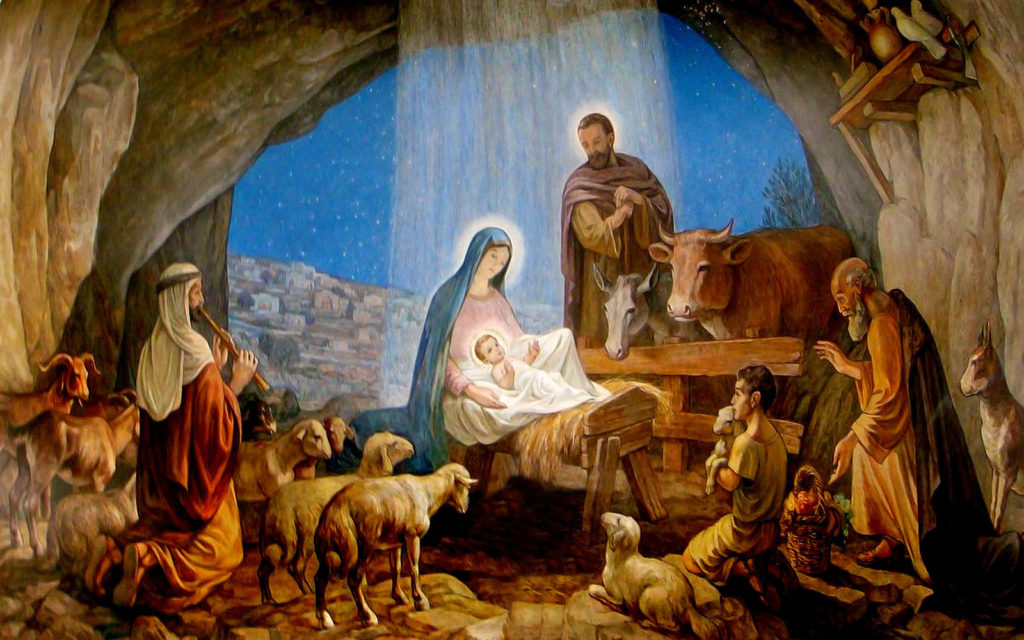

Merry Christmas from the John Wesley Institute!
At this joyous time of year, we ponder anew the reality of God with us, God made one of us, even as a babe in a manger. In Christmas services, we often hear the Christmas story read from Luke (hopefully from the King James Version), but the prologue of the Gospel of John is also an appropriate text for this festival season.
In Wesley’s translation provided in his Notes Upon the New Testament he translated John 1:14 as:
And the Word was made flesh, and tabernacled among us, (and we beheld his glory, the glory as of the only begotten of the Father,) full of grace and truth.
Christian tradition has long highlighted this verse, even liturgically. In High Church settings, the congregation bows or genuflects when it’s read.
Wesley also knew the significance of this verse and the beautiful reality that it describes. In his comment on it in the Notes, he does something unique, something that he rarely does in this work; he provides a paraphrase of the verse, highlighting its meaning.
It’s such a striking description of John 1:14 that I want to share it with you in its entirety. This is what he wrote:
And in order to raise us to this dignity and happiness, the eternal Word, by a most amazing condescension, was made flesh, united Himself to our miserable nature, with all its innocent infirmities. And He did not make us a transient visit, but tabernacled among us on earth, displaying His glory in a more eminent manner than ever of old in the tabernacle of Moses. And we, who are now recording these things, beheld His glory with so strict an attention, that we can testify it was in every respect such a glory as became [i.e. was fitting for] the only begotten of the Father. For it shone forth not only in His transfiguration, and in His continual miracles, but in all His tempers, ministrations, and conduct through the whole series of His life. In all He appeared full of grace and truth. He was in Himself most benevolent and upright; made those ample discoveries of pardon to sinners which the Mosaic dispensation could not do; and really exhibited the most substantial blessings; whereas that was but ‘a shadow of good things to come.’
And this is what we celebrate at Christmas. God tabernacled among us. Grace and truth became tangible, known. And because of that, everything has changed. Merry Christmas!
Ryan N. Danker is director of the John Wesley Institute, Washington, DC. This is reposted from a weekly JWI newsletter that you can subscribe to here.




Comment by Salvatore Anthony Luiso on December 27, 2025 at 3:08 am
Thank you! Merry Christmas!
Thank you for this article–I am telling others about it.
Regarding the phrase “united Himself to our miserable nature, with all its innocent infirmities”: some readers may like to know that one of the definitions of “miserable” by Oxford Languages is “pitiably small or inadequate”. I think that’s an appropriate word to describe human nature–even in its unfallen state–with respect to the incarnation of the Son of God as a man. As good as God created human nature, it is “miserable” in comparison with His nature.