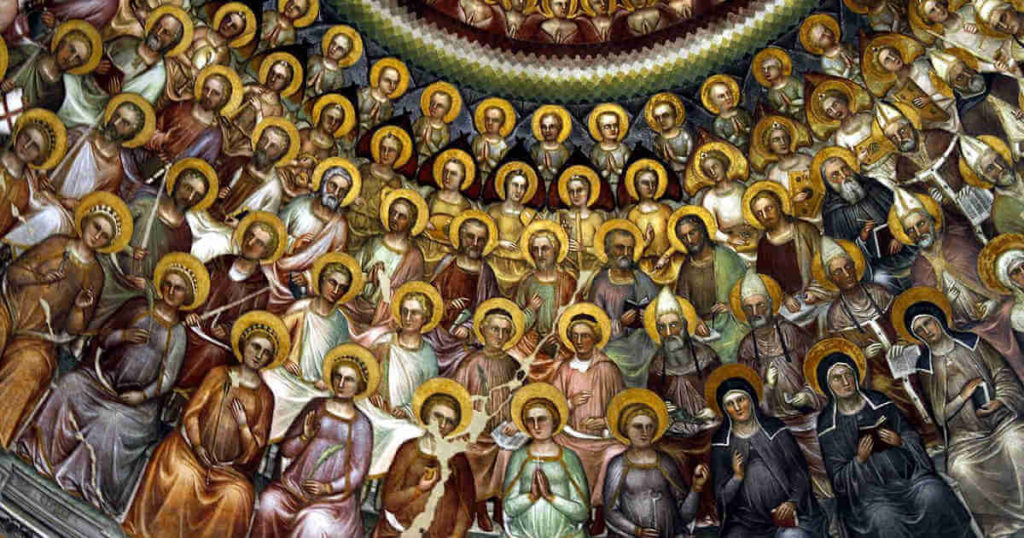
It is the day after Halloween. Sugar-laden children are enjoying their treats while parents take down decorations. And for more than a billion people around the globe, they also prepare to go to church. Why? For a Holy Day of Obligation in the Roman Catholic Church: All Saints’ Day.
All Saints’ Day is November 1st of every year, a day set aside to celebrate saints. But, if you’re a Protestant like I am, you might be wondering what that means. Aren’t we all saints? That seems a bit self-congratulatory. Or is this a day set aside for Catholics to do that “saint-worshipping thing” they are accused of?
In growing up as a nondenominational Protestant, my idea of sainthood was vague at best. I was taught that all believers are saints, but nothing else.
While the Catholic Church does agree with that statement broadly, it also defines “saint” in a stricter sense. When Catholics speak of saints, they specifically mean those whom we know are in Heaven. The church recognizes that by a process of canonization, by which the Pope declares that a saint is with God.
The Making of a Saint
The definition of sainthood and the process of recognizing saints exists in both the Roman Catholic and Eastern Orthodox churches. The Orthodox also have a specific day wherein they recognize the saints. This is the first Sunday after Pentecost. Both the Orthodox and Roman Catholic traditions have many similarities in regards to saints. This article will focus on the Catholic tradition.
The Catholic church has a strict process of recognizing saints known as canonization. It consists of four stages. In the first stage, the diocese initiates a Cause for Beatification and Canonization. If accepted, a commission begins to investigate the life of the individual. The commission aims to ascertain if the individual has lived a life characterized by great virtue. If this is the case, the Pope will award the individual with a Decree of Heroic Virtue. The individual then needs two proven miracles that happened specifically due to intercessory prayer to them. Once that happens, the person is officially canonized and recognized as a saint.
The Intercession of Saints
Catholic teaching declares that saints play an intercessory role in the Kingdom of God. That is, even after death, they still involve themselves in the life of the church and pray for it constantly. Catholics pray together with the saints in the same way that one would pray with a friend or grandmother.
Some saints have specific vocations or interests they are especially known for, that they are “patron” of. These can range from St. Luke, patron saint of doctors, to St. Lawrence, the patron saint of grilling (who was, incidentally, burned alive). Saints serve as sources of inspiration to the faithful. Saints also have distinct struggles that resonate powerfully to those who have faced the same in their own lives. Saints have faced violence, abuse, loss of children, mental illness, and much more. The faithful often form unique connections with saints because of these struggles.
Popular Saints
There are thousands of saints officially recognized by the Catholic, Orthodox, and other churches. These include saints from the Bible such as the patriarchs, prophets, and disciples, as well as more recent saints such as Mother Theresa. However, some saints are more well-known than others. Here are a few well-known and loved saints in the church.
Saint Anthony of Padua is the patron saint of lost things. The story goes that he once had a book stolen from him and prayed that it be returned. Not only did the thief return the book, but also returned to the religious order itself. The return of many lost items and even people have been attributed to St. Anthony’s prayers.
Saint Dymphna is the patron saint of mental disorders and victims of incest. Her story is dark and sad. After her mother died, her father tried to marry her. St. Dymphna fled and founded a hospital for the sick but was eventually tracked down. When she refused to marry her father, he beheaded her with a sword.
Saint Monica is the patron saint of unanswered prayers and abuse victims. She survived a hard marriage with an ill-tempered husband and mother-in-law, but relentlessly prayed for their conversion. Her prayers were finally answered a year before her husband’s death. She then went on to pray for the conversion of her son, a prayer that went unanswered for seventeen years. Finally, it was answered and in a miraculous way – her son, Augustine of Hippo, converted to Christianity and became a church father.
Saint Francis of Assisi is the patron saint of animals and ecology. He founded the Franciscan order, an order based on extreme poverty. This came in response to the corruption and wealth of many other religious orders in his time. St. Francis thought of all of God’s creation as part of the brotherhood, even animals and the fire that blinded him. To this day, some churches hold an animal blessing service because of St. Francis.
The Blessed Virgin Mary is, of course, the most revered of all saints. She is the Mother of God and held by Catholic teaching to be sinless from conception and kept from bodily corruption through her Assumption. The Virgin Mary has prayers specifically dedicated to her such as the Hail Mary and Hail, Holy Queen, as well as the practice of praying the rosary.

Comment by David on November 1, 2025 at 9:25 am
The veneration of saints is a vestige of polytheism. Some local saints in Italy are known to have existed prior to Christianity. Protestants take the verse about there being only one mediator between God and man seriously. However virtuous a person might have been, there is a question if they are still in their graves awaiting the resurrection of the dead or the rapture if alive. The lack of punctuation in the Greek statement to the thief on the cross has led to endless debate.
The Virgin Mary has assumed the position of a goddess. Many cultures have a male and female divinity. Mary seems to busy herself with making brief appearances on earth, but never in a church it seems. She actually is said to appear in a local city park near me. There is a group that has periodic pilgrimages to a specific bench there.
Comment by Rogelio on November 2, 2025 at 7:26 am
According to the New Testament, All true believers are the Saints.
Comment by David Gingrich on November 4, 2025 at 6:55 am
“In growing up as a nondenominational Protestant, my idea of sainthood was vague at best. I was taught that all believers are saints, but nothing else.”
That is what God’s Word actually says.