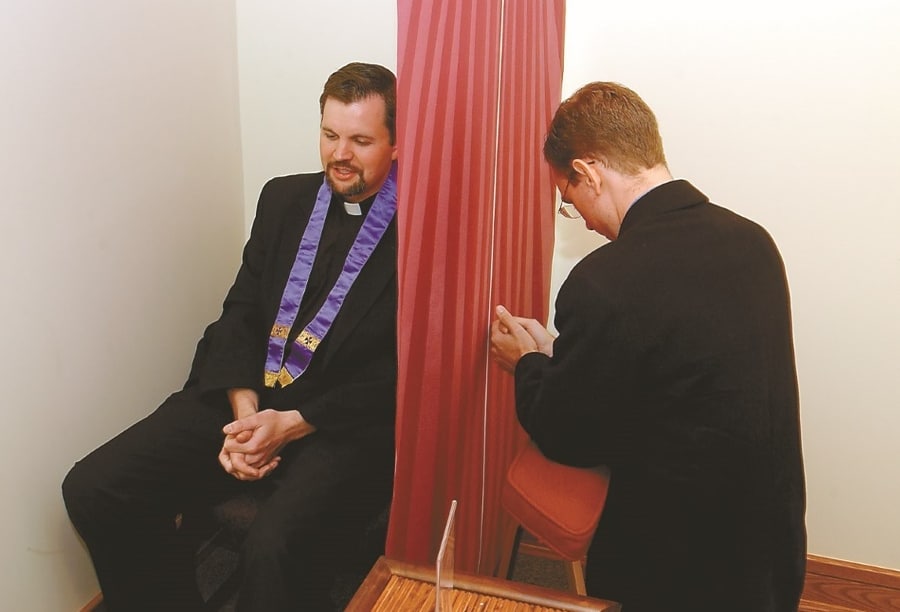

Despite Supreme Court victories in recent years, the struggle to defend the free exercise of religion for traditional Christians continues. As noted last month, religious professionals who provide products for weddings continue to be at risk of prosecution for declining creative products for same-sex weddings. Another stark challenge, recently being pressed would require Catholic and Orthodox priests to break the seal of the confessional, the absolute obligation never to disclose to anyone for any reason what is confessed in sacramental confession. This is one of the most strongly held proscriptions within sacramental/sacerdotal Christianity. In the United States there is legal support for the priest/penitent privilege in the majority opinion of Trammel v. United States (1980, section III, C, third paragraph).
There is only one state at present in which the issue is being pressed, but the exception demanded at this point is the requirement to report sex abuse to state authorities. This, it is apparently thought, would be hard to argue with. Of course, more and more exceptions will likely be demanded over time, claiming the common good against religious dogma. New Hampshire and West Virginia already have laws which provide no exceptions for priestly/penitent privilege; similar laws have been considered in Delaware, Montana, Vermont, and Wisconsin. Another bill to remove legal protection from the seal of the confessional was recently tabled (i.e., practically defeated) in Montana.
Washington is the state where the conflict is currently focused. The state has enacted bill SB5375, which requires clergy to report sex abuse however it was learned. The law has been at least temporarily stopped by a court injunction. Inconvenient to the law’s supporters is the fact that the law continues to provide exceptions to the requirement to report sexual abuse for other privileged communications, in particular attorney/client privilege, spousal communications, and people who advocate for victims of sexual assault. Washington’s governor, Bob Ferguson, who earlier as Attorney General of Washington initiated legal action against the Christian florist Barronelle Stutzman for declining a floral arrangement for a same-sex wedding, signed the bill on May 2, which was to go into effect on July 27.
Conflict with Catholic Faith and Canon Law
The governing Canon Law of the Catholic Church (1983) strictly prohibits disclosing information received during sacramental confession with a penalty of automatic excommunication. This is specified in Canons 983, 984, and 1386 of Canon Law. Canon 983 §1 declares that the sacrament is “inviolable,” and the priest may not divulge confessions “in any manner” or for “any reason.” 983 §2 extends this to any interpreters used in confession. Canon 984 specifies that if the confessor (priest) has been placed in “authority,” he cannot use information received in confession for “external governance” (matters other than the penitent and his sin). Canon 1386 prescribes automatic excommunication for anyone who directly violates the seal of the confessional, which can only be removed by the Holy See. These canons clearly establish that the rule against divulging information received in sacramental confession is absolute and universal. Where there is a legal requirement to report something heard in confession, the choice for the priest according to the doctrine of the Catholic Church he upholds is between breaking the law of the state and disobeying God (sinning).
The inviolability of the sacramental seal has been the firm holding of the Catholic Church for centuries, not an obligation to be violated for any reason, including torture, threat of death, or death by burning. Although the requirement of absolute secrecy can only be documented from the High Middle Ages, sources at that time reference ecclesiastical holdings in earlier centuries. These increasingly emphasized the confidentiality of confession. The Decretum of Gratian (ca. 1140) is the first explicit reference to a rule of secrecy that was universal and absolute, and this was a source of later canon law. The great Fourth Lateran Council (1215) emphasized the silence of the confessor/priest.
The Catholic website New Advent provides an extensive history of the seal of the confessional in England, showing that it had firm grounding in secular law in medieval England, noting “the very close connection between the religion of the Anglo-Saxons and their laws, many of which are purely ordinances of religious observance enacted by the State.” Impressively, this respect seems to have continued in some degree after the Reformation, although in the established Church of England it was not absolute, as it had been in medieval times.
The Unconstitutionality of Laws Requiring Disclosure of the Confessional
Existing or proposed legislation requiring clergy to act against church law are plainly unconstitutional, according to Jonathan Turley, professor of law at George Washington University. He has said that the legislation “ presents a novel problem for priests if they both encourage the faithful to unburden themselves while at the same time reminding them anything that they say can and will be used against them in a court of law.” Essentially, “the state would be using the church as an agent to compel confessions on the threat of damnation and then turn over the evidence to the police.” He therefore concluded that “in my view, the Washington State law is a frontal attack on free exercise and would be struck down if enacted. The only question is why Democrats consider such legislation to be any more viable politically than it is constitutionally.”
Similarly, Eric N. Kniffin of the Ethics and Public Policy Center (EPPC) submitted his own testimony to the Washington State House Committee on Human Services, Youth & Early Learning. His work at EPPC has focused on religious liberty and the rights of conscience, and has represented “dozens of Catholic dioceses, as well as the United States Conference of Catholic Bishops.” His memorandum to the committee focused on five major points:
1. “The Catholic Church in the United States and in Washington State is committed to preventing and reporting child abuse;”
2. “The absolute confidentiality of what is said in the confessional is a longstanding and fundamental part of a Catholic sacrament;”
3. “The clergy/penitent privilege is not a ‘loophole’—it is a venerable part of our legal system, and there is no evidence that the seal of the confessional has contributed to the sexual abuse crisis in the Catholic Church;”
4. “No existing mandatory reporting law directly attacks the Catholic Church’s sacraments as would SHB 1098 [the then existing bill requiring disclosure];” and
5. “A mandatory reporting law that eliminates the clergy penitent privilege would likely be found unconstitutional.”
The memorandum recounts stories of Catholic priests in past centuries who were martyred rather than breaking the seal of the confessional. It notes that the obligation not to disclose the contents of confessions is “deeply ingrained” in Catholic priests, and they will suffer legal penalties rather than violate the mandate of secrecy. Indeed, the commitment not to break the seal of the confessional is so deeply engrained in Catholic priests that Bishop Thomas Daly of the Diocese of Spokane, Washington has declared that “Priests and bishops will go to jail rather than break the seal of confession.” Daly also observed that priests are “mandated reporters” of any information about sex abuse they become aware of from any source outside the confessional. He seemed to imply that the point of the law (since it singles out clergy, while leaving reporting exemptions for other professions untouched) was simply to attack ecclesiastical authority.
Additionally, LifeSiteNews notes that the “same people requiring priests to break the seal of the confessional are supporting provisions in the current legislation allowing schools to withhold information about sexual abuse of their children for 48 hours. In other words, the legislation is a clear attack on traditional authorities (parents and clergy).”
Washington Law Currently Blocked by Court Injunction
On May 30, Catholic bishops in Washington sued Governor Ferguson and state prosecutors, claiming the new law (enacted May 2) was a violation of religious liberty, and thus unconstitutional. Bishop Robert Barron of Winona-Rochester, Minnesota added his voice in an amicus brief to the court, in which he noted that the law “expressly targets the confessional seal based on religious status. As noted, the very face of the statute excises ‘members of the clergy’ (and only members of the clergy) from an otherwise existing exemption for privileged communications to Washington’s mandatory reporting requirement for supervisors.” He adds further considerations showing that it expresses animus toward religious belief and practice, not allowed by the Masterpiece Cakeshop v. Colorado Civil Rights Commission (2018) decision. The lawsuit also claims that the law in fact expands exemptions from reporting for secular counselors, while denying exemption for clergy. On July 18, Judge David Estudillo of the Western District Court of Washington, granted a preliminary injunction against enforcement of the law, which was slated to come into effect on July 27.
Ferguson et al. also face a lawsuit from the Orthodox Church in America and several other Orthodox churches, filed on June 16, noting as others have emphasized that ““while the state’s law maintains confidentiality privileges for attorneys and clients; peer supporters; sexual assault advocates; and alcohol and drug recovery sponsors, it does not afford the same privileges to priests, uniquely targeting them for punishment. A single violation can carry up to 364 days in jail, a $5,000 fine, and civil liability.” John Bursch, Senior Counsel with the Alliance Defending Freedom, which is representing the Orthodox churches has added that “that governments cannot single out religious believers for worse treatment.”
On May 5, three days after SB5375 was signed into law, the U.S. Department of Justice announced it was opening an investigation into the law “which appears on its face to violate the First Amendment.” Assistant Attorney General Harmeet K. Dhillon of the Justice Department’s Civil Rights Division said in the announcement that “SB 5375 demands that Catholic Priests violate their deeply held faith in order to obey the law, a violation of the Constitution and a breach of the free exercise of religion cannot stand under our Constitutional system of government,” And further, “worse, the law appears to single out clergy as not entitled to assert applicable privileges, as compared to other reporting professionals. We take this matter very seriously and look forward to Washington State’s cooperation with our investigation.”
Religion and law blogger Matt Miranda has keenly observed that attacks on religious freedom in the U.S. “rarely declare themselves as such; they hide behind language of safety, progress, and reform. But the effect is the same: The creeping assumption that government has the right to dictate even the terms of moral conscience.”
Additionally:
“All of this is happening while attorney-client privilege remains untouched. Doctor-patient confidentiality is still respected. Only clergy are singled out, as if the sanctity of the confessional is less real, less deserving of protection. This is not a neutral public safety measure. It is a declaration of mistrust. In a culture increasingly hostile to religious authority, the confessional becomes a target. The selective application of privilege betrays the deeper reality: Our culture no longer treats religious belief as legitimate. It treats it as a dangerous curiosity to be managed … This is about which institutions the modern state trusts, and which ones it resents.”
Thus, because secular councilors, whether legal or other professional, are still protected in the confidential information they receive from clients, the law is implicitly but loudly saying that these secular professional relationships are truly important, even if the privileging of their communications may result in serious crime, whereas the work of religious councilors is not important. This is basically the same principle as allowed churches to be closed for months on end during the coronavirus shutdown, while stores, bars, and abortion facilities remained open.
Virtue-Signaling for Liberals
LifeSiteNews reports that the effort to break the seal of the confessional for sex abuse cases is evident elsewhere in the secular West. It is currently a point of controversy in Great Britain, and such removal has already occurred in Australia and France. In Hong Kong, however, the law requires priests to report “treason” (opposition to the communist regime).
Pope Francis reiterated the absolute rule of confessional secrecy in 2019, and so far no one has been either prosecuted or convicted of failure to report sex abuse which a clergymen learned in sacramental confession. This is only natural. Neither the priest nor the penitent have any interest in reporting what was confessed, such information would have to be learned through subsequent law enforcement interrogation. Indeed, if sex abusers fear disclosure, they may be dissuaded from confession, and from priestly encouragement to surrender to authorities. All churches concerned remain doctrinally and adamantly opposed to exceptions to the sacramental seal, and this doctrinal commitment has been deeply formed in priests for centuries. The many prosecutions and convictions based on clerical abuse cover-ups are all based on information received outside confession.
The campaign in the West to remove the priest/penitent privilege seems a form of virtue signaling. Its rhetorical force is really based on the clerical abuse scandals that were revealed in the twenty-first century, and liberal opposition to the Catholic (and general Christian) sexual ethic that confines sexual relations to opposite-sex marriage. Activists and politicians have an opportunity for posturing, but it does nothing to protect children or anyone else.
But because of the direct and sharp conflict between secular and ecclesiastical law, this issue is important to non-Catholic Christians who may think the issue doesn’t concern them or even support the disclosure requirement because they reject sacramental soteriology. But it is really important to anyone, Christian or otherwise, who values religious freedom. The state must not dictate conscience. No state maintaining religious freedom can give liberty to any action held to be religiously required (as the cases of human sacrifice and polygamy show), but religious freedom means little if people can be required to act against strongly held religious precepts. Religious commitments are not mere preferences, but matters of what is right and wrong, good and evil, held because one believes them based on the final truth and reality.




Comment by David on October 6, 2025 at 6:54 am
If a person confesses child abuse, does the priest give absolution immediately, or require them to first report their actions to the authorities?
An interesting aspect of the Mexica (“Aztec”) culture was a confession that could be made only once in a lifetime. Persons who did this could not be held to account for any crime which was admitted. Obviously, the revelations were not secret and known to the authorities.
Comment by Mark on October 6, 2025 at 1:40 pm
But many states do have exceptions around confidentiality in secular professions written into a law, including in cases of child abuse and elder abuse. Your claim that only religious institutions are being explicitly targeted is not entirely accurate. Doctors and lawyers are also required by law to report their client if they express intent to commit future crimes. They are also obligated to come forward if they believe their client poses an immediate or ongoing danger to someone else. Knowing what we know about sexual abuse and patterns of behavior, I can’t see a situation in which a priest hearing a parent confess to abusing their child who does not turn themselves in and continues to have direct access to that child, does not pose an ongoing danger. In the absence of a seal of confidentiality we can all agree that an adult who learns of child abuse occurring in any situation and does not report it would be morally irresponsible if not complicit in the abuse, especially if they were a person in a position of authority or entrusted with the care of the community. Catholics believe in a hierarchy of goods. It would seem to me that the message the Church is sending is that they place higher value on maintaining consistent confidentality in confession over protection children and the weak from unspeakable harm.
Comment by Td on October 8, 2025 at 6:03 pm
Anti-catholicism runs deep in the US.. It’s as American as apple pie.
Comment by Td on October 8, 2025 at 6:11 pm
David- no, that is generally not required as a penance. Can you even imagine the intracacies of the priest determining if a penance of that type is requisite to the sin? The point is repentance and salvation. Temporal punishment from God will still occur in this life and purgatory. But this sin, if confessed with true contrition and its penance being completed, will not block their entry into heaven
Comment by Mark on October 8, 2025 at 6:46 pm
Td,
But shouldn’t accepting responsiblity for one’s actions by turning one’s self into the authorities for punishment be part of the penance, especially when the crime is so heinous?
Comment by Td on October 12, 2025 at 10:13 pm
Mark-
That’s not how a penance works. Is there an example in the bible where someone confesses to Jesus and he says, “okay, now go turn yourself into the authorities for punishment”?
No. He says “go and sin no more”. You are asking for more than the Lord requires.
The practical consequence of this law is that child abusers will not go to confession and therefore will be barred with grace to stop abusing and also barred from entry into heaven.
Comment by Mark on October 13, 2025 at 12:23 pm
Td,
But Jesus also taught reconcilation between the sinner and the person they have wronged. When Jesus honored Zacchaeus by coming to his house and the tax collector promised that he would pay back anyone who had cheated in the past several times over. Shouldn’t penance for a sin against another person (especially as egregious sexual abuse) not also require attempted reconciliation between the sinner and the person wronged?
“Therefore if you are presenting your offering at the altar, and there remember that your brother has something against you, leave your offering there before the altar and go; first be reconciled to your brother, and then come and present your offering.” Matthew 5:23-24
Comment by Mark on October 13, 2025 at 9:27 pm
And I believe the Lord does require justice for children who have been abused.
Comment by Td on October 14, 2025 at 11:19 am
Mark- the penance assigned to be completed after confession is not about justice. This article is about sacramental confession in the Catholic Church. Sacramental confession is about reconciliation with God; this reconciliation is needed because serious sin separates a person from God in both this life and the next.
Comment by Mark on October 14, 2025 at 12:32 pm
Td,
I’m sorry, but I don’t see reconciliation with God and reconciliation with one’s fellow man as mutually exclusive. It seems to me these two should be acting in harmony and it should be the responsibility of the priest hearing confession to “actively encourage” reconciliation of both kinds. Our commandment to love the Lord Our God with all our heart, mind, soul, and strength runs hand-in-hand with the command to love our neighbor as ourselves.