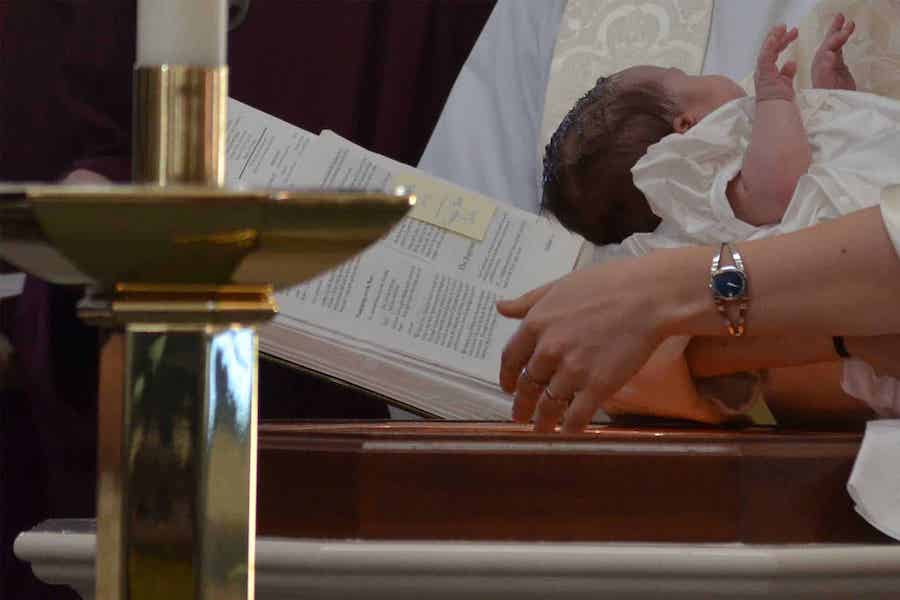
Despite having been set up as something of a counter-viewpoint to the recent article by Dale Coulter, Wesleyans, Grace, and the Ambiguities of Water Baptism, my intention in this article is not a point-by-point refutation. I don’t disagree with everything in his article. Nor is it my intention here to present the “Anglican” view, but to seriously examine the larger catholic tradition, or consensual tradition, of the historic and universal Church as it relates to baptism and by extension Wesley’s witness to it. This historic witness is the tradition embraced by Wesley, even if we acknowledge the ways that Wesley’s ministry included (at times) pragmatic innovations. Wesley fully embraced the Church’s historic witness to Nicene orthodoxy. He also embraced the historic witness of the Church related to the dominical sacraments, including baptism. As such, the claim that infant baptism and infant dedication are of equal value is to move well beyond what Wesley taught, and arguably to offer an ahistorical Wesleyanism that bears little resemblance to the namesake.
Wesley embraced certain irregularities. He could admittedly be a maverick. But there are both contextual issues to appreciate and theological guardrails that he never crossed. Neither experience itself, nor pragmatism itself, guided his theological vision. He was grounded in Scripture, the early church and its universal witness, the Reformers, the foundational documents of Anglicanism, the Caroline Divines, and so much more.
In his article, Coulter leans very heavily when writing about baptism on a certain interpretation of prevenient grace in which the guilt of original sin is wiped away for everyone at birth by the work of Christ. This can be found in a few places in Wesley’s writings. In the Minutes of the June 25, 1744 conference, Wesley wrote that “By the merits of Christ all men are cleared from the guilt of Adam’s actual sin.” This begs the question, however, why did Wesley claim that baptism clears us from the guilt of original sin? And this is one of the questions that Coulter attempts to answer. In the same section of the Minutes, however, it’s apparent that the effects of that sin, while stunted, remain. Wesley will argue in numerous places that no one will be damned solely because of Adam, but it’s also clear that there’s still a problem that needs to be addressed. Original sin matters for Wesley. And it matters in part because even if we’re not damned for it, it ultimately keeps us away from God, and therefore the new life of grace that is the promise of salvation. Without the new birth (the remedy for this state), we inevitably fall into the sin that leads us further away from God.
For Wesley, as for the historic church, baptism communicates the salvific remedy that the sinner so desperately needs. Original sin, regeneration, and baptism are invariably linked in sacramental theology. Baptism is the very means by which we are plunged into the death and resurrection of Christ, marking us permanently as God’s own, and bringing us into the body of Christ, his church.
But before we go too far, it seems necessary, given the comparison between the sacrament of baptism and the act of infant dedication, to define sacraments and why Christian teaching includes them. For Wesley, as for most Protestants, there are two sacraments, baptism and Holy Communion. These are recognized by Christians of most traditions as the “dominical sacraments,” meaning those that were instituted by Christ himself.
Continue reading at Firebrand here.
Ryan N. Danker is director of the John Wesley Institute, Washington, DC and a member of the Firebrand Editorial Lead Team.
No comments yet



Leave a Reply