Over the weekend I visited churches in which my ancestors played major roles. First stop was the New Monmouth Presbyterian Church outside Lexington, Virginia. My Scots-Irish forebearers, who were Presbyterian, came down the Shenandoah Valley from Philadelphia in the 1730s and settled here, helping to found this church in 1746. Unfortunately, they were killed in a Shawnee attack in 1759. They are possibly buried in the church’s old cemetery. The first church was log, later frame, then stone, of which there remain some ruins. The congregation later moved up the street and has a handsome 19th century stone sanctuary and an apparently vibrant congregation with a young pastor. By coincidence, I happened to be interviewed in a podcast by one of the church’s young members, who is preaching as a lay person in a couple weeks. It’s wonderful to know this church endures across 300 years. My ancestors would be pleased.
The son and daughter-in-law of my slaughtered ancestors were attacked about 5 years later by Shawnees at the same place. She and her baby were taken captive to Ohio, and he was left for dead but survived. Later she and the baby were freed and reunited with the father. Together they moved to what became Russell County in southwest Virginia. Their son converted to Methodism in the late 1700s and became a Methodist preacher. In the early 1800s he freed his slaves, as Methodism required. He was my great-great-great-great grandfather, and largely I’m Methodist because of his choice, as have been hundreds of other descendants across over two centuries (he had over twenty children).
On Sunday, I attended the Methodist church in Lebanon, Virginia, founded in 1828, where many of his descendants worshipped, including my great-great-great grandparents, great-great grandparents, and great grandparents, with my grandfather likely baptized there. I wondered if any of the family were still there, and sure enough, several cousins with their spouses were seated together up front. I introduced myself, and I noticed a plaque on one pew honoring my great-great grandparents. He had found Christian faith as a boy during the Civil War when he experienced healing from an ailment. She was very devout, even in her nineties helping to raise money, in the 1950s, for the Lebanon church after a fire. As a young woman, she mentored a motherless boy in the church who went on to become known as the Los Angeles Methodist firebrand preacher and radio broadcaster “Fighting” Bob Shuler.
Lebanon United Methodist Church at the 11 a.m. service had about 60-70 mostly older people. Presumably the 9 a.m. service included younger people. The preacher was a young man recently graduated from seminary. Worship began with the Nicene Creed, which was encouraging.
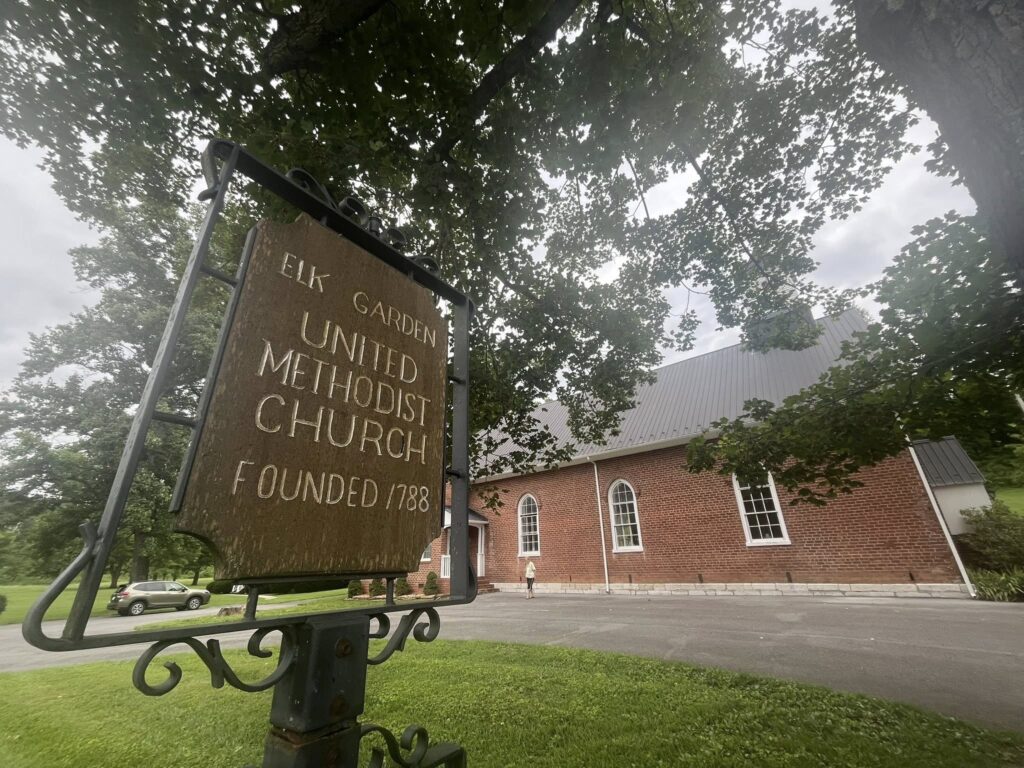
My earlier ancestors, survivors of the Shawnee attack, originally would have been active in a nearby older church, Elk Garden Methodist Church, founded 1788. Francis Asbury, after riding 21 miles and evading a rainstorm, as he noted in his journal, preached there at the “meeting house” in the early 1800s and mentions overnighting with another ancestor of mine who lived close by, a Revolutionary War veteran. His granddaughter married the son of the preacher ancestor mentioned above who freed his slaves. The Elk Garden church also appears to be active. It’s well maintained and has an outdoor memorial to its early pastor Richard Price, whom Asbury mentions as a dining partner. The church also hosts a hostel for bicyclists. Originally the church would have been log. It’s now a handsome brick building that dates to the 19th century.
It’s wonderful to see these three congregations surviving across several centuries. Through my ancestors who founded and shaped them, I feel personally connected to their ongoing ministry. All three congregations remain part of Mainline Protestant denominations. They seem theologically orthodox. They are not megachurches, but they’re doing better than most. Yet as venerable old churches they are increasingly anachronisms. How many church attenders today are in churches or denominations that involved their previous generations? Most American Christians today are in congregations they recently chose, and without regard to denominations. Denominations are becoming almost irrelevant, and Mainline Protestant denominations especially so.
This cycle is not new for Protestants across 500 years. We Protestants are constantly evolving, dividing, planting, inventing, moving on. In the Second Great Awakening, when my ancestors became Methodist, the old established churches of the East Coast were left behind as new revivalist movements of Methodists, Baptists, Restorationists and others arose, creating great new national denominations that are now fading.
But the historic Protestant denominations did offer a multigenerational continuity that helped shape our nation and that guided families across decades and centuries. The future will be very different but not necessarily worse. “Behold, I will do a new thing, Now it shall spring forth; Shall you not know it? I will even make a road in the wilderness and rivers in the desert.”
More from IRD:
Remain in My Love: A Visit to the National Cathedral
Arresting a Methodist Preacher
Comment by Salvatore Anthony Luiso on August 5, 2025 at 6:47 pm
Regarding “The future will be very different but not necessarily worse”: Not necessarily, but what is the trajectory of the last fifty years?
Is it one of greater earnestness? Of greater wisdom? Of greater godliness? Of greater fear of the Lord? Of greater love? Of greater holiness? Of greater spiritual maturity?
Or is it one of less of all of these qualities?
One of the reasons for the change is the foolish neglect and even rejection of church history.
Comment by William Beckett on August 6, 2025 at 12:06 pm
My Scotch Irish ancestors passed through Pennsylvania and settled near Winchester, VA in the 1730s. They helped to found Opequon Presbyterian Church, which is still operating. Most of their descendants became Methodists as far as I know.
Comment by Gary Bebop on August 6, 2025 at 4:58 pm
As fetching as Mark Tooley’s narrative reads, he knows that American legacy denominations do not have preferential “chosen” status in God’s eyes, but these denominations continue to make polemical use of their (now soiled) history in curious fixation on the past. Everything “Methodist” thus claims a certain cachet (in their eyes). But they must keep reminding us they are Methodist because the gloss is gone.
Comment by David on August 7, 2025 at 3:57 pm
I’ve recently discovered that I have maternal forebears who were active in the Second Great Awakening as part of the Stone-Campbell movement. My third great-grandfather was listed as a trustee of the Union Church of Christ in Washington County, Tennessee, in 1856. Last year I discovered that a second cousin three times removed taught at Milligan University. Same surname. An auditorium and a faculty award were named for him. Milligan is affiliated with the Churches of Christ. This makes me wonder whether there were other people in this line with similar associations.
On my father’s side, by contrast, I am descended from a line of Orthodox priests.
Comment by Skipper on August 9, 2025 at 2:46 pm
Now that the United Methodists have defined a marriage as “two people” there is a huge break in continuity for them as Methodists and really as believers as well.
Comment by Diane on August 16, 2025 at 2:37 pm
My paternal ancestry is English Separatist (9 Mayflower ancestors); Boston/Charlestown, MA, Puritan/Congregationals; the Baptist Fletchers of NH; the Salem, MA, Congregationalists of the witch trials; though through the 1800s, mostly MA Congregationalists, including Edwards Church in Northampton, MA (early 20th century). My family tree includes Congregationalist abolitionist/male feminist Parker Pillsbury (defrocked for his rabble-rousing in churches against slavery) and several abolitionist-society members. There’s a few other Congregational clergy, one of whom served a MA church in 1838, when the congregation nearly split over debate re abolition. Three years later, that congregation made a public statement declaring slavery was not in keeping with the spirit of Christ. My MA Tarbell ancestors, one of whom protested the fabricated witch trials testimony (his mother-in-law, Rebecca Nurse, was hanged), were shunned/ex-communicated by Rev Sam Parris of the Salem Village church. Three of my Tarbell kin were kidnapped as small children and taken to Canada by Mohawk tribal nation members. In adulthood, two returned and having been immersed in Mohawk culture most of their lives, decided to return to Canada and ended up marrying the chief’s daughters..their Mohawk Tarbell descendants are still thriving. I’ve found it interesting that the traditions of my forbears were mostly characterized by religious dissent. First Church of Plymouth, MA, long ago became Unitarian, then UU. I started out in my mother’s tradition, Disciples of Christ, but am much more at home now, having transferred to a Congregational/UCC church. Have for a long while said I’d probably make a good UU (Congregationalists and UUs have strong ties). I was not raised in New England and was not raised in the Congregational tradition of my ancestors. I’ve always wondered how strongly my DNA has been influenced by my faith-dissenter ancestors and whether it’s more than a coincidence that I’m very happy finding my home in a UCC Congregational setting. Most of my ancestors’ congregations are now open & affirming, as is the one I attend.