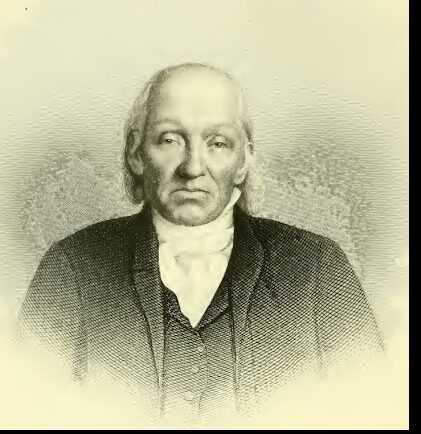

(On Saturday I toured historic properties in Washington County, Maryland, including the Spielman Farm, discovering this powerful story of a Methodist camp meeting there over 200 years ago and the courageous preacher who challenged slavery.)
In 1819 a Methodist minister in Maryland was prosecuted for sedition because he preached against slavery at a camp meeting. At trial he was acquitted, thanks to his lawyer, ironically future Supreme Court Chief Justice Roger Taney, whose infamous 1857 Dred Scott ruling claimed blacks could never be U.S. citizens, helping to trigger the Civil War. The Methodist minister was defiant and offered no apologies for his anti-slavery stance. The trial evinces that religious liberty and free speech for all must always, in every age and place, be relentlessly defended. And Christians must extol justice for all, no matter its unpopularity.
On August 16, 1818, south of Hagerstown, Maryland, Reverend Jacob Gruber preached over one hour at a Methodist Episcopal Church camp meeting at the Spielman Farm, with text from Proverbs: “Righteousness exalteth a nation, but sin is a reproach to any people.” The open-air audience, typical of Methodist camp meetings, was large, estimated at 3,000-5,000 whites and 200-300 blacks, both free and slave. The indictment charged him with “the monstrous offence of maliciously and wickedly endeavouring to incite the slaves of Maryland to insurrection and rebellion in the state.”
Gruber in his sermon preached in Methodist style for “national and personal righteousness,” as “whoever lacks in either of these particulars is not scripturally, experimentally, and practically righteous.” He cited infidelity, intemperance, and profaneness, likely not surprising anybody until he cited lastly the “national sin” of slavery, as a “reproach to our nation.” Gruber was from Pennsylvania, a free state, but Maryland was a slave state. Still, he preached:
We pity other nations who are under the yoke of Emperors and Kings, who tyrannize over, and make slaves of their subjects. We are happily delivered from such bondage; we live in a free country; we hold self-evident truths, that all men are created equal, and have unalienable rights, such as life liberty, and the pursuit of happiness. But are there no slaves in our country? Does not sweat, and blood, and tears, say there are? The voice of thy brother’s blood crieth. Is it not a reproach to a man to hold articles of liberty and independence in one hand and a bloody whip in the other, while a negro stands and trembles before him, with his back cut and bleeding? There is a laudable zeal manifested in our country to form Bible and Missionary Societies to send the Scriptures and the gospel to heathen nations. Would it not be well for some to be consistent? Instruct the heathens at home in their kitchens, and let them hear the gospel likewise. What would heathen nations at a distance think, if they were told that persons who gave money liberally to send them the Bible and the gospel did not read, believe, or obey it themselves, nor teach their own families to read that book; nor allow them time to hear the gospel of their salvation preached?
Gruber continued:
We Pennsylvanians think strange, and it seems curious to read the public prints or papers from some states and find for sale, a plantation, a house and lot, horses, cows, sheep and hogs—also, a number of negroes; men, women and children—some very valuable ones, …for sale, for life, a likely young negro, who is an excellent waiter, sold for no fault—or else for want of employment. Look further and see—Fifty dollars reward—One hundred dollars reward—Two hundred dollars reward. What for? Has an apprentice run away from his master? No—perhaps a reward for him would be six cents. A man that ran off has, probably, gone to see his wife, or child, or relations who have been sold and torn from him; or, to enjoy the blessings of a free country, and to get clear of tyranny. In this inhuman traffic and cruel trade the most tender ties are torn asunder, the nearest connexions broken. That which God has joined together let not man put asunder. This solemn injunction is not regarded. Will not God be avenged on such a nation as this?
He went on: “Is there not some chosen curse, some secret thunder in the stores of heaven, red with uncommon wrath, to blast the wretch that traffics in the blood of souls.—or, makes his fortune from the blood of souls?” Gruber concluded by warning the blacks that they too must turn to righteousness, so they can “be happy in heaven forever; while wicked masters are turned into hell and damned forever.”
As Gruber recalled that after his sermon, “Some went away grumbling and talking; others, when they found their portion so honestly allowed them, even by their neighbours, looked rather cross; not well pleased: resolved not to hear or pay any more attention.” To generate the indictment by the grand jury, he said the authorities had to “get Slave-holders, Overseers, Churchmen, Methodists, Free-thinkers, Half-thinkers, and No-thinkers, to bear witness against me, about the rebellion and insurrection.”
The trial itself seems to have been fairer. One witness recalled Gruber had preached with “energy and zeal.” No doubt. Another witness recalled: “He seemed to speak in a great passion. A person could hear him half a mile distinctly.” A third recalled: “He preached with zeal and vehemence; but not more so on that occasion than usual. I have heard Mr. Gruber often, and he delivered his sermon on that occasion with his usual manner.” Another admitted: “I got so mad with Mr. Gruber for his severity on other sects of Christians that I do not remember much about the sermon.”
In his defense, Gruber’s lawyer, Taney, declared: “No man can be prosecuted for preaching the articles of his religious creed; unless, indeed, his doctrine is immoral, and calculated to disturb the peace and order of society. And on subjects of national policy may, at all times, be freely and fully discussed in the pulpit, or elsewhere, without limitation or restraint.” He noted:
It is well known, that the gradual and peaceable abolition of slavery in these states, is one of the objects, which the Methodist society have steadily in view. No slave-holder is allowed to be a minister of that church. Their preachers are accustomed, in their sermons, to speak of the injustice and oppressions of slavery.
And:
There is no law that forbids us to speak of slavery as we think of it. Any man has a right to publish his opinions on that subject whenever he pleases. It is a subject of national concern, and may at all times be freely discussed.
Taney’s fellow defense counsel, Mr. Anderson, warned: “The freeman who condemns a man for uttering the dictates of his heart, commits suicide upon his liberties: and by sacrificing this reverend gentleman, they sacrifice those noble attributes of their constitution, the right of free sentiment and the right of free discussion.” And he quoted Thomas Jefferson: “The whole commerce between master and slave is a perpetual exercise of the most boisterous passions, the most unremitting despotism on the one part, and degraded submission on the other.” Anderson further noted that Gruber had “addressed his own congregation, confined his remarks to the pale of his Church; and surely if any can be authorised, it is the Pastor who teaches the doctrines of his Church, to those who compose it.” Like Quakers, he said, “he draws his right from that freedom of opinion, and prerogative of speech, every man living under the sun of America, has exercised, since the memorable period of [1776].”
Anderson also quoted Maryland’s constitution: “That it is the duty of every man to worship God in such manner as he thinks most acceptable to him,” recalling that the Founders were “informed by the history of the old world…that civil liberty could not long exist in any state where religious liberty was not freely enjoyed.” He observed that the Methodist and the Quaker “both consider slavery as a great vice, and if it could he said that the act of preaching, itself, under circumstances, which do not show a criminal intent, would justify the arrest and indictment of a preacher, these two Sects of Christians must be silenced, and submit to be deprived of that very liberty of conscience evidently secured to them by the “Bill of Rights.”
The jury deliberated only briefly and found Gruber not guilty. He offered no regrets:
But whatever I have learned, I can assure you, I have not yet learned to call good evil, or evil good. I hope, while I keep my senses, I shall consider involuntary perpetual slavery miserable injustice; a system of robbery and theft. I hope I never shall rank men, women, and children, with horses, and cows, and property, and countenance or justify such sales and merchandize. May our merciful God save us from this sin and reproach—and let every honest man say, AMEN.




Comment by David on June 10, 2025 at 8:07 am
It might be noted that Lincoln’s Emancipation Proclamation specifically exempted slave states that remained in the Union. Despite the approaching Juneteenth observance, slaves in Delaware were not freed until the ratification of the 13th Amendment on 6 December 1865—nearly half a year later.
Comment by Gary Donald Foster on June 10, 2025 at 12:10 pm
Excellent article. Great story.
Comment by Tim Ware on June 11, 2025 at 12:39 am
Now David, let’s not let a little insignificant thing like facts get in the way of Juneteenth…
Comment by Wilson R. on June 12, 2025 at 2:47 pm
The Emancipation Proclamation had much less to do with the principle of ending slavery than the prosecution of the war.
As to the trial of the Methodist preacher, the case illuminates several trends in US history at that point in time.
In the years immediately following the American Revolution, there was a general consensus among the Founding Fathers–even those, like Jefferson, who owned slaves–that slavery was a great moral evil and that the nation would eventually pay a price if it did not find some way to rid itself of this evil. It shows up clearly in their own writings.
So it would not be unusual to find a Methodist preacher in 1819 who presented slavery as incompatible with the Gospel. John Wesley had done as much. The early Methodists at the time of the Revolution (and the early Baptists) were known for their anti-slavery stand. William Wilberforce, a convert of Wesley’s, led the effort in Parliament to abolish the British slave trade in 1807.
But what happened between the Revolution and the 1820s is also evident in this case. The Founders concluded (rationalized) that ending slavery was impracticable, because the cost of sending them back to colonize in Africa on a large scale was prohibitive; because the idea of giving them land in the new territories beyond the Appalachians was unworkable because land speculators already were claiming and selling properties there; and because they convinced themselves that freed slaves could not live alongside white Americans in the original colonies (Robert Carter of Virginia, who owned more slaves than Washington and Jefferson combined, and who freed them all and gave them tenancy on his vast estates, was such a notable exception to this rule that almost nobody knows his story, which is told in a marvelous history called “The First Emancipator.”) So by 1819, those who had once railed about the moral evil of slavery had become more accepting of its continuation.
The other big development was the Haitian revolution of 1803–the first successful slave rebellion in the Western Hemisphere. The spectre of “San Domingo” hung over southern slaveowners, who were even more terrified about the prospect of slave rebellions than Cold Warriors in the 1950s were paranoid about the spread of communism. After the French failed to reclaim Haiti, this fear escalated in the South, and by the 1820s it was dangerous or even illegal to be an abolitionist below the Mason-Dixon Line. So in 1819, a time that marks the end of one era and the early stages of another, it would not surprise me to see an anti-slavery preacher prosecuted in Maryland, a state that had been more important to the slave economy in 1783 than any other except Virginia and South Carolina. That, too, changed in the second and third decades of the 1800s as Georgia grew and Alabama and Mississippi opened up to the new cotton economy.