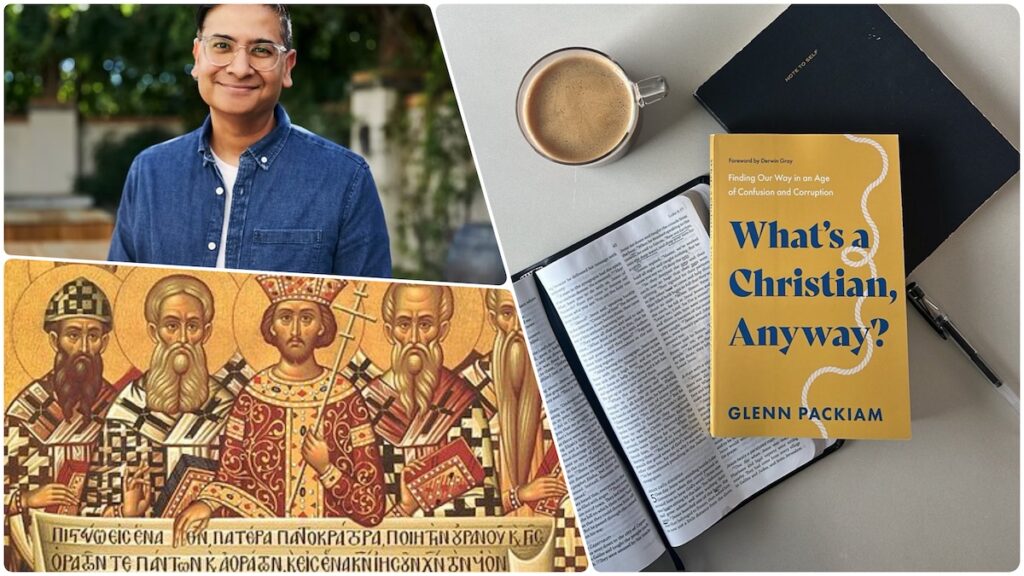

What’s a Christian, Anyway?: Finding Our Way in an Age of Confusion and Corruption
by Glenn Packiam
Thomas Nelson, 2025. 240 pages.
Timed with the 1700th anniversary of the Nicene Creed, the Church’s historic, lasting statement of Christian belief, Pastor and theologian Glenn Packiam offers a new look asking what it truly means to be a Christian and to practically walk with Christ.
Based out of Rockharbor Church in Costa Mesa, California, Packiam holds a Doctorate in Theology and Ministry at Durham University in the United Kingdom and is an ordained priest in the Anglican Church in North America. A regular speaker at conferences, he frequently lectures, speaks on Christian podcasts, and is co-founder and songwriter with Desperation Band.
As What’s A Christian, Anyway? suggests, Packiam walks through the Creed to bring us back to the roots of our common Christian faith. In a time of difference, disillusion and confusion, Packiam provides a needed and timely antidote in the form of the foundational creed. His interpretation and analysis is theologically rich and yet his presentation is simple and accessible for those unaccustomed to the ancient creeds and the grounding and unity they offer the Church, lighting a path for both the new and experienced traveler to follow.
I first became acquainted with Packiam’s work while attending the nondenominational evangelical New Life Downtown in Colorado Springs for some time while he pastored there. Sad to see him go off to a new season of life in California, I still hold his teaching and mentorship close as I walk through my own faith journey (I distinctly recall a sermon with specific messages now in this book that I still carry with me today). Knowledgeable, thoughtful, and full of kindness, grace, and humility, Packiam’s traits flow from every page of this book.
I did not want to put the book down until I was finished, partly due to Packiam’s personal stories and conversational tone. Even if one may struggle with an interpretation or analogy, Packiam makes complex and difficult ideas from the ancient church creed easy to follow and understand.
A primary goal of this text was not only to help restore a way home for Christians who are confused and lost for its own sake, but in doing so, to restore credibility of Christianity in the world. This effect is necessary to draw others in and regain trust in the church or the “believing community.” As Packiam outlines in his opening chapter, the church is losing credibility in the world, corrupted and co-opted.
“We believe in Jesus, but our lives look nothing like Him,” Packiam writes.
Although Packiam preaches in a nondenominational, evangelical church setting, he writes for an audience across Christian traditions. The Nicene Creed is a uniting force that brings all Trinitarian Christians back to where they began and a shared understanding of who Jesus Christ is.
The beginning chapters of his book reveal just why a renewed focus and emphasis on the Nicene Creed is needed, both in Orthodox and Catholic churches where creeds are liturgically recited and in non-denominational, evangelical churches where the Nicene Creed may not even be acknowledged in a normal Sunday service.
Packiam sees our age as similar (in terms of developments within the Christian faith) to the early decades of the fourth century. Christianity had multiplied and vastly expanded throughout the world. However, with that popularity and reach came false teaching, syncretistic mixing of pagan superstition and philosophy with the faith, a twisting of core tenets, and mass confusion.
A “simple summary of the heart of the Christian faith” was needed. It served and still serves as a reminder of the “Way”; it is a rope that leads us home amidst the fog. It grounds us and helps us to not fall astray as a church or as an individual which can lead to false teaching and unfaithfulness. When this happens, the soul is tarnished and credibility falters.
Packiam envisions this Christian credibility as being restored through “believing and living the Creed.”
In using the words, “We believe in…” the ecumenical authors of the Nicene Creed present us with a faith that is not merely individual, a faith that is “neither fantasy nor certainty” but an invitation into a great, true mystery, and a faith that draws us near and beckons us to “cling to Jesus.”
In reading through this understanding of faith for myself, I was both refreshed and encouraged. Our faith is, as it ought to be, transformative in the present life. Packiam welcomes the reader into an understanding of Christian doctrine that invites radical and beautiful change in the way we live.
At the end of each chapter after tackling the doctrinal statements about the Father, the Son, the Holy Spirit, and the church and its practices, Packiam finishes by asking two questions in summary:
“What does it mean to believe these words?” and “What does it mean to live by these words?”
He gives us a roadmap for our belief in and walk with Christ.
What’s A Christian, Anyway is simple yet profound, practical yet wonderful, and hopeful yet transformative. Packiam takes the reader on a wonderful voyage through an ancient Creed that arrives at the destination of a new life and new way forward for the body of Christ.


Comment by Glenn Wheeler on July 23, 2025 at 11:54 pm
So…yet another person with a sectarian view of Christianity telling us that his particular version of Christianity is the only true one and that the way he views things is the only “correct” way and that all other ways are wrong.
How many times have we heard stuff like this? It gets to be boring.
Comment by Salvatore Anthony Luiso on July 28, 2025 at 3:05 am
Thank you for this review. I’m telling other people about it.
Regarding the sentence which begins “The beginning chapters of his book reveal just why a renewed focus and emphasis on the Nicene Creed is needed”:
1. I heartily agree that the Nicene Creed can be an invaluable means of instructing and correcting, enlivening, and reviving churches.
2. As I think the author of the review knows, it isn’t only Catholic and Orthodox churches which recite the Nicene Creed in liturgically. Lutheran and Anglican churches have been doing that since the time of the Reformation, and other kinds of churches do it, too.
3. I think most non-denominational churches not only do not acknowledge the Nicene Creed “in a normal Sunday service”, but that the vast majority of members of such churches know nothing or next to nothing about it, and that the vast majority of those who are familiar with it became familiar with it at a church where it was recited liturgically.