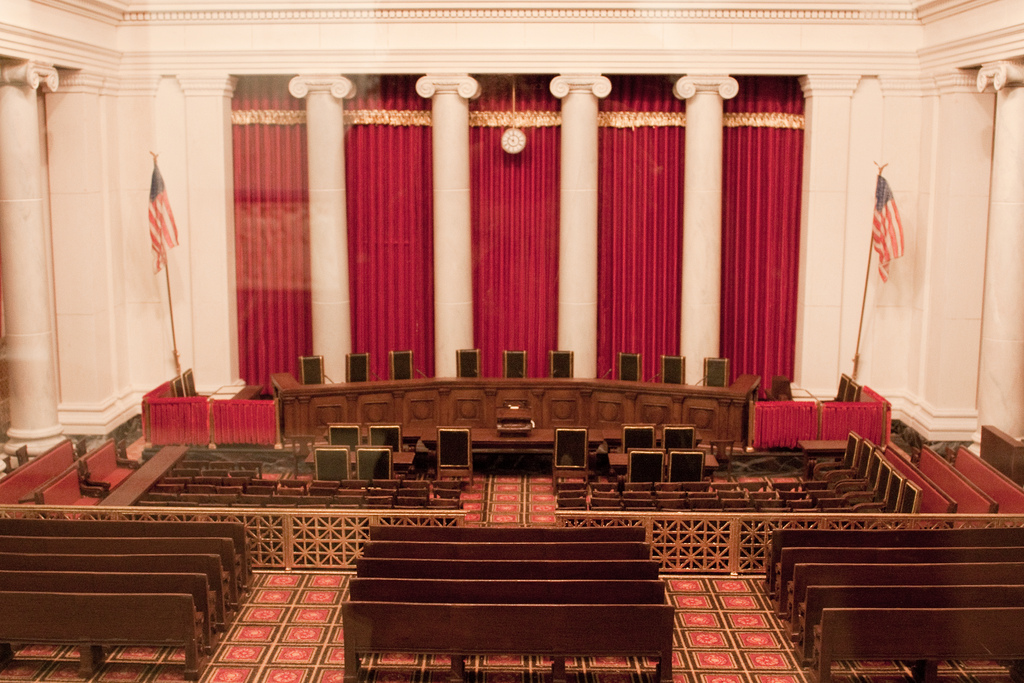
Recent decisions by the nine-justice U.S. Supreme Court are a barometer for constitutional rights across the nation. Here are four recent and upcoming cases that impact religious liberty.
Mahmoud v. Taylor
This morning justices ruled in favor of parents who fought to opt their children out of public-school curricula that included LGBTQ+ literature. The court concluded that the refusal of the Montgomery County, Maryland school board to allow for opt-outs unconstitutionally burdened the parents’ Free Exercise rights.
The proposed school curricula centered on seeding approval for same-sex marriage and transgenderism amongst students as early as kindergarten. The majority opinion of the court noted that these books often went beyond mere “exposure,” often depicting opposition to gay marriage or transgenderism as hateful and wrong. The Supreme Court’s decision grants parents a preliminary injunction and orders the county to allow for opt-outs. Read Rick Plasterer’s in-depth analysis here.
St. Isidore of Seville Catholic Virtual School v. Drummond
The Supreme Court dispelled dreams of a religious charter school that initially secured a contract with Oklahoma’s Charter School Board. Had the plan succeeded, St. Isidore of Seville Catholic Virtual School would have received government funding while operating explicitly under the Archdiocese of Oklahoma City and the Diocese of Tulsa.
In Oklahoma, the charter school laws and the constitution both prohibit the use of public money for religious institutions. Both also bar public schools from being sectarian. Unlike school voucher programs, the funneling of taxpayer money towards religious education is not directed by parents’ choices. Because of this, the Oklahoma Supreme Court rejected the aspiring charter school’s contract.
In a May 22 decision, the U.S. Supreme Court was evenly split due to Justice Amy Coney Barrett’s recusal. This automatically affirmed the judgment of the lower court, leaving in place the Oklahoma Supreme Court’s rejection of the religious charter school.
Catholic Charities Bureau v. Wisconsin Labor and Industry Review Commission
Wisconsin operates an unemployment benefits program funded by a payroll tax. State law allowed certain religious organizations to be exempt from this tax. In order to qualify for the exemption, an organization needed to be controlled by a religious group and “operated primarily for religious purposes.” To satisfy that latter requirement, an organization needed to have both religious motivations and religious activities, according to the Wisconsin Supreme Court’s interpretation.
The Wisconsin Supreme Court barred the Catholic Charities Bureau (CCB) from receiving the payroll tax exemption. The CCB engaged in charity work amongst disadvantaged communities, and the group avoided proselytization because it violated Catholic doctrine against “misus[ing] works of charity for purposes of proselytism.” According to the lower court, the CCB’s refusal to inculcate its religion using its charitable work meant the CCB’s activities weren’t expressly religious. This reasoning led the Wisconsin Supreme Court to rule against the CCB.
The Supreme Court disagreed. Writing for the majority in a June 5 decision, Justice Sonia Sotomayor rejected the lower court’s requirement for religious activities as outright “denominational discrimination.” Basically, the only reason the CCB was excluded from the exemption was because the group upheld Catholic doctrine. In her majority opinion, Sotomayor wrote that Wisconsin’s requirements violated the CCB’s First Amendment rights.
Landor v. Louisiana Dept. of Corrections
On June 23, the Supreme Court agreed to hear Landor v. Louisiana Dept. of Corrections in an upcoming term. The central question of the case is whether prison inmates can seek monetary damages from individual prison officials who violate their religious liberty. In other words, the Supreme Court will decide whether prison officials may be induced to pay money to the inmates if they violate the inmates’ religious freedom rights.
This case involves Damon Landor, a former inmate whose dreadlocks were forcibly shaved by prison guards. Landor’s Rastafari religion prohibits the cutting of hair, an imperative drawn from Old Testament passages such as Leviticus 19:27.
While the appeals court agreed that Landor’s religious freedom rights were grossly violated, the court stopped short of addressing the question of individual liability. The lower court pointed to somewhat conflicting Supreme Court precedents and asked the higher court to decide the matter.
A Supreme Court decision on this case likely would not touch on religious liberty per se, since the lower court agreed that Landor’s rights were violated. However, the Supreme Court’s decision would impact how religious liberty cases may be brought and resolved under laws like the Religious Freedom Restoration Act (RFRA) and the Religious Land Use and Institutionalized Persons Act (RLUIPA). A judgment in favor of Landor could expand the options plaintiffs have for suing those who violate their religious liberty.
More from IRD:
Parental Rights in the Balance – Part 1
Trump Religious Liberty Commission Urges Return to Faith in Public Square


Comment by Diane on June 28, 2025 at 3:24 am
The Supreme Court’s decision supporting opt outs from classroom instruction when it infringes upon parents’ religious freedom rights is unworkable. Teachers aren’t mind readers. How are they to know the religious beliefs of every student’s family? As an educator with more than thirty years in the classroom, conservative Christian parents of one of my kindergartners believed male ballet dancers are gay or gender-queer; ballet dancing is a “girl sport” and boy ballet dancers are clearly as gay as the gay characters in a storybook they don’t want read to their child. They wanted their kid opted out of watching the Nutcracker Ballet with their classmates, but failed to share this belief with me. So, they went ballistic, angrily demanding their child be transferred to another classroom , accusing me of teaching a gay curriculum. Who knew the Nutcracker Ballet is sexuality instruction in the minds of conservative Christians?
Another parent, a member of the conservative Church of Christ, requested her son be opted out of all art activities because art activities are for girls, she said. Engaging in art activities can make boys “soft”, turning them gay in later life, she said. Again, who knew?
And what to do when progressive Christian parents, who believe the bible is a narrative text open to interpretation, claim schools are indoctrinating their children to believe that there are only two biologically distinct sexes and only heterosexuality exists? These parents know intersex kids exist and their religious belief includes n9n-binary people. If the teacher never reads storybooks with same-sex couples as characters, then that’s grounds for claiming indoctrination that runs afoul of progressive beliefs. If there’s never a story with a non-binary character, that, too, is ground for indoctrination.
I had parents who objected to Jingle Bells based on their religious beliefs, and parents who objected to any make-believe story because make-believe is a form of lying, they said. Others disliked books with girls wearing shorts or pants (conservative parents say such girls are gender non-conforming).
Best bet is to discourage young people from a teaching career. Used to be public schools were expected to teach diverse topics that would prepare students for citizenship in a pluralistic democracy. The court now says parents of public school students have the right to insist schools keep their kids in whatever religious bubble aligns with the beliefs of a child’s parents. Too stressful wondering what’s going to tick these parents off. Maybe government-operated schools should require parents to share all of their pertinent religious beliefs at the beginning of the year and again, whenever parents change their beliefs. Sounds intrusive, but that’s the only way teachers would know which lessons infringe upon any of the religious beliefs of parents.
Comment by Steve Tauber on June 28, 2025 at 12:08 pm
Or….we could just give parents the financial resources to put their kid in a decent conservative school and opt out of government run public schools. Every parent knows their child is going to be fed plenty of progressive garbage in college, they shouldn’t have to put up with it from their children’s elementary school teacher. Problem solved. Liberal school teachers will still be able to indoctrinate the kids of liberal parents. But hey, you’ll still have plenty of Lutherans and Episcopalians to teach!
Comment by Douglas E Ehrhardt on June 28, 2025 at 3:12 pm
Gee , I wonder why so many kids are confused about their biological sex.
Comment by David on June 29, 2025 at 7:40 am
There are very few courses in college where “liberal garbage” would even be mentioned. This is especially the case in a STEM major. Physics, chemistry, engineering, and biology offer no place for politics.
The US has long had anti intellectualism. It is always the absent-minded professor, the mad scientist, etc. The benefits to society from improved medical treatments and technology seem to get ignored.
Comment by Steve T on June 29, 2025 at 1:17 pm
I know you are aware that engineering majors are required to take some liberal arts courses to be “well rounded.” My oldest son majoring in nuclear engineering got to waste my money on a semester of listening to a professor tell them about their white privilege. Later switched his major into accounting. Got to hear more of the same. He said he had to suck it up or the professors punished you with poor grades. He graduated with honors but was very disgusted by this part of the college experience.
Comment by Different Steve on July 1, 2025 at 8:36 am
ChatGPT responds to comment #1:
While the concerns raised about the practical difficulties of honoring religious opt-outs in the classroom are understandable, the conclusion that the Supreme Court’s ruling is unworkable—and that public education is now doomed by parental interference—is overly pessimistic, one-sided, and not reflective of what the Court actually said or what a pluralistic democracy demands.
1. No One Is Asking Teachers to Be Mind Readers
The ruling does not require teachers to magically intuit the religious beliefs of every family. It simply affirms that when a parent explicitly raises a religious objection, public schools must take that objection seriously if it concerns instruction that is not essential to the school’s educational mission. That is not unworkable—it’s a reaffirmation of the constitutional protection of religious freedom in public life.
The kindergarten example involving the Nutcracker Ballet is a case of miscommunication or lack of proactive parental engagement, not a flaw in the Court’s decision. If a parent fails to inform a teacher of their objection, it is unfair to expect the school to anticipate it. But once objections are clearly raised, schools have a duty to accommodate when reasonably possible. That’s a far cry from requiring curriculum approval by every household.
2. Religious Freedom Is Not a One-Way Street
The rebuttal complains about conservative Christian parents objecting to ballet, art, or gender content—but then presents progressive Christian objections as equally problematic. The takeaway seems to be: since people can disagree on what is religiously offensive, we should dismiss all religious objections as unworkable. But in a pluralistic democracy, diverse beliefs are not a bug—they’re the system functioning as designed.
What this educator is describing isn’t a reason to give up—it’s the challenge and responsibility of teaching in a society that values liberty and diversity. Respecting religious conscience—left, right, or otherwise—is part of that deal.
3. Educators Have Tools to Manage This Already
Teachers already navigate IEPs, 504 plans, allergy accommodations, custody limitations, and language needs. These are complex, individualized, and sometimes frustrating. Yet we manage. The solution is not to discourage teaching, but to build better systems of communication with parents—something good schools already strive for.
A simple opt-out form at the beginning of the year—or a system that flags sensitive units and invites feedback—could easily address most concerns without requiring full disclosure of someone’s entire belief system. That’s not intrusive; that’s just good communication.
4. Don’t Blame the Court for Cultural Division
The stress described in this piece is not caused by the Court’s decision. It’s caused by an increasingly fractured culture in which trust between parents and schools has eroded. The ruling doesn’t demand submission to every whim; it demands that public schools not trample religious conscience when it’s explicitly raised and when the accommodation is reasonable.
This isn’t the death of public education—it’s an invitation to treat parents as partners, even when they hold views we don’t personally share.
5. Discouraging Teaching Is Not the Answer
Yes, teaching is harder now. But telling future educators to avoid the profession because of parental complaints is defeatist and counterproductive. Strong, thoughtful, principled teachers are more necessary than ever. Throwing in the towel because the system has to honor religious diversity sends the message that only educators with no tolerance for dissent belong in public schools. That’s not democracy—that’s a monoculture.
Bottom line: The answer to cultural complexity isn’t to reject religious accommodation—it’s to manage it with clear boundaries, good policy, and mutual respect. The Supreme Court’s decision doesn’t make teaching impossible. It reminds us that public schools serve a diverse population, and that honoring that diversity is part of the work—not a betrayal of it.
Comment by Diane on July 6, 2025 at 6:36 pm
Re ChatGPT responds to comment #1:: obviously AI hasn’t been in a classroom to realize parents don’t tell teachers before a lesson what offends them, they always throw a hissy fit afterwards. Which is why I said teachers aren’t mind readers. There’s no way to know what a parents off-the-wall religious beliefs are unless parents are required by the government to detail every single one of their beliefs. The parent who believed all male ballet dancers are gay and was livid to learn his son watched the Nutcracker Ballet, was accusatory only after he learned his son watched it and announced he wanted to be a ballet dancer; the Jehovah’s Witness parent complained about “Jingle Bells” after he came home singing it – , claimed it’s a Christmas song; the mother who went ballistic thinking her daughter was being taught left wing ideology only after her daughter came home and proudly announced she was learning upper and lower case letters; the mother who objected to her son participating in art activities weeks after school started. Everyone of these objections were not conveyed by parents to the schools prior to their introduction. Teachers are not mind readers.