Parental rights are a particular target in the moral revolution which is being attempted in the twenty-first century. But a strong defense of parental rights in America has been the Pierce v. Society of Sisters of the Holy Names of Jesus and Mary decision (1925), which said that the state cannot require secular, public education for all children, and recognized parents’ primary role in the education and discipline of children. On the 100th anniversary of the Pierce decision, parental rights are being challenged by the public school system of Montgomery County, Maryland, which is requiring children at the pre-K and elementary levels to be instructed from pro-LGBT story books, with no opt-outs by parents allowed. This has resulted a lawsuit from parents, Mahmoud v. Taylor, now before the U.S. Supreme Court, with a decision expected by the end of June.
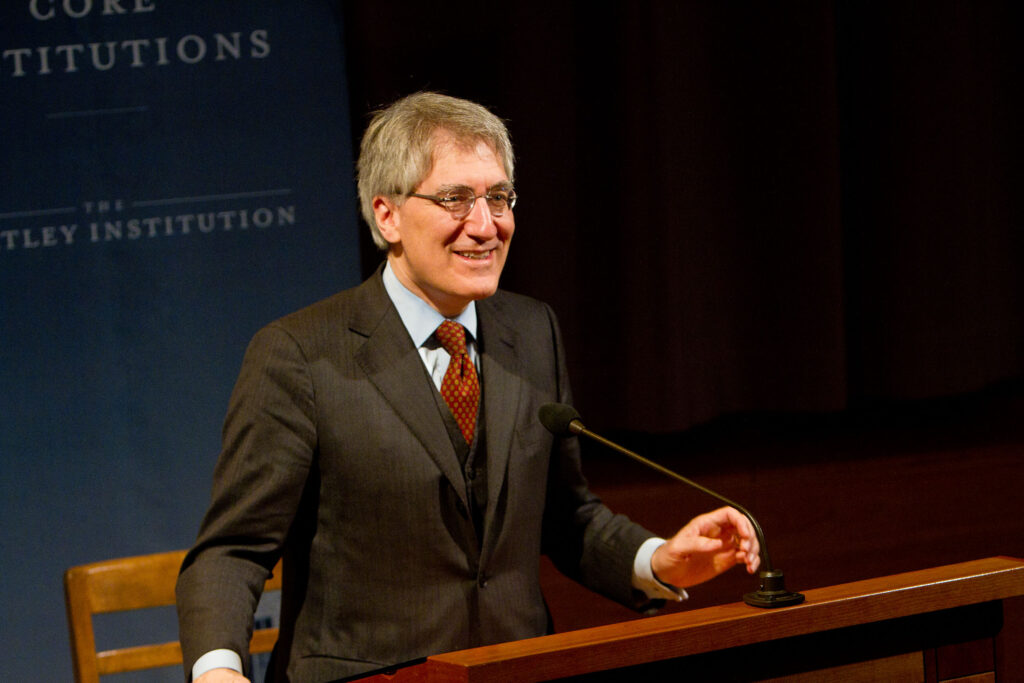
The Heritage Foundation conducted two panel discussions about the case on May 29, preceded with remarks by Robert George, McCormick Professor of Jurisprudence and Director of the James Madison Institute in American Ideals and Institutions at Princeton University.
George asked the basic question, “should children’s parents, or should the government direct the moral and religious formation of children?” He observed that “children are born to parents, a mother and a father, and are therefore theirs.” This is “no mere matter of cultural convention, but an objective moral truth.” Parents have a duty to ensure the education and moral formation of their children. The role of the state in raising children is strictly subsidiary to that of parents. This is the judgment of natural law, affirmed by the Supreme Court in the Pierce decision, through the use of a “substantive due process” interpretation of the Fourteenth Amendment, which permits courts to pass judgments on laws according to whether or not they are just.
But he said that contemporary progressives “view the state as having what amounts to a quasi-parental role.” They claim that the expertise of professional educators is equal to or superior to that of parents. He referred to the work of Amy Gutmann, formerly President of the University of Pennsylvania, who maintains, in George’s words, that the state has a duty “to shape, even independently of parental wishes, the moral character and fundamental beliefs of children.” The state should address the “souls” of children to make citizens “free to choose their own version of the good life.” She has said that is “no a priori” reason to choose parents over the state in the education of children.
Even more direct, George said, is Elizabeth Bartholet of Harvard Law School, who has said the many homeschooling parents are “extreme ideologues” who train children in beliefs and values “in serious conflict” with the wider culture. The “subtext” of this criticism, George maintained, “is that such ‘ideologically committed’ parents are those who are committed to living lives and raising families in conformity with traditional religious and moral values, as Christians or Jews, for example.” Essentially, she pleads for intolerance in the name of tolerance. This spring has seen several state level legislative attacks on homeschooling, which seem to spring from viewpoints such as Bartholet’s.
But George said there is no value-free education. Parents may and must teach values – those of the natural law, in addition to any religious faith of which they are convinced. Such precepts as “stealing is wrong,” not cheating on tests, and keeping promises are universal values all parents should inculcate. Children may certainly be removed from “objectively harmful” situations. But in that case the doctrine of parental authority does not change, and the state’s objective is to restore children to the family unit, if this becomes possible. Bad parents do not mean that parental authority should not be primary in raising children. There are also “bad schools,” “bad teachers,” and “bad counselors.” The state’s role is always “subordinate and subsidiary” to that of parents.
The Mahmoud v. Taylor Case
Mahmoud v. Taylor is basically about an attempt to erode parents’ rights by requiring public school students to be indoctrinated in pro-LGBT curricula at the pre-K and elementary school levels. The state claims, George observed, “an independently grounded, non-subsidiary role to play – sharing role – in making normative judgments about the sort of ideas that ought to guide a child’s moral and intellectual upbringing.” Not requiring pro-LGBT lessons for all students, Montgomery County claimed, would expose children who think the pro-LGBT curricula “represent them and their families to social stigma and isolation.”
The county thus claims a right. George said, to engage in “ideologically influencing the moral formation of children enrolled public schools at least in part because not doing so would allegedly have a negative impact on other children whose parents seek to raise them with socially liberal moral commitments.” Essentially, “for the sake of the supposed comfort of their socially liberal peers, the government – the county – claimed an interest in encouraging all students to adopt views normatively favorable of and disposed toward same-sex marriage, transgenderism, sexual liberation, and hotly contested conceptions of sexuality and gender identity, and claimed that parents had no right to stop their children from being subjected to what truly was indoctrination.” He said that in Mahmoud, the reason leftists want to “share and eventually override” the authority of parents in child rearing becomes apparent.
George believes that the Supreme Court will side with the parents in this case. That would protect the free exercise rights of students, but also “the fundamental rights of parents to direct the upbringing and education of their children.” This outcome will be a result of United States having “a long tradition” of upholding the natural law account of parents in directing the upbringing of their children. Starting with Pierce v. Society of Sisters, there is an essentially “unbroken line of efforts” upholding the natural law account of the rights of parents against “myriad efforts to undermine it.”
Pierce v. Society of Sisters
The Pierce decision concerned an Oregon law that required all children to attend public schools, even those who had attended state recognized private schools. The principal objective of the law was to close Catholic schools. The Supreme Court, however, declared that the Oregon law was an unreasonable interference with the right of parents to direct the upbringing of their children, and in a memorable phrase, said that “the child is not the mere creature of the state.” But the court also defended a broader conception of parental rights “that does not stop at the schoolhouse door.” Children are persons who participate “in a unique and timeless person-to-person relationship.” This relationship “is replete with duties on the part of parents.” Yet George said that “parental rights are defeasible, not absolute.”
Parental rights are “deeply rooted in our nation’s constitutional order.” Defending parental rights “is not a doctrinally sectarian or even explicitly religious or theistic position.” Therefore, “a substantively robust reason-based account of parental rights, regardless of how it’s undermined or slandered in the public square, must be defended for all Americans of all shades … of belief.” This, he said, includes atheists, who “have as much right to direct the upbringing and education of their children as devout Jews do, or devout Christians, or others.”
George insisted that we must “be courageous defenders” of parental rights, because they “are not rights conferred by any merely human authority.” Also, “they are not subject to the whims of such an authority.” He said, “there’s a name for rights that we have that are not merely conventional, they are natural rights.”
Panel discussions regarding the Pierce and Mahmoud cases will be reviewed in subsequent articles.
It can be viewed here.



Comment by David on June 19, 2025 at 7:33 am
We should also consider student rights. Should parents be allowed to keep their children in ignorance? All persons have a right to know the functioning of their bodies by reproductive age. Then there are subjects which some religious groups would rather not discuss such as evolution or science in general.
Perhaps the worst examples of this abuse are found in Hasidic Jewish academies. The studies there are devoted almost entirely to religious texts with minimal instruction in science, math, and English. Indeed, there is one group which forbids its members from possessing printed matter in English along with TVs, radios, etc. This prevents people from leaving the group as they cannot function in the outside world.
Comment by Gary Bebop on June 19, 2025 at 11:27 am
Let’s not use this forum site to insert dogmatic attacks on Hasidism or any other religious minority. The state’s “conditioners” (as C.S. Lewis referred to them) do not have sovereign authority over our children’s minds. Don’t presume the state is Supreme.
Comment by Rick Plasterer on June 19, 2025 at 11:14 pm
David,
You’re offering a rehash of Elizabeth Bartholet’s position. The final say-so over children’s education either rests with parents or with the state. In 1925, the state thought that Protestant Christianity had the correct ideas. Today Montgomery County and other liberal/left jurisdictions think homosexuality and trnasgenderism have the correct ideas. In Sudan, it’s Islam, in Vietnam, it’s Marxism-Leninism, in North Korea, it’s Marxism-Leninism in its Juche ideology version. But education and discipline of children should rest with parents, for the reason Robert George said – natural law.
Rick
Comment by David on June 21, 2025 at 8:27 pm
Natural law is a myth.
Comment by Mike on June 22, 2025 at 8:04 pm
David:
Natural law is not a myth. Everyone has an innate sense of right and wrong. Mothers have an instinct that tells them how to care for their children. Fathers have a natural protective instinct. These combine to guide them to do what is best for their children. That includes educating them.
Comment by David on June 22, 2025 at 8:47 pm
If behavior is governed by genetics, which it is to a degrees, what become of free will? You cannot have it both ways.
Comment by Different Steve on June 22, 2025 at 8:48 pm
The statement “Natural law is a myth” is a bold philosophical claim, and how one responds depends heavily on how natural law is defined—and whether we’re looking at it morally, politically, or scientifically. Let’s break it down from several angles:
1. What Is Natural Law?
In classical philosophy, natural law refers to the idea that:
> There is a universal moral order built into nature and accessible by human reason.
This is often associated with Aristotle, Cicero, and especially Thomas Aquinas, who saw natural law as:
Flowing from human nature
Discoverable through reason
Binding across cultures and times
In modern contexts, natural law is often used in:
Ethics (e.g., it’s wrong to kill because human reason recognizes human dignity)
Law and politics (e.g., human rights are “natural” and not just legal inventions).
2. Why Would Someone Call It a Myth?
The claim that natural law is a myth usually comes from one or more of these critiques:
A. It’s not “natural”—it’s cultural
Critics argue natural law claims are just moral norms dressed up as nature, often reflecting the dominant culture, religion, or era.
For example, saying “marriage is naturally between a man and a woman” might be less about reason and more about traditional norms.
B. Reason isn’t universal
What one culture’s thinkers say is “natural” (e.g., private property, gender roles, warfare) might look wildly unnatural to another.
Critics say reason is shaped by bias, emotion, and context, so it can’t reliably discover a universal moral law.
C. It blurs “is” and “ought”
David Hume’s famous “is–ought problem” says you can’t derive moral rules from facts alone.
Just because something is natural (say, competition or inequality), doesn’t mean it’s morally good.
D. Scientific challenges
Modern biology and anthropology show a huge diversity in moral practices and social structures, undermining the idea of a shared “natural morality.”
3. Why Others Defend Natural Law
Despite those critiques, many still see value in natural law theory:
A. Basis for human rights
The idea that humans have rights just by being human—not because a government says so—comes from natural law thinking.
B. Reason-based ethics
It’s attractive to believe that moral truths can be known by thinking carefully, not just by appealing to religion or law.
C. Moral realism
Many people intuitively believe there is a moral reality—that things like genocide or child abuse are wrong regardless of culture or consensus.
4. Middle Ground: Natural Law as a Framework, Not a Fact
Some modern thinkers (like Alasdair MacIntyre or John Finnis) defend a revised version of natural law:
Less about specific “rules of nature”
More about promoting human flourishing
Open to historical and cultural variation while still insisting some moral truths transcend custom
Others suggest that what we call “natural law” is just shared human tendencies, not fixed laws—useful for dialogue, but not absolute.
5. Conclusion: Myth, Metaphor, or Moral Bedrock?
So is natural law a myth?
If you mean it’s not an objective, fixed set of moral rules coded into the universe, many would agree—it’s a kind of useful fiction or cultural projection.
If you mean it’s a dangerous illusion, critics see it as a way to smuggle in ideology under the cover of “reason” or “nature.”
But if you mean it’s totally baseless or irrelevant, that’s harder to defend—because the concept still underpins major legal and ethical systems, including human rights and constitutional law.
So whether natural law is a myth or moral compass depends on what you expect from it—and what you think morality is in the first place.
Comment by Diane on July 1, 2025 at 5:19 am
I find it hypocritical when conservative Christian parents love to read aloud to their children lgbtq-authored children’s classics and then claim they don’t want their kids to hear stories with lgbtq characters. During the pandemic, I noticed one such parent conducted an online storyhour for K-1 kids, reading three books, all written by lgbtq award-winning writers of children’s books. . Two of the three books were also lgbtq illustrated. If conservative Christians are going to trash lgbtq people, do the rest of us a favor and stop pleasuring your kids with the gifts and talents of lgbtq authors and illustrators. Exploiting the gifts of lgbtq people suggests the god conservative Christian people worship is highly manipulative.