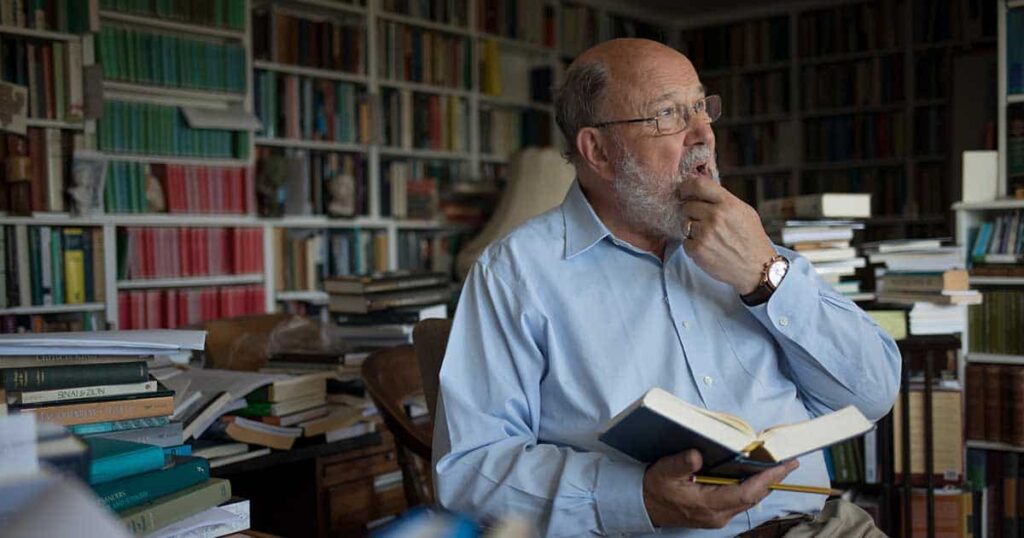

Anglican Theologian and New Testament Scholar N.T. Wright unintentionally waded into controversy last week when in a podcast conversation he spoke supportively of abortion early in pregnancy in the cases of rape, incest, and fetal abnormalities. Conservative Christians who have valued his rigorous scholarship were left disappointed by his comments.
Wright, a well-respected scholar, author of books including Simply Jesus and Surprised by Hope, and former Bishop of Durham offered remarks that were unpastoral to all involved: the caller, women with unexpected pregnancies, and the children that result from those pregnancies.
While rejecting late term abortion, Wright stated:
“At the same time there may be certain exceptions of which severe deformity might be one of which certainly incest and rape would be others. And in those cases I would say the sooner the better.”
Wright is not alone; many in our culture wish to appear nuanced at the expense of real care for those experiencing difficult circumstances in pregnancy.
Wright appeared on the Ask N.T. Wright Anything podcast hosted by Australian Theologian Michael Bird. Bird could have asked Wright more challenging questions, but instead went along with Wright’s assertions. Significantly, neither Wright nor Bird attempted to provide a biblical or theological rationale for the opinion asserted.
The discussion began when a female caller named Sarah asked about abortion. She explained that she had grown up as a Christian and understood that she was supposed to believe that abortion was wrong without exception, but now in college, she did not find church teachings to be “intuitive,” particularly when it came to cases of rape and incest.
After reading the question, Bird was quick to state that the issue isn’t “black and white” because there are difficult cases to address. Wright agreed, launching into his response.
The caller asked for the “Christian reasoning when it comes to abortion,” but she did not receive it. Wright could have provided a theological and biblical reasoning for his views on abortion but chose not to. He also did not offer helpful advice to those college students having their faith challenged potentially for the first time. It’s normal for college students to struggle to defend their faith. It doesn’t mean that convictions should be jettisoned but that students should be encouraged to ask questions confident that, if their beliefs are true, they will stand. Any apologist should start with this simple reassurance.
There will be times when the teachings of scripture do not seem “intuitive” to us. After all, we are fallen and sinful, and the teachings of scripture ask something of us. The caller struggled in part to understand the value of the unborn child and why its value, in bearing the image of God, means that it should not be aborted. But, as C.S. Lewis writes, we often fail to have a proper value response, to give the object what is due, because of our sinfulness. We then must change and realign those responses to agree with God. Lewis notes that he didn’t “enjoy the company of small children” but he recognized that he was wrong to feel that way. In the same way, we are wrong when we deny the value of the child and accept abortion.
It is a problem in us when we can’t see the value of the unborn, just as it was a deficiency in Lewis when he couldn’t enjoy children.
From the standpoint of caring for women who are raped or are the victims of incest, Wright’s answer was also lacking.
“There may be a very strong argument for saying this ought never to have happened and with sorrow because we do not want to do this in principle but with sorrow and a bit of shame, the best thing to do is, as soon as possible, to terminate the pregnancy,” Wright stated.
Pro-Life activists note that abortion will not remove the trauma of the rape. However, often abortion is the only answer discussed, as if by aborting the child, the problem will be solved. But a woman needs people to come alongside her in grief and support. Ultimately, she needs the healing that only comes from Christ.
Wright went on to critique Roman Catholic clergy in stating that, if a woman finds herself in this situation, “celibate men” will tell her she must keep her baby. He called this male bullying that must be avoided.
But, the question should be, where do these “celibate men” get this teaching? This is important because, ultimately, healing will come from a relationship with Christ. Christ, who is God and who became man and was celibate, is the only way to true healing.
It is Christ who loved the woman enough to die on the cross for her, Christ the God who is “close to the brokenhearted,” who tells us that we must take up the cross, Christ who says she shouldn’t abort her baby.
As the Church, we need to support these women through the pregnancy and after in a real and incarnational way. We should also acknowledge that what is required of her is difficult, it is a cross. But when we go along with the assumption that, because it will be difficult, these women need not do it, we buy into a paternalistic assumption that women aren’t capable of making the virtuous choice to protect the baby. And we should desire virtue of all persons.
A subsequent piece will further examine Wright’s answer as lacking concerning rape, incest, and the children that result from these cases.




Comment by John on June 18, 2025 at 1:27 am
“But when we go along with the assumption that, because it will be difficult, these women need not do it, we buy into a paternalistic assumption that women aren’t capable of making the virtuous choice to protect the baby.”
But you’re not giving them the choice. You’re making it for them.
Comment by Michael on June 18, 2025 at 12:10 pm
John: The author of this essay is not making any choice for anyone. The choice is still the women’s, but nevertheless there is a morally right and a morally wrong choice.
To be fair to Wright, his comments about Catholic clergy were more in reference to the “optics” and public perception of the situation of celibate priests seeming to be bullies, rather than Wright actually endorsing this view. But excellent job from the author of this essay.
Comment by Dale D. Coleman on June 18, 2025 at 12:41 pm
I am in agreement with Bishop Wright. There are hard choices which women alone can know about. Do you want a Bible verse to guide us? To decide what the Black/White “There is a morally right and a morally wrong answer” question is? I refer you to Psalm 23 KJV. The lack of nuance and seriousness in this response to Bishop Wright is a disappointment to me.
Comment by John on June 18, 2025 at 1:28 pm
Michael,
But it’s not a choice in many states now and the IRD is presumably in favor of more laws restricting or outlawing abortion in most cases. I felt it was disingenous for the author to end the article by claiming women have the ability to make the right choice for themselves, when advocating laws that deny them said right. Also even though she calls out Wright for not using scripture in his answer, she didn’t offer much in the line of biblical support either aside from a vague reference to Psalms that doesn’t actually speak to the mortality of the issue at all.
Comment by Wilson R. on June 18, 2025 at 1:32 pm
I guess I’ll need to go read what Wright actually said, because I’ve learned that the take from this blogger will be jaundiced and not conducive to an honest conversation.
Comment by Wilson R. on June 18, 2025 at 2:18 pm
Also, the author of this post seems to assume the Church has always followed a standard that life begins at conception, and that just isn’t true. Maybe it’s just ignorance on her part. For most of the Church’s history, life was regarded to begin at “quickening,” when the mother could first feel the baby moving.
Comment by Thomas on June 18, 2025 at 8:47 pm
Yes, the Church always believed life begun at conception. No question about that. Period. The science nowadays also demonstrates that. I am a bit perplex about the pro-abortion people, like John, obsession with the right to women make their own choices. I fully support that right but concerning abortion she should decide before and not after pregnancy. There is not a morally acceptable choice between abortion and death. We can hide that “choice” into nice sounding words but its all hypocrisy. Also remember that most women who go for abortion have no other choice, or are forced by other people. I think the sad true is that pro-abortion people want abortion to happen all the time to justify their stance. Its troubling that in the United States pro-abortion fundamentalists even attack pregnancy crisis centers, who save thousands of lives every year.
Comment by Thomas on June 19, 2025 at 9:50 am
Christianity always condemned abortion in the strongest terms. The fallacy some use today is that some people, like St. Augustine, made a distinction betwen before and after the ensoulment, but still condemned it strongly. This distiction nowadays doesn`t exist anymore. Abortion was rampant, especially in ancient Rome, and the early Christians, like the Jews, consistently opposed it. Judaism at the time of Jesus also condemned it. From The Gospel Coalition website:
“For some ancient citations to this effect, I’ve reprinted some relevant sections from an essay in the back of the ESV Study Bible on “The Beginning of Life and Abortion,” which offers a concise overview on the extrabiblical Jewish and early Christian literature in contrast to Roman culture:
First-Century Judaism Condemned Abortion
For example, the Sentences of Pseudo-Phocylides 184–186 (c. 50 B.C.–A.D. 50) says that “a woman should not destroy the unborn in her belly, nor after its birth throw it before the dogs and vultures as a prey.”
Included among those who do evil in the apocalyptic Sibylline Oracles were women who “aborted what they carried in the womb” (2.281–282).
Similarly, the apocryphal book 1 Enoch (2nd or 1st century B.C.) declares that an evil angel taught humans how to “smash the embryo in the womb” (69.12).
Finally, the first-century Jewish historian Josephus wrote that “the law orders all the offspring to be brought up, and forbids women either to cause abortion or to make away with the fetus” (Against Apion 2.202).
Roman Culture Sanctioned Abortion
Cicero (106–43 B.C.) records that according to the Twelve Tables of Roman Law, “deformed infants shall be killed” (De Legibus 3.8).
Plutarch (c. a.d. 46–120) spoke of those who he said “offered up their own children, and those who had no children would buy little ones from poor people and cut their throats as if they were so many lambs or young birds; meanwhile the mother stood by without a tear or moan” (Moralia 2.171D).
Early Christian Literature Condemned Abortion
Against the bleak backdrop of Roman culture, the Hebrew “sanctity of human life” ethic provided the moral framework for early Christian condemnation of abortion and infanticide.
For instance, the Didache 2.2 (c. A.D. 85–110) commands, “thou shalt not murder a child by abortion nor kill them when born.”
Another noncanonical early Christian text, the Letter of Barnabas 19.5 (c. A.D. 130), said: “You shall not abort a child nor, again, commit infanticide.”
There are numerous other examples of Christian condemnation of both infanticide and abortion. In fact, some biblical scholars have argued that the silence of the NT on abortion per se is due to the fact that it was simply assumed to be beyond the pale of early Christian practice. Nevertheless, Luke (a physician) points to fetal personhood when he observes that the unborn John the Baptist “leaped for joy” in his mother’s womb when Elizabeth came into the presence of Mary, who was pregnant with Jesus at the time (Luke 1:44).”
Comment by John on June 19, 2025 at 11:30 am
Thomas,
I never said I was pro-choice. You just assumed that. I was merely critiquing the author’s line of argument. And now I’ll take a poke at yours. You say the woman should make the choice before getting pregnant, but Wright’s original response pertained to instances of pregnancy by rape, which means in this case the woman was not given a choice in the matter at all. This was not argument between being pro-life and being completely pro-choice, but whether and when abortion may be a viable choice for a Christian due to extenuating circumstances.
Comment by Thomas on June 19, 2025 at 9:32 pm
Its easy to say that abortion should be allowed in cases of rape. But it does change anything that already happened? Isn`t the trauma even greater? Its sad to see a scholar like N. T. Wright taking the easy way.
Comment by Simon on June 20, 2025 at 8:52 pm
@Thomas, “The fallacy some use today is that some people, like St. Augustine, made a distinction betwen before and after the ensoulment, but still condemned it strongly”: for St Augustine, and others who followed the ensoulment-at-quickening view, post-ensoulment abortion was the sin of homicide, pre-ensoulment abortion was the sin of contraception. Contraception and homicide are not the same sin; the exceptions may plausibly differ between them.
“This distiction nowadays doesn`t exist anymore”: why? I don’t think we should be so quick to dismiss what centuries of Christians believed. I know people will claim the view has been “disproven” by modern science, but I think that’s very debatable-“ensoulment” is a theological concept, it is not within the proper domain of the natural sciences
Comment by Thomas on June 21, 2025 at 9:28 pm
Abortion is the sin of murder, always. St. Augustine and Christianity always knew that. St. Augustine was mistaken by the lack of scientic knowledge of his time. How come contraception that prevents conception and pre-ensoulment abortion are the same? This is nonsense. Its impossible to argue with intelectually dishonest people. Anyway, we all know today that science teaches that life begins at conception. Faith teaches that life and ensoulment also begin at conception. Those who deny this aren`t Christians. “Abortion: Augustine, in common with most other ecclesiastical writers of his period, vigorously condemned the practice of induced abortion. Procreation was one of the goods of marriage; abortion figured as a means, along with drugs which cause sterility, of frustrating this good. It lay along a continuum which included infanticide as an instance of ‘lustful cruelty’ or ‘cruel lust.’ Augustine called the use of means to avoid the birth of a child an ‘evil work:’ a reference to either abortion or contraception or both.” Saint Augustine, who said: ‘the law does not provide that the act (abortion) pertains to homicide, for there cannot yet be said to be a live soul in a body that lacks sensation.’” (Saint Augustine, On Exodus 21.22) Clearly Augustine believed, according to the science of his day, that the “body” of a pre-born child “lacked sensation” and from this he concluded that the child likewise lacked a human soul. Since the creature in the womb of its mother seemed to lack both sensation and soul, at least until the 40th day after conception, he had questions about the full humanity of the child. If Augustine had access to ultrasound images or if he had seen the film, “Silent Scream,” he would have had no doubt about whether the child “lacked sensation.”/ Precisely because of the lack of scientific precision, Augustine distinguished between a vivified and unvivified fetus, (a fetus before or after ensoulment). Since he could not conceive of an ensouled person without sensation, he concluded that the abortion of a “pre-vivifed” fetus, while a grave evil, could not be considered, in the strict moral sense, a murder./ I certainly commend the public official for going to Saint Augustine, a great theologian and philosopher, for views on morality but Augustine’s views need to be read and adopted in context. It is highly disingenuous, deceptive and intellectually dishonest to take this ecclesial sound bite from 1,500 years ago and treat it as if it is the last definitive word on the subject. This is particularly true since Augustine himself “vigorously condemned the practice of induced abortion” despite the unavailability of accurate scientific information. Furthermore, according to Bauerschmidt, Augustine also called the use of means to avoid the birth of a child “evil work.” It would appear that the public official conveniently missed that part and thus does not allow Saint Augustine to form any part of her understanding of the evil of either abortion or contraception while boasting that this is precisely what she has done.” (Bishop Robert Vasa)
Comment by Alem on June 22, 2025 at 4:42 pm
Strangely and amusingly, NT’s comments are largely being discussed by American evangelicals! NT’s concern was primarily about shortening the pain the onlooker would not be part of. Remember, Wright had said he was no expert in this. Some of us tend to pick up topics as entertainment.
Comment by John on June 22, 2025 at 6:18 pm
Thomas,
Both you and Sarah seem fixated on the question of abortion and rape, yet Wright mentions two other scenarios in which abortion may be permissible: incest and deformity that may risk the life of the mother. I’d be very curious to hear your thoughts on those issues.
Comment by Thomas on June 23, 2025 at 11:54 pm
John, the cases of deformity, if you mean something like Down`s Syndrom, isn`t by any means a risk to a mothers health or life. I am bit perplext how come N. T. Wright can claim abortion can be acceptable in these cases. This is really eugenism. As for incest, I think the same can be said about rape, because these cases rarely are of mutual consent.
Comment by Ken MacAlister on June 24, 2025 at 7:07 am
I’m really sick of people making excuses for the barbaric evil known as abortion on demand. I don’t care how many excuses people make to condone it, it is wrong. It is one putting oneself on God’s throne & determining who lives & who dies. I challenge anyone supporting this evil to track down any & all failed abortion survivors such as Melissa Ohden & tell them they should be dead instead of breathing & living because it’s “a woman’s right to choose”. Also neither body, the woman’s or that of the child growing in her womb belongs to the woman . They belong to God & Him alone. Our bodies are on loan until God determines our time on this earth is over. A lack of respect for all life is one of the reasons, a big reason this world is in the shape it’s in.
https://melissaohden.com/
Comment by Thomas on June 24, 2025 at 3:44 pm
Well said, Ken,
Comment by John on June 25, 2025 at 12:50 pm
Thomas,
I don’t consider Down Syndrome to be a deformity, nor do I imagine does Dr. Wright. Before you accuse either of us of eugenics let me explain what I mean. There are plenty of fetal anomalies that can occur in pregnancy that can severely endanger the life of the mother should she try to carry the fetus to term and/or make it impossible for the baby to live outside the womb. Down Syndrome does not fall under either of these categories. So I’lll ask again more clearly, if the pregnancy endangers the life of the mother or the fetus is shown to be unable to ever live outside the womb, do you still believe abortion in these cases would constitute murder and should be both outlawed and discouraged?
Comment by John on June 25, 2025 at 12:58 pm
Ken,
What would you say to Amber Thurman, Candi Miller, Nevaeh Crain, Josseli Barnica, and Porsha Ngumezi if they were still alive? Would you tell them it was God’s will that both they and their babies should perish together even though medicine could have saved one of them?
Comment by Thomas on June 25, 2025 at 7:12 pm
John, for these extreme cases, indirect abortion can be an alternative, but only if there is no other option.
Comment by Lorenzo Palon Jr on July 9, 2025 at 7:21 pm
When the church faces agonizing questions—like abortion in cases of rape, incest, or severe abnormality—we must hold together truth and compassion, Scripture and the realities of human suffering. The biblical vision always upholds the value of life (Psalm 139:13–16), yet recognizes the deep pain and brokenness in our world (Romans 8:22–23).
Jesus often rejected simplistic, legalistic answers—he responded with both truth and mercy (John 8:3–11). To say there are tragic exceptions isn’t to abandon Christian ethics, but to echo his call to “mercy, not sacrifice” (Matthew 9:13).
Our call is to walk alongside those who suffer, supporting them in love and prayer, not standing at a distance in condemnation (Galatians 6:2; Romans 12:15). The Church’s witness is strongest when it refuses easy answers and embodies Christ’s cross-shaped, costly love (1 Corinthians 1:18; Mark 12:31).
Faithfulness means costly, prayerful discernment in the messiness of life—not legalism, not indifference, but walking humbly with our God (Micah 6:8).