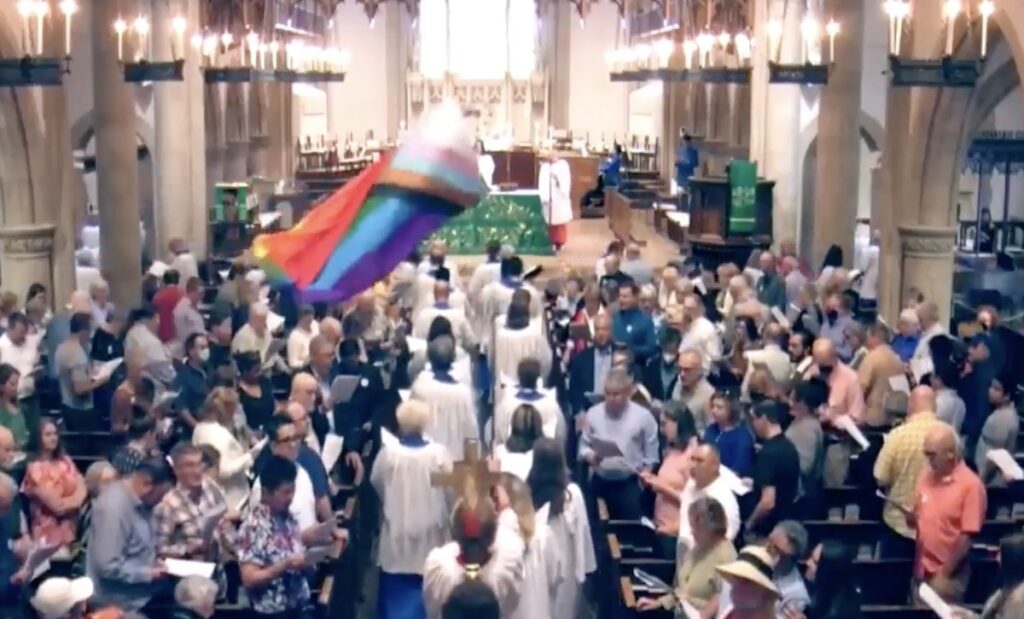

Episcopal Church officials are emphasizing lesbian, gay, bisexual, transgender and queer (LGBTQ) advocacy even as the Federal government and some corporations dial back their public embrace of Pride Month following the “Bud Light” backlash of 2023 and increasingly visible public skepticism of transgenderism.
The denomination’s Manhattan headquarters hosted a special June 1 communion service to bless and commission Episcopalians participating in Pride Month celebrations. Led by Presiding Bishop Sean Rowe, the service featured a sermon delivered by transgender Episcopal Priest and activist the Rev. Cameron Partridge.
The service took place at the Chapel of Christ the Lord at the Episcopal Church Center in New York. Presiding Bishop Sean Rowe celebrated the Eucharist while Partridge preached remotely from San Francisco’s St. Aidan’s Episcopal Church in the livestreamed event.
Partridge, as was touched on briefly in the sermon, transitioned from a female to male identity in 2001 and went on to be ordained in the Episcopal Diocese in Massachusetts. In 2011, Partridge served at Boston University as its first transgender chaplain. In 2014, Partridge became the first transgender priest to preach at the Episcopal Church’s Washington National Cathedral.
Among the most influential conversations Partridge had, then identifying as gay but not as transgender, when questioning whether or not to pursue ordination was with a Philadelphia gay clergyman named John, who, when asked by Partridge about being gay in relationship with his ministry, said “My life is defined by love, and being gay is how I love.”
This largely focuses on the concept upheld by the Episcopal Church, which stands out in Partridge’s sermon, that the church should recognize the unique embodiments of every individual as a signpost of the divine image and that people ought to be glorified as such. This interprets and utilizes the idea from Genesis 1:27 indicating that people are made in the imago dei (image of God).
The sermon message drew from passages in the Gospel of John and the First Epistle of John emphasizing a connection and identity of those who follow Jesus Christ as being first and foremost children of God.
“Both God and the community were not and would not be seen for who and what they were,” Partridge preached.
Partridge cited 1 John 3:1 in support of this idea that reads, “The world does not recognize us for the world has not recognized God.”
According to Partridge, Jesus Christ offers for the people of God a community defined by a shared love that illuminates the glory of unique individuals made in the image of God. The San Francisco Rector described that God’s glory shines through those who are truly recognized by him. The community of God is held together and becomes one through a shared radical love that rejects no person. The recognition of the light and glory of God in unique persons of the LGBTQ community is realized, not in spite of what they are but because of what they are, Partridge insists.
Partridge described the love of God in action as the church and its members seeking out the light and uniqueness of every individual and to celebrate, recognize, and to allow that light to radiate even brighter through what Partridge describes as the “transformative love” of God. This is the exhortation that the preacher concluded with in sending out the Episcopal Church into the activities and events in the month of June.
“As this month unfolds, as we celebrate Pride around and beyond our church, let us seek out and celebrate that light in one another. Let us actively seek to perceive one another, refusing the distortions and dehumanizing political rhetoric all too often uttered in the name of Christian theology. Let us behold and uphold one another in recognition of the divine beauty in which we stand, queer, trans and allied beloved,” the Episcopal priest concluded.
Episcopalians have a long history of LGBTQ affirmation. In 1976, deputies to Episcopal General Convention adopted resolutions stating that “homosexual persons are children of God who have a full and equal claim with all other persons upon the love, acceptance, and pastoral concern and care of the Church” (1976-A069), and that they “are entitled to equal protection of the laws with all other citizens” (1976-A071).
What began as toleration shifted to required affirmation.
In 2012 General Convention authorized canonical changes prohibiting discrimination in the ordination process on the basis of gender identity and or expression. In 2015, immediately following the Supreme Court decision in Obergefell v. Hodges, canon law was further changed for gender-neutral marriage rites between any two persons. The denomination’s Book of Common Prayer remains unchanged, but most parts of the Episcopal Church today hold that homosexual practice, transgenderism, and other configurations of gender identity and expression are not sinful and requiring of repentance. Instead, they are viewed as immutable characteristics central to a person’s identity and therefore merit special protection and privilege, as displayed in the recent Pride Eucharist.
It can be tempting for Christians outside of the Episcopal Church who uphold a biblical sexual ethic and oppose same-sex and transgender practices on scriptural, theological, or moral grounds to quickly disregard these views as mistaken without first engaging their line of reasoning. The June 1 service and Pride Month in general raises important questions and ideas for Christians who oppose this view to wrestle with, including asking what it means to show radical love to our LGBTQ neighbors without condoning or unconditionally affirming practices that the Episcopal and other progressive mainline Protestant churches accept and promote.
More from IRD:
National Cathedral ‘Comes Out’ With Transgender Preacher
Episcopal Chaplains Sought for ‘Identity-affirming Spiritual Care’
Drag ‘Sister’ Indulges Episcopal Washington National Cathedral




Comment by Scott on June 10, 2025 at 10:53 am
Yet another reason why the Catholic Church is beckoning me . . .
Comment by Daniel on June 10, 2025 at 11:05 am
Scott, you might want to take a look at the Lutheran Church Missouri Synod before you cross the Tiber. lcms.org web site should give you an idea of who they are.
Comment by Corvus Corax on June 10, 2025 at 12:22 pm
TEC sure spends a lot of time and energy affirming deviant sex acts.
Christian moral guidance around sex has always been pretty strict. It’s impossible to read this new permissive standard into the scriptures or into the historic teachings of the church–it just isn’t there. Instead it has to be invented, by people who are themselves deviants and therefore motivated to find points of emphasis that obscure their own transgressions.
Some conservative churches make the mistake of only talking about Truth to the exclusion of love. These people only talk about Love and have no room for truth.
Comment by Tim Ware on June 10, 2025 at 10:11 pm
I think the difference boils down to two different ideas about what homosexuality is. Those who promote it say it is what you “are,” while those who oppose it says it is what you “do.” So really, the difference is a disagreement over whether it is an identity (what you are), or whether it is an action (what you do). There used to be general consensus that it was an action, but in the past 40 years or so, it has been promoted as an identity.
Comment by Tim Mc on June 11, 2025 at 7:29 am
Romans 1:21 For although, they knew God, they did not honor him, as God, or give thanks to him, but they became futile, in their thinking, and their senseless minds, were darkened. 22 Claiming to be wise, they became fools.
Romans 1:26 For this reason, God gave them up, to dishonorable passions. Their women, exchanged natural relations for unnatural, 27 and the men likewise, gave up natural relations, with women, and were consumed, with passion for one another, men committing shameless acts, with men, and receiving, in their own persons, the due penalty, for their error. 28 And since they did not see fit, to acknowledge God, God gave them up, to a base mind, and to improper conduct.
29 They were filled, with all manner of wickedness, evil, covetousness, malice. Full of envy, murder, strife, deceit, malignity, they are gossips, 30 slanderers, haters of God, insolent, haughty, boastful, inventors of evil, disobedient to parents, 31 foolish, faithless, heartless, ruthless.
32 Though they know God’s decree, that those who do such things, deserve to die, they not only do them, but approve those, who practice them.
Comment by Dave Jackson on June 11, 2025 at 12:55 pm
Yet another straw on the camel’s back. Farewell Episcopal Church.
Comment by Td on June 11, 2025 at 1:18 pm
Can anyone realistically claim that the episcopal church is Christian at this point? They are dedicating a whole month to celebrating and encouraging serious sin.
Comment by Td on June 11, 2025 at 8:04 pm
“Being gay is how i love”.
Well, your method of love is sexual abuse.
Comment by Skipper on June 12, 2025 at 6:57 pm
The Episcopals did like the USA Presbyterians and United Methodists in making their own rules and teaching them as God’s rules. They don’t understand how offensive this is to God. Like the old country song goes, “What part about ‘No’ don’t you understand?'”
Comment by Thomas on June 12, 2025 at 8:33 pm
TEC has exchanged an omniscient, unchanging God to a deity that is subject to human whims. They have put their god in a box of their own construction, within the limitations of human imagination. Their “Jesus” is like a trinket they trot out and show off for credibility.
Comment by Thomas More on June 13, 2025 at 11:24 pm
I think you are right, Thomas. Some Episcopalians don`t even believe in God anymore. The former Dean of Washington National Cathedral, Gary Hall, said he was a “non-theistic Christian”. Anyone remotelly Christian should leave TEC while they can.
Comment by John Harutunian on June 17, 2025 at 4:33 pm
“Being gay is how I love.”
But can’t you love someone without having sex with them?
A good question for gays and straights alike.
Comment by Stephanie Jenkins on June 17, 2025 at 4:46 pm
Good grief
Comment by Mary Lou Longworth on June 17, 2025 at 4:51 pm
Anyone who reads the Bible knows that sexual immorality is taboo for those who follow Christ. And just in case some one is confused or befuddled by this teaching, the bible makes it crystal clear exactly what sexual immorality is.
Comment by Henry Stokes on June 17, 2025 at 6:17 pm
And yet we are God’s creation— each of us; all of us; everyone of us, In a time when genetic research has revealed the complexity of genetics that show XX and XY chromosomes are not plainly determinative, we are hardly in position to argue we know more than other persons about their own sexual identities.
You may think you are arguing against sinful behavior; but, you may well be arguing with God..
Comment by Robert "Robbie" Walker on June 17, 2025 at 8:38 pm
I appreciate the effort to stay balanced despite the author’s position. As a Nicene orthodox Anglican who supports equal marriage and the discernment of transgender people, I would be much more concerned about the number of clergy who cannot affirm the Creed than I would an ethical disagreement (albeit serious, since both sides rarely ask for the charism of interpreting tongues any longer).
There is a “middle way” between “what you are” and “what you do”: vocation. Because I do not believe Scripture condemns all forms of queerness across time and space, and because I don’t think being born a certain way means that it’s good, I have discerned that my faithful queer life (including marriage to my current partner, God willing) is an aspect of my calling as a Christian. It may be that I am wrong, but if so, when I stand face to face with Jesus, I hope he will accept me for the same reason he does anyone else: “My hope is built on nothing less than Jesus’ blood and Jesus’ righteousness.”
Comment by David Gingrich on June 18, 2025 at 7:58 am
“Doubling down” on rejecting the Word of God.