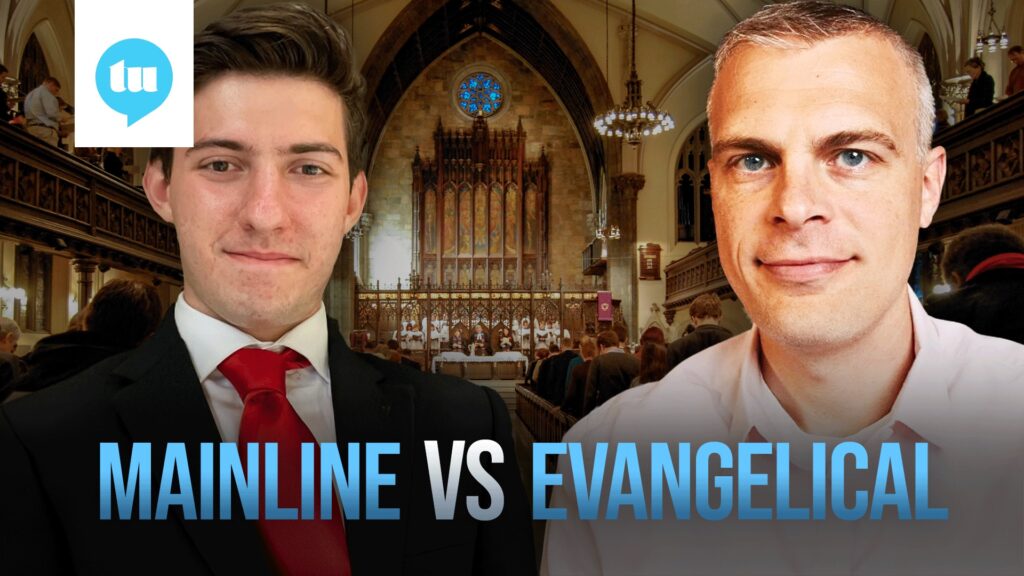

Conservative Christians collectively cower from reconquering their leftward-bound denominations. That’s according to Redeemed Zoomer, the online nom de guerre of Presbyterian YouTuber Richard Ackerman who recently faced off with Gavin Ortlund, a Baptist pastor and founder of Truth Unites, in a May 28 “respectful clash” on Ortlund’s YouTube channel.
Redeemed Zoomer, an influential figure in Operation Reconquista, warned that modern Protestants and evangelicals are too willing to break away from mainline churches. Specifically, he argued that Christians are only justified in leaving a church if they are either formally excommunicated or violently persecuted by that church.
In one of the most controversial moments of the video, Redeemed Zoomer stated that he would still attend a mainline congregation that denied the bodily resurrection of Christ if there were no other mainline congregations nearby. He maintained that conservative Christians must stay loyal to mainline denominations, even if it means fighting rampant heresies and liberalism from within.
Redeemed Zoomer allowed that attending a non-mainline church may be a necessary evil to preserve some congregants’ faith, but he considered it undesirable nonetheless.
“It’s a concession I make to people who are weak in their faith, basically. I wouldn’t go [away from the mainline]. I would go [to the mainline] no matter how liberal it gets,” the advocate of Reconquista insisted.
Redeemed Zoomer’s arguments stem from his broader critique of evangelicalism, which he defined as “non-institutional Christianity.” Instead, he advocated for theological conservatives to reclaim mainline denominations, which have not split illegitimately from their institutions. He listed the seven mainline churches as the United Methodist Church, Presbyterian Church (USA), Episcopal Church, Evangelical Lutheran Church in America, Reformed Church in America, United Church of Christ, and American Baptist Churches (USA).
In contrast, Ortlund disputed Redeemed Zoomer’s narrow allowance for church splits. Ortlund argued that Christians may leave mainline churches if that church abandons the Gospel, even if formal excommunication or violent persecution are not present. When a congregation departs from the Gospel, Ortlund contended that it ceases to be a true church. Ortlund posed the question from 2 Corinthians 6:14, “What fellowship has light with darkness?”
Ortlund pushed back against Redeemed Zoomer’s language of “cowardice” when describing conservatives who voluntarily leave heretical congregations. Ortlund worried that such language was unwise, unhelpful, and untethered to on-the-ground pastoral experience.
“Sometimes the best way to deploy our lives for God’s Kingdom is departing an unfaithful institution,” Ortlund advised.
In response, Redeemed Zoomer pointed out that Old Testament believers did not separate from Israel or the Temple until after the stoning of Stephen, despite the paganism that sometimes dominated that institution. Additionally, he argued that the Apostle Paul never disfellowshipped churches addressed in the epistles, regardless of the heresies embraced. On this point, Ortlund cited Revelation 2-3, which uses the imagery of removing a church’s lampstand to show that a church’s status as a true church may be revoked.
Ortlund also took issue with Redeemed Zoomer’s disapproval of evangelicalism, disputing his definition, noting that evangelicals outside the U.S. have created thriving institutions and are responsible for the fastest-growing Christian communities outside the West. The Baptist pastor agreed that American evangelicalism often neglects its history and global connections, but he maintained that evangelicalism involves specific theological distinctives rather than mere anti-institutionalism.
Central to Ortlund and Redeemed Zoomer’s discussion was the question of how conservative Christians should engage a post-Christian world. For Redeemed Zoomer, conservatives should concentrate their efforts on retaking historically conservative institutions instead of constructing entirely new institutions. Ortlund agreed that reclaiming liberal-drifting institutions should be a priority, but he also argued that conservatives’ strategy should include building new institutions.
As Ortlund was quick to emphasize, he and Redeemed Zoomer agree more than they disagree. Both see the dangers of abandoning historically conservative institutions. Both agree on the goals pursued by conservatives, even if they disagree about the methods.
Their disagreements expose the inner turmoil many theological conservatives face when deciding whether to leave or to weather the storm in increasingly heretical and liberal institutions. Both Ortlund and Redeemed Zoomer’s arguments raise questions worth contemplating in a post-Christian culture.
More from IRD:
Reconquering Mainline Protestantism? (interview)
Reconquering Mainline Protestantism? (article)



Comment by Mark Siegman on June 2, 2025 at 10:05 am
I admire and respect Redeemed Zoomer for what he’s trying to accomplish and am impressed and heartened that he has as many followers as claimed.
However, his loyalty appears to be to the institution of a denomination, NOT the gospel of Jesus Christ. This is a criticism often made against Roman Catholics, who are loyal to the Vatican and the Institutional Church, not the gospel.
This is where Reformed Zoomer loses me.
That said, he’s fighting a tough battle. By their own admission, the PCUSA forecasts total active membership to drop below 1 million this year (the 2 denominations that combined to form the PCUSA had over 4.3 million members in 1965; and the PCUSA itself had 3.1 million members when formed in 1983). Peruse the news stories covered on their website; look at the amendments that a majority of presbyteries have ratified to change the Book of Order, and dig into the numbers of baptisms, professions of faith, and other demographic data. They’ve become rapidly declining “boutique” denomination (I’d say dying, not declining), consisting mainly of aging political progressives and octogenarians.
I note this sadly as one who served as an Elder in 2 PCUSA churches before departing for the PCA.
Saving the PCUSA and the other mainline denominations is a losing proposition, sadly.
Comment by PFSchaffner on June 2, 2025 at 1:32 pm
It strikes me that this discussion is fundamentally tactical, not theological: it raises questions about leaving or staying with a church without ever asking what a church is, or what it means to be a member of one. I was raised in one of those Reformed churches that took membership and members’ loyalty seriously, but after having had three churches collapse around me*, I have thought again and come to the conclusion that churches — both congregations and denominations — are merely ephemeral assemblies, temporary working groups, if you like: institutions merely, conferring no sacred obligations and likely to come and go within the active life of an individual congregant, much as we now regard corporate employers. So, radical as it sounds: let them go. No more memberships. No more lifelong commitments. For that matter, no more guilt about church-hopping or abandoning institutions that have their own life cycles. Embrace the individualism of the church-market model.
(* the three collapses include: one (Presbyterian), which went charismatic, and died; one (Baptist), which went ‘seeker’, disclaimed its Baptist identity, and died; the third (Methodist), which split in the recent UMC schism, lost two thirds of its members, and will continue to struggle briefly as a financially unsustainable relic.)
Comment by John Sampson on June 2, 2025 at 4:25 pm
As one reads the Bible and discusses it one’s understanding what a church is may improve. In that case one may find that what one thought was a church is not a church. One is then obliged under God to find a real church and join it.
Comment by Kerry Bowers on June 2, 2025 at 4:50 pm
My question to those who remain in a denomination that has accepted heresy, apostacy, and or blasphemy, as is increasingly inherent in the mainline denominations, … ‘What is your idol?’ Is your idol the physical facilities, the pastor, friends in the congregation, or just memories of what once satisfied your soul while your number and resources today satisfy the radicals that have consumed your denomination or, should I say, cult? I attend one of the largest independent churches in the area in which I live, one among others that have disaffiliated from the UMC, and the benefits to self and community have been overwhelming while still serving worldwide through other organizations. If you feel as I felt, that a dark cloud is hanging over your head, one that makes you question, even for a second, … ‘Am I in the right place, especially given there are so many other options to worship, serve elsewhere, and give of my resources to that which, prayerfully, is not contradictory to scripture?’… then, perhaps, it is time to go and give peace to your soul in another church. Perhaps, too, your leaving will motivate others to do the same. God Bless!
Comment by Donald R Bryant on June 2, 2025 at 5:09 pm
This debate is over. Mainline is no option. It’s over!!!
Comment by Eric Rathburn on June 2, 2025 at 5:16 pm
The violinist and band leader of the Titanic played continuously as the ship sank. Every year, on the day of his death, his hometown in Wales celebrates him. I’m not a violinist.
Those that tout an orthodox belief system but are still in these apostate denominations are bound to an idol.
Comment by Stephanie Jenkins on June 2, 2025 at 5:24 pm
As I have said, I left the Episcopal church after 72 years. I struggled with this decision for many years. The Episcopal Church gets involved in every woke movement that comes along. Church collection money goes to a reparations program. The Church refused to cooperate with Trump’s resettling of Africans, so that contract has been cancelled. There is a definite bias in the leadership. Many of the leaders don’t believe in the resurrection, which all my life we recited this belief in the Nicene Creed. This creed being a definition of what Episcopal beliefs are. So if this can be changed for the culture, who is say more these changes are correct or not. TDS was rampant in the congregation. I felt before my life ended I needed a different culture, one that truly is fair and does not change as the culture changes. I am not in a church now. Most Protestant churches are headed the same way. But, regardless I know I made the right decision for myself. My spirituality matters, too. I try to help those around me, driving folks for doctors’ appts, I have a couple of people who lean on me some, and I read devotionals everyday. I have read the Bible once from front to back, but guess I need another go at that. I am at peace.
Comment by David Scott Carter on June 2, 2025 at 5:25 pm
The mainline churches can’t be reformed, nor do they want to. They will take evangelical dollars and spend them on salaries and political lobbying to get USAID dollars to spend even more on salaries and benefits for executives. The UM is among the worst offenders as countless studies have proven. Stay and fight is among the worst ideas as it is wasteful of time and money, both better spent on mission and ministry.
Comment by Steve on June 2, 2025 at 8:44 pm
It amazes me that some Christians will fight and protest when progressivism takes over our country but flee and cower when it takes over our churches.
Comment by Tim Ware on June 3, 2025 at 12:37 am
Really, now! I mean, are we actually supposed to take seriously what some youtube internet personna says? Since when did the freaks gain credibility in serious Christian circles?
And we wonder why people are leaving Christianity in droves….
Comment by Brad Barringer on June 3, 2025 at 7:08 am
If I stay in a mainline church that has gone astray should I continue to tithe to that church even though they are using my tithe to promote things I consider evil? I faced that question in my home church and decided I would attend that church but send my tithe somewhere else if we did not disaffiliate. Fortunately we voted 98% to leave the UMC Zoomer is 100% wrong in my opinion. I now realize I would have been a hypocrite to have stayed in a church that no longer preached the gospel regardless of what I did with my tithe.
Comment by Robert Kellner on June 3, 2025 at 7:11 am
One guy saying risible stuff on the internet sitting in-front of a screen in his parents basement.
Get a life.
Comment by Donald R Bryant on June 3, 2025 at 7:36 am
Even after the collapse of the UM, people are still wondering about this? Time to move on.
Comment by David Gingrich on June 3, 2025 at 7:36 am
So these guys keep giving money to promote evil causes???
Comment by Steve on June 3, 2025 at 7:51 am
Brad,
Designated giving is regulated by the IRS. If you tithe and designated it to stay in your local church then none can go to the denomination by law. This also works with apportionments. If a church designates all their appointment funds to say the Methodist children’s home, then they have paid their apportionments in full and none of the funds would go to the bishops or other groups that support evil. If more traditional UMC churches practiced designated giving then the progressive’s money would dry up and they would flee. It’s all about power and money is power.
Comment by Mike on June 3, 2025 at 8:32 am
It sounds like “Zoomer” is admitting that he is not a true Christian. After all, Liberal “Christianity” is not actually Christian: rather it is a false religion. No true, born again believer can can be part of such a parody and feel comfortable, much less whole-heartedly support it.
Comment by John on June 3, 2025 at 6:18 pm
There’s a lot of judging and assumptions happening on both sides here. One side calls the other cowards for leaving, while the other side calls them heretics for staying. To both sides I say, “Bless your hearts.”
Comment by David on June 3, 2025 at 9:29 pm
Redeemed Zoomer’s argument doesn’t work in the case of Lutheranism. There has never been a unified Lutheran Church in North America. The ELCA has only been in existence since 1988 and there are many Lutheran synods that has never been part of the ELCA. In many parts of the U.S. one would switch Lutheran church bodies when one moved, because the the only Lutheran congregation in the new town was part of another synod/denomination. RZ’s argument works better as a reason to go home to the Catholic Church. The Catholic Church has never excommunicated me or threatened me with violence.
Comment by Brad Barringer on June 4, 2025 at 9:09 pm
Steve. Good info. I hope folks that are trapped I the UMC see your comment and take appropriate action. Thanks
Comment by McGarto on September 27, 2025 at 5:44 pm
This argument is so tiresome. It is impossible to have a fruitful discussion and debate about these institutions because both sides are essentially drawing from different cultural orientations at this point. I recently left my church and resigned from session after the congregation voted to request dismissal from the PC USA. I agreed that the denominations loosening of discipline amongst its ministers on theological issues was straining the broader, churches, identity, and ability to minister together. However, the motivation for the congregations move was so far from righteous…. Very much aligned with American culture war issues, worries about wokeness, and just some really heinous hateful speech coming from fellow church leaders. After hearing from our congregation, and from the majority of the session, I decided that I would never put my kids or grandkids under their spiritual care, so why am I here?
It never occurs to conservatives that a church or denomination can hold to very orthodox and traditional Christian doctrines and stances on social ethics and be an unfaithful, unfruitful, or even apostate as an institution. I suspect that the language used in these debates are tied to the fact that local ministries are drawing from evangelical publishing sources and engaged in evangelical mission organizations, which by their very nature have been set up to disrupt institutions involved in ecumenical dialogue for many many years.
I’m not a big fan of the reformed zoomer, because I don’t think rec conquering should be the goal. The goal should be to build up individuals for faithful ministry and life. Institutional faithfulness will follow when that happens. I tend to agree with the comment above, who stated that institutional loyalty may be the thing that needs to go.