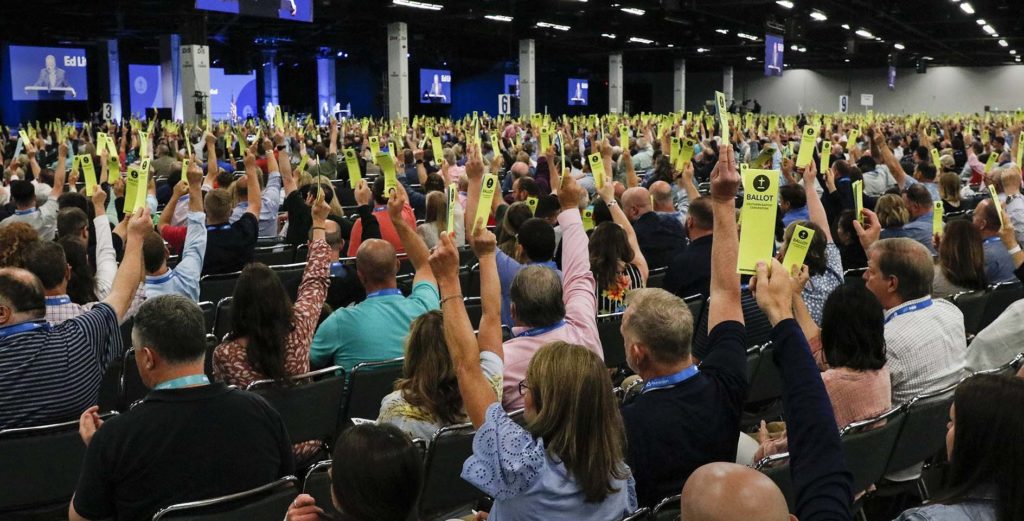

Messengers from Southern Baptist churches will soon gather for the Southern Baptist Convention’s (SBC) annual meeting June 10-11 in Dallas, Texas. As the largest U.S. Protestant denomination and the second largest religious organization, numerically trailing only the Roman Catholic Church, the 2025 SBC meeting will be closely followed by many. The much-anticipated convention will focus on key issues of increased prominence across recent years.
Notable among these are women serving in ordained ministry. In 2024, SBC messengers narrowly rejected an amendment to the convention’s constitution requiring local churches to only appoint or employ men in the role of pastor or elder. The proposed amendment fell just short of the two-thirds vote majority required to be ratified at the 2024 meeting in Indianapolis. This was the second straight year in which the amendment failed to receive a two-thirds majority.
Proposed by Pastor Mike Law of Arlington Baptist Church of Arlington, Virginia, the “Law Amendment” sought to solidify and institutionalize the SBC’s stance on women in ordained ministry. First introduced in 2022, the amendment stated that a church could only be considered in cooperation with the SBC if it “affirms, appoints, or employs only men as any kind of pastor or elder as qualified by Scripture.”
The SBC Baptist Faith & Message, a statement of common belief adopted by the convention in 2000, states that only men may be pastors or elders.
“While both men and women are gifted for service in the church, the office of pastor/elder/overseer is limited to men as qualified by Scripture,” the statement reads.
Although the Baptist Faith & Message contains a clear stance against women pastors, the SBC constitution lacks such a statement. By requiring only male pastors and elders, the Law Amendment, if adopted, would immediately disfellowship from the SBC any churches that currently have women serving in pastoral roles. Law and supporters of the amendment believe there are a large number of churches within the SBC that presently employ women serving in the role of pastor.
The actual number of SBC churches with female pastors is not fully known. Former SBC president JD Greear stated that the number is shrinking. Others, such as Law and Saddleback Church Founding Pastor Rick Warren, have concluded that the number of female pastors within the SBC is growing. In 2023, The American Reformer conducted a study concluding that more than 1,800 female pastors serve local churches that are in cooperation with the SBC. Although the actual number is unknown, there is a high likelihood that over 1,000 women currently serve as pastors in SBC affiliated churches. Subsequently, the number of churches ousted from the SBC if the Law Amendment were ratified could be significant.
Although ratifying the Law Amendment would institutionalize and enable enforcement of the SBC’s existing position on female pastors, opposition to the amendment is concerned that the Law Amendment goes beyond banning women from serving as senior pastors. This opposition narrowly staved off ratification of the amendment in 2024 by securing 38 percent of the vote, a mere 5 percent above the required threshold.
In the lead up to the 2025 SBC meeting, supporters of the Law Amendment have reportedly been pleading for representatives to suspend the SBC’s Standing Rule 6, which would bypass the standard committee review and allow the amendment to immediately face a floor vote.
Ratification of an amendment to the SBC constitution requires a two-thirds majority for two consecutive annual conventions, making repeat passage in 2026 necessary if the Law Amendment were to pass this year in order to be put into effect.
The SBC’s possible ban on female pastors comes at a time after an increasing number of Christian denominations permitted their ordination in the 20th century. Such denominations include both mainline Protestant bodies such as the United Methodist Church (UMC), Evangelical Lutheran Church in America (ELCA), Presbyterian Church (USA), and Episcopal Church. Additionally, several denominations within the Wesleyan-Holiness tradition have ordained women as pastors since their inception, including the Wesleyan Church, Free Methodist Church, and Church of the Nazarene, alongside many Pentecostal and Charismatic denominations such as the Assemblies of God (AG).
Traditionalist offshoots of mainline Protestant denominations also affirm the ordination of women to the pastorate, including the Global Methodist Church, Covenant Order of Evangelical Presbyterians (ECO), and North American Lutheran Church (NALC), as do a minority of dioceses in the Anglican Church in North America (ACNA).
By creating an avenue for the enforcement of the SBC’s disallowance of female pastors, the SBC would solidify themselves as one of the last major Protestant denominations in the United States to officially institutionalize the barring of women from pastoral roles, alongside the Presbyterian Church in America (PCA) and Lutheran Church – Missouri Synod, as well as the Roman Catholic and Eastern Orthodox Churches.
As the SBC Baptist Faith & Mission is explicitly against women serving in these roles, it is surprising that the amendment authorizing the enforcement of that viewpoint has continued to face so many legislative roadblocks. It will be interesting to see whether the Law Amendment is at last passed at June’s convention or if it will again be blocked.
UPDATE [6/12/2025]: An SBC proposal to amend the Convention’s constitution on male-only pastors did not reach the necessary two-thirds vote to pass, with 61 percent of messengers casting a vote in favor. Christianity Today‘s Kate Shellnutt has a report here.
More from IRD:
America Needs Southern Baptists




Comment by David on May 30, 2025 at 8:28 am
The verse trotted out is usually 1 Timothy 2:12, “I do not permit a woman to teach…” Notice that he says “I” and not “God” or “Christ.” In 2 Chronicles 34 when King Josiah wishes to know the will of the Lord, he sends a priest and other to inquire of Huldah. She declares, “This is what the Lord, the God of Israel, says…” Likewise, Miriam, sister of Aaron and Moses is described as a “prophetess.” So the matter hinges of which verses one cares to believe.
Comment by John on May 30, 2025 at 9:28 am
This issue will never go away. As long as there are women in churches at all, some will inevitably feel the call to ordained ministry. The SBC and others can keep clamping down all they want, but it’s a battle they need to be prepared to keep fighting indefinitely.
Comment by Gary Donald Foster on May 30, 2025 at 11:56 am
I was first a member of an SBC Church in 74. I attended SBC Colleges and Seminary. I learned that Baptists had certain distinctives that were part of the definition of being “Baptist”. One is the independence of each Church, recognizing that no other body could govern the local Church but that is strictly reserved for that local church.
The Baptist Faith and Message had no authority nor had any forced compliance. Then the Texas Fundies came along and led Baptist fundies into an embrace of denominational power and enforcement. These miserable men have since been disgraced but the damage remains. The SBC was a big tent with good seminaries that were theologically moderate. The one I attended was great that way. Baptist faith and practice do not go well with a mega denomination. Young people today are not buying into the renewed sexism the fundies peddle. I see a split coming….again.
Comment by exumc on May 30, 2025 at 3:08 pm
Well (with notable exceptions, of course), I am not sure we can say that ordaining women ministers in mainline churches has been a roaring success (not to mention the feminist bishops). Too many have been more about shattering ceilings and breaking barriers and social justicing than about preaching the gospel, converting souls, and discipling for spiritual growth. I expect this sad trend is especially true in the left branch of the newly-splintered United Methodist Church.
Comment by Different Steve on May 31, 2025 at 10:12 am
Yep in the Episcopal Church the ordaining of women appears to have been the beginning of the end. Not sure if that necessarily had to be the case. I certainly knew at least one lady clergy that was solid theologically and if all women clergy were like her there’d be no problem. Weird rebellious intersectionalist dynamic resulted in the deconstruction of the denomination. Another way of saying intersectionalist: special interest group alliances of convenience. Deconstruction: tearing things down for not being perfect, not to achieve perfection, but to assume control of a chaotic new order.
Comment by John on May 31, 2025 at 3:19 pm
Has ordaining men been a roaring success? Statistically they’re more likely to use their position to commit sexual abuse, engage in financial impropriety, and develop unhealthy life habits (morbid obesity among clergymen is super high). I often wonder what would have happened if the early church had been led by the one person who didn’t abandon Jesus, Mary Magdalene, instead of that putz Peter.
Comment by Tim Ware on May 31, 2025 at 9:05 pm
In response to Different Steve…I agree with you. I knew some female priests who were sound, but on balance there were more who were not.
In response to John…I agree with you, also. The main problem was not necessarily gender, it was infection with certain ideas. Denominational hierarchy seemed to attract, seek out, favor, and promote those who were infected of both genders.
Comment by Loren J Golden on June 1, 2025 at 12:58 am
In 2014, a job change led to a geographic relocation from suburban Kansas City to Denton, Texas, and I had to leave my beloved church home of nearly eighteen years, Colonial Presbyterian, formerly affiliated with the PC(USA) and then (and still now) affiliated with the Evangelical Presbyterian Church. There were no EPC churches within easy driving distance of my new home (the only one in the DFW metroplex at the time was an hour’s drive away), and the only church then affiliated with ECO: A Covenant Order of Evangelical Presbyterians (Highland Park) was likewise about the same distance. My only choices locally, if I wanted to stay Presbyterian, were three PC(USA) congregations, one affiliated with the Cumberland Presbyterian Church (which has a Presbyterian polity but essentially a Methodist theology), and Denton Presbyterian Church, which is affiliated with the Presbyterian Church in America. Unlike Colonial, which ordains women to the offices of teaching and ruling elder (i.e., pastor and lay elder) and deacon, the PCA denies women ordination to all three offices. Although I was moderately egalitarian (i.e., pro-women’s ordination) at the time, women’s ordination was less important to me than a church that consistently preached the Gospel from the pulpit and held to historical Presbyterian (Reformed) theology. Thus, I switched my membership from an egalitarian church to a complementarian (i.e., unique roles for men and women, and ordination only open to qualified men) church.
Six years later, a reduction in force (occasioned by the COVID-19 virus) ended my job in north Texas, and as the aerospace industry was hiring precious few aircraft interiors airworthiness certification engineers at the time (that situation has been dramatically reversed within the past several years), I found myself with quite a bit of time on my hands. As I was a member of a complementarian congregation and had arrived at my egalitarian position without a great deal of in-depth study, I decided to put my time to good use and rectify my lack of education (alongside searching for a new job and taking classes to learn how to design parts and assemblies in SolidWorks).
The Bible’s position is quite clear:
This passage immediately precedes the qualifications Paul lays out for the office of bishop/overseer (I Tim. 3.1-7; Gk. ἐπίσκοπος, or elder, Gk. πρεσβύτερος; the Bible uses the two terms interchangeably; compare Acts 20.17,28, Tit. 1.5,7), of which one of the requirements is to be “the husband of one wife” (v. 2; Gk. μιᾶς γυναικὸς ἄνδρα), literally a “one-woman man.” The noun used here is ἀνήρ, the Greek word for male or husband, not ἄνθρωπος, the Greek word for human being, commonly translated, “man.” Moreover, following the qualifications for elder and deacon, Paul tells Timothy, “I am writing these things to you so that, if I delay, you may know how one ought to behave in the household of God, which is the church of the living God, a pillar and buttress of truth.” (I Tim. 3.14-15) Further, Paul in verses 13 & 14 grounds his proscription of women from teaching and exercising authority over men in the creation order and the Fall, not in response to specific issue facing the Church at Ephesus, where Timothy was ministering at the time. Within the context of what Paul is writing in I Timothy, then, it is clear that Paul is specifically prohibiting women from serving in the office of elder, whose primary responsibility is to “teach and exercise authority” over men, women, and children in the Church, not as a local proscription only, as some would have us believe, but as a general rule to be observed throughout the Church of Jesus Christ worldwide.
The largest part of my study on the ordination of women focused on the interpretation of egalitarian scholars highly regarded in evangelicalism (especially in evangelical Presbyterianism) who held to the egalitarian position—John Jefferson Davis of Gordon-Conwell Theological Seminary, the late missionary and New Testament scholar Kenneth E. Bailey, the late Roger Nicole of Gordon-Conwell and (later) Reformed Theological Seminary, and Walter C. Kaiser (retired) of Gordon-Conwell, as published by Christians for Biblical Equity. (I did not consult Theologically Liberal scholars, who believe that the Bible is unreliable, and thus not the infallible Word of God, whose position on the ordination of women is irrelevant, since the arguments against their position would, of necessity, focus on the trustworthiness of the Scriptures, which is outside the scope of my study.)
In the course of my study, I found that the arguments put forward by these respected scholars in favor of women’s ordination were weak. Their interpretations of Paul’s prohibition in I Timothy 2.12 hinged upon an assumption that the Apostle must have been addressing a local issue and completely ignored what Paul wrote at the end of Chapter 3. The most common assumption they held is that, since Ephesus was dominated by the cult of Artemis (Acts 19.23-41), women elders in the Church of Ephesus must have been abusing their authority, and Paul, instead of chastening them and simply telling them that they must not be overbearing in their exercise of authority, forbade women from teaching or exercising authority over men at all. And assuming this was the reason for Paul’s prohibition, they further assume that if this condition for the prohibition is absent, then the prohibition is not required to be enforced.
One would think, however, that if women elders were abusing their authority, Paul might have at least mentioned it somewhere in I Timothy. Paul does address the issue of false teachers at Ephesus in both of his epistles to the Evangelist Timothy (I Tim. 1.3-11, 4.1-5, 6.3-10,20-21, II Tim. 3.1-9, 4.1-4), but of the specific names of troublemakers he mentions (I Tim. 1.19-20, II Tim. 2.16-18, 4.14), not one of them is feminine. Neither is there any mention in Paul’s epistles to Timothy or the Church at Ephesus of the cult of Artemis and any supposed effect that it might be having on women elders in the Ephesian Church (nor does the Lord Jesus mention it in His own epistle in Rev. 2.1-7). Moreover, especially in light of the requirement of an elder to be a “one-woman man,” there is no evidence that there were ordained women elders in the Church of Ephesus (Bailey’s bizarre use of the inverted parallelism interpretive method notwithstanding). And even if we were to agree with the assumption that Paul, in his prohibition, was addressing a local issue only, there is no evidence that Paul, speaking from his Apostolic authority delegated by our Lord (Mt. 16.19, John 16.12-15, 20.22-23, Acts 26.16-18, I Thess. 2.13, II Pet. 3.15-16), intended the prohibition to be time-limited and localized to Ephesus, especially considering what he says afterward in I Timothy 3.14-15 in the context of the whole epistle.
Another of their arguments suggests that the examples of a dozen or so women in Scripture who taught and/or exercised authority over men, such as Deborah, Huldah, and Priscilla, nullifies Paul’s prohibition in I Timothy 2.12. Again, such an interpretation assumes that Paul’s prohibition is divorced from Chapter 3, and that he is categorically prohibiting women from teaching and exercising authority over men, as opposed to simply prohibiting them from serving in the office of elder. Thus, they would make Paul out to prohibit Priscilla from calling the Evangelist Apollos aside in the Church at Ephesus, to “explain to him the way of God more accurately” (Acts 18.24-26), if I Timothy 2.12 were not nullified. Likewise, according to this interpretation, the ministries of Deborah (Judges 4-5) and Huldah (II Kg. 22.14-20, II Chron. 34.22-28) would also be invalidated, were Paul’s injunction not held to be time-limited and localized.
(As a brief note, what I’ve written here on the ordination of women is but a brief synopsis of the findings of my study. The full treatise with the findings of my study is published in my blog.)
To be sure, the Biblical doctrine of the role of women in the Church is not a salvation issue, and those who believe the Bible to be the Word of God, the “only infallible rule of faith and practice,” as both the EPC and the PCA both require their officers to affirm, and who trust in the Lord Jesus as He is revealed in the Scriptures, even if they dissent from this doctrine on the basis of an egalitarian interpretation, their faith is not invalidated, nor should they therefor be barred from the Lord’s Table. Neither am I impugning the scholarship of Professors Davis, Bailey, Nicole, and Kaiser, for I respect and admire these learned men of God, even if I do respectfully disagree with their interpretations on certain doctrines.
Nevertheless, I have found every argument that I have read advocating for the ordination of women on Scriptural grounds to be weak and ultimately unpersuasive. Moreover, the hermeneutics involved in advocating for the ordination of women on Scriptural grounds can be quite damaging to the Church. To quote Don Carson of Trinity Evangelical Divinity School in his on-stage conversation with the late Pastor Tim Keller of Redeemer Presbyterian Church in New York City and Pastor John Piper (retired) of Bethlehem Baptist Church in Minneapolis on why the Gospel Coalition, of which they were founding members, includes a statement regarding complementarianism in its Confessional Statement, “We often use hermeneutics today as a way of sidestepping what Scripture unambiguously, repeatedly, and clearly says, by trying to locate the rationale in some reconstruction of the background of I Timothy…instead of listening to what the Scripture actually says in its own terms. And that is finally…not listening to what God says to these people, ‘I will look at those (who) have a contrite spirit and who tremble at my word’ (Is. 66.2). This does not feel like trembling at the Word of God; it feels like ways of domesticating it. And that, in the long haul, has massive repercussions down the road. I think it’s that serious.”
The hermeneutics involved in advocating for the ordination of women necessarily involves making arguments that can be used to neutralize an unpopular teaching in Scripture, so as to justify disobedience thereto. Many commenters on the Juicy Ecumenism blog are quick to call out arguments made to neutralize Scripture’s teachings on human sexuality, but they are open to arguments made to neutralize Scripture’s teachings on women’s roles in the Church and the home. Taken far enough, and arguments can be made to neutralize Scripture’s teachings on the exclusivity of salvation in Christ, so as to make room for universalism and the salvation of non-believers, thereby undermining the necessity and worth of the work of Christ on Calvary—which is precisely what has happened in the mainline Protestant denominations in this land, and why they are languishing. The more a church or a denomination is open to arguments used to neutralize unpopular teachings of Scripture that have little to no direct bearing on the Gospel message, the more susceptible that church or denomination will become to arguments used to neutralize unpopular teachings of Scripture that do bear directly on the Gospel message.
Finally, I would caution those who post uncharitable remarks of those with whom they disagree on the interpretation of doctrines such as women’s ordination. Please do not disparage men and women who honestly believe what the Scriptures teach regarding the roles of men and women in the Church and the home, as if their motivation for doing so could only be to justify abuse. These are your brothers and sisters in Christ, even if they do not agree with your interpretations. You cannot look into their hearts to discern and judge their motives; only the Lord does that (I Sam. 16.7, I Kg. 8.39, I Chron. 28.9, Ps. 7.9, Jer. 11.20, 17.9-10, 20.12)—and not only theirs, but yours and mine as well.
Comment by David on June 1, 2025 at 8:08 am
It might be noted that ancient Greek culture was rather similar to that of modern orthodox Muslim countries in regard to the treatment of women. Married women lived in quarters in the back of the house where they spent their lives weaving, etc. They rarely left the house. Indeed, there was a saying at the time that a virtuous woman was one whose very name was unknown outside the home. Women were entirely covered from neck to ankle and were sometimes veiled. They did not entertain male visitors. Depictions of parties with women involved the use of “professional ladies.” By the Christian era, things had liberalized to a degree, but tradition lingered on.
Comment by John on June 1, 2025 at 12:53 pm
Loren J Golden,
Some critiques. First, I would advise you to stop using the terminology of complementarianism altogether. This is a term no one used prior to 1988 when the Council of Biblical Manhood and Womanhood introduced it purely as a proposed alternative to the egalitarianist theology of most mainline and liberal Protestant denominations. It appears no where in scripture, Christian theology, or church doctrine prior. The term became popular mostly because it sounds less controversial and sexist than patriarchy, even though that is what you’re actually defending and what people who were against women’s ordination 50 years ago would have said they were advocating for. I think simply by using the term complementarianism you’re giving more ground to the egaliterianists than you realize because you’re acknowledging that there is something inhererently wrong with patriarchy and how it is perceived. If you’re going to defend patriarchy, then defend patriarchy. Don’t use PC terms.
Secondly, I don’t believe complementarianism lives up to its name in the actual life of the congregation that upholds it. You talk of the need for distinct roles and divisions between genders in the church, yet where are rules establishing and maintaining unique offices for women? The only prohibition is against women assuming certain roles or offices, but not vice-versa. The SBC and other so-called complementarian denominations have not church laws telling a man he can’t assume roles in the church that might be considered the preview of women. In other words its a one-way division. Men can come and go as they please at all levels and offices of the church, but women are isolated to only a certain section, just like in the Hebrew Temple. That’s not complementary at all.
In the case of the SBC, this double standard is visible in other polity decisions. For instance, the same texts the SBC uses to justifying prohibiting women from being pastors also lays out the qualifications for deaconess as an office they can assume. Yet rather insist all its congregations allow for deaconesses, the SBC has allowed individual congregations to decide for themselves how to the interpret those texts and whether to allow deaconess as an office at all in their congregations. So the SBC believes it must establish a permanent and universal barrier to women’s ministry based on its reading of scripture, but not defend ministerial opportunities for women where they already exist in scripture? The SBC also has doesn’t enforce a universal prohibition against divorced men serving as pastors, even though many in the church believe a literal reading of 1 Timothy would require this. It seems their application of this scripture is very selective.
Finally, your argument rests on treating scripture like a mathematical proof rather than lived expression of faith. You point to specific texts to claim women shouldn’t assume the office of pastor, yet you don’t make any appeals to the lived truth of this scripture nor ask the simple question why shouldn’t women be pastors? What specifically about them make them unfit to be pastors or to teach men? Your premise seems to be simply because it is in scripture we should just accept and move on, but that’s not how being a Christian works. We should always be striving to understand the truth of scripture and not take that truth for granted. In other words instead of using scripture to try to cut off the conversation, we should be using it to better understand what is actually happening in our churches. If we can’t come up with a logical reason for the prohibition against women’s ordination, then we may be left to assume we’re not reading the scriptures correctly.
Comment by Tim Ware on June 2, 2025 at 12:12 am
To Loren,
Thank you for this insightful and thorough analysis.
Comment by Td on June 2, 2025 at 11:25 am
I find it funny that people think this is something that can be decided by a vote. What would Israel have voted to do in desert? Keep the golden calf?
Comment by David Gingrich on June 3, 2025 at 7:41 am
I am uncertain about the theology of this issue.
But I am certain that mainline churches allowing female pastors was the beginning of the end for those denominations.
Comment by John on June 3, 2025 at 10:57 pm
David Gingrich,
Church of the Nazareth, Free Methodists, Salvation Army, the General Lutheran Church, Assemblies of God, Reformed Church in America, and the Moravians. All these denominations ordain women, but are otherwise conservative/traditional in their theology and social positions. The Anglican Church in North America, Seven Day Adventists, and Evangelical Presbyterian Church allow congregations to decide whether to ordain women. Perhaps you’re perspective is too narrowly focused on the mainline traditions.
Comment by Tim Ware on June 4, 2025 at 12:23 am
From personal experience in more than one congregation I can say that women pastorates don’t work. They lead to a congregation becoming a feminized women’s club, and such congregations wither away.
Comment by John on June 4, 2025 at 12:02 pm
Tim Ware,
That has not been my experience. I’ve noticed that male pastors who forcefully argument against women in ministry are often guilty of megalomania in their churches. Whenever I hear a pastor talk of need for a more “masculine” Christianity I look more closely at the way he leads his church and usually find a dictator. Here’s the double-standard: We could literally be buried in stories of clergymen engaging in abuse, cruelty, corruption, and financial and sexual impropriety, and no one would ever question the right or ability of men to be pastors, except perhaps those who think there should be no pastors at all. All it takes is one scandal involving a woman in ministry and the abilities of all clergywomen are challenged. Suddenly the internet exposes with men claiming this is what happens women are entrusted with powers they shouldn’t have. They never ask that question of the men. Any clergywoman serving today ministers with a permanent target on her back. That’s the double-standard. So you’ve had some bad experiences with clergywomen. So what? I’ve had so horrible experiences with clergymen.
Comment by John on June 4, 2025 at 9:14 pm
Different Steve,
I think just proved my point. When a scandal involving a clergyman happens no one questions the legitimacy of male ordination entirely. So why is different when the scandal involves a clergywoman? Prosecute her yes. Defrock her sure. She should be made to answer for her crimes, but don’t try to turn it into an indictment of all clergywomen.
Comment by Daniel on June 5, 2025 at 4:47 pm
The Church of the Nazarene and the Reformed Church in America are currently engaged in the LGBT wars from what I hear and I would no longer consider them conservative/traditional.
I have always looked at the pastorate in relation to the priesthood of the Old Testament. God designated Aaron and his male descendants to be priests and minister in the Tabernacle, and later, the Temple. For a sacramental denomination, I look at a male priesthood as a continuation of what God instituted. For denominations that have no sacraments or take them very lightly; e.g., Baptists, Salvation Army, etc., my argument would be weak. Also, I know people will say the new covenant supersedes the Old Testament, but Jesus said he would not change even one jot or tittle of the law.
One thing that is very noticeable in these comments is that almost everyone is trying to use human reasoning and sensibilities to come up with what God has ordained. Whenever we do this we do not end up in a good place. Prominent examples are the mainline denominations who started with women’s ordination and are now at the point of praising aberrant sexual behavior and gender disorders. Finally, we must recognize that almost all of the people clamoring for women’s ordination approach it from a perspective that anything less is not equal or fair, and then fit their exegesis to their preordained conclusion.
Comment by Loren J Golden on June 7, 2025 at 9:31 pm
At the end of the time the Lord Jesus spent fasting and praying in the desert, Satan came to tempt him—to transform stones into loaves of bread to assuage His hunger, to cast Himself from the pinnacle of the temple to test the promises of God (in Ps. 91.11-12), and to fall down and worship him and from him to receive power and authority over all the kingdoms of the world (Mt. 4.1-11, Lk. 4.1-13). And each time, the Lord Jesus answered him out of Scripture (Dt. 8.3, 6.16, & 6.13, respectively). He did not make “appeals to the lived truth of this scripture,” nor did He ask Satan why He should do any of these things.
The Scriptures of the Old and New Testament are the Word of God, imparted by His Holy Spirit, “at many times and in many ways” (Heb. 1.1), to specially chosen men, who set it to writing. It is not a set of guidelines that we may disregard at our discretion; rather, it is His instruction to us as to how we are to live our lives, both individually and corporately as the Church. It is true that, “All things in Scripture are not alike plain in themselves, nor alike clear unto all,” as we Presbyterians confess (Westminster Confession of Faith §I.7), but that does not mean that we ought to question the validity of the contested passage as our first recourse. Rather, as we Presbyterians also confess, “The infallible rule of interpretation of Scripture is the Scripture itself: and therefore, when there is a question about the true and full sense of any Scripture (which is not manifold, but one), it must be searched and known by other places that speak more clearly.” (WCF §1.9)
In the matter of interpreting I Timothy 2.12, we dare not take it out of its context, either in the immediate passage of I Timothy 2.8-15, or in the broader context of Paul’s instructions to Timothy in his first epistle to him (especially the second and third chapters), or in the scope of the entirety of Scripture.
In the immediate passage (I Tim. 2.8-15), Paul is instructing the men in the Church of Ephesus (through Timothy) to “pray, lifting holy hands without anger or quarreling,” and the women to dress modestly and respectfully, adorn themselves with good works, and “learn quietly with all submissiveness,” that is, to respect the authoritative teaching and governing role of the leaders the Lord has appointed to His Church. Then he forbids women from “teaching or exercising authority over men,” and he grounds the reasons for this prohibition in the creation order and the Fall (which I will discuss in a moment). Finally, Paul says that a woman “will be saved through childbearing—if they continue in faith and love and holiness, with self-control.” To be sure, as Paul elsewhere emphasizes that we are saved by grace through faith in Christ, apart from the works of the Law (Rom. 3.28, Gal. 2.16, Eph. 2.8-9), he cannot mean that women are saved from sin and death by childbearing. Neither is he trying to say that she is saved by the birth of the Child, that is, the Lord Jesus, for no one is saved by His birth, only by faith in His atoning work on the Cross. Given his allusion to the Creation and Fall accounts in vv. 13-14, Paul is likely alluding to woman’s specially created purpose in childbearing (Gen. 1.27-28, 3.16, I Cor. 11.11-12) as a remedy for the sins of being idlers, gossips, and busybodies (I Tim. 5.13-14).
In the broader context of I Timothy, Paul warns against false teachers in the Church, followed by a brief proclamation of the Gospel message, namely, that God had forgiven him for his blasphemy, persecutions, and insolent opposition to that Gospel message during his days as a Pharisee (Acts 7.58-8.3, 9.1-2), and “that Christ Jesus came into the world to save sinners.” Then in the next section (Chapters 2-3), he gives specific instructions to Timothy regarding how the members of the Church of Ephesus should live together: offering prayers “for all peoples, kings, and all who are in high positions,” and proclaiming the saving truth of Jesus Christ; then the immediate passage, which we just discussed; and then the qualifications for elders and deacons. He closes this section by telling Timothy that he is “writing these things to you, so that…you may know how one ought to behave in the household of God,” and offers a benediction. In the following sections, Paul warns against apostasy; enjoins Timothy to faithfully preach the Gospel and set himself as an example before the Church; gives instructions regarding the care for widows, honoring elders and what to do if they are accused of wrongdoing, how slaves and masters are to treat each other, and how to handle false teachers and malcontents in the Church; and finally encourages Timothy in his ministry. There is nothing in all of this context that suggests that Paul meant something by saying, “I do not permit a woman to teach or exercise authority over a man,” other than prohibiting women from being in a position, such as an elder in the Church, in which she would authoritatively teach or exercise spiritual oversight over an adult man.
When looking at this prohibition, as noted above, Paul grounds the reasons for his prohibition against women teaching or exercising authority over men in the creation order and the Fall. Specifically, “Adam was formed first,” to work and keep the garden of Eden (Gen. 2.7,15), and “then Eve,” to be “a helper fit for him.” (Gen. 2.18,21-22) And in the creation order, Adam named his wife (Gen. 2.23), indicating his authority over her—inasmuch as in the Biblical economy, naming someone, something, or someplace always connotes an exercise of authority—an authority given to him by God.
Moreover, with respect to the Fall, Paul noted that, “the woman was deceived,” which she herself freely admitted (Gen. 3.13), “and became a transgressor,” but “Adam was not deceived.” He had been entrusted with the care and protection of his wife, and yet he failed in that task, when she was endangered by the serpent’s enticement. Indeed, he “was with her” when she was listening to the serpent’s lies and half-truths, telling her that her “eyes will be opened, and you will be like God, knowing good and evil,” when she ate the fruit of the forbidden tree (Gen. 3.5-6), and he said nothing to counter the serpent’s lies. He remembered that God had said, “Of the tree of the knowledge of good and evil you shall not eat, for in the day that you eat of it you shall surely die” (Gen. 2.17), but instead of obeying God’s express prohibition by refusing to eat the fruit and telling Eve not to eat it either, he “listened to the voice of (his) wife and (ate) of the tree of which (God) commanded him, ‘You shall not eat of it.’” (Gen. 3.6,17) Thus, God held him responsible, and because of his disobedience (not his wife’s), God made our race mortal, doomed to die (Gen. 3.17-19). As Paul elsewhere wrote, “Just as sin came into the world through one man, and death through sin, and so death spread to all men because all sinned” (Rom. 5.12), and again, “For as by a man came death, by a man has come also the resurrection of the dead. For as in Adam all die, so also in Christ shall all be made alive.” (I Cor. 15.21-22, emphasis added)
But notice what did not happen: God did not rescind man’s authority over woman. After the Fall, “the man called his wife’s name Eve, because she was the mother of all living.” (Gen. 3.20) Just as he did before the Fall, Adam named his wife again after the Fall, confirming that he still possessed the authority over the woman delegated to him by his Creator. However, after the Fall, there is now a difference in the relationship between man and woman that was not there before, because Eve was still culpable for her role in the Fall. To her God said, “Your desire shall be for your husband, and he shall rule over you.” (Gen. 3.16) To understand what the Lord meant by Eve’s desire being for her husband and that he would rule over her, we turn to Genesis 4.7, where He said to Cain, “(Sin’s) desire is for you, but you must rule over it.” Man’s authority over woman was never meant to be an onerous thing, but sin has made it so. She, in her sin, would desire to dominate her husband, and her husband, in his sin, would react by suppressing her, by lording it over her.
Consequently, fallen woman chafes at the command, “Wives submit to your own husbands, as to the Lord” (Eph. 5.22), because she fears that he will abuse his authority and mistreat her, whereas thoughts like these would never have gone through Eve’s head before the Fall, and she would have joyfully obeyed this command. Now to fallen man, Paul commands, “Husbands, love your wives as Christ loved the church and gave himself up for her, that he might sanctify her, having cleansed her by the washing of water with the word, so that he might present the church to himself in splendor, without spot or wrinkle or any such thing, that she might be holy and without blemish. In the same way, husbands should love their wives as their own bodies.” (Eph. 5.25-28) In other words, men who are called by Christ’s name are called to do for their wives what Adam failed to do for Eve, but what Christ faithfully did for His bride, the Church. Moreover, He told His disciples, “You know that the rulers of the Gentiles lord it over them, and their great ones exercise authority over them. It shall not be so among you. But whoever would be great among you must be your servant, and whoever would be first among you must be your slave, even as the Son of Man came not to be served but to serve, and to give his life as a ransom for many.” (Mt. 20.25-28, Mk. 10.42-45, Lk. 22.25-27) Thus, a man’s God-given authority over his wife is a delegated servant leadership, not an abusive or selfish subjugation of her, just as Christ’s Lordship over His bride, the Church, is likewise a servant leadership. Thus, when Paul commands, “Wives submit to your own husbands,” and Peter says, “Wives, be subject to your own husbands” (I Pet. 3.1), women should not fear to do so (I Pet. 3.6), trusting the Lord to work all things out for their good (Rom. 8.28). And remember: The Lord will call husbands to account on the Day of Judgment for how they treated their wives.
Now, when we consider leadership in the Church, if God has not rescinded the authority He delegated to husbands over their wives but will call them to account for how they treated them, do you suppose that He will call women to a leadership role in the Church, whereby she will have been delegated authority not only over her own husband but over other women’s husbands as well? This is not a logical conclusion from what Scripture teaches about the relationship between men and women. “I do not permit a woman to teach or to exercise authority over a man.” (I Tim. 2.12) “An overseer must be above reproach, the husband of one wife, sober-minded, self-controlled, respectable, hospitable, able to teach, not a drunkard, not violent but gentle, not quarrelsome, not a lover of money.” (I Tim. 3.2-4, emphasis added) “Appoint elders in every town as I directed you—if anyone is above reproach, the husband of one wife, and his children are believers and not open to the charge of debauchery or insubordination.” (Tit. 1.5-6, emphasis added) Overseers/elders in the Church are required by the Word of God to be qualified men. And lest they be tempted to abuse the authority delegated to them, the Lord through the author of Hebrews commands us all, “Obey your leaders and submit to them, for they are keeping watch over your souls, as those who will have to give an account.” (Heb. 13.17) And again through James, “Not many of you should become teachers, my brothers, for you know that we who teach will be judged with greater strictness.” (Jas. 3.1)
To be sure, as some have mentioned, there are Biblically faithful churches, such as the Evangelical Presbyterian Church, ECO: A Covenant Order of Evangelical Presbyterians, the North American Lutheran Church, Lutheran Congregations in Mission for Christ, the Global Methodist Church, and the Anglican Church in North America that do ordain women, although they have believed weak arguments in order to justify the practice. I pray that the Lord would make them strong, effective witnesses for the Gospel message of Jesus Christ, and many would believe in His name on account of their testimony. But I also pray that their compromise of the Scriptures would go no further than the ordination of women, lest their proclamation of the Gospel message would likewise become compromised.
Comment by Tim Ware on June 8, 2025 at 11:32 pm
Loren,
Just wait. Within 25 years, those “biblically oriented churches” you mention will be
fully on-board with what they today seem to oppose.