This is part two of a three part series on the Catholics and Antisemitism Conference. Read coverage of the beginning of the conference here.
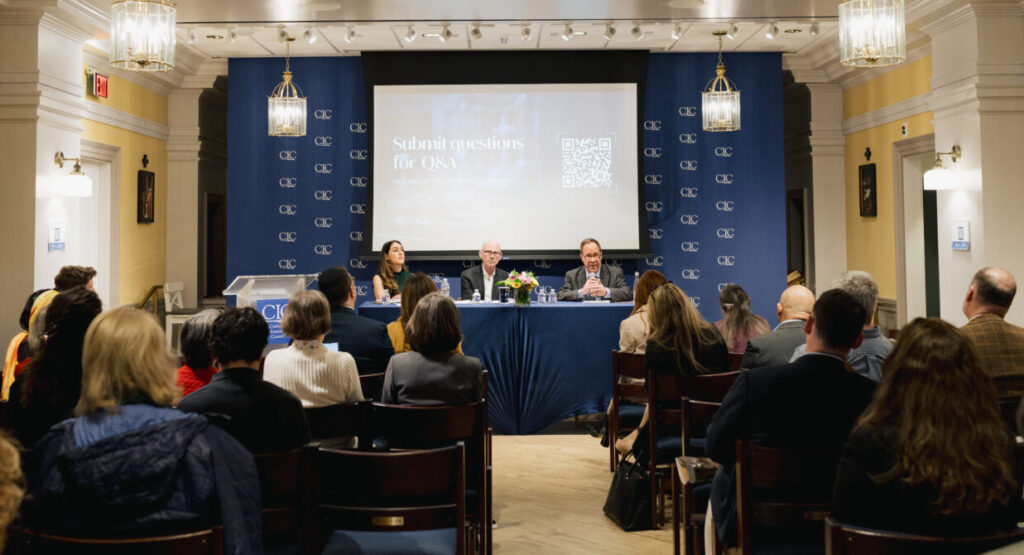
Dr. Russ Hittinger of the Institute of Human Ecology and Richard Crane of Benedictine College headed the second panel at the Catholics and Antisemitism Conference, entitled A Historical Look at Catholics and Antisemitism.
Conference moderator Simone Rizkallah opened the discussion by reading a quote from Adolf Hitler’s April 26, 1933, address to German Bishops on the Jewish Question, where he declared: “I do not set race over religion, but I recognize the representatives of this race as pestilent for the state and for the Church, and perhaps I am thereby doing Christianity a great service by pushing them out of schools and public functions.”
To this point, Richard Crane was asked how Christianity had, wittingly or not, laid the groundwork for the violent antisemitism of the Holocaust. Crane identified three areas in which his own understanding of the issue had evolved. First, he criticized many Christian thinkers for identifying too clean a distinction between religious anti-Judaism and racial antisemitism. This misunderstanding locates racial antisemitism as a uniquely modern problem, divorced from the medieval Christian tradition.
Second, Crane argues for a more fluid transition from ancient to medieval to modern Christian-Jewish relations. He pushes back against the date-driven model that tracks this relationship through key moments: the destruction of the temple in 70AD, the Edict of Milan in 313, and the Fall of Rome in 476. Instead, Crane proposes taking a longer view of Christian-Jewish history to better understand the interplay between Church and synagogue.
Third, Crane opposes what he terms a “lacrymose conception of Jewish history,” a history of the Jews that exclusively considers Jews the recipients of Christian spite and contempt. To address this, he raises the positive fruits of the Vatican II document Nostra Aetate, which treats Judaism as a living religion with an active relationship with God.
Hittinger continued this discussion by opposing the erroneous view that antisemitism emerged in the 20th century and ended after the Holocaust. He also expanded Crane’s attention to Nostra Aetate by raising two interpretive questions. Why did it take the Church so long to produce documents on religious liberty and interreligious dialogue, and why were the two documents addressing those topics, Dignitatis Humanae and Nostra Aetate, the shortest from the Council?
Hittinger drew attention to the different kinds of documents produced by Catholic Church Councils. Nostra Aetate and Dignitatis Humanae are both declarations, documents not addressed to the Church but addressed to the world on the Church’s behalf. To illustrate, Hittinger reminded the audience to whom the American Declaration of Independence was addressed, not to the King of England but to the whole world.
In the Vatican’s declarations, Hittinger attributes the length to a strong sense of humility. In previous Church documents on religious liberty, for example, a great deal of time was spent delineating the rights of the Church, with little focus on other religions. Dignitatis Humanae focuses primarily on interfaith concerns and closes with the rights of the Church. This reversal demonstrates the spirit by which the Council Fathers engaged these issues, focusing their efforts on the Church’s witness to the world, not herself.
Rizkallah then asked why some of the Church Fathers, like John Chrysostom in his Adversus Judaeos, seemed to express theology overtly hostile to Jews. Crane responded by identifying this tradition of antisemitism as located in the post-apostolic age. During the time of the apostles, the Church and the synagogue were closely related institutions; their drifting apart happened over time. The reinterpretation of Augustine to allow for the mistreatment of Jews in the Latin West during the Middle Ages followed the same pattern.
The panel then moved into a discussion of Jacques Maritain and his impact on modern Catholic-Jewish relations. Maritain, a convert, was treated by Paul VI as a maestro and introduced into the Church the line of thinking that led to the refutation of the deicide charge at Vatican II. Crane noted that Maritain was a starting point of a long dialogue that continues now, with further work needed on the issue of Zionism.
Hittinger returned to the issue of Chrysostom. He underscored the change in the Christian mind brought about by their growth in political power after Constantine, which Hittinger termed imperium. This notion of imperium returned to the Christian mind during colonialism, but Nostra Aetate worked to return to a Pauline understanding of Judaism.
Crane paralleled this view, noting that Christianity without Judaism is the heresy of Marcion. He attributes the work of JPII, Benedict XIV, and Francis to pushing against this non-Scriptural notion of Christian antisemitism in the Church.
The third conference panel explored practical solutions to Catholic-Jewish relations, which will be posted subsequently.
The conference panel may be viewed below via the Catholic Information Center YouTube channel.




Comment by Wilson R on May 13, 2025 at 1:55 pm
I highly recommend the book “Constantine’s Sword,” written by a former priest, as the best one-volume history of the tortured relationship between Christians and Jews.
Most Christians know little of this history before the 20th century.
Comment by Tim Ware on May 13, 2025 at 10:46 pm
Books are not objective statements of fact; rather, they are written to promote a certain agenda or perspective. It’s obvious what perspective Carroll is promoting. But that’s not the only perspective there is.
Comment by Wilson R. on May 14, 2025 at 1:50 pm
Carroll is promoting the theme—backed with reams of supporting evidence—that Christians have persecuted Jews as “Christ-killers” on and off again for nearly 2,000 years. The persecution is a fact. Is there some alternate “perspective” you’d care to share that excuses the way Christians have treated Jews?
Comment by Tim Ware on May 14, 2025 at 7:08 pm
In all my years, having been a part of two different major mainline denominations, I never once heard Jews referred to as “Christ killers.”
Comment by John on May 14, 2025 at 8:39 pm
Tim Ware,
And I’m white man living in the Deep South who never once heard one of his parents or grandparents use the N word. That doesn’t mean racism and white supremacy are not historic problems in this part of the country.
Comment by Tim Ware on May 14, 2025 at 11:07 pm
This “conference” is nothing more than a handful of religious bureaucrats patting themselves on the back for spouting worn-out, politically-correct statements about what they call antisemitism. It is insignificant, and they are insignificant, except in their own minds. People are tired of this. Things have moved on from them and their worn-out slogans. This stuff doesn’t work anymore.