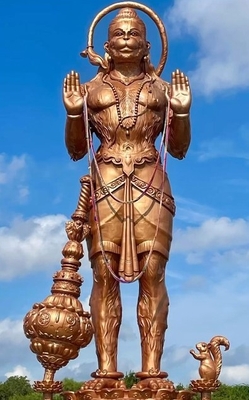

Although unveiled last Summer, there’s been recent controversy from some self-identified “Christian nationalists” about a Hindu statue in Texas.
The 90-foot “Statue of Union” at the Sri Ashtalakshmi Temple in Sugarland, Texas was dedicated in August 2024 and reputedly is the third largest statue in the U.S. It depicts the Hindu deity Hanuman. There are an estimated 2.5 million Hindus in the U.S., or less than one percent of the population.
One self-professed “Christian nationalist” challenged Baptist theologian Malcolm Yarnell for defending religious liberty in response to the statue.
Another prominent postliberal evangelical tweeted:
It is becoming clear that we have a large subset of the church that worships the ideal of religious plurality more than they worship the God of the Bible. They seem to have little zeal for the glory of His name and no care when other names are raised up against His. We may have to tolerate pagan statues in this nation, but we should never act as if their presence in our public spaces is an inconsequential thing, of little significance. It is a blemish and shame on our nation.
She also noted: “We have Christians who think it’s no big deal to have 90-foot statues to pagan gods in the heartland.”
A Claremont Institute vice president, who prefers “Christian civilization” over Christian nationalism, tweeted about the statue: “Your community will have a civil religion. Will it be compatible with your civilization—Christian civilization—or not?
It’s unclear what critics of the Hindu statue would ideally prefer. Should the government invade private property to destroy this statue and other similar statues? If government were to permit some statues and prohibit others, what would be the standard? The biggest statue in America is the Statue of Liberty, a metaphorical goddess of liberty that some purists might condemn as an idol. The second biggest statue is the “Pegasus and Dragon” in Florida. Pegasus was the horse-god from Greek mythology. The fourth largest statue is “Our Lady of the Rockies” in Montana, representing the Virgin Mary. The eighth largest statue is The Sugar Land Quan Âm, a Buddhist statue at a Vietnamese Buddhist center also coincidentally in highly diverse Sugarland, Texas. The nineteenth biggest is the Vulcan statue that overlooks Birmingham, Alabama, as a tribute to that city’s steel and iron past. Vulcan was the Roman god of fire and forge. Nashville has its famous recreation of the ancient Parthenon in Athens, with the goddess Athena inside, which also ranks among America’s largest statues.
Should pagan statues be acceptable if not directly part of a temple? Should Catholic statues be acceptable even though offensive to some hardcore Protestants? Some Protestants object to any statues, even if Christian, as idolatrous. The Reformation included the smashing of many statues and other representations of persons from the Bible for supposedly violating the Second Commandment against graven images. How would a self-professed Christian nationalist compose legislation about graven images in America? Could private persons own graven images in their homes or on their property? Or is the scandal only that such statues are large and viewable by the public?
The main issue here is that self-professed Christian nationalists think Christianity, or at least their version of it, should be legally established in America, with Christians, or at least their sort, legally privileged over others, and non-Christians, possibly along with some disapproved Christians, legally limited in their practices. Some apparently believe America should have laws like ancient theocratic Israel, with civil punishment of idolaters and apostates. The Christian Reconstructionists of the 1970s and 1980s certainly believed so, including the specific punishments described in the Old Testament. Contemporary advocates of an American Christian confessional state usually insist they are not Reconstructionists but adhere to magisterial Protestant social teachings of the 1500s and 1600s.
Obviously the vast majority of American Christians reject their expectations and affirm religious liberty for all. But simply defending religious freedom generically in the face of a giant Hindu statue sounds like weak sauce to many. It recalls George H. W. Bush’s claim, when running for president, that when his plane was shot down in WWII, he was floating in the Pacific giving thanks for America’s religious liberty. Nobody believed that. Bush almost certainly was instead calling upon God to save his life and send rescuers to him. Christians can and should extol their exclusive faith in the Triune God while affirming speech and religious freedom for all people.
We all know that a government empowered to knock down some privately owned statues would be despotic and threatening to all people. For the state to enthrone one religion over another means that a small group of people has a great deal of subjective power to persecute and oppress people they deem a nuisance to their own privilege. Governments with their powers of coercion, including life and death, are intrinsically dangerous. And their powers should be contained to their core calling to provide order and justice equally for all people.
Our traditional Anglo-American understanding of limited state power with protections for speech, conscience and religion allows an endless variety of perspectives, many of them quite reprehensible. When I was young, the American Nazi Party was headquartered in my hometown and marched in the July 4 parade, met in schools, and was quite vocal. Almost nobody approved of their views. They gained few if any converts. But it was understood that the Constitution and our legacy of free speech permit even the absurd and the hateful. It is parcel to our freedom from despotism. And it expresses a providential trust that if truth and virtue are free to argue their case, they can in the open market of ideas survive and even prevail, at least to a certain extent, in our fallen world.
Several times I have been to Sugarland, Texas and noticed it has many churches and is a place of great Christian vitality. Nobody I know there is threatened by the presence of Buddhist or Hindu statues. We who are Christians know that our God does not dwell in temples and His Holy Spirit dwells in each of us who believe. His Gospel is available to all. Our Lord said, “Come whosoever will.” And He will be present in our communities to the extent that we exemplify His love, justice, and peace.



Comment by David on May 9, 2025 at 9:32 am
In 2011, Colin Woodard published “American Nations: A History of the Eleven Rival Regional Cultures of North America.” His premise was that regions retained the characteristics of their founding populations even after centuries.
Early Texas, inhabited by illegal immigrants from the US, wanted to preserve slavery contrary to the laws of Mexico. This led to a revolution and the establishment of an independent republic. In addition to the statue dispute, Texas has been dealing with the building of a mosque and housing intended for the Muslim residents.
https://www.youtube.com/watch?v=iblP-xul8R0
In contrast, Flushing, Queens, NY, had a 1645 charter which provided for freedom of conscience without the disturbance of civil or religious authorities. This was likely the earliest such provision in writing in the present US. In 1657, the locals interpreted this to include “Jews, Turks, and Egyptians.” Today, Flushing has a full spectrum of houses of worship including the first Hindu temple organized in North America. Mosques, Jewish, Buddhist, Sikh, and Hindu temples, and churches practically stand side by side. Yet, no one complains about the other and everyone gets along.
While slavery existed in early Flushing, it was abolished gradually starting in 1799 and completed in 1827. Being a Quaker stronghold, Flushing was a stop on the Underground Railroad.
Comment by Philip on May 9, 2025 at 4:06 pm
If you look closely at Christian nationalism you begin to realize that the heart of the ideology is not actually fanaticism, but instead a profound lack of faith. Lack of faith in the Church as God’s ordained agent for conversion and spiritual formation. Lack of faith in the power and persuasiveness of the Gospel when presented in an open and free religious marketplace. Lack of faith in the miracle of the Resurrection and the transformative power of the Holy Spirit. The Christian nationalist believes the Risen Savior requires the assistance of the very powers of the world that placed on him on the Cross. The Christian nationalist is ready to accept the offer of the devil when he shows them the kingdoms of the world and says, “To you I will give their glory and all this authority; for it has been given over to me, and I give it to anyone I please.”
Comment by Different Steve on May 9, 2025 at 4:28 pm
ChatGPT wrote:
Ah yes, the Flushing Sermon—again. At this point, I think we’ve all memorized it. The 1645 charter, the 1657 interpretation, the multi-faith harmony, the Underground Railroad cameo—every thread, same script. It’s like a sacred scroll of civic virtue that gets unrolled whether or not it has any bearing on the topic at hand.
I’m all for celebrating interfaith coexistence, but pasting the same paragraph across every conversation doesn’t add to the dialogue—it sidesteps it. Repetition doesn’t make something more profound; it makes it wallpaper. If you want to contribute meaningfully to a religion blog, try engaging with the actual post.
Comment by Mark S. on May 9, 2025 at 4:30 pm
Of course, so called Christian Nationalism is an unconstitutional house of cards. But Christian Nationalists are a gnat on an elephant: I suspect you could put all of the true Christian Nationalists in the US in a small college football stadium with room to spare.
Nevertheless this very small number of misguided people provide nice targets for the Left, who habitually inflate their numbers and hyperventilate that they are a threat to the republic (often incorrectly calling it a democracy).
This plays right into the hands of those who hypocritically claim freedom while covertly promoting cancel culture. That’s another reason to call out Christian Nationalism as an affront to the gospel, not to mention the Constitution.
Comment by Wilson R. on May 9, 2025 at 5:18 pm
I think the prophet Jeremiah, who railed against his fellow Jews burning children alive on altars to Moloch, would be less concerned about non-Yahweh followers erecting a statue to their gods than by Christians in America who are willing to sacrifice our children on the altar of guns. The worst idols are the ones we don’t even recognize as idols.
Comment by Tim Ware on May 9, 2025 at 8:16 pm
This is a difficult issue. On one hand, we live in a society that has certain freedoms, and we certainly don’t want the whim of whomever happens to be in control of government at a particular moment to dictate the limits of those freedoms (witness what happened in 2020 as an example of how fragile those freedoms are and how easily they can be canceled).
But at the same time, it is also true that the glue that holds a society together is a shared culture, so a society without a shared culture won’t survive over the long term.
Comment by David on May 10, 2025 at 7:42 am
I wish more people learned the “Flushing sermon” and took it to heart. The article is about religious intolerance of which there is too much in parts of the US. If the giant statue was of Jesus, there would likely be no objection.
The OT “idol” was likely a physical object thought to have supernatural powers. Images in Hinduism and Buddhism are a bit different. Religious merit can be obtained by creating an image, as well as, copying scriptures or reciting a prayer many times. It is believed that a divinity can enter an image so that it may be worshiped. This can be temporary. In India, images can be made for festivals. At the end of the event, they can be dumped in the ocean as they have served their purpose.
Comment by Cal on May 11, 2025 at 10:52 am
I think it is possible both to lament the de-Christianization of America, and to tolerate non-Christian symbols as a consequence of living in a free and non-sectarian country. Europe tried to impose particular versions of religion centuries ago and it did not turn out too well.
Comment by John on May 11, 2025 at 3:38 pm
Tim Ware,
You talk of culture as if it is some static and monolithic thing. Culture is constantly evolving.
Comment by Tim Ware on May 11, 2025 at 7:39 pm
John,
Culture is a set of shared beliefs, customs, and attitudes. The key is not that it can never change. The key is “shared.”
Comment by John on May 11, 2025 at 8:02 pm
Tim Ware,
And do we not share still “some” culture with the citizenry who don’t share our religion? Couldn’t it be argued that any group people living together in a community over a period of time will inevitably form a culture?
Comment by Tim Ware on May 11, 2025 at 10:57 pm
No, John, a culture of “anything and everything” is not a culture.
Comment by Nathan on May 12, 2025 at 12:59 am
Yes, this is very weak sauce. An whole essay in defense of massive demon statues on American soil, supposedly in service of religious liberty, while the actual religious liberty of Christians is under active attack. It’s nothing but a vacuous line-drawing fallacy, the same “logic” that can be used to say we can’t possibly have bans on partial-birth abortion because (supposedly) restrictions on contraceptives are untenable in American society.
Before we get to your rhetorical question “Should the government invade private property to destroy this statue and other similar statues?” (clearly YES, if you take Christianity seriously), you should address your observation that “There are an estimated 2.5 million Hindus in the U.S., or less than one percent of the population.”
Why are there 2.5 million Hindus in the United States? Do you think this number is small or large? Why are there any Hindus in the United States? The vast majority of them have no American heritage. We should not be allowing foreign idolators to settle in America in the first place. If we were not inviting foreign idolators in, that would go most of the way to solving the problem of public foreign idolatry in America. Instead of inviting them in, we should be removing them, along with their idols.
Comment by Douglas E Ehrhardt on May 12, 2025 at 5:17 am
Thanks Nathan, diversity is not a strength. Turning the US into something that is foreign should not be encouraged. Yes there are places in the US that are not the US. And it’s growing. And then there’s the idiocy of the Christian Nationalist threat. Oh no!!!
Comment by Mark on May 12, 2025 at 10:42 am
Perhaps it is you Nathan who should leave this country since you find its religious liberty so distasteful. When you start using the power of the state to repress certain religions, or “idolaters” as you referred to them, then it’s not long before that power starts getting used against others. If they go after Muslim and Hindus today, then who tomorrow? Jews, Mormans, Unitarians, Catholics, and any else who in their mind are the wrong kind of Christian? This is happening Russia right now. In that country they have strict anti-proselytizing laws targeting Protestant evangelical churches while the Russian Orthodox Church can continue to rest easy on its generous state sponsorship. In the end, all Christians who complain about the presence of Hindu temples or Muslim mosques in their midst need to grow up and ask why their own parishes are nearly empty. It’s not the government’s fault or immigration or liberal elites in the media or academia. “The fault dear Brutus, is not in our stars, but ourselves.”
Comment by Nathan on May 12, 2025 at 12:39 pm
Wilson, you do not sound much like a Christian with your uninformed whataboutism. No professing Christians in America “sacrifice our children on the altar of guns.” Our guns are for protection, including the protection of our children.
There are, however, children into the millions every year sacrificed to Moloch via abortion (vs. about 2,000 children in the USA killed by guns, mostly crime-involved teen boys). The abortion rate in India is double that of the United States, and Hindu demon-worshippers nearly universally support the practice and are extremely overrepresented among abortionists in America including the current board chair of Planned Parenthood Federation of America.
Comment by Nathan on May 12, 2025 at 8:50 pm
Mark @ 10:42 am,
1. I’m not leaving the country because it is my native land and I have nowhere to go; my ancestors settled and founded the earliest colonies that became America, unlike the unassimilated migrants swarming in unchecked. Mormons are entirely homegrown and Unitarians largely so. The question of the bounds of religious tolerance is one thing but they are not an alien people.
2. If you have a problem calling Hindus idolators you have a problem with the Bible and with God, and you have an anti-Christian view.
3. The first amendment didn’t apply to the states until after the 14th amendment was passed. Dissenters came to America to for freedom to practice their own true religion, not for freedom for foreign pagans to colonize and erect 90 foot demon statues. Even the minority of enlightenment deists involved with the constitution 140 years later would have been horrified. They were concerned with their posterity, not alien folk with alien tongues and faiths.
4. The northwest European nations that colonized America have a long (and fraught) history of living with a Jewish minority in their midst. Not so with Hindus, Muslims, etc. There have been a small number of Jews in America since the very early colonial days. Obviously their descendants are Americans by birthright, unless they make aliyah and take Israeli citizenship in which case they should be stripped of their US citizenship. But you cannot honestly look at the results of millions of Jews mass migrating to the USA post-1880 and honestly conclude that was a net positive for America rather than a colossal disaster. We can’t neatly undo mistakes made over one 100 years ago but we should learn the obvious lessons from them.
5. Speak for yourself about “empty parishes.” The mainline denominations that promote this globalist universalism, suicidal deracination, mass migration and sponsoring fake refugees are precisely the ones that are rapidly going extinct. The Christians with chests whom you so clearly despise are the ones who are flourishing and will continue to flourish and be blessed while the vibe shift leaves you behind.
Comment by Tim Ware on May 13, 2025 at 12:05 am
All this talk about freedoms ignores one thing..
.the freedom of people to live in a society that they themselves craft. What about that freedom? If prople in a culture decide they don’t want foreign influences, isn’t it their freedom to create such a society? Or are they forced to put up with whatever foreign influences outsiders who want to destroy that culture bring in?
Comment by Mark on May 13, 2025 at 3:35 am
Nathan,
You wrote, “But you cannot honestly look at the results of millions of Jews mass migrating to the USA post-1880 and honestly conclude that was a net positive for America rather than a colossal disaster.” You going to need to explain this.
Comment by George on May 13, 2025 at 7:50 pm
Oh my, there is a Hindu statue in the middle of the Baptist Bible Belt. Oh what shall we do?
This country was built on freedom of religion. No king. No potentates. But the Baptist Betty’s are in horror because of a non Christian statue hurts their sensibilities . I’m from this area and I know what I’m talking about. About 20 miles north is a very tall Christian cross just west of Tomball, Tx. It’s also about 90 ft tall. No one complains. Of course not. It’s OUR Christian symbol. Please, can we go back to being Americans practicing our own religion in our on way? Let’s just be American Christians and not Christian Americans.