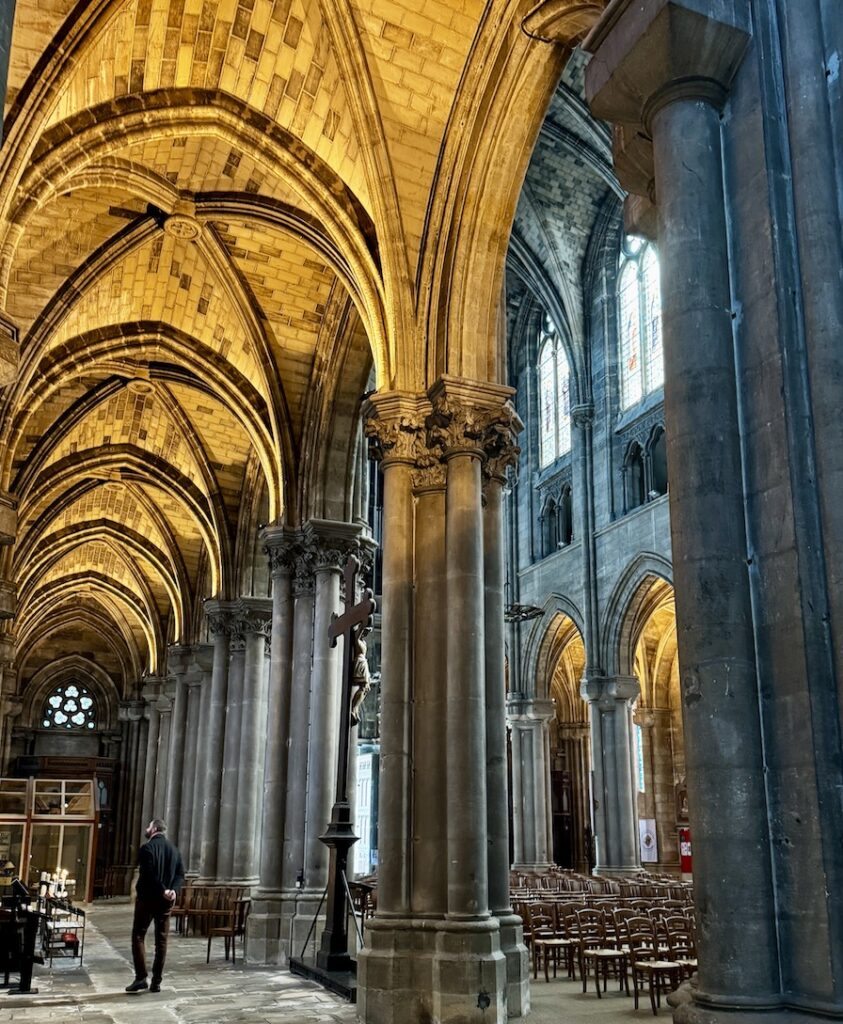

This past month I had the pleasure of two weeks of travel in France, my first visit there. While this wasn’t a work trip, French religiosity did pique my curiosity; enough so that I’ve been casually reading up on the subject since my return to Washington.
My new curiosity was well timed: new data has been released about both Protestants and Catholics in France, and what it reveals may have implications for American Christians ministering in a post-Christian (or is that potentially pre-Christian?) context.
Among many sights, I visited the restored and surprisingly bright Notre Dame de Paris, in addition to numerous churches in Bordeaux, Lyon, and Strasbourg (I also attended Sunday services at an age-diverse and multi-national Church of England parish in Lyon in which I met Chinese, Nigerian, and Iranian believers, alongside western expats).
Walking through Notre Dame on a weekday afternoon, I inquired if a significant number of seated people were awaiting mass to begin. No, I was told – they were waiting for confession. It was an unexpected sight of religious vitality.
Indeed, just this month France’s Roman Catholic Church announced the scheduled baptisms of more than 10,000 adults on Easter, the highest number of new members reported in over 20 years (a 45 percent increase in adult catechumens compared to last year, and the largest reported number since 2002, when the Catholic Church created the annual catechumenate survey). A tip of the hat to Michael Gryboski of The Christian Post who covers that here.
Separately, new data from the French Institute of Public Opinion (IFOP) shows that evangelicals now comprise a majority of French Protestants (thanks to Daniel Silliman of Christianity Today for spotlighting this), and that there is an influx of converts from non-Protestant backgrounds. About one-quarter of Protestants in France are converts.
“In our secularised society where the dominant norm is not to have a religion, having a religion and practising it has become a non-conformist act of personal choice,” write IFOP researchers Sébastien Fath and Jean-Paul Willaime.
Interestingly, French Protestants are now more likely to self-report as “Evangelical” rather than as “Protestant.” This possibly correlates to what IRD President Mark Tooley has observed about a decline of denominational loyalties in the U.S.
“The evangelisation of Christianity is leading to a deconfessionalisation in relation to inherited denominational traditions,” IFOP’s Fath and Willaime write. French Christians who in a previous time might have categorized themselves Lutheran or Reformed are now simply “Evangelical.”
Does this sound familiar?
A number of cultural observers have stated that the United States has become a “post-Christian” nation, with the potential to become a “pre-Christian” nation. Notoriously secular France might already be an example of this. The country is among those listing the highest percentage of self-described atheists (France ranked 13th for prevalence of atheism as recently as 2020). At the same time, surveys of the French population reveal that nearly 40 percent of adults have consulted an astrologer, psychic, or other spiritual medium – I’m certainly not saying this is a good thing (arguably it is an example of re-paganization) but at the same time these are not practices consistent with atheism, and they speak to a felt spiritual need, albeit one addressed with a maladaptive response.
I was also told (by a Protestant cleric) that there is an identifiable renewal of Roman Catholicism underway in France, something that the recent French Roman Catholic baptism numbers back up.
“The influx of catechumens – adults and young people – is not an epiphenomenon,” writes Archbishop of Lyon Olivier de Germay introducing the data from the most recent catechumenate survey. “We can see it as an encouragement from the Lord reminding us that he is the Master of the mission, it is he who attracts to him, touches hearts and reveals himself.”
American Christians obviously minister in a substantially different context than French Christians do, and most Americans retain some awareness of Christian practice in their recent family history (it wasn’t that long ago that 70 percent of Americans had membership in a house of worship), unlike the French. But glimmers of vitality in both French Protestant and Catholic faiths indicate that even in a post-Christian context, there is evidence for growing Christian presence in the future.
More:
French Catholic Church to baptize over 10K adults on Easter; 45% increase over last year
New data in France shows that evangelicals are now the majority of Protestants




Comment by Salvatore Anthony Luiso on April 28, 2025 at 5:54 pm
Thank you for this article. I intend to tell others about it.
Regarding “French Protestants are now more likely to self-report as ‘Evangelical’ rather than as ‘Protestant’: I wonder why this is. I don’t assume it’s for the same reason that something similar has been happening in the United States. In France, the name “Protestant”, “Lutheran”, and “Reformed” have long had historical and negative connotations among the French. (Some years ago I heard or read that many French consider all forms of Protestantism to be as respectable as a cult.)
Regarding “A number of cultural observers have stated that the United States has become a ‘post-Christian’ nation, with the potential to become a ‘pre-Christian’ nation”: I wonder if it is possible for a nation to go from post-Christian to pre-Christian. Maybe post-Christian can be inter-Christian? That is, a time between two separate periods of being Christian? (I like and generally agree with what C.S. Lewis has written about post-Christianity in letters he wrote to Don Giovanni Calabria. One can read about these letters in the article “CS Lewis as many have never heard him.”, by Msgr. Charles Pope, which was published on the website of Community in Mission in 2013.)
Regarding its last sentence: I would say that there is *hope* for growing Christian presence in the future, and that we have too little knowledge about what is happening for it to be more than a little hope.
Comment by David on April 29, 2025 at 4:22 pm
Let us not forget the fate of the Calvinist French Huguenots who experienced a massacre in 1572. They were eventually granted religious freedom which was taken away by Louis XIV in 1685. Many fled to England and British North America.
Comment by Colin Ross on April 30, 2025 at 12:53 pm
Meh I wouldn’t put too much into it. Every young French person I’ve ever met has had a very strong distaste for religion. Immigration is really the only thing boosting their numbers. They also published that for every 100 people joining the Catholic faith 840 are leaving. Im glad you admit that Christianity has pretty much collapsed in the us. It has a pathetic last gasp coming out from the trump administration but it’s hard to take cults seriously in the age of the internet