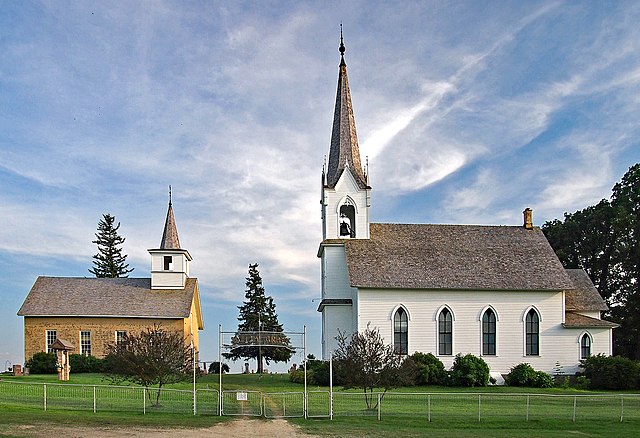

American denominationalism is fading. Non-denominationals are now the largest non-Catholic religious group in America. Nearly all denominations are declining. Liberal ones are declining faster than conservative ones. Nearly all growing congregations are non-denominational.
What is the impact on American society?
We at IRD have across over 40 years mostly focused on denominations. From the start in 1981 we have been ecumenical, including Mainline Protestants, Evangelicals, Roman Catholics and Eastern Orthodox. We critiqued the National Council of Churches and the World Council of Churches, which are mostly comprised of Mainline denominations. We sometimes collaborated with and sometimes critiqued the National Association of Evangelicals, which is mostly comprised of denominations, although congregations and parachurch groups can join.
For many people, IRD is mostly associated with Mainline Protestantism. Critiquing its political witness and working for its reform was a big part of our work. We had special renewal projects for United Methodists, Episcopalians, and Presbyterians (PCUSA) that focused on the legislation at their governing conventions. Eventually, in the early and mid 2000s, traditionalists lost their battles in these denominations and either left, created new denominations, or yielded to the new reality. The exception was United Methodism, where traditionalists never legislatively lost, but who are now exiting, mostly for a new denomination, realizing the U.S. part of the global denomination is unfixable.
The new denominations that emerged from Mainline Protestantism are lean, don’t have bureaucracies, and themselves reflect in many ways America’s post denominationalism. Perhaps America has only one remaining “great” denomination, which is the Southern Baptist Convention. A “great” denomination is national, has millions of members, has universities and colleges, seminaries, publishing houses, journals, and transgenerational brand loyalty. But the Southern Baptist Convention is annually losing hundreds of thousands of members. Many of its most successful congregations now disguise their denominational tie. And even many ardent church members no longer relate strongly to the denominational brand. They and their children move seamlessly among evangelical congregations. Many if not most nondenominational churches are effectively Baptist in theology and polity, governed congregationally, through elders, and practicing believer’s baptism.
There are some growing denominations, such as the Assemblies of God, which is Pentecostal and very multiethnic. But its adherents don’t necessarily strongly identify with the denomination. They regard themselves as Christians, or maybe as Pentecostals, who relate to their congregation but give little thought to their denomination, if they are even aware of it. Why should church goers think much about their denominations if their clergy don’t talk a lot about them, if they are not going to denominational gatherings, if they are not attending denominational schools, if they are not reading denominational literature, and if there are no major denominational leaders with high profiles?
The decline of American denominationalism is sad in many ways. The Mainline Protestant denominations, with the Baptists and a few others, have been the pillars of American religion and for much of American civil society since the beginning of our republic. All successful movements and communities ultimately need multigenerational institutions to sustain and transmit their message. Christianity, if orthodox, cannot be divorced from institutions.
But the decline of American denominations does not necessarily herald the decline of American Christianity. Most of today’s denominations emerged from the ferment of the Second Great Awakening, or were breakoffs from those denominations, or emerged from the Holiness and Pentecostal revivals of the late 19th and early 20th centuries. The rise of post-WWII evangelicalism generated a new wave of denominational activity, although much of the action emanated from independent parachurch ministries, contributing to our current post-denominational times.
Such evangelical entrepreneurship, expressed through radio, television, schools, and other independent missions, helped dethrone the centrality of denominations. But so too did the failures of denominations. Mainline Protestant structures were liberalized in the early 20th century, became hostile to populist piety, and began their irreversible membership plunge in the 1960s. Conservative denominations initially benefitted from post-WWII evangelical resurgence but eventually, over the last 20 years, suffered from evangelicalism’s frequent indifference to tradition and ecclesiology. From the evangelical perspective, focused on individual conversion and experience, why were denominations needed? Weren’t they actually a distraction?
Irrespective of denominational failures, nearly all human institutions have a limited shelf-life. None of the Protestant denominations claim a permanent authority like Roman Catholicism. They were all born in particular cultural contexts, which all evolve with time. Schism, growth, sclerosis, mergers, decline and death are part of the rhythm of Protestant denominationalism.
For contemporary American Christianity, national religious institutions with large bureaucracies, strong brand loyalty, famous leaders, and a self-sustaining subculture are deemed not very relevant. Of course, aspects of the old denominationalism will continue. Many Southern Baptist seminaries are quite strong and will produce clergy for post denominational America. And many denominations will survive on a much smaller scale, with very lean structures, and often deemphasizing their denominational brands. In their place, there will be growing congregationalism attenuated by informal church networks. Christians, individually and congregationally, will rely on online resources that are not specific to any denominational traditions.
While the importance of denominations and their structures decline, the traditions that birthed them will not. Lutheranism, Calvinism, Anglicanism, Wesleyanism, Restorationism, and various flavors of Baptists, will continue and often will thrive in America, if not always carefully stewarded by denominations. And while post-denominational, contemporary populist piety will always thrive, behind it there will always by more rigorous outlines of orthodox Protestant theology providing some ballast.
For IRD, whose mission is to shape Christian political witness that strengthens democracy, the task is in some ways more complex. Christians no longer look to centralized structures and prominent church leaders for guidance for societal guidance, if they ever really did. Their sources of reference and authority are now defused across a swirling ocean of websites, independent publishers, social media, parachurch groups, and new schools. In this mix are every form of horrors and virtues.
Reaching individual Christians is now easier. There are no more denominational filters. IRD publishes online materials, host talks and conferences, and organizes hard copy books. We strive to reach Christians who are particularly concerned about principled Christian political witness rooted in permanence and tradition. The great Protestant traditions, if not the old denominations, remain our reference, supplemented by Catholic teaching and other historic Christian frameworks.
Ultimately, American Christianity will shift and reorganize in ways that best serve American Christians and other spiritual seekers. It may appear messy and disconcerting. Much of the old Christianity is dying. But new forms of Christian vibrancy are emerging.
American Christianity has always been entrepreneurial and adaptable. Its transitions may often look like decline. But often they are preambles to new spurts of growth and the creation of new institutions. These evolutions are intrinsic to Protestantism, especially in America, a nation whose churning restlessness is rooted in the endless Protestant quest for improvement.




Comment by Pem Schaeffer on January 9, 2023 at 1:59 pm
What do you know of the Christian Missionary Alliance?
Comment by Henrietta on January 9, 2023 at 2:22 pm
Catholicism is not a denomination
Comment by George on January 9, 2023 at 11:07 pm
Ok then Henrietta, please explain what you mean.
Comment by PFSchaffner on January 10, 2023 at 7:37 am
Though as a Baptist I sympathize with the congregational model, I do wonder if the post-denominational environment, and the consequent loss of tradition and structure, have not left many individuals floundering, and contributed to the de-churching of America. We’ve been attending a hitherto successful UMC church for a decade — successful because it largely ignored the UMC affiliation and preferred to stress the Wesleyan tradition –; but that is becoming impossible. Where do we go next? The mainline churches are all PC (post-Christian if you like), and the evangelicals (or perhaps post-evangelicals) are all light shows and drums. Individuals who want neither have no place to turn, no rut to remain in, and may end up nowhere.
Comment by Randy Thompson on January 10, 2023 at 2:52 pm
The comment about mainline churches being “post-Christian” and evangelical churches being “all light shows and drums” strikes me as being on target.
Having served in a mainline church setting for twenty-five years, I was stunned by the level of theological and Biblical illiteracy in those churches. And, for all the talk about the Bible in evangelical circles, the Biblical and theological illiteracy is just as bad if not worse. Drums and lightshows are are emotional distractions and not catechism.
Mainline Protestantism is decomposing before it’s even dead. The evangelical subculture is becoming good hearted, entertaining, and well-intentioned folk religion. Post-denominational America is going to end up post-Christian America.
Comment by John Smith on January 10, 2023 at 3:12 pm
I agree with Henrietta, catholicism is not a denomination. Christianity is a catholic religion. The Roman Catholic sect is an entirely different matter.
Comment by Tom on January 10, 2023 at 3:43 pm
Both the mainline denominations and the independent evangelical churches have earned the descriptions here. Where to go for some solid Bible teaching and somewhat more traditional and dignified worship?
I do like the Presbyterian Church in America. We are a confessional church and do teach the Bible as interpreted by the Westminster standards. And there are a lot of PCA churches that don’t have an electric guitar in sight.
And, best of all, we’ve weathered the controversy over homosexuality with the departure of our homosexual pastor and his congregation–so far for parts unknown, but they are no longer part of the PCA.
Comment by Dan on January 10, 2023 at 5:38 pm
Have to put in a recommendation for LCMS (Lutheran Church Missouri Synod). Confessional, sacramental and, so far, holding to Lutheran theology as expressed in the Augsburg confession and related doctrinal statements. Overall, I am most impressed by the catechesis done by orthodox Presbyterians, not PCUSA, and orthodox Lutherans, not ELCA. Their catechumens end up knowing what they believe and why they believe it.
Comment by Gary Bebop on January 10, 2023 at 5:58 pm
Mark Tooley has done scholarly compiling and sorting here. For those of us who have served in denominated settings, the implications were foreseen. Good News and IRD and Confessing Movement were harbingers of the present disintegration. Will the GMC attract those who want a traditional Wesleyan/Methodist denominational expression? The answer may depend on what kind of leader commits to a denominationally-aligned future. Don’t expect equivocating leadership or lost-and-wandering laity to make the GMC viable.
Comment by Sharon Whitlock on January 11, 2023 at 7:20 am
The Catholic Church is THE Church founded by Jesus Christ Himself. A study of history will prove the truth of this statement. My late husband (COVID 2020, R.I.P.) and I, along with our grown children, all converted to Catholicism after several years of study of Church history. I suggest the book Evangelical Is Not Enough by Thomas Howard, who is the brother of Elisabeth Elliot, the wife of missionary Jim Elliot, who was martyred by Auca Indians (along with several other Christian missionaries).
Comment by Eric Lytle on January 11, 2023 at 10:33 am
Excellent article, on a topic that most media fail to notice. I take issue with your statement “The decline of American denominationalism is sad in many ways.” Why is it sad? Sad in the way that many brands and chain stores no longer exist? People no longer shop at Woolworth’s, but they still get their shopping done. Sears and K-Mart are almost extinct, but people still get their shopping done. If people are still getting their Christianity “done,” that’s what matters. I am one of millions of ex-United Methodists, having attended UM colleges and worked for the UM publishing house. I’m sad to see the liberal takeover, but can’t help smiling at the inevitable decline of any left-wing denomination.
Regarding the Southern Baptists: as you point out, nondenominational evangelicals are Baptists in all but name, so while the official denomination shrinks, its theology and ethos still remain alive and well. Also, the Southern Baptists have done very well with their Lifeway bookstores (which long ago abandoned the name Baptist Bookstores). Lifeway carries Sunday school curriculum not just for Southern Baptists but for non-denom evangelicals, and also for Wesleyans and Anglicans.
Comment by John Smith on January 11, 2023 at 7:35 pm
Dan and Tom:
If you can get Methodists to embrace either Augsburg or Westminster you will have done a good work but they will no longer be Methodist.
Comment by John Smith on January 11, 2023 at 7:38 pm
Sharon,
When selecting a church theology is far more important than history. Churches depart the truth, as established by Jesus. One would be more accurate to say the Orthodox rather than the Catholic church was established at Pentecost but in either event the Roman Catholic denomination is the heir of neither.
Comment by Abigail on January 12, 2023 at 1:12 pm
Yeah, I agree with those who say that Catholicism is not a “denomination.” Denominations are a specifically Protestant phenomenon that came about as Protestants sorted each other into various theological camps associated with this or that specific reformer or reformed tradition.
Orthodox don’t have “Denominations” either; they have Churches that (mostly) share an organic communion with one another.
The Catholic Church is just… the Catholic Church. Whether you believe in it or not, you can’t deny that it has existed as a continuous sacramental institution since the apostles and still includes the majority of Christians globally, making it’s claim to universality somewhat credible.
But back to the changes in Protestantism, of which I have two observations.
FIRST, Protestant Christianity is only 500 years old. 500 years is not a long time; 500 years after Jesus the Catholic and Orthodox traditions had just completed their first big “transition,” from being a persecuted church of martyrs to being a politically supported institution sending missionaries to convert all of Europe. Since then the Church has undergone transitions into and out of Christendom, has sent out new rounds of missionaries, and is now a global institution in conversation with modernity.
So for Catholicism there have been many major transitions in response to historical and cultural contingencies. Protestantism, I think, is due now for a major transition of its own.
SECOND, I think this transition has been going on for some time. We are noticing it now because it has been accelerated by secularization in the West and the spread of Protestantism to the larger globe.
My hypothesis is that this transition will result in a Protestantism that is mostly Evangelical and Charismatic, decentralized, and theologically eclectic, because that is the endgame of the very logic of the Reformation.
Catholicism and Orthodoxy are by nature institutional; Catholic and Orthodox Christians are defined by organic, sacramental communion with Jesus in unity with our bishop. Protestants, however, primarily define themselves through their individual faith in Jesus and their relationship with him through prayer and scripture.
Protestantism doesn’t just not require large institutions; large institutions are unnecessary and even a little disingenuous.
Without a sacramental economy, or a need for tradition to interpret scripture, why have an institutional “Church” that defines itself as anything other than a group of believers in Jesus?
If I am my own authority on what scripture and Jesus mean to me, then why would I care what Luther or Calvin thought, except as an academic exercise?
In the aftermath of the Reformation, “denominations” made sense as a way to effectively organize as an alternative to the Catholic Church and sort adherents to the theological traditions associated with particular reformers or state churches. But I think these were inherently temporary and historically contingent, and in the long run they are not compatible with the ideals of Protestantism.
Denominations in America were held up by the elite and upper middle class – WASPs, Southern gentry, “respectable people,” and Germanic immigrants. In the post-war period there was a strong and aspirational attachment to civic institutions; to be a respectable middle class American was to belong to a respectable “brand” name Church.
But Protestant denominations, unlike the sacramental hierarchies of the Catholic and Orthodox Churches, were never part of the logic of Protestantism itself. They are not *necessary* to it. They were never more than secular structures to serve historically contingent needs.
And it could be argued they no longer serve those needs.
Most people who are attracted to Protestantism today are attracted to its message of faith, forgiveness, and a personal relationship with Jesus. They seek fellowship with other believers. They want to experience Jesus without institutional mediation. Yet they also want to feel like they are part of a broader, global, and historically continuous movement of *Christians.* A brand name based on a specific theological orientation or a vestigial connection to a specific reformer is not only not a selling point for ordinary people, it is actually a *turn off.*
If your relationships is with *Jesus Christ* and through him other *Christians*, why narrow it down to a label like “Reformed” or “Methodist” or “Lutheran” or whatever? It makes your church feel small, parochial, and petty. It even feels a little scandalous to a lot of people, like you aren’t even trying at Christian unity by naming your church after your theological particularities or a German from 500 years ago.
And if all Protestants are their own interpreters and final authorities on Scripture and its meaning, and ultimately then of doctrine, then why submit to any institution?
Who gives “The Denomination” the authority to discipline and organize Christian life if the believer is their own authority and the local community the locus of Christian life?
Denominations have served their purpose. They might still serve some purpose when it comes to running seminaries and universities and pooling resources. But I think for most Protestant Christians, denominations are just no longer relevant, and are even a little embarrassing.
I think Protestantism will eventually just become non-denominational Evangelicalism. They will be primarily divided by whether or not they practice infant baptism. Eventually, the believer’s baptism people will dominate the movement, and most of those who believe in infant baptism will end up getting absorbed into Catholicism, as defending infant baptism usually involves a deep dive into the traditions and practices of the Early Church, and once you go down that road… well, there’s really no where to go but Rome.
Comment by Jeff on January 12, 2023 at 9:32 pm
Abigail,
Thank you for the thoughtful, and thought-provoking, comment!
>> I think Protestantism will eventually just become non-denominational Evangelicalism.
The doctrinal dumpster-fires that have balkanized the Episcopal, Lutheran, Presbyterian, and soon the United Methodist denominations, are certainly pushing many of us formerly-denominational orthodox Bible-believing Christians in that direction…
Blessings
Jeff
Comment by Richard Graham on January 16, 2023 at 9:26 am
There was no mention of the missionary organizations supported by any of the ‘denominations’ declared to be declining in this article. As just one example, the Southern Baptist Convention has two—the International Mission Board and the North American Mission Board. Both have over 3,000 missionaries each, supported by the local churches of the denomination. I seriously doubt, therefore, that this article realistically describes the denominations it says it understands.
Comment by The Rev. Dr. Lee Cary (retired UMC clergy) on February 15, 2023 at 5:58 pm
Good to see this article. Keep them coming.