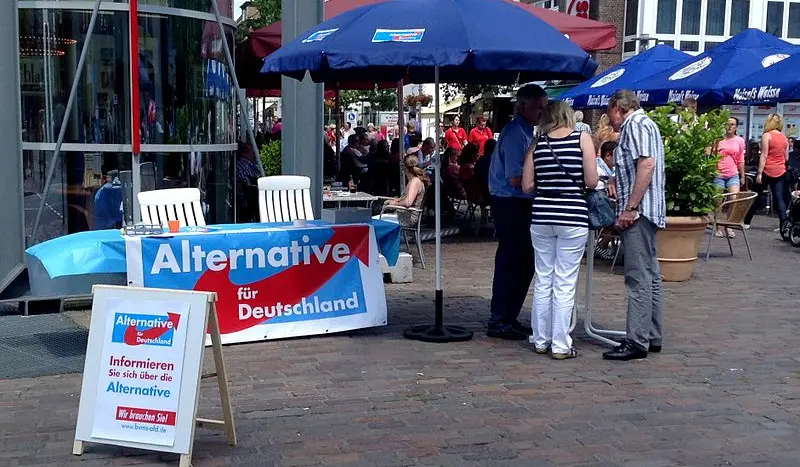
In the wake of last year’s collapse of Olaf Scholz’s “traffic light coalition,” Germans voted to elect a new federal legislature and, by extension, a new Chancellor this Sunday. Although the center-right Christian Democratic Union (CDU) and its Bavarian sister party, the Christian Social Union (CSU), won handily, the far-right Alternative for Germany (AfD) had its best performance ever, marking the biggest federal victory for the German far-right since before the Second World War.
Amid this rightward turn in German electoral politics, the historical position of the German churches, Protestant and Catholic, has also shifted. Historically the patrons of the CDU, the churches have reconfigured into a bulwark against rightward movement in German society, particularly on immigration policy, much to the chagrin of many Christian Democrats. This process has not only disrupted the traditional nature of German Christian Democracy but also endeared some Christian voters to the AfD.
Since its inception, the CDU has looked to German Catholic and Protestant churches for moral inspiration and reliable voting blocs. The party’s original manifesto was drafted before West Germany was established in 1946, still within the British postwar occupation zone. This document argued that the “Christian ideology” was the only antidote to the materialism of National Socialism and placed human dignity, ecumenism, and church-state cooperation at the center of its political program.
The CDU’s most recent platform, updated in May 2024, was seen as a return to form for the party after the Merkel era. Titled To Live in Freedom, the new platform explicitly reaffirms the party’s commitment to Christian ethics, Western common culture, and German patriotism. This new platform is closely aligned with the rightist leanings of presumptive next chancellor Friedrich Merz.
The new, brusquely conservative agenda for the Christian Democrats has not been universally accepted, facing resistance from liberal and leftist voices, naturally, but also the established churches. After a tragic stabbing attack by an Afghan migrant in January, the CDU introduced a measure to encourage German border security to turn away more migrants at the country’s borders. To get this motion to the floor, the CDU relied on AfD parliamentarians, a surprising breach of the typical political quarantine imposed on the AfD by the other, more mainstream parties.
A joint statement from the Catholic Church and the Evangelical Church in Germany, the country’s two largest denominations, harshly decried this breaching of the “firewall” around the AfD. These leaders accused the CDU’s immigration restrictions of defaming migrants as a bloc and endangering German democracy by cooperating with the AfD.
This is not the first time the major churches have attempted to stem the AfD’s growth. Catholic parishes in the country have sacked parish council members and altar boys for work with the party. The Catholic bishops of the country also published a document denouncing the party for its alleged racial nationalism, deferring to the German Federal Office for the Protection of the Constitution as the arbiter of what sort of politics ought to be acceptable for German Catholics.
Despite the cold shoulder from major German churches, the AfD has publicly warmed to Christians in the last few election cycles. The party’s Christian interest group, Christians in the AfD, describe their party as the most reliable force to oppose the growth of gender ideology, the proliferation of abortion, and the continued atrophy of Germany’s Christian heritage. AfD’s parliamentarians also attempted to declare an International Day Against the Persecution of Christians last year, a measure shot down by all mainstream parties.
Given the rightward shift in the German election and the failed attempt by the churches to stymie it, the future of traditional German Christian Democracy is unclear. A laity attracted to messages of family, faith, and country from the establishment and populist right has run aground a clergy just as willing to evangelize on behalf of liberal democracy as Christianity.
Violations of Christian principles must be addressed, whether from the right or left, but Germany’s churches must be willing to engage with the causes and contours of the country’s rightward turn to ensure that German Christian Democratic values survive the issues of the day.




Comment by David Kingsworthy on February 25, 2025 at 10:01 am
“the German far-right ” — goodness gracious, even here in this seemingly fair portrayal of the situation in Germany, the author cannot resist applying the “far-right” epithet to conservative Germans.
If Germany is to ever escape the Nazi shadow — which is entirely possible — they must resist the cordon sanitaire and reject external pressure to see Nazis behind every patriotic poster.
As for the Christians and the churches, if they must involve themselves in politics, let them preach repentance, obedience and love.
Comment by Wilson R on February 25, 2025 at 1:21 pm
By any reasonable measure, AfD is a far-right party — far-right enough that the conservative Christian Democrats will not bring them into a government.
From what I’ve read, it’s not strictly accurate to call AfD a neo-Nazi party, though it’s also easy to see why they get called that. But if any country has a reason to build firewalls, it’s one that experienced what happened to Germany and wants to avoid the possibility of that ever happening again. For them, it’s not ONLY about what Germans did to others; it’s the disaster they brought on themselves. And no US politician has any moral authority to go lecture them on what their stance should be toward the far-right.
Comment by Douglas E Ehrhardt on February 25, 2025 at 8:43 pm
West Germany received how much in US tax dollars last year? And we’re not supposed to have a say in the direction of the government? And to use the word Christian in that country. Merkels party ? About as Christian as the UMC..
Comment by Wilson R. on February 26, 2025 at 12:01 pm
According to Foreign Assistance.gov website, Germany (there is no longer a “West Germany,” btw) received $15.6 million in US assistance in FY 2023.
Of that, $15m came from the World Bank Institute and went to something called the Childcare Incentive Fund. Ten million dollars of that was for “basic education,” and the other $5 million was for “government and civil society.”
There was another $637k for operating expenses.
By contrast, we gave $68 million in assistance to Angola.
$93 million to Armenia
$25m to Azerbaijan
$19m to Belize
$64m to Botswana
$163m to Burkina Faso
$117m to Central African Republic
And, no, we’re not supposed to have a say in the direction of the government in return for financial aid.
Comment by Thomas on February 27, 2025 at 10:55 am
Douglas, you`re being unfairn with the German CDU. The party was traditionally social conservative, it went more liberal only in recent years. Former chancellor Helmut Kohl was a devout Roman Catholic and pro-life. The CDU wasn`t able to avoid the legalization of abortion in Germany, in 1995, but at least they have a legislation were abortion needs previous justification and consentment. In some regions of Germany, the CDU and their partner, CSU, are still fairly conservative.