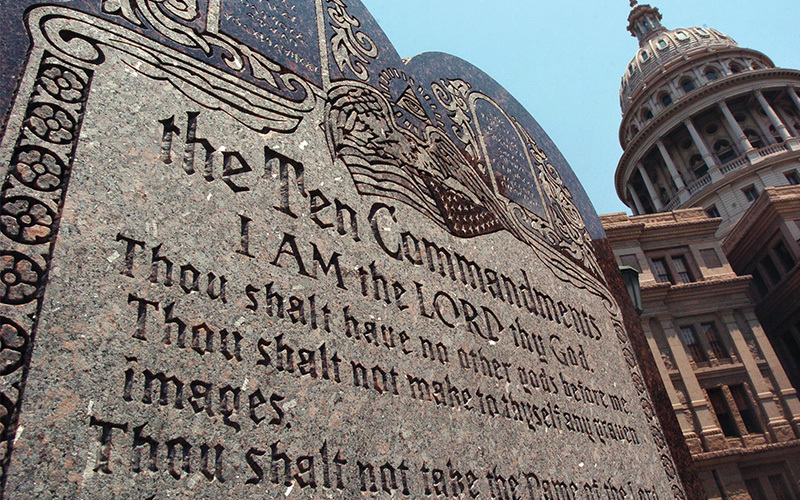
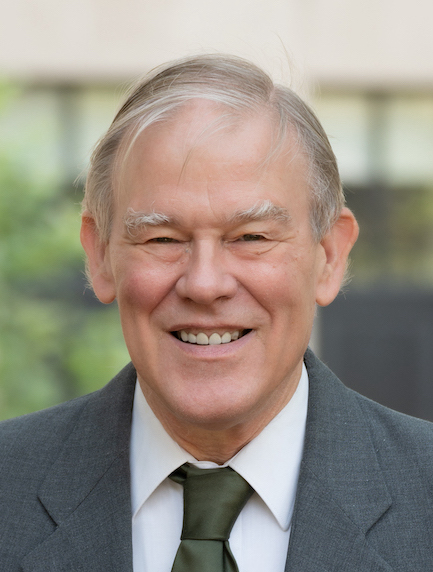
Paul McNulty, President of Grove City College, discussed the decades long era of challenge to religion in the public square at a Faith and Law forum on Capitol Hill on November 15.
The Rise of Separationism
The era began with the Supreme Court’s Everson v. Board of Education decision in 1947, which advanced a doctrine of “strict separation” of religion and the state. Arch Everson of Ewing township, New Jersey sued the Board of Education of Ewing claiming that a program of re-imbursing parents for the transportation of children to schools, including parochial schools, was unconstitutional. The court found instead that re-imbursing parents for transportation of their children to school was a general public interest, and therefore not unconstitutional. But the court said for the first time that the Establishment Clause of the First Amendment applied to states as well as the federal government, and that the Establishment Clause erected “a wall of separation” between church and state, which “must be kept high and impregnable.” Less commonly quoted, but no less exclusionary of religious faith and practice from the public world was the court’s declaration in the same paragraph that the government must not “aid” any particular religion or religion in general.
But, McNulty said, the American founders had no desire to “extract” religion from the public square. Their concern was protecting churches from the state, not the state from the church. He noted that the Northwest Ordinance of 1787, enacted by the Congress of the United States under the Articles of Confederation “provided for space for churches to be built.” In contrast, the Everson decision decreed a “strict separation” of church and state. Seriously applied, Everson would “seek to limit religious influence in the public square.” Together with other important developments in society at mid-twentieth century, the Everson decision resulted in significantly reducing “the place of the Christian faith in public life.”
Another event in 1947 bearing on the relation of religion to state, McNulty said, was the publication of Carl Henry’s “The Uneasy Conscience of Modern Fundamentalism.” Henry held that the early twentieth century fundamentalists had set aside the social reform concern of nineteenth century Protestantism, and that ethical concern for the common good could not be divorced from Christianity.
The next major “separation of church and state” decision was Engle vs. Vitale (1962), which declared corporate school prayer to be unconstitutional. In this decision, the court said that the Establishment Clause was intended “to protect the government from religious influence.” Next, Lemon vs. Kurtzman (1971) introduced the “Lemon test.” It allowed some religious influence in the public square but said that laws must have a primarily secular purpose, have a primarily secular effect, and avoid excessive entanglement of church and state. McNulty said that the “separationist mindset” was very clear in the court at this time. The basic idea was that religion could be about “private faith,” but not “public engagement.”
In a case typical of this time (both in its separationism and in its inconsistency) was the Lynch vs. Donnelly (1984) decision, which declared that a creche on public property was acceptable, provided that it was accompanied by sufficient secular display. This is sometimes referred to as the “three reindeer rule.” But the court said that religious displays on public property were allowable only if they were customary and had “lost through rote repetition any significant religious content.” This was referred to as “ceremonial deism.” McNulty said that this period (mid-twentieth century through the 1980s) were “good times” for people who believe in “strict separation” of church and state.
The lead-up to this period saw the modernist/fundamentalist controversy, in which the modernists became ever more secular over time, and the fundamentalists moved away from interest in public policy, instead defending basic Christian doctrine and personal morality, and pursuing the saving of souls. McNulty said that prohibition was an exception to this. But after prohibition, public engagement by fundamentalists was essentially nil.
At mid-twentieth century, a secular morality of self-determination began to attack Judeo-Christian morality, which is ultimately based on one’s place in the divine order. McNulty pointed here to several aspects of the social revolution of the 1960s: “the sexual revolution, the anti-war movement, civil rights, which further divided the remaining influence of mainline churches.” McNulty summed up the spirit of the ruling secularism of the day by quoting John Rawls definition of “public reason”: “citizens are to conduct their fundamental discussions of justice based on values that the others can reasonably be expected to endorse, and since religion is about private values, it has no place in public reason in American public life.”
McNulty noted, however, that in the mid-1960s “Christians weren’t even prepared to make much of a contribution” to public life. He referred to the book “The Christian Mind: How Should a Christian Think” (1963) by Harry Blamires. Blamires said “there is no longer a Christian mind. There is still, of course, the Christian ethic, a Christian practice, and a Christian spirituality. But as a thinking being, the modern Christian has succumbed to secularization. He accepts religion, its morality, its worship, its spiritual culture, but he rejects the religious view of life, the view which relates all earthly issues within the context of the eternal, the view that relates all human problems, social, political, cultural to the doctrinal foundations of the Christian faith.”
Thus, by the 1970s, Christian engagement in the public world was restricted from both sides – traditional Christians were averse to social and political involvement, and widely held legal philosophy denied the legitimacy of any such involvement which would be contrary to what the wider world already believed and approved.
Return to the Public Square
McNulty then recounted the return of Christians to cultural engagement which began as the twentieth century moved toward its close. In 1973, the Chicago Declaration of Evangelical Social Concern offered a somewhat “left-leaning” understanding of Christian involvement in society and politics. In 1974, the Lausanne Congress “called by Billy Graham” came to declare “a shared view of the gospel and key principles of Christian doctrine that together would help in global evangelism.” It declared that “evangelism and social/political involvement are both part of our Christian duty, for both are necessary expressions of our doctrine of God and man, our love of our neighbor and our obedience to Jesus Christ.”
The election of Mark Hatfield as U.S. Senator from Oregon in 1966 and Jimmy Carter as President of the United States in 1976, both strongly affirming Christian commitment as part of the reason for their public involvement gave further impetus to Christian involvement in politics at this time. Time magazine declared 1976 “the year of the Evangelical.” The Association for Public Justice advanced Abraham Kuyper’s doctrine that “every square inch” of society should be informed by the lordship of Christ. This was followed in 1979 by the appearance of the Moral Majority. McNulty said that it was during these times, in the 1970s, when he along with his friends developed their views on the relevance of Christianity to society, and the duty of Christian involvement.
Nevertheless, elite institutions, universities, and the news media remained resolutely committed to secularity and separationism. The Establishment Clause was still taken to exclude religion and religiously based ideas from the public square. Richard John Neuhaus wrote “The Naked Public Square,” (1984)\ which described the result of the secularist advance in American society.
This secular establishment was challenged by the Moral Majority, which focused on the defense and advance of Christian morality in the public world (later to be followed by the Christian Coalition). As an example of the change in Evangelical orientation, McNulty quoted from Carl Henry’s 1984 book, “The Christian Mindset in a Secular Society: Promoting Evangelical Renewal and National Righteousness:” (written 37 years after The Uneasy Conscience of Fundamentalism): “politics is the obedient service of God in the midst of changing history. The norms and principles are fixed, and Christ, at his return will demonstrate the superiority and durability of their uncompromised translation into history. In a society in which human beings remain free to mold their immediate political destiny, the principled politician will stimulate the conscience and will of his generation to reach for the lasting good. The political leader serves his country and God best and his own constituency as well, if he risks all other claims to promote what he confidently believes to be right and just. The Scriptural norms and principles will identify the worthiest alternatives.”
By the end of the 1980s, there was no resolution between forces advancing the 1960s social revolution, and defenders of traditional religious morality like the Christian Coalition on the right. In 1991, James Davison Hunter published “Culture Wars: the Struggle to Define America.” Hunter claimed that all of American public life has been markedly affected by the struggle between the cultural left and the cultural right. This was capped by Pat Buchanan’s 1992 speech before the Republican National Convention, in which he declared that America is in a “culture war.”
The Return to Religious Accommodation
McNulty then asked, “where are we now?” First, there is “good news with regard to the secularists and the separationists.” These groups can no longer count “on the courts to advance their desire for a privatized religion disconnected from the civil government.” As early as 1985, William Rehnquist, who was then a Supreme Court associate justice, wrote in an opinion dissenting from a court ruling that “there is simply no historic foundation for the proposition that the framers intended to build the wall of separation that was constitutionalized in Everson.”
Today, McNulty said that free exercise of religion and free speech claims are “increasingly overriding” secularizing claims based on the Establishment Clause. He referred to the Kennedy v. Bremerton School District case ((2022) concerning coach Joseph Kennedy who knelt after games to offer quiet personal prayer). In this decision Associate Justice Neil Gorsuch declared that “both the Free Exercise and Free Speech clauses of the First Amendment protect expressions like Mr. Kennedy’s, nor does a proper understanding of the amendment’s Establishment Clause require the government to single out private religious speech for special disfavor. The Constitution, and the best of our traditions counsel mutual respect and tolerance, not censorship and suppression for religious and non-religious views alike. The Establishment Clause and the Free Exercise Clause are two sides of the same coin, they work together, to protect, even encourage, genuine religious belief.”
McNulty said that the attitude of the courts toward religious belief changed from accommodation (before 1947) to separation (after 1947) to accommodation (in the 21st century). This, he said, was “good news” for religious engagement in the public square. Public benefits can no longer be denied to religious institutions because they are religious, he said, referring to the Trinity Lutheran Church of Columbia, Inc. v. Comer case (2017). Similarly, state benefits avaliable to private schools cannot be denied to religious schools because they are religious (Carson v. Makin, 2022). This writer would add that a signal event was the Bladensburg Cross case (American Legion v. American Humanist Association, 2019), in which the court first said that a cross was acceptable on public property.
Nevertheless, McNulty said, “the culture war rages on.” It is true that “for now” wokeness is in retreat. But the culture forming institutions on the coasts remain convictionally committed the social upheaval begun in the1960s. They will retain much of their social power. Additionally, he believes that Evangelicals need to beware of taking the opposite tack of the early twentieth century fundamentalists. They turned away from social engagement to focus on doctrine. Today, Christians may be in danger of ignoring the requirement of personal morality in the interests of the political success necessary to defend religious liberty. McNulty did observe that Americans have not placed a high bar on personal character in public life. Here he quoted Martin Luther as saying that he would “rather be ruled by a wise Turk than a foolish Christian.” Yet “godly character” and “wise leadership” are connected, he said. We still should aim for both.
Next, McNulty referred to the “postliberal perspective that’s emerging.” He said that the “principles of liberal democracy” (defined as “pluralism, tolerance, individual freedom, limited government, rule of law”) are now under threat. These have been “bedrock, for public life.” The alternative to liberal democracy is the unchecked rule of the majority or the unlimited power of the state.
McNulty said that “we should be hopeful for an inclusive public square for the religious voice.” There should be space for “full-throated” religious expression, such as might be seen by quoting Scripture in Congress. He said that this might not persuade people, “but there ought not to be any reason why you couldn’t do that.” Whether it’s “advisable,” he said, is “a different kind of question.” If Christians “understand the importance of pluralism … there is more likely to be a receptivity to a public square that all can participate in.”
Conclusion
This writer would add that as the culture war has continued for several decades, and remains as sharp as ever, the claim that there are commonly held values that sufficiently cover life in order to provide for Rawls’ “public reason” seems less plausible. Christians and adherents of other religions do hold non-negotiable beliefs and values that others do not, but today it is clear that many secularists hold non-negotiable values as well. This can be seen particularly in the battle over transgenderism, and in the struggles over sex and abortion more generally. Here a commitment to individual self-determination is non-negotiable. One has to wonder how commonly values have to be shared to be in order to be acceptable for law and public policy. To demand unanimity is an impossible demand. It is not wrong to support Christian or religious ideas with rational argument. But, if either religious or secular values are enacted into law, all need not agree with them for them to be just.
However successful or unsuccessful Christians may be in the public square newly opened to them, we must remember that our ultimate commitment is to obey God. McNulty concluded by saying that “our citizenship is in heaven.” God’s “kingdom is sure, and he is faithful.”



Comment by David on December 11, 2024 at 5:26 pm
Let it not be forgotten that until 1833, many of the US states had official tax-supported churches. The last of these was in Massachusetts. Following the Revolution, populations rose up and abolished these established churches.
When public schools appeared, it was assumed these could be used to promote Protestantism. Only Protestant prayers and scriptures were used. When the Catholic bishop of Philadelphia requested the use of Catholic Bibles and prayers for Catholic students, there was a nativist riot sometimes called “The Philadelphia Bible riots.” Targeted were churches and convents. Pennsylvania never had an official religion. Today we have people trying to get religious activity back into schools. As one advocate mentioned, “These kids are not getting this at home.”
Comment by Different Steve on December 12, 2024 at 1:19 pm
FYI (off topic):
Historic church in downtown Akron planning its final service
https://fox8.com/news/historic-church-in-downtown-akron-planning-its-final-service/
Looks like a really nice campus. Akron probably isn’t doing well.