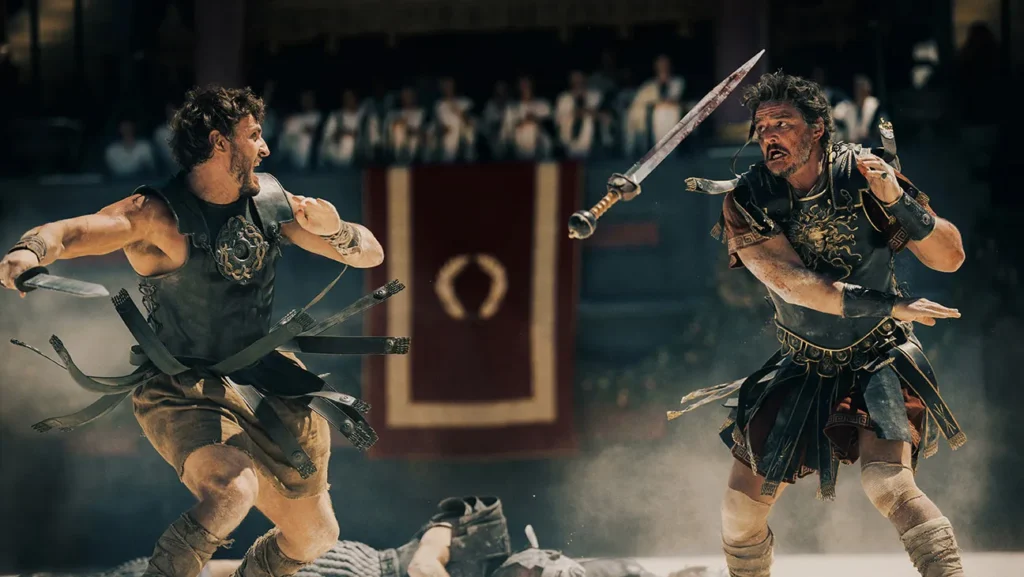

“A republic, if you can keep it.”
So went Benjamin Franklin’s reply when asked about the kind of government the Constitutional Convention had just birthed. More than simply declarative, Franklin’s answer was a warning: Republics require a lot of maintenance. It’s been nearly 25 years since Maximus Decimus Meridius died in Gladiator to make Rome a republic again. Gladiator II makes it clear he failed, if through no fault of his own. Real history concurs. At no point following Julius Caesar’s crossing of the Rubicon would Rome ever truly be a republic again. There’s a warning for America implicit in that as well.
Republicanism looked good on Rome. Her military, architectural, and institutional brilliance facilitated expansion across the Mediterranean, building a wonderous infrastructure of roads, bridges, aqueducts, and ports that facilitated trade and enriched her. She was a thing to behold. Admittedly, Rome, after the Republic succumbed to itself, also wore Empire well. While the compelled peace of Pax Romana meant subjugation for conquered peoples, it was, more than any available alternative, capable of bringing stability and creating and preserving interconnected webs of culture, civilization, art, and tradition (and don’t forget “the sanitation, the medicine, education, wine, public order, irrigation, roads, the freshwater system, and public health”) that helped even those beneath the Roman yoke to prosper. Gladiator makes clear Rome, despite her imperfections, could earn a good man’s devotion. Recall Maximus, after subduing Germanic tribesmen at Vindobona, defending the Roman vision: “I’ve seen much of the rest of the world, it is brutal and cruel and dark. Rome is the light.”
By Gladiator II, this luminescence is in jeopardy. Following his own victorious opening battle, Gen. Marcus Acacius declares over the conquered enemy: “I claim this city for the glory of Rome.” But it’s very clear his heart is not in it. We soon learn why. Despotic rule has again seized the capital. The dream that was Rome is once again rotting from within. A continuing question throughout both Gladiator films is whether Rome is worth the life of one good man. Gen. Acacius appears on the cusp of saying “No.”
This matters. Both films also address themes of war weariness. Gens. Maximus and Acacius, men of violence, fighting to advance the Roman Pax, are more than simply physically exhausted. They long to return home. But duty calls, and each is willing to continue having his life spent—and to spend the lives of his men—for the glory of Rome. Neither, of course, are willing to waste them. This should resonate with us.
Continue reading at WORLD here.




Comment by David on November 29, 2024 at 9:32 am
Doubt has been cast on the Franklin quote in recent times. However, it remains true. It should not be forgotten that the only governmental form to come out of the Judeo-Christian tradition was divine right monarchy. Democracies and republics are all pagan in origin. “Honor the king” (! Peter 2:17) was not the inspiration of 1776.
The greatest danger to republics is the military. This was found in Roman history with various generals fighting among themselves for supreme power. For years, South America suffered from military takeovers. More recently, the democratic government of Myanmar (Burma) was overthrown. It is very difficult for common people to resist the military. The notion that an armed citizenry can preserve a government is a delusion. The US has been fortunate in not having to deal with mutinies.
As noted by the author of the article, the military is viewed as not the best career by young people. Currently, it attracts mostly persons from lower-income populations who have limited options. Of course, AI automation is coming to the military, as well as, industry. The use of remote-controlled drones, and possibly weapons acting on their own volition in the future, are changing warfare.
Comment by Salvatore Anthony Luiso on November 29, 2024 at 10:37 pm
I’ve read that *Gladiator* is set in 180 A.D., and *Gladiator II* is set in 211 A.D..
Does the author not know that the Roman Republic ended hundreds of years before those dates?
I think he does, but doesn’t realize that both movies are set in the Roman Empire, not the Roman Republic.
This is not to say that there’s no merit to his article and its main points.
Note, though, that one period of the Roman persecution of Christians ended in 180 A.D., another ended in 211 A.D., and more followed.
I think that when we consider the question of “whether Rome is worth the life of one good man”, we bear the Roman persecutions of Christians in mind.