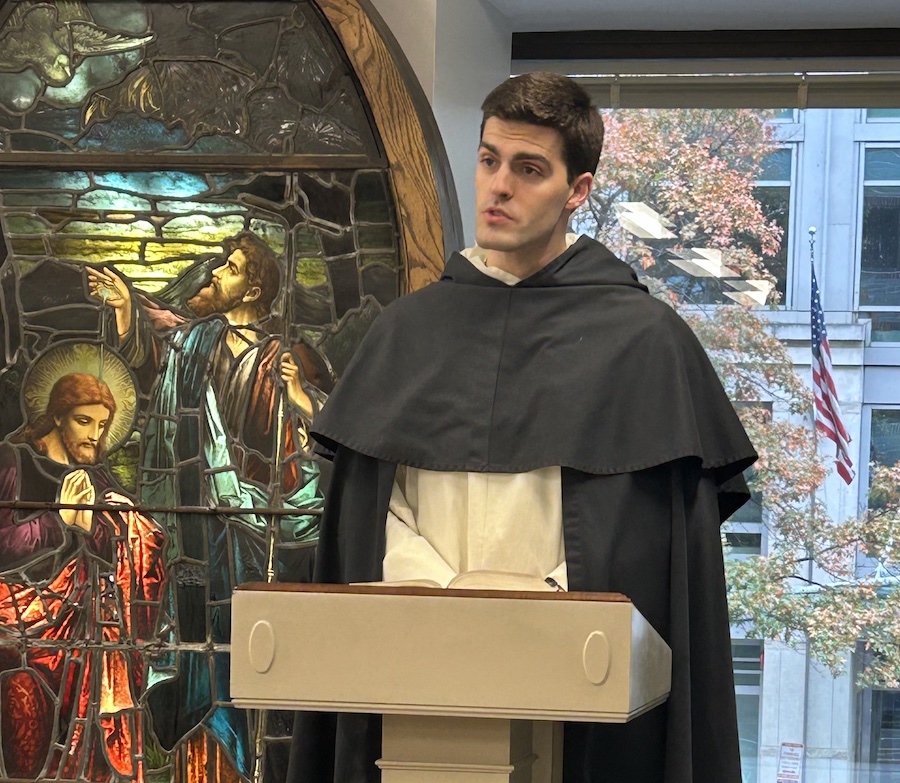

The Institute on Religion and Democracy hosted Fr. Charles Marie Rooney in Washington, D.C. on November 20 for our “Wednesday Worship” noonday prayer and luncheon.
The monthly gathering aims to foster Christian fellowship within the greater Washington area. IRD hosts prominent Christian leaders to deliver sermons, pray, and facilitate worship.
Rooney, a Dominican Friar, spoke to the IRD staff and guests on “The Kingship of Christ, the Democratic Citizen, and the American Soul.”
Video of the worship service can be accessed below via IRD’s Facebook page. Text of the sermon follows.
If you are interested in joining IRD for worship, please contact Events and Outreach Director Sarah Stewart at [email protected].
Since our nation’s inception, Americans have always been suspicious of kings. Too much concentrated power. Too little accountability. Not to mention the apparently arbitrary fate of genetics, familial line, nobility—ripe for corruption and ineptitude.
And yet at the end of every liturgical year, as we approach this Sunday, which many Christians will celebrate in honor of Our Lord Jesus Christ, King of the Universe, we confront a truth quite counterintuitive to the American soul: that every Christian is in fact a monarchist. For, well, Jesus Christ is unabashedly our king, born of the line of David—a genealogical line with its own fair share of corruption and ineptitude (Luke 1:32, 3:23-38; Matt 1:1-16). And heaven is indeed a kingdom—his kingdom—not one of this world, no, but all the same a kingdom at hand in this world. Because yes, by grace and through faith, any human person on the face of the earth can have, even now, citizenship in heaven (Phil 3:20) thus becoming a citizen—a subject—of Christ the sovereign king.
The Kingship of Christ
Often, when we think of the Kingship of Christ, especially at the end of the liturgical year, our minds turn to his judgment—to what we might call his judiciary power. That he is, truly, the judge of the living and the dead (Apostles Creed).
But we also know that Christ not merely the Chief Justice of the heavenly courts. He is also Supreme Legislator, for he himself is the eternal Law of God made Incarnate—conceived by the power of the Holy Spirit and born of the Virgin Mary for this purpose, that he should come into the world to testify to the truth of God’s eternal law (John 18:37). The eternal law: God’s eternal wisdom itself… the eternal designs of his providence and predestination. To Christ, the Supreme Legislator, false teaching, corrupt legislation, illicit concessions to special-interest groups—these things are wholly foreign. His Word is truth. And His Word sanctifies us in the truth (John 17:17).
Yet Christ is not merely Chief Justice and Legislator: he is also indeed Chief Executor, which rule he executes from the throne of His Cross. Because when the truth of God’s eternal wisdom and love enters into the world and meets the fallenness, the sinfulness, the political weakness (pusillanimity) of which Pontius Pilate is such an icon—we get the Cross. The Cross is no accident, then, but the very playing out in time of that eternal divine legislation. That God would manifest on earth not the extent of his wrath but rather the power of his love… by meeting sin face to face and even allowing himself to be—by all visible appearances—conquered by sin. Yet for those who are being saved… for us who believe… Christ, the Executive Power of God and Christ the Wisdom of God (1 Cor 1:24). Such that we can really say that the glorious throne room that St. John beholds in chapters 4 and 5 of the Book of Revelation with its bright light and precious stones and flashes of lightning and peals of thunder, wherein God’s executive, legislative, and judiciary power are absolutely concentrated—when the power of that throne room descended to earth, we beheld the throne of the Cross.
Christ, the King—he is an absolute monarch in as much as he possess all power in himself. Christ, the King—he is a constitutional monarch inasmuch as we, by grace, are made constitutive members of his body, of which he is the Head.
The Democratic Citizen
To the ears of the democratic citizen, the foregoing may sound quite strange. The key features of democracy—the choice of our leaders, freedom of expression about them, and limitations on their governance—these do not pertain to the life of Christ and His Church. Yes, it is true, we can choose whether or not to subject ourselves to Christ’s Kingship, and what or if we would like to speak to God, but we cannot choose whether or not we are actually subjected to the Kingship of Christ. For no one can escape his Executive, Legislative, and Judiciary Power. And everyone will glorify the Kingship of Christ for all eternity… whether the glory of his mercy in heaven, or the glory of his justice in the infernal fire.
Yet the reverence we must render to God never militates against the true responsibilities of democratic citizenship that we enjoy and render to Caesar here on earth. You would have no power over me unless it had been given to you from above, Christ will say to Pilate shortly after our Gospel today (John 19:11). Which is to say that the only way to serve Caesar is first to serve God. Only God has universal knowledge, goodness, and universal power—which means only God can govern perfectly. That he gave all authority in heaven and on earth (Matt 28:18) to the sacred humanity of His Son flows from the sheer gratuity of the Incarnation—that God would invest one man with all of his knowledge, all of his goodness, all of his power, all of his Personhood.
But for us mere humans—who are not true God and true man but are only true men, and so do not have the universal knowledge, goodness, or power of God—the only way to govern rightly and the only way to be governed rightly is first to know and to love the eternal law of God. The eternal law of God as it is made known to us by nature (in the natural law) and then, even more, as it is inscribed on the flesh of our hearts by the light of grace (in the Divine Law). For it is indeed the eternal law of God—even as it is made known to us merely by nature through the natural law—that enables us to make sense of what government is for… which in turn moves us to choose good leaders, to live as good citizens, and to recognize due limitations on political power. For thus we trust trust that only God’s governance—which reaches even to the heart—can cure sin, while political governance—which extends only to external behaviors—cannot.
The American Soul
It should bring great relief to the American soul, then, that the Kingdom of Heaven and the Democracy of Man are not per se in tension. For they have the same ultimate object: God. God is the common good of each. Which really means that our whole life, civic and celestial, can really be all about God. The Democracy of Man—it exists to order us, its citizens, to virtue, to material prosperity, and to a civic friendship that directs all things toward God our common creator, whose image and likeness we bear (Gen 1:27). And the Kingdom of Heaven exists to elevate us in grace to a supernatural virtue, a supernatural prosperity, and a supernatural friendship—divine charity—that directs all that we are to God, who is not just our common creator but, even more, our common redeemer according to the Image of His Son (Rom 8:28ff).
Thus, in the civic polity: God. And in the celestial polity: God. Because the God who created us as political animals is the God who saves us as political animals, even if these polities operate according to different dynamics, different lights… the earthly according to the light of reason elevated by faith, the heavenly according to the light of faith received in and extended through reason.
***
Here, then, the American soul sees one final key point of continuity between the two kingdoms: mediation. Every polity needs mediators, which diffuse the concentrated power of an authority outward to each of its parts. In the earthly polity, a government’s first responsibility—the preservation of its polity—is mediated at its most basic, intimate level to its citizens, to a man and a woman who unite before a magistrate at a civil marriage. Thus they bring new life into the world, rear children to full adulthood, feed them daily, and teach them justice through their household responsibilities and mercy, when they misstep, through an apology. And then through many other offices and ministries, a government’s central authority over its citizens is mediated, diffused locally—not so as to obstruct the affairs of its citizens but so as to assist them, to order them, to perfect them: and so we have general standards for healthcare and education, and other endeavors that care for infrastructure and the commonweal.
In the Christian tradition, in the heavenly polity, the causes of this mediation during our time as wayfarers are called sacraments. They are holy signs of Christ’s Passion which mediate the redeeming power of his Passion—the saving grace of his Passion—by infusing his life into our depths. Such that the very same pattern of human life that plays out over the course of the natural city, the earthly city—from birth to adulthood to daily food to justice and mercy to marrying and being given in marriage to healthcare to political governance—is now elevated and transfigured in Christ. And so the Christian is born into the Kingdom of Heaven through Baptism and brought to full stature in Confirmation, fed with daily bread in Communion, and taught God’s perfect justice and boundless mercy through the Confession of sins. The Christian replicates the Church and her members in Holy Matrimony, receives spiritual healthcare in danger of death by Anointing, and is governed—ordered to the heavenly kingdom—by those in Holy Orders. Through these sacraments, Christ’s power, Christ’s saving grace is refracted for us… not as if to put more distance between us and God but rather to draw us closer to him in and through each of our needs, to encompass the whole of our humanity, at every stage of life, in every respect—the whole of which he himself assumed, save sin (Heb 2:17, 4:15), for our salvation.
This mediation begets a union that is not merely one of subjection—as servant to master, or citizen to potentate. No, this union culminates in friendship: that every Christian would by grace be truly be called a friend of the King—I have called you friends (John 15:15)—and so come to converse daily, even constantly, in the King’s presence within him. Divine friendship with Christ, the Absolute Monarch, and divine civic friendship among the members of his Constitutional Monarchy. So that the Kingdom of Christ, which is not of this world, would be made present in this world, to the ends of this world (Mark 16:15).
Thus we hear from St. Elizabeth of the Trinity, a French Carmelite nun and mystic at the turn of the twentieth century: “I have found my Heaven on earth, since Heaven is God, and God is [in] my soul.” He longs to be in ours, too—our American souls, working to win fellow democratic citizens for the Kingdom of Christ.


Comment by Mary Susan Meyer on December 5, 2024 at 9:38 am
Thank you for this delimation of us as duel citizen of God’s Kingdom and a democratic nation. I love your oft mentioned reference to marriage and child-raising–so needed today. I only wish the Catholic Church allowed its leaders live as examples of it.