
As U.S. voters return to the polls today, culture war issues are potentially at the top of many Christian voters’ minds. Abortion, Religious Freedom, LGBTQ+ issues, and Israel policy have in recent years informed Christians’ decisions in casting a ballot, but attention to these important matters has led some to neglect other policy prescriptions gleaned from the Christian tradition.
Christian attention to the free market and property has waned significantly this election cycle. To revitalize this integral element of Christian politics, there is no better place to turn than the Church Fathers.
Free market skeptics, from the Evangelical Left to the Populist Right, are often tempted to assume that market economics is a theological innovation of mercantile Dominicans, thrifty reformers, or 20th Century Christian conservatives. It is often tempting to read Gospel verses commanding the rich to “sell all [they] own” as an endorsement of state redistribution of wealth. Instead, the tradition of the Church, since the patristic period, has always been one of economic freedom and voluntary charity.
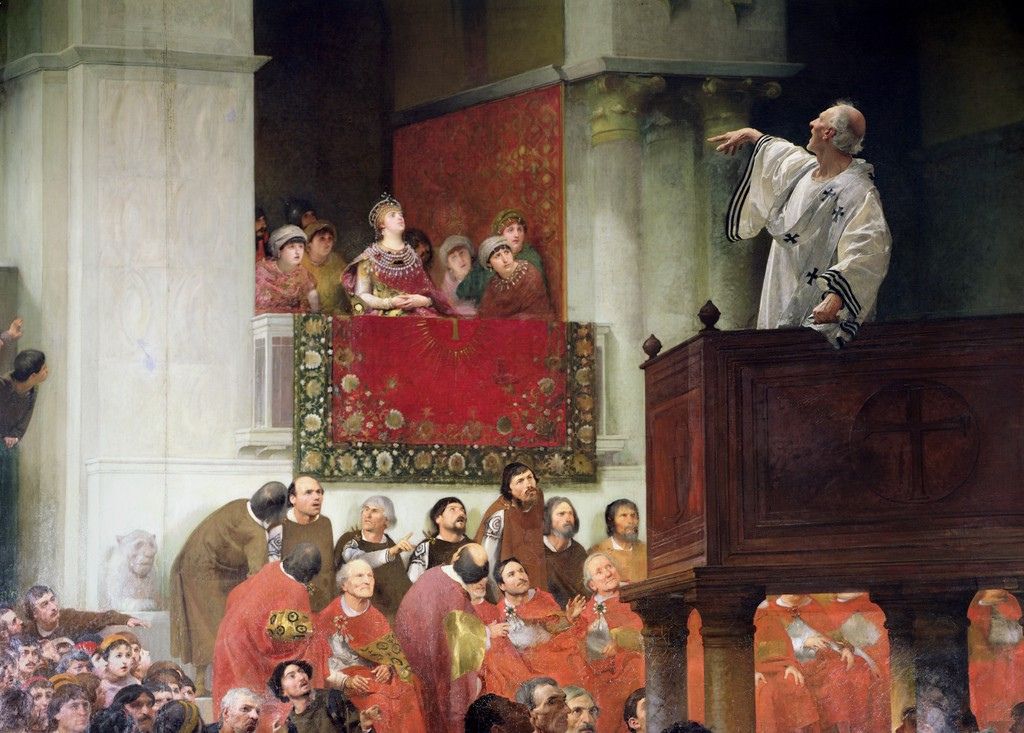
Church Father John Chrysostom is among those most remembered for his writing on wealth while serving as Archbishop of Constantinople. The early Church’s fieriest orator, Chrysostom’s homilies have long been considered among the foundation of Christian thought on wealth. Chrysostom was such a ferocious opponent of the wealthy that, when questioned why he so frequently assailed the rich, he replied: “Because the rich are continually attacking the poor.”
Despite his disgust for the greed of the rich, Chrysostom understood wealth as a fundamental good deformed by sin. In his homily on Lazarus and the rich man, Chrysostom implored the rich that “God has permitted you to possess much… that you should distribute it to the needy.”
Chrysostom taught that wealth was produced for the good of the community through voluntary distribution.
A sharp critic of the market as a hotbed of vice, Chrysostom also found that the market was far from irredeemable. He wrote that man established markets “in order that we may be united with each other,” brought into God’s community by satisfying each other’s needs through exchange and eschewing luxury. An enduring opponent of excess, Chrysostom still identifies a market economy with robust charity as the proper engagement of Christians with money.
This understanding of the economy is also echoed in another patristic opponent of avarice, St. Basil the Great. Basil harshly excoriated accumulators of vast fortunes, writing, “Your possessions are more a part of you than the members of your own body, and separation from them is as painful as the amputation of one of your limbs.”
Nevertheless, Basil saw the remedy to the spiritual perils of wealth not as forced redistribution but as circulation through commerce. Referencing the Psalms, Basil remarked, “If you hoard [wealth], you won’t keep it; if you scatter, you won’t lose.” The purpose of money is not to accumulate but to circulate throughout the community, exchanging for necessities and aiding the unfortunate.
Basil calls the covetous man one who decides to “keep for private use what [was] given for distribution.” This distribution is not the construction of grand public works through the beneficence of the state, which the Greeks called philotimia and the Fathers despised. Rather, Basil implores the faithful to give freely to each other out of interpersonal obligation derived from our common humanity rather than a top-down system of reallocation.
Beyond Chrysostom and Basil, similar concepts are found in Ambrose, Augustine, and Gregory of Nyssa. As Christians engaging in the public sphere, we must remember that although the poor will always be among us, the early Church understood the solution to the problem of poverty as astoundingly simple.
The voluntary transfer of wealth, the circulation of goods in a market economy, and a Church willing to rebuke state and private greed are the foundational elements of Christian economic thought.
Amidst hot-button debates on tariffs, price controls, and other state transfer mechanisms, we must recall that “our money is the Lord’s, however we may have gathered it,” and encourage our legislators to act accordingly.




Comment by Tim Ware on November 5, 2024 at 8:36 am
John Chrysostom does get the distinction of being the first whose writings have survived to assure us that the things Jesus clearly and explicitly said about material wealth and possessions were not what He really meant, and that what He really meant were things He never said.
Comment by Wilson R. on November 5, 2024 at 11:16 am
At first I thought it was only the headline that is misleading, but I see that the problem is embedded within the column itself.
First, this piece focuses primarily on the perils of accumulating wealth and the proper stewardship of it. Not a lot to disagree with there, but it’s not the focus that the headline suggests.
Second, to the extent that this piece DOES deal with free markets, it’s about the marketplace economics that existed in John Chrysostom’s time. We don’t know what this church father would say about unfettered corporate power today, or about the imperative to put profits and “shareholder” value over any sense of shared responsibility to the poor and weak. But I have a pretty good guess, because even the conservative popes of my lifetime have expressed a dim view of corporate wealth and power.
Comment by David on November 5, 2024 at 1:54 pm
Acts 4:32 All the believers were one in heart and mind. No one claimed that any of their possessions was their own, but they shared everything they had.
Anyone suggesting that today would be branded a communist.
Comment by Tim Ware on November 5, 2024 at 3:55 pm
Western Christianity has long allowed itself to be used as the chaplain to society, which means that it finds a way to give divine sanction to whatever happens to be current in society at any point in time. This is illustrated in its support for capitalism, in its flip-flop on slavery, in its flip-flop on women, in its flip-flop on sexual issues…the list goes on and on. Whatever happens to be current in society, it will give divine blessing to.
Comment by John on November 8, 2024 at 5:56 pm
Tim Ware,
What exactly do you mean when you say flip-flop on women?
Comment by David Gingrich on November 10, 2024 at 6:45 am
Economic freedom has been proven – over and over again – to provide the greatest economic good to the greatest number of people.
Or, Tim Wise and David, you can move to North Korea or Cuba (or Russia or China or….) to learn for yourselves.