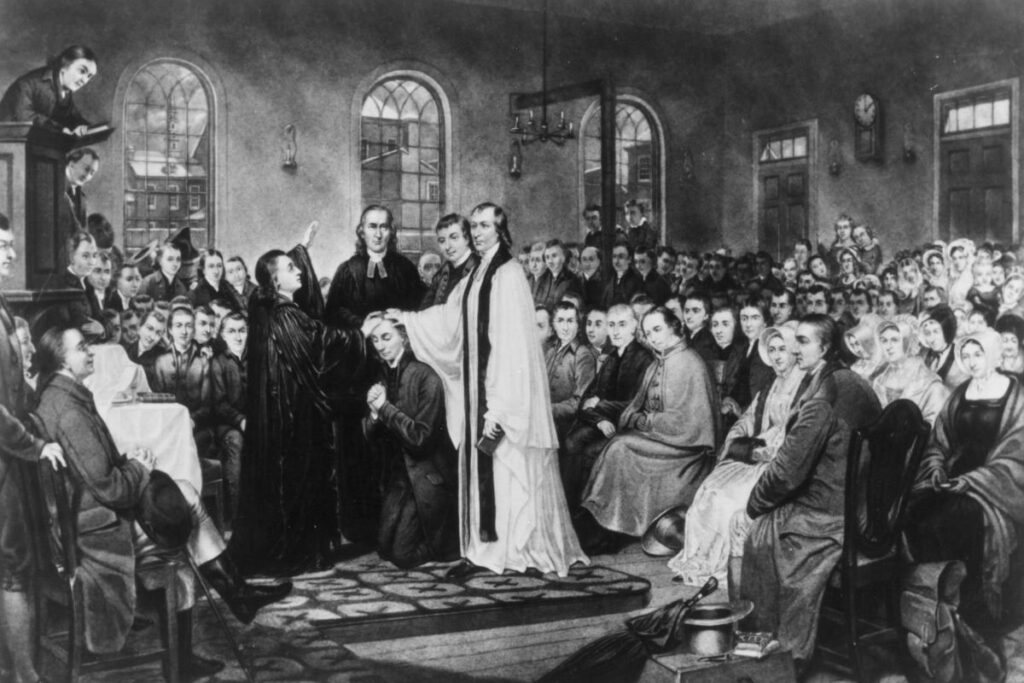
The Wesleyan movement has had an awkward relationship with episcopacy from the beginning. When John and Charles Wesley first began to organize the “people called Methodists” into classes and societies and send out lay preachers across Britain, they fell foul with the bishops of the Church of England, and rightly so. What they were doing was nicely called “irregular.” They were crossing boundaries, sometimes literally in terms of parishes, and clashing with the spiritual oversight of the church. But the Wesley brothers never intended to upstage the church, but to revive it, or better yet restore it. At the heart of Wesley’s overarching vision for Methodism is a restoration of the passion and power of the early church, what he called “primitive Christianity.”
Beginning in the 1750s, the Wesley brothers begin to work less and less closely with one another as John’s vision for Methodism begins to take on a more independent hue. He never left the Church of England. He died within her embrace. But at the same time, he created a worldwide network that for the most part would leave Anglicanism and create its own ecclesiastical structure. The causes for this are too many to discuss in this article. But it can arguably be said that both intransigence among the church’s leadership and bullheadedness on Wesley’s part contributed in unhelpful ways. There could have been a way to incorporate the Wesleyan movement into the structures of the church and Wesley could have been less authoritarian, but that is not what happened.
In England, this separate Methodism took decades to evolve, even after the Wesley brothers had died. But in America, the Revolutionary War and the subsequent need for clergy in the newly independent United States quickened the situation. Arguably, John Wesley took advantage of it and fully embraced the revisionist ecclesiology that Charles detected decades earlier. He declared himself a “New Testament bishop” and ordained Thomas Coke as a “superintendent” and Richard Whatcoat and Thomas Vasey as “elders.”
When this took place, Charles Wesley exploded. He’s so well known for his hymns and little known as a person by most Wesleyans today, but Charles was first and foremost a loving husband and father, and an ecclesiastical conservative. I have argued elsewhere that the reason he began to travel less in the 1750s was not because he was married but because he perceived the initial stirrings of revisionist ecclesiology emerging from his brother and some of the lay preachers and wanted nothing to do with it. Yet he remained at the heart of the movement as the conservative voice, the traditionalist who tried to remind his brother of the church, and of the theology behind what it means to be the church.
Continue reading at Firebrand here.
Ryan N. Danker is the director of the John Wesley Institute, Washington, DC and Assistant Lead Editor of Firebrand.



Comment by Dave on August 28, 2024 at 10:30 am
In the full article, there are references to ordination being treated more as licensure than as lifelong ordination. That suggests that early American Methodists (and perhaps British Methodists — I don’t know enough about the difference) were either influenced by the Puritans or they reached a similar conclusion to the Puritans. “The Congregational Way” (in its strictest interpretation) posits that your ordination is a “setting apart” for ministry in a particular church, and when you go to a new church, your “installation” is actually a form of re-ordination (at least historically). Regrettably, even many Congregationalists abandoned that idea by the early 1800s. Ensuring that every minister is truly accountable to a local congregation would temper a lot of the problems faced by mainline denominations.
Comment by John on August 28, 2024 at 7:54 pm
Dave,
I’ve found in practice that pastors ONLY accountable to a local congregation, end up being only accountable to themselves. Congregationalism has a higher tendency toward cults of personality.