Roman Catholics should consider different classes of liberalism and how they affected the society and culture of today, according to two Catholic thought leaders seeking to engage with both secular pluralism and post-liberal movements including Integralism.
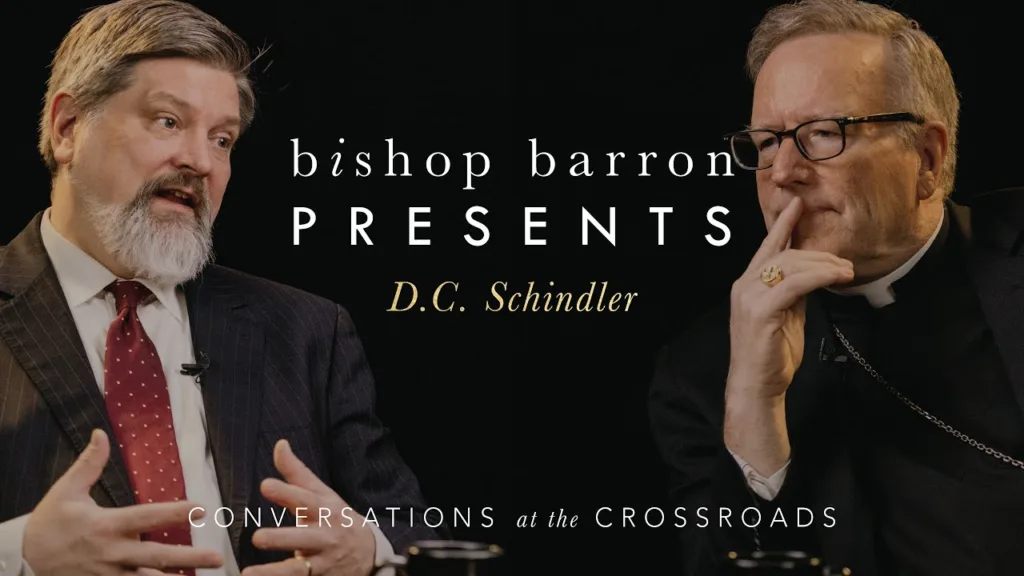
Bishop Robert Barron sat down with Catholic philosopher D.C. Schindler on March 14 to mull over the goods of classical liberalism and those who, spurred on against exaggerated forms of liberalism, swing to an absolutist, contrary position.
Among the ideas discussed was that the church proposes, rather than imposes, in public life. It is neither silent nor is it dictatorial in the public square.
Barron, who serves as bishop of Winona–Rochester in Minnesota, is founder of the Catholic ministerial organization Word on Fire. Schindler is a Professor of Metaphysics and Anthropology at the John Paul II Institute in Washington, D.C.
“Do we recognize the goods that we rightly see in liberalism, do we recognize those in their truth as having their roots in this organic tradition that we’ve inherited, or do we isolate them from that?” Schindler asked. “The most enthusiastic and sincere Christian believer can actually interpret these things as isolated from this tradition. That’s the main issue. My contention is the moment you’ve separated from this tradition, it’s going to evolve and devolve over time.”
The Catholic philosopher proposed that this is only a matter of time, and that American society is bearing the fruit of, and seeing, some of that now.
“Especially in our ‘wokest’ time, I’m kind of with those who say there’s a trajectory within classical liberalism toward where we are now because, you’ve got to just keep finding new groups to liberate, and new forms of oppression, and then the ever-increasing focus on the self and the sovereignty of choice,” Barron suggested. “But that’s such a desert landscape.”
In response to that desolate landscape, Schindler noted that post-liberalism has emerged as one of the growing movements.
“I think it’s arising precisely after liberalism,” Schindler identified. “It tends to lack an anchor in something substantial, and so we’re beginning to see some really frightening instances: people are so tired of wokeism and the exaggerated forms of liberalism that they want the absolute contrary as you take solace or consolation in something that’s a violent overthrow of that.”
The problem, Schindler proposed, is that an otherwise sympathetic movement sets into greater relief the mission that Catholics have right now to show that Catholicism isn’t post-liberalism (in the sense of something that emerged after liberalism).
“It predates all of our liberal institutions,” Schindler said of Catholicism. “There’s still this green branch extended to us that we can reattach ourselves to and restore a healthy culture.”
Among the classically liberal concepts that Schindler celebrates is the freedom of religion.
“We have freedom to practice religion precisely because of the truth of religion,” Schindler identified. “Being rooted in the tradition enables you to first of all practice your own religion. But, I would argue – and this hasn’t always been recognized properly adequately in history – but that also is precisely the same resource that would allow you to recognize the dignity of other traditions.”
That, the Catholic philosopher noted, differs from saying “let’s clear the deck, let’s clear the space, and all possible claims for religion are equal.”
“What you then give liberty to is not religion, because religion was always a part of a tradition, it always had a cultural dimension: it was always public, it always included politics, the political sphere in its particular way,” Schindler explained.
“Would you hold the church has become too much in a hand-wringing attitude and withdrawing too much from the public sphere? And ‘well that’s not our business’ and part of the answer is a boldness on the part of the church to come forth into the public arena and to, as John Paul II said, not impose but propose our vision of life?” Barron asked.
“Young people want a bold proposal,” Schindler proposed. “The danger is that if the church doesn’t make a bold proposal, there are a lot of people on the internet that are making bold proposals that are deeply problematic.”
Barron insisted that there is no neutral space.
“Everyone’s got a metaphysics and then it’s power language, too,” Barron stated, with those in power to impose a basic metaphysical view. “We do have that in our public space in our country. It’s a certain metaphysical view, this privileging of the individual and choice, so let’s have a vibrant public conversation about it.”
“Liberalism has taught us to think that every interpretation of reality is a competing opinion over and against others,” Schindler observed. “Once you concede that, the game’s really already over. The point is that we don’t begin with an opinion or an interpretation, we begin with a recognition that there’s a truth that precedes us. So that when we attempt to articulate it we actually have grounds for correcting our interpretation and recognizing what I had thought previously is actually not adequate. You can’t really do that if it’s competing opinions.”
The full interview is embedded below from the Word on Fire YouTube channel:




Comment by Hannibal on April 22, 2024 at 8:10 pm
Bishop Barron the man who claims Hell might be empty, and who has praised several immoral and unnacceptable films on his YouTube channel? Who claims to be a fan of pornographic anti-Christian filmmaker Quentin Tarantino, with his vicious depictions of meaningless violence and aberrant sexuality? He might as well be a fan of Marquis de Sade or Henry Miller. No, thank you. The guy is a fake and a mediocre, and should never have been made a bishop.