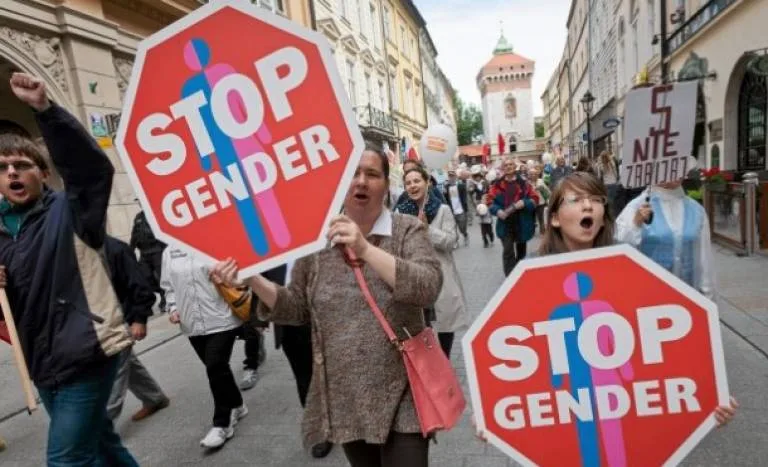

Europe recently is giving signs of pushback against gender ideology and its coercive policies, as gender transitioning of minors has been banned in England, and caution is evident elsewhere. Nevertheless, the United Kingdom faces the threat of a “conversion therapy” ban, essentially prohibiting religious activity against LGBT behavior, as was reviewed in an earlier article, while the alarming speed with which gender activists have seized the overculture is just as evident in even the reputedly socially conservative nations of Poland, Hungary, and Italy as in America and the U.K.
This was discussed by Jay Richards, Director of the DeVos Center for Life, Religion, and Family at the Heritage Foundation and a panel of European experts involved in the conflict with gender ideology there on February 27.
Richards explained that gender ideology rejects the concept of biological sex (which is really to reject sex per se) on the grounds that it does not “capture human reality and human experience, but rather if we want to understand human beings in all of their variety and diversity, it’s much better to think in terms of an entirely internal, subjective psychological state called a ‘gender identity,’” This he said “is an internal sense of gender.” Of course this is “circular,” but “that’s the best we can do.” Sex, according to gender ideology is only a set of biases associated with certain body parts, “but it’s an assignment … it’s not the real thing.” But the “real thing” is really subjective. To state the obvious, society cannot be based on subjectivity, but that’s exactly what gender ideology proposes. The ideology simply attempts to force people to regard an individual’s subjectivism as objective reality. Thus under our current “medical regime,” it becomes reasonable to transform an individual’s surroundings and even body to conform to their psychological state.
This concept of “gender” was unknown to people in the past, Richards said, but has now has “suddenly work[ed] its way through our consciousness and come to dominate most of the institutions of the West.” Although Americans may be focused on the struggle over gender ideology in the United States, we “often don’t realize how this is playing out in other countries.”
The Gender Threat in Italy and Hungary
Richards turned to Daniele Scalea, Founder and President of the Centro Studi Machiavelli, a think tank promoting social conservatism in a contemporary context, to describe the situation in Italy. There, Scalea said, “the Left has fully embraced gender ideology.” It favors “the criminalization of dissenting views under the guise of transphobia.” The news media is pushing gender ideology, especially to the young. Partisans of the ideology deny “the very existence of a gender theory … they think that their view is not just a theory, but an objective truth.” Of the Italian population, very few publicly hold to gender ideology, yet advocates of the ideology are spread throughout academia and the media. Each year, the Left manages to push “the boundaries of what is perceived as common sense” further to the left. At this point 60% of the public support same-sex marriage, 50% support adoption by same-sex couples, 40% support surrogacy, and 10% claim LGBTQ identity. This, he said, is not only due to the news media, but also due to LGBT indoctrination in the schools. “Hundreds of projects” push “gender ideology on children and teenagers.”
Richards then asked about Hungary, often perceived as socially conservative. Is gender ideology advancing there? Gergely Szilvay, a journalist and Senior Fellow of the center-right news group Mandiner said that gender ideology proceeds from second wave feminism and “its sharp separation of soul and body.” Its motto of “quality of life” prioritizes pleasure. Szilvay said the professed objective gender ideology is “to bring heaven to earth.” It proposes to change the structure of the family, and “change society from the very base.”
In response to gender ideology, Hungary has passed a Child Protection Law, which dealt in part with pedophilia, but also prohibited LGBT ideology directed at children. The European Commission then sued Hungary, maintaining that it violated the basic values of the EU. These values, such as the “rule of law,” are formally listed, but are sufficiently broad and idealistic to permit widely different interpretations. “Gender equality” has indeed been a formal objective of the European Union and its predecessors since 1957, Szilvay said, but then this equality referred to biological sex, and not “gender” in the sense of one’s subjective feeling about sex. This writer would add that it says something about the EU regime that a law banning sexual material directed at children should be against its “basic values.”
Poland’s Shift to the Left and the Istanbul Convention
Richards then asked about Poland. Jerzy Kwaśniewski, President of the Ordo Iuris Institute for Legal Culture said that the situation in Poland is now quite “dangerous,” since the socially conservative Law and Justice Party government has been replaced by a socially liberal, pro-European Union Civic Platform coalition in the recent election. Poland faced fierce criticism during the years of conservative government from both the EU and the international media for not implementing the LGBT agenda. With the move to “hate speech” laws, expansion of the abortion license, arrest of political opponents, and purging institutions of social conservatives “we are stepping into the gender ideology time.”
Kwasniewski said that the “anthropological error inside gender ideology” is very similar to the error Pope John Paul II found when he analyzed communism. According to the false anthropology used by gender ideology, sexual gratification “is a central aspect of being a human.” Making sexual gratification central to human life results in individuals unbound to their families, the past, and even future prospects. Expressive individualism and Critical Theory are additional parts of this anthropology. All social tensions are held to be “a simple result of difference between gender roles.” These elements “are being implemented into the Polish legal system by the new liberal majority.”
U.S. diplomacy under the Biden Administration is “supporting those radical revolutionary changes.” Although in the past, the Polish people thought of the United States as a “trusted ally,” it now is a force for social radicalism. Poland, unlike Hungary, but like Italy, has ratified the “Council of Europe Convention on Preventing and Combating Violence against Women and Domestic Violence” (the “Istanbul Convention”), and is thus committed to its social engineering goals aiming at the elimination of traditional sexual roles and morality. Those states that have ratified the Convention are “overwatched” by the Group of Experts against Violence (GREVIO) which monitors the Convention for compliance. Kwasniewski noted that a draft law prohibiting the gender transitioning of minors, supported by majorities of all parties in Poland, “was not taken to Parliament … because of this international pressure.” Realistically, he said, many European countries have “limited sovereignty,” and so cannot or will not take the action they otherwise would.
The Istanbul Convention and Mandated Social Engineering
Richards asked Kwasniewski to briefly review the Istanbul Convention. Kwasniewski said that the convention is the first binding international agreement to attempt to integrate gender ideology into state law. He said the preamble defines “all the tensions in the families” as a result of differences in gender roles. History is understood as a struggle between men and women for power. The family is seen as a source of violence. Article 12 proclaims an obligation for all states “to implement social engineering to eradicate tradition,” he said. Article 14 obliges all parties to the treaty to implement a “gender based violence approach at all levels of [educational] curricula.” Article 29 “waves attorney client privilege in cases concerning violence.” The convention’s ultimate aim is to realize a utopian vision “where the family is perceived as a source of violence.” Natural marriage and the natural family are to be understood as “a danger, a threat for children.”
Richards added the Convention presents itself as dealing with the laudable goal of preventing violence against women, but essentially uses Conflict Theory to find violence. Kwasniewski noted that a number of central European countries have refused to ratify the convention, most notably Hungary, Slovakia, Czech Republic, and Bulgaria (by Bulgarian Constitutional Court decision).
It should be added to Kwasniewski’s observations that a review of the Convention’s text show how radical it is, that it indeed explicitly attacks tradition and attempts to change culture with the force of (new) law. It involves social engineering by unaccountable experts, which would effectively render sex differences irrelevant (at least in law and public policy), which of course they can never really be, since sex is real.
The Convention is in fact a tool to make national governments and societies conform to the reigning gender ideology. It holds that sex (or “gender” as the text of the Convention describes sex) to be “socially constructed” (Article 3) and calls for state intervention to prevent violence based on its doctrine of gender. With no necessary connection to the human body, “gender” has many varieties, those of which we have become familiar (male homosexual, lesbian, “transgender man,’ and “transgender woman,” plus many more). Both “sexual orientation” and “gender identity” are included as antidiscrimination categories (Article 4), so “gender” does have this expansive meaning. Indeed, being specific to an individual at any given moment, there are theoretically an infinity of genders.
The Convention’s preamble speaks of “the structural nature of violence” (presumably traditional sexual structures, such as the natural family), and “all forms of violence against women” (which could mean anything state authorities care to make it mean). Article 3 specifies that “violence” includes “psychological” violence, so virtually anything could indeed be classed as violence. The expression “all forms of violence” seems to recur throughout the document. One thus has no way of knowing exactly what is meant and is left with the suspicion that whatever those charged with policing the Convention deem “violence” will be cause for state intervention in personal relations. Article 12 of the Convention specifically calls for state intervention to change culture, so this is definitely social engineering according to what the text of the Convention itself calls a “gender perspective” (Article 6), and critics would call gender ideology.
Subsequent Convention articles (13-15) call for consciousness raising (rendering people woke), and indoctrination “at all levels of education”. (Article 14). The private sector is enlisted in the consciousness raising project (Article 16). The general public is encouraged to report “violence” (Article 27) as are professionals (Article 28). Lawsuits based on gender law are to be provided for (Article 29) and compensation to victims (Article 30). Article 33 calls for “psychological” violence to be “criminalized.” All this and much more is to be monitored and evaluated by a “group of experts on action against violence” (Article 66). It is clear that the various mechanisms to prevent violence against gender are mechanisms to dissolve social relations and reconstruct them according to the preferences of the authorities who enforce those provisions of the Convention that a state has enacted into law.
The Convention has now been ratified by much of Europe (Russia and some central and southeastern European countries excepted) and represents a grave threat to freedom in personal life.
Awareness of the Gender Threat by the Political Right
Ernesto Araújo, International Advisor the Fundación Disenso, which promotes social conservatism in the Spanish speaking world, said that the Iberian Peninsula is a bridge between Europe and Latin America. He said that the center/right parties in Europe “tend to focus only on the economy, on trade.” The center/right party in Spain has joined both the LGBT and climate agendas. But the source of conflict in Europe is definitely “not the economy.” The denial of sex differences is far more radical than economic measures, but is presented as merely a matter of customs, when in fact it is a denial of realities. He said that “the most important distinction is between what is and what is not.” This distinction takes us away from the nominalism of gender ideology. Things are classed not by their names, but by their substance, what a thing really is. Richards emphasized that gender ideology represents “an attack on the most fundamental reality” we see in ordinary life, the difference between males and females and the need for the family and the reproductive act as the “cell” of any society. Against the mere economic conservatism of many of the old right parties in Europe, “you have to build [a] solid conservative program on top of values,” Auraujo said.
Richards asked if any conservative parties are recognizing the threat of gender ideology. Scalea said that in Italy the conservative parties have two objectives. First is to “avoid the criminalization” of opposition to transgenderism. A recently defeated law would have disqualified for office “any politician deemed as transphobic.” The other is to recognize surrogacy “as a universal crime.” It is already illegal in Italy, but proposed legislation would prohibit obtaining children through surrogacy in foreign countries.
Richards further observed that European countries often do not stand up against gender ideology at the United Nations because of the pressure they experience in Europe. Szilvay said that United Nations actions are often non-binding, but they effectively become “soft law,” which then tends to move toward becoming hard law. The term “rule of law” in particular has no clear meaning, he said. There is also a tendency to “medicalize” issues. People who disagree with gender ideology are described as suffering from a “phobia” (homophobia, transphobia, etc.).
Kwasniewski said that many of the policies attacking traditional society by implementing gender ideology are created on the international level and then imposed on European countries such as Poland. These include measures against “homophobic speech” (defined by one NGO as opposition to the political objectives of the LGBT movement), hate speech laws, and the abortion license. Currently much of this is non-binding “soft law,” but “through the rule of law” principle, they are being used to evaluate countries by international bodies according to the objectives of the radical left. There is currently the beginning of a massive project to alter many international treaties in Europe to conform to the mandates of gender ideology. This also has the effect of transferring authority from the democratic national governments of the EU to bureaucrats in Brussels.
Three key elements in the implementation of gender ideology in the United States are the assumption of new gender identities by students at school without the knowledge of parents, compromise of the integrity of women’s sports by the inclusion of males, and the gender transitioning (stopping puberty, surgery, etc.) of minors, Richards said. He asked how the ideology is proceeding in Europe. Kwasniewski noted that the educational system in Poland is public and centralized, making the inclusion of gender ideology easier. There is now a growing interest in private and classical education. Laws in other countries may differ (Germany prohibits homeschooling). But non-public education is threatened by the amendments of the European treaties, which give centralized control of education to the EU bureaucrats in Brussels, who aim “to prepare a new European man, for a new European Empire.” Szilvay noted that one of the earliest EU resolutions against Hungary claimed that Hungarian society was “too conservative.”
Richards asked what was “most likely to be the Achilles heel” for the gender ideologists. It was agreed that gender transitioning of minors was where social conservatives are most likely to prevail, but there was a danger of winning that battle and still being unable to stop other destructive parts of the program of gender ideology. Richards mentioned the French philosopher Michel Foucault in this connection, and his objective of the sexualization of children.
Kwasniewski said it rests with conservatives to oppose the various ideologies that deny human nature, as centrists will likely fold on cultural issues. He said that the longer these anti-human ideologies live, the more people will die. Only Christianity offers a metaphysics and anthropology that can accommodate human life as it should be lived. Whenever “Christianity is strong, the ideologies are weak,” he said. He added that many in the general public are indifferent to the depredations of gender ideology, or intimidated by the ferocity with which it is advanced. Courage and political action are needed to stop it, he said.





Comment by Corvus Corax on April 4, 2024 at 1:12 pm
I’ve always found it interesting the former Soviet bloc nations seem to be more resistant to what I will call American homo-imperialism. My hypothesis is that social liberalism, in particular the sexual revolution and its consequences, represent incursions of bourgeois decadence into ordinary human life. Western Europe and North America have simply been worn down by prolonged exposure to contamination from which the iron curtain once shielded the communist East.
Nonetheless it is coming for the whole planet unless the forces of liberalism and individualism are somehow rolled back. Not holding my breath.
Comment by Gary Bebop on April 8, 2024 at 11:46 am
The Vatican has now spoken out in the way Protestants should be capable of speaking. The statement on human ontological dignity eclipses the language of dithering and ambiguity and euphemism so often used by Reformation churches in their plays for popular appeal. Let’s take heart!
Comment by Poppypapa on April 8, 2024 at 6:07 pm
The arrival of post-modernism in the halls of academe under-girds such vast dismissal of common sense and obvious reality right before our eyes.
It holds that there is no such thing as objective truth. Think about the implications of that, beginning with 2 + 2 is not 4. Leading eventually to a penis is not really a penis, and a vagina is not really a vagina.
Wonder what Eve Ensler has to say about “The Vagina Monologues” these days.
Comment by David Gingrich on April 9, 2024 at 8:28 am
As Jan Hus proclaimed, “Truth will prevail”. It always does. But these bouts of temporary madness are…maddening.