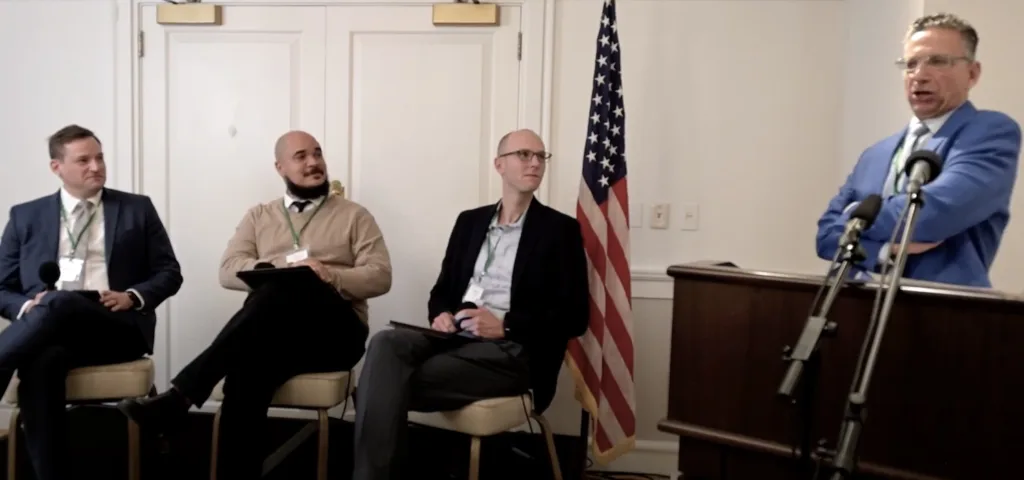
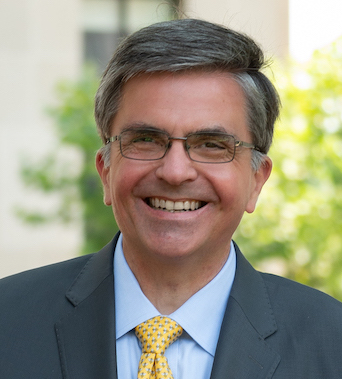
The following panel discussion was held at IRD’s conference on the 75th anniversary of evangelical theologian Carl F.H. Henry’s book The Uneasy Conscience of Modern Fundamentalism on November 10, 2022 in Washington, D.C. featuring Scott Redd, Charles Howard and Aaron Graham.
Keynote speaker Anne Snyder’s address can be viewed or read here. The panel featuring Snyder, Joe Loconte, Thomas Kidd and Jonathan Leeman can be viewed or read here.
LOCONTE: We have another all-star panel today, and they will tackle the question: what issues need to be addressed by evangelicals, both within our own community and outside of it, with regards to its engagement with public life?
Some brief introductions: Scott Redd is President and Professor of Old Testament and Reformed Theological Seminary here in D.C., the author of The Wholeness Imperative: How Christ Unifies Our Desires, Identity and Impact in the World. Scott cares deeply about the teaching of Scripture and its application to all situations in life.
Charles Howard—the Reverend Charles Howard—serves as the chaplain and vice president for social equity and community at the University of Pennsylvania, his alma mater. He has been ministering to college students for over 25 years. Charles is the author of five books, including most recently Black Theology as Mass Movement. I am proud to call him friend.
Aaron Graham serves as founder and lead pastor of the District Church, a multiethnic community committed to transforming the city for Christ, one neighborhood at a time. Aaron and his wife, Amy, founded DC 127, which unites churches to end the foster care waitlist in DC, as well as Just Homes, to expand affordable housing in the city. I have been greatly blessed personally by Aaron’s ministry and I am grateful to call him friend.
SCOTT REDD: Well, thank you, everyone. It’s a privilege to be a part of this. Thank you, Joe, for including me in this conversation. I come as a seminary administrator, a theologian, but of the Old Testament type. And I’ve been pleased to hear a lot of Old Testament being quoted today. And that just warms my heart. I would also say I was raised in a family that was politically and socially aware.
I was not directly influenced by Carl Henry in those days—I didn’t actually read him until later in my adult life. But it was one of those experiences, which I’m sure you’ve all had, when you’re reading someone and you’re saying, “I really agree with that. It’s funny how much we agree on things.” And then you realize it’s because people who influenced you were influenced by him.
And, so, I came to the realization of how deeply Henry had influenced the world in which I had grown up and had lived in and operated in even before doing my Ph.D. and working and in policy here in Washington, D.C.—how much he had influenced so many of the voices around me. And he influenced it in what I would consider very healthy ways, which have already been highlighted today.
The one I want to focus upon is his emphasis on the teaching of Scripture and the Christian life as being something that pervades, even infects the whole of the human experience. Henry was quoted as saying, “There is no room for a gospel that is indifferent to the needs of the total man.”
This brings to mind Deuteronomy chapter six, a great passage about the wholeness of the person being involved in the worship of God. This is a passage that, of course, Jesus and his interlocutors refer to as the greatest commandment, the beating heart of the Old Testament, referred to as the Shama because of its first word: Shama Israel, hear o Israel, the Lord is our God and the Lord is one. And this creed was repeated every morning and every evening in the second temple period by believing and devout Jewish people. [footnote] He is their covenant God. They don’t own him like an idol-maker makes and owns an idol, but they own him. They have him in the sense that he is their covenant God, and they are to love the Lord their God. That’s the covenant part: with all of their heart, all of their self, all of their strength. They’re supposed to be one. They’re supposed to be whole.
As Walter Kim said earlier, we shouldn’t focus just on what we’re saved from, but also on what we’re saved to. And I would argue that we’re saved in order to love the Lord our God with all of our heart, all of our inner self—all of our soul. Following the King James translation, it probably refers to the whole of the person. Robert Alter [ck], in a recent translation, translated the verse as “all of your body,” and I think that’s probably getting at it. It’s where you stop, and the world begins.
Lastly, the verse adds “all of your strength,” meaning all of your influence in the world—all of what we might call human capital. That means financial, relational, political, as well as creative capital. Every way in which you’re changing the world should be directed to the love of God. As a matter of fact, I think Jesus is basically quoting or exegeting the Shama when he says “where your treasure is, there your heart is also.” I think he’s talking about all of the person, everything that you’re directing your energies to.
Henry understood this: The Christian faith involves God’s calling of the whole person. Henry was operating in the aftermath of the fundamentalist-modernist debate. And we have to read him in that context. He’s trying to address the problem of the modern rise of the fundamentalist right, and he’s dealing with the conflicts that arise in such a society. He is creating a paradigm shift for the Christian experience in the modern West, particularly in modern America.
In doing so, Henry gives us some great broad-brush guidance. And we shouldn’t expect more from him than that. But as we as we take that guidance, we now speed ahead 75 years forward, and it gives us a trajectory and a way to measure how we’re doing today.
And that raises a problem. Henry has directed us he’s given us guidance on how to apply the teaching of Scripture to real-life situations. And, yet, as we think about the way we engage in public life and social life, we have to admit there is fragmentation happening in the Christian political vision. Oftentimes our involvement in the public square is episodic, when there is a hot-button issue in the news. Oftentimes Christian political theology is taking its lead from the news cycle.
And, of course, it’s not the 24-hour news cycle of cable news. It’s now the constant moment-to-moment news cycle of social media and the Internet. I think we can all acknowledge there is a problem in the way that the Christian public witness is finding expression.
As we approach this, being armed with Henry’s challenge, we need to think about how to connect the vision and values that he laid out, as an application of scripture. How do we connect that, downstream, to the everyday work that is going on in public life? To every level of every discipline? I think that’s the work that is set out for the Christian church today.
Put another way: How do we approach the issues that are facing us in the public square and develop a kind of connective tissue with these broad values—the dignity of human beings made in the image of God, the reality of a relational and personal creator, the reality of common grace, of natural theology? How do we take these doctrines and apply them in a responsible, faithful way to these downstream issues that we’re all wrestling with? Are we creating places where there are conversations where people can actually apply their basic beliefs to the intricacies of their craft?
One of our graduates, for example, is the head of the Ethics Committee at Georgetown Hospital. He is helping them think through the real issues that arise day to day in critical care—not just the big picture issues like abortion or euthanasia—but also those issues that show up over and over and over again on any given day at the office.
I’m talking about applying scripture, as we’ve already said, to every situation in life. This assumes that God has an organic relationship with the world around us and that we’re engaged with it. The Bible doesn’t tell us everything there is to know about these issues, but it does give us all of God’s Word that we need for these issues. I think we can sit down with the Scriptures and develop the principles that will guide us in these day-to-day issues.
And lastly, I think this needs to be one of our guiding principles: to develop a positive public theology, a positive political movement going forward that is not just merely reactionary, not just responding to whatever is in the news, but a theology that offers an uplifting, glorifying vision of the role of the Christian in civic and public life. Henry put us on a trajectory. But 75 years have passed, and we still have a lot of work to do. And I think conferences like this are wonderful. I love hearing these voices and considerations in this endeavor. Thank you.
CHARLES HOWARD: Thank you so much, Scott. I want to hear more about positive contributions that are constructive and less reactionary. Thank you all for letting me be with you today and for the grace and hospitality. You all have shown this over the last several hours to me and my daughter. And I want to give a shout-out to “Uncle Joe,” as he’s known in my house, my brother Joe Loconte, who I’ve known for about 20 years now. Joe and I are family. We really disagree on a lot of issues. And we have remained, I think, interlocutors and brothers over that time. I love you, Joe, and it’s good to see you again.
I want to share a brief story, if that’s okay. I grew up in Baltimore. I was an orphan: both of my parents died when I was young. And my older sister took me in and became my legal guardian when I was 11 years old. And in many ways my faith formation was under her watch, she kind of rescued me in many ways. She’s very much a hero in my life. She was 23 years old when she took in an 11-year-old. And I was a big boy and she was trying to figure out what to do with me in the summer because she wanted a little bit of a life for herself.
She found, through the principal at my middle school, a summer camp. And this camp gave me a full scholarship to go. And I really didn’t want to go. I was going to be homesick. But she put me on the plane to get to this camp way up in Naples, Maine. It was an all-boys sports camp, with sports like basketball and football. I get off the bus, walk to the camp, and it’s beautiful. And I realize I’m the only black person there. My bunk mates were wonderful, deeply hospitable, and they also like comic books and Michael Jordan and, you know, all that stuff.
The first week goes by and we get told to get dressed go down to the recreation hall. We walk in and someone’s handing all of us something like little hats. We put these little hats on our heads and sit down, and all the white folks in the place start speaking in a different language: Hebrew. And my sister failed to mention that this wasn’t just a sports camp. It was a Jewish sports camp that she sent me to.
And rereading Carl Henry brought me back to this moment. I went to that camp for ten years. I sang the Shama every Friday night. It was a good prep for seminary because I had a good amount of Hebrew before I started there. It was also good for my confidence: I was a head taller than most of the other guys I was playing basketball with.
I want to share one other story from my time there. We were going to play basketball against another camp and we had four guys and we needed one more to field a team. And I thought my buddy Johnny could play with us. Johnny was really good at soccer, lacrosse and street hockey, really bad at basketball, but we needed a guy.
So, I asked Johnny, who really didn’t want to play. “I hate basketball,” he said, “You know, I’m not good at it. I’m going to stay over here in the hockey rink.” Well, I convinced Johnny to come play with us. And he brought so many good things to the team. He is scrappy, his defense is hardcore. He also fouled out in about 10 minutes because he was kind of ham-handed and a little rough and pretty aggressive.
The three things I think we need right now, lessons from Carl Henry, are these: First, come and play. We need another guy. We need another teammate out here with us. But when you come to play, play nice. Second, bring your friend, bring your uncle. And third, be welcoming. I love this call by Carl Henry to not be comfortable over in the hockey rink, but to get on this court, too, because there’s real need out there.
You know the issues: affordable housing, orphans, homelessness, poverty, gun violence, racism, sexism, war. All of that. We need not only the brilliance of evangelicals, but the hearts of evangelicals to engage these issues. And I think everybody in this room gets that. But when you come, play nice. Don’t throw a bunch of elbows over here. When people think about evangelicals, what is one of the first things that often comes to mind? I work at a secular school. And there’s a wonderful little remnant of believers who are still on our campus. And when you ask people to tell you about the Christians, what do they say? What comes to mind? They say “judgmental,” “hypocritical,” “homophobic,” “racist,” “anti-Semitic,” etc.
Some of that is earned. Some of that is unfair. But those reputations are real, and people have caught elbows from Christians before. People have been fouled by Christians before.
Let me say one more thing about being welcoming. This is one of the great challenges within Judaism, this notion of welcoming the stranger. As I mentioned, I went to that Jewish camp for ten years. I was the only black kid for almost all of those years. I went to a lot of bar mitzvahs, a lot of weddings afterwards. And I have been asked to do some of their weddings. I’m not Jewish, right? I’m not a rabbi. One of them said, “I thought you were Ethiopian this whole time.” They were so welcoming.
I am the only black man in this room, and there are pictures of white people on the walls. I’ll just be honest here. I work at a liberal secular school. I would describe myself as a liberal Christian. I vote Democrat in almost every election. We were talking about communism earlier. My granddad was literally a communist. What will you do with me? Will we still be able to hug at the end of this conference? I think we will. But I think we need more of that kind of welcoming, especially in an age of deep division. Thank you for letting me be with you all today.
AARON GRAHAM: Thank you, Charles, for sharing and for your story and for the framing metaphor. I was just preaching yesterday about Paul challenging us to speak the truth in love and how we have a lot of people who speak a lot of truth, but without love, and there a lot of people that are all about love without truth. So, thank you for sharing your story and challenging us.
Having recently read The Uneasy Conscience of Modern Fundamentalism, I believe that 75 years later Carl Henry would critique Christian nationalism and progressive and progressive Christianity in the same breath. He would critique the worldviews that lead to January 6th and the worldviews that lead to the deconstruction of biblical truth. In fact, I believe Carl Henry would argue today that the majority of evangelicals are actually too engaged in culture—they’re engaged in the uncritical pursuit of the American dream that is built on the lie of expressive individualism.
I believe Henry would argue the church is not bold enough about the claims of Christ, about the reliability and power of biblical truth that is able to speak into the heart of every social issue today. Carl Henry says in his preface, “While we are pilgrims here, we are also ambassadors.” The challenge throughout church history has always been to be both biblically faithful and culturally relevant, right? It’s to live in the tension between these two things.
Fundamentalists sought to be biblically faithful but did so in a way in which they became too separate from the culture and ended up on the wrong side of many critical moral issues of the day—issues such as war, race, class, and imperialism. On the other hand, liberals became so fascinated with becoming culturally relevant that they prioritized social engagement above biblical faithfulness and then reinterpreted many of the core doctrines of the faith, as the apostle Paul said, to suit “what their itching ears want to hear.”
I think if Carl Henry was pastoring in the heart of D.C. today—and I love the story of him teaching Sunday school here in D.C.—he would need to spend more time critiquing what he calls “optimistic liberalism” than he would need to spend time critiquing conservative fundamentalism.
My story is one of growing up as a Southern Baptist missionary kid being called into the gospel ministry at 16 years old, being ordained in the Baptist Church, serving as an urban missionary for five years in Boston. I’ve been in D.C. for 15 years. And, so, I’ve been in the urban core for 20 years now. And I have seen how the evangelical church too often accommodates to culture.
When we planted the District Church in 2010, I thought that if I could, like a good evangelical, get people in the front door, help lead them to faith in Christ, get them plugged into a small group, get them actively serving in the city, then our city would be impacted for Christ. What I have found pastoring in the heart of D.C. is that without teaching the core doctrines of the Christian faith people will be more influenced by progressive Christianity and secular culture than by the Word of God in the historic Christian faith.
I grew up around conservative evangelicalism and I spent so much time trying to contextualize the faith because I didn’t see it getting contextualized, making it relevant, emphasizing mercy and justice ministry. But what I found among many of my peers is that in our efforts to contextualize the gospel, we have often become too adapted to culture and not distinct enough. And one of the ways that happens—and one of the things I want to really emphasize—is what I’m talking about in critiquing the over-contextualization of the urban church.
I’m not saying we need less justice. Because we know poverty and injustice is spreading everywhere. The suffering of people is way worse than we think. So, I’m not saying we need any less justice. We need to see the gospel incarnated. We need to see more sacrificial generosity. We need to see the chains of injustice loosened. We need to lead on issues of race and the conversations about race. What happens when we don’t is that the world leads the conversation, and then we’re reacting to the frameworks of the world rather than leading, as we should.
But my point is this: From my experiences, we’ve neglected basic discipleship, teaching the Bible, teaching the power of prayer, understanding what it requires to maintain the faith.
There are a lot of young people who, in my experience, have grown up in church and they’ve moved to the city. And anybody who moves to the city, the first thing you want is community, right? If you’ve been socialized in the church, where do you find community? You find community in the church. You want to get engaged in the issues of the city, so you find ways to serve through the church.
However, I have found that if you don’t disciple people, even people who have grown up in the church around biblical truth and prayer, that over time they will drift away. And a church not committed to biblical truth will eventually devolve into a social club or simply a social ministry over time. And we will not disciple the next generation to fear God and to follow all his commands.
In many ways, the challenge of making disciples is one that is faced by churches of all theological persuasions. It’s the challenge of making disciples in a culture of expressive individualism, where the self and autonomy reign. I used to read those “choose your own adventure” books growing up. Today it is “choose your own spirituality.” When my highest goal in life is my own autonomy and freedom, it becomes difficult to near impossible to follow Jesus, who asks me to lay that down. Autonomy was the original sin in Genesis chapter three.
Conservatives accommodate to expressive individualism when they do not have the courage to speak truth to the systemic sins of racism and violence and economic inequality that Scripture teaches us about. But liberals accommodate to expressive individualism when they allow the secular worldview to influence how they read and view Scripture.
You all know the book Rise and Triumph of the Modern Self by Carl Trueman, a professor at Grove City College. He references the secular sociologist, Philip Rieff. He has three categories of culture. The first culture believes in many gods. The world is a spiritually charged place. We must do things to appease the gods. It is very much a pre-Christian culture. The second culture believes in the Judeo-Christian view, in one true God. It is the belief that when we obey God’s revealed commands and truth, that this will lead to human flourishing and justice and peace. It is the belief that there is a higher truth, a higher authority, and that we are to submit ourselves to that.
I grew up as a missionary kid in Liberia, in Kuwait, and studied theology, did my doctoral work in theology, and I learned how to evangelize in the first culture, how to share my faith and do cross-cultural evangelism. A good missionary will learn how to share his faith across cultures in a way that doesn’t “colonize” that culture, where you teach biblical principles, but you allow the gospel to be incarnated in an indigenous, church-planting movement over time.
The problem is that many people today think that to reach the secular left we need to use the same methods that we use to reach pre-Christian cultures. And that’s the world that Carl Henry and Billy Graham largely operated in, even in America 75 years ago. But the reality is that we’re not ministering—at least in the urban core—in pre-Christian cultures anymore, as Rieff argues. There’s a third culture, and the third culture exists primarily to define itself against the second cultures. The members of the third culture believe in no greater truth, no sacred order. Instead, they spend their energy deconstructing the sacred. Anything that restricts individual autonomy is leveled and left up to individual interpretation.
What I would argue is that the third culture is the engine that is currently driving progressive Christianity and that has led many people to post-Christianity. It also empowers Christian nationalism, which I’m not going to critique now. And the third culture is centered on the self.
Mark Sayers talks about this in his book Disappearing Church [ck]. He says when you’re in the second culture and evangelizing to the first culture the challenge is to not colonize them. But when you’re sharing faith as the church to the third culture, to a post-Christian culture, the challenge is to not be colonized by that culture. And I think that’s something of the challenge that we’re dealing with today.
But I also believe that there’s a hunger for God in our generation and there’s a desire to know him. It usually has been white liberals that have led the way to the progressive deconstruction of the historic faith. Our church, the District Church, has over 80 nationalities, and it’s because white liberals don’t represent the global church. White liberals might be sensitive to issues of racial justice, but they’re out of step with the convictions of most immigrants and people of color who remain conservative on the authority of Scripture, on the belief that Jesus is the only way to salvation, and that the principalities and powers of this dark world are real, that this is a spiritually charged place. Spiritual warfare exists.
I think that Carl Henry would warn us today not to deconstruct our orthodoxy or abandon our efforts to have a more socially engaged faith, for it is our commitment to biblical authority and truth that will lead to a more just and peaceful world. So, let’s expose the lie of expressive individualism that tempts progressive Christians and conservative Christians in similar ways and embrace the whole gospel for the whole world.
LOCONTE: What a banquet of insights. Thank you, gentlemen. I’m going to have you in conversation with each other. Let me offer a quick recap of some of things you said: Scott, you emphasized a positive public theology. Charles, you stressed that Christians need to get into the game, but they need to “play nice.” That’s a character issue. Paul McNulty used the expression “a breathtaking decline of kindness in society.” And, Aaron, you shared your deep concern about the church being co-opted by the culture in its attempt to achieve a more just society—and losing its biblical foundation. Gentlemen, let me give you an opportunity to interact with each other, pose questions to each other. You have the floor.
HOWARD: Could you say a bit more about the affordable housing work you are doing?
GRAHAM: Churches [??] own more vacant land than any other group in DC, other than the federal government. And many of these churches are being sold to condo developers and others. Affordable housing is one of the most urgent issues in our city. Many people are being displaced because of gentrification in the city and the high cost of living. And so the call to do something about this really came from members of our own church—particularly people who are not upwardly mobile in our church, who had been displaced from Columbia Heights, the fastest gentrifying neighborhood in D.C.
We have learned that many churches, though they have the asset of the land, face the complexity of navigating how to build affordable housing. It is very expensive. And you can really be taken advantage of by developers. We created a process in educating church leaders, to walk through this process with them. Tonight, for example, we’re holding a one-on-one housing workshop for churches throughout the city to help educate people on the biblical call to this effort. A lot of people believe it is the right thing to do, but there’s not necessarily a sound understanding of the biblical call to this work.
REDD: That’s excellent, Aaron. In the Old Testament, you’re dealing with corporate realities. When you move to the New Testament, you’re dealing with individual faith, individual realities. Yet with the call to holiness that we find in Deuteronomy chapter six, it’s notably aimed at the individual. Moses tells us to talk about God’s Word with your family members, talk about it when you’re on the road. Put it on your hands, put it on your doors and your gates. It is an individual application of the wholeness that we’re called to.
When you move into the New Testament, this creed is echoing in the backs of everyone’s minds. In John 17, we read that Christ, as he’s about to go be betrayed, makes a high priestly prayer. At the end of the prayer he suddenly says, “Father, I pray that they would be one, just as we are one. They in me, just as I am in you, so that the world will know that you loved me and you love them.” New Testament scholar Richard Baukham [ck] points out that Jesus is executing Deuteronomy chapter six in a prayer form—but that he is applying it corporately. He’s saying you need to be one, not just as an individual who is made whole, but also you need to be made one as a community.
We share the same lordship, the same spiritual DNA of the Holy Spirit, testifying to your spirit of the lordship of Christ. There’s a reason why we all ought to weep when we see the lack of hospitality and fragmentation in the Christian witness in the world. Hospitality ought to be something that is a driving force, an impulse in the Christian church to be united as one under the lordship of Christ. And we see that as Jesus is about to be betrayed. That is the thing that is on his mind.
What I mean by a positive theology is that instead of waiting for issues to be handed to us, we start developing a kind of magisterium on these issues. We start developing a consensus about the authorized range of views—I mean by authorized by Scripture. What direction does Scripture give us about how we ought to think about humanity?
Poverty issues, for example, involve both the spiritual and the physical. Carl Henry talked about the importance of the gospel being understood socially and philosophically. Let me mention a book called Biblical Critical Theory by Chris Watkin [ck]. Watkins is an Australian philosopher interacting with philosophical readings of Scripture. He says we need to be able to look past the issues that are being handed to us by the world and see what God’s Word, what God’s revelation of himself, tells us about these issues. We must not settle on the arguments as they’re framed by the media or by the discourse around us.
GRAHAM: Following Carl Henry, we are talking about how to have a socially engaged, robust political engagement in public life. One of the challenges in this is the social gospel-evangelical divide: One group seems to emphasize personal sin, and the other group seems to emphasize systemic or social sin that manifests in policy. Why does that divide exist in America? How would you challenge the evangelical world to have more of an understanding of systemic sin?
HOWARD: Terrific question. Part of the reason why I identify as a progressive Christian is because of a lack of care about social issues. Most of my adult life, I went to churches that would be described as evangelical. I don’t think I ever would have called myself that. I grew up in the black church, which is often erased when we talk about evangelicals. But I had to leave when Trayvon Martin got killed, and every black church I knew had a million hoodies on Sunday, and I showed up at a white evangelical church with a hoodie on. No one else did. And the pastor didn’t preach about it. We didn’t talk about it in the prayer time, not in the coffee hour, ever.
I don’t think we all have to agree about what’s wrong in the world. But let’s talk about it. Can we have an open conversation about it during our coffee hour? Can we engage our students about it? Let’s have a conversation, in love.
LOCONTE: That’s quite a challenge. I wonder if there was more of that public conversation between church leaders, how that might actually affect the larger conversation: When the world sees Christians who disagree with each other but sees them conducting themselves really beautifully—in a loving, civil way—that is a form of public witness for the gospel that can challenge the conscience.
Thank you, everyone, for your magnificent contributions today.
No comments yet



Leave a Reply