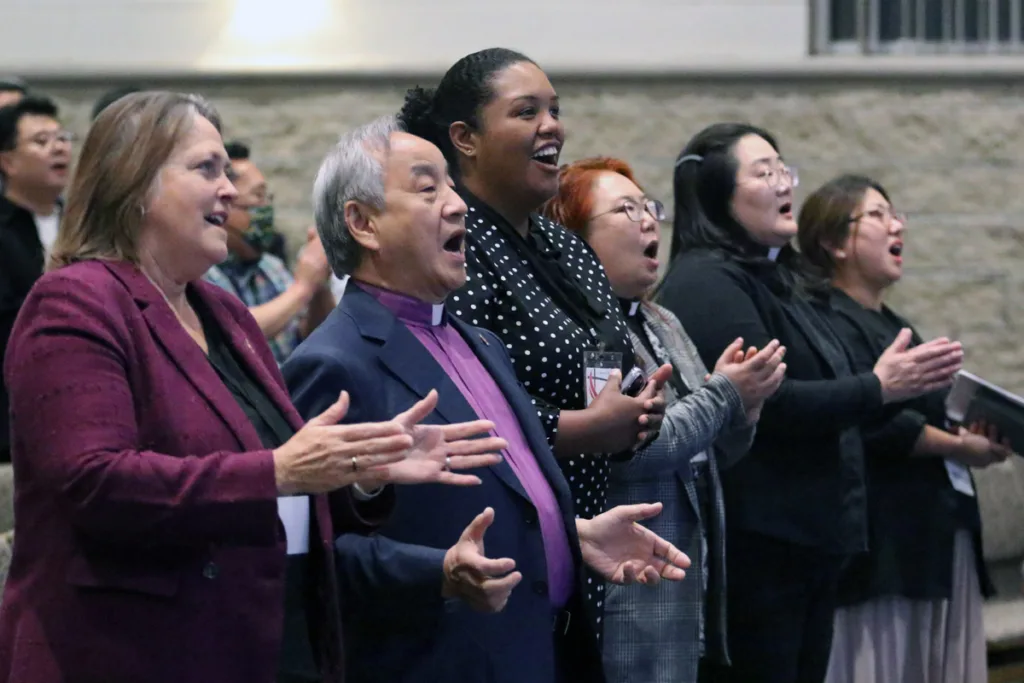

My last article, (Confessions of a Maverick, Part I), dealt with the tremendous gap between the clergy of mainline denominations and their laity.
A poll taken by the Public Religion Research Institute and reported in The Christian Century (Nov. 2023) found that 55% of the clergy of those mainline denominations identified as “liberal” while only 22% of their laity so identified.
But another telling, and I believe significant finding, is the difference between the mainline denominations. 84% of United Church of Christ clergy identified as liberal and only 6% as conservative. For Episcopalians the percentages were 69% liberal and 11% conservative. For Presbyterians (USA) the percentages were 70% and 9%, for ELCA Lutherans the percentages were 68% and 12%, for Disciples 62% and 19%. For the two most conservative of the mainline denominations, the United Methodists were marked as 44% liberal and 29% conservative, and American Baptists 26% liberal and 56% conservative.
This is pretty much in line with how I have, for a number of years, characterized my brother and sister clergy persons, whether United Methodist or otherwise. These are persons I have come to know through ministerial associations, though working together in community activities, and through other contacts. It has always amazed me, at the same time, that leaders of my United Methodist denomination seem to have a very different understanding of the theological and cultural orientation of their church members.
Denominational leaders seem to assume that they are for the most part aligned with the beliefs and views of ordinary church members. I argue they are not.
After 65 years as an ordained UM elder and with experience as a district superintendent and a faithful attender of annual conferences and five times a General Conference delegate and years in the camping program, I would seek to make the case that United Methodist persons in the pew generally are quite evangelical in theology and moderate to conservative in politics and in cultural and social matters. Denominational leaders are much more liberal and “progressive” about our Methodist beliefs and other matters. A good deal of the mistrust of church members toward their leaders comes from this “gap.”
I refer to the church’s doctrine of atonement as an example. Methodism basically defined the American understanding of the word “evangelical.” Methodism gave to American religious culture the revival meeting, the camp meeting, the altar call, the mourner’s bench, and the gospel song. It is not by accident that even secular dictionaries, at least until recent years, linked the words Methodist and Atonement and Evangelical together:
Evangelical – Of or having to do with the Protestant churches that emphasize Christ’s atonement and salvation by faith as the most important parts of Christianity, as the Methodists and Baptists. (Thorndike Barnhart Comprehensive Desk Dictionary, 1958)
This, of course, is based on John Wesley: “Nothing in the Christian system is of greater consequence than the doctrine of Atonement. It is properly the distinguishing point between Deism and Christianity …” (Letters: “To Mary Bishop” (VI 297-299)
It is also articulated in the words of our Methodist Articles of Religion: …one Christ, very God and very Man, who truly suffered, was crucified, dead, and buried, to reconcile his Father to us, and to be a sacrifice, not only for original guilt, but also for actual sins of men.” (Article II – Of the Word)
On the denominational level these days I see very little emphasis on the blood of Jesus, or the doctrine of the Atonement. Despite the fact that we put crosses on our altars and on our steeples and on jewelry around our necks, I fear we do not take seriously the apostle’s words in I Cor. 15:1:
“Now I would remind you…in what terms I preached to you the gospel…by which you are saved…For I delivered to you as of first importance…that Christ died for our sins in accordance with the scriptures…”
When one can read pages of materials from official UM sources without any references to salvation and/or the cross one concludes our priorities are not straight.
I remember asking my mother once what was wrong with our Methodist Sunday school material. My mother, who was quite perceptive, replied simply, “No cross.” I thought of that another time as a pastor when the pre-school teacher came to my office and asked if the church had pictures of Jesus on the cross that she could use to explain Good Friday to her pre-scholars. I told her to check the collection of teaching pictures from Cokesbury that we had saved through the years from our Sunday school lessons. She came back and said, “I did, but there are no pictures of Jesus on the cross.” I checked with a person I knew serving on the Curriculum Resources Committee in Nashville why we couldn’t find pictures. She replied, “We normally don’t show Jesus on the cross until junior high. Children might get the wrong idea.”
Wrong idea? When I first joined the Good News board in the early 1970s I got involved in the Task Force on Curriculum. Perhaps the greatest issue for Good News at the time was the matter of Sunday school material which reflected the extreme liberalism that dominated in the Methodist Church. The overwhelming pervasiveness of this liberalism was, of course, denied by editors and writers associated with the Curriculum Resources Committee, but these same persons really could not respond well to the invitation to show us precisely where in the material the gospel was clearly proclaimed, and/or where personal sin was discussed, and/or where Christ’s death on the cross as atonement for that sin was clearly presented.
A bit of research clarified the situation. As far back as the 1850s the writings of Horace Busnell, the Congregational theologian, were arguing that children did not need to be taught they were sinners; indeed, ideas about sin and need for atonement and accepting of Jesus Christ as savior ran counter to modern theories of child development and needed to be corrected. The radical makeover of Christianity in the name of religious education was later traced in 1935 by E. B. Chappell, the editor of church school materials in the Methodist Episcopal Church South in his book Recent Developments of Religious Education in the Methodist Episcopal Church, South. Earlier leaders, according to Chapell, lacking in scholarly equipment, though well intentioned, taught an inherited Calvinism leading to “erroneous opinions that became a serious hindrance to the development of effective religious education.” Chappell specified the “erroneous opinions” as total depravity, emphasis on blood atonement, and the necessity for radical conversion. Chappell admitted that some of these erroneous opinions were reflected in the writings of John Wesley and then stated that Wesley would need to be “reconstructed.”
And so the effort to reconstruct. When I served as a consultant on the 1988 Hymnal Revision Committee I remember a rather heated discussion with another member of the committee who happened to be a professor in one of our UM seminaries. It was over the hymn which had been in every Methodist hymnal since day one. I made the point that it was one of Charles Wesley’s clearest expressions of the atonement. His comment: “the Wesleys were not always right on the atonement.”
I think of incidents like that when I read things like what Mainstream UMC, a political group, is repeating over and over. Mainstream UMC identifies itself as “compatibilist” (let’s all live together under one big tent regardless of what we believe or our moral standards) and argues clearly in its literature that “no one is working to change the foundational UM theology.” In reply I respond that certain elements in the church have been working to change foundational UM theology for the last 150 years.
But wait. There is another side, and this relates to “the gap.” I counter the above paragraphs by pointing out that the majority of UMs, if by majority we include ordinary lay people and hundreds of churches, still uphold UM doctrine and do not wish to “reconstruct.” Even back at the beginning of the Good News movement, it was reported that despite the pressure by church leaders to use only “approved” and official Sunday school material, at least 10,000 churches were using unofficial materials. In 1952 the Methodist Discipline specified that “Methodist connectionalism requires curriculums which contain the present Methodist traditions, purposes, programs, and movements. Each church school shall provide instruction in the curriculum approved by the Curriculum Committee of the General Board of Education of the Methodist Church.” The phrase “present Methodist traditions” was in stark contrast to “historic Methodist traditions.”
But ordinary Methodists were not (and are not today) so easily controlled. Other influences often overrode the leaders’ attempts at reconstruction. Alongside the bureaucratic influences, Methodist believers have also been influenced by decades of tradition, by the liturgies of the church, by the churches’ hymnals, by parachurch ministries, and by growing evangelical influences in their communities.
Especially by the hymnal. In the early 1980s there was agitation on the part of feminists and others to revise the hymnal so that it would reflect some newer developments of the times (especially inclusive language). The Status and Role of Women presented a petition to the General Conference to that effect. The Board of Discipleship, somewhat concerned lest the Status and Role of Women petition might be too narrowly focused, presented their own petition for a hymnal. Then the Publishing House, with concerns that even a Board of Discipleship might be too narrowly focused in the day of quotas and caucuses, and also because a politicized hymnal would not sell well and the Publishing House stood to lose if the hymnal was not successful, also presented a petition. It was a petition with a difference. Extensive research would determine what ordinary people were actually singing, or wanting to sing. In addition, the editors, (mostly Carlton Young), would be able to add “consultants” to the denominationally-selected Revision Committee to ensure more inclusivity (such as evangelicals and common, ordinary people). I was blessed to be one of those “consultants.”
The result, approved by the General Conference of 1988 and soon published as The United Methodist Hymnal, has been one of the most successful hymnals ever published by a denomination. The hymnal worked out successful compromises on the matter of inclusive language, added hymns from several new ethnic traditions, added many more African-American spirituals, and included hymns by contemporary composers.
But for the focus of this article, it added hymns that United Methodist people were actually singing, including some praise choruses. Specifically, it added what I refer to as “blood” hymns, or atonement hymns, or salvation hymns. Examples of hymns added: “Great Is Thy Faithfulness,” “It Is Well With My Soul,” “To God Be The Glory,” “Victory In Jesus,” “Nothing But the Blood of Jesus,” “My Tribute,” and “Grace That Is Greater Than All Our Sins.”
The significance of this can be seen when the UM hymnal is compared with the other hymnals published by mainline denominations in the last 40 years. There are over 80 hymns in the UM hymnal that refer to the blood of Jesus. In contrast, the Presbyterian hymnal Glory to God (2013), has fewer than 10 hymns referring to blood. In numbers of instances other mainline denominations have revised hymns in order to omit references to the blood atonement. So, Wesley’s “He breaks the power of cancelled sin, he sets the prisoner free, his blood can make the foulest clean, his blood availed for me” (vs. 4, “O For a Thousand Tongues to Sing”), is simply omitted in the Presbyterian hymnal.
Lessons to be learned? We appeal to our denominational leaders to listen to the people in the pews. Our doctrines and moral standards are set. Our theology does not need to be reconstructed.
(The next “Confessions of a Maverick” article will be an analysis of how UM doctrine has been handled by our hymnals down through the years)


Comment by Tim on December 22, 2023 at 8:44 am
I am a life long Methodist. About 10 years ago I bought a crucifix to hang on the wall of our home. My wife said, “What do you want that for?” I said, “It is my daily reminder of what Jesus did for us on the cross.”
Blood atonement is not a pretty thing, but it was a necessary thing.
Comment by Tim Ware on December 22, 2023 at 12:09 pm
From my experience in seminary and afterwards, I did not feel that denominational leaders thought their views were aligned with the views and beliefs of ordinary church members. On the contrary, from what I saw, denominational leaders had great disdain for the views and beliefs of ordinary church members.
Comment by Gary Bebop on December 22, 2023 at 2:34 pm
Thanks for exposing the path within Methodism that leads it onward toward irrelevance. For many of us this is autobiographical. Our lives and ministries have been twisted into ridiculous shapes by corrupted teachings. We were led astray. Now even greater error awaits its day of official embrace.
Comment by David on December 22, 2023 at 3:00 pm
A clergy survey may be found in detail here:
https://www.prri.org/research/clergy-and-congregations-in-a-time-of-transformation-findings-from-the-2022-2023-mainline-protestant-clergy-survey/
The use of crosses in Methodist churches is not easily found before roughly 1920. This was due to the “low church” nature of the Anglican Church at the time of the founding of Methodism.
“To a good protestant of 1830 the least suggestion of symbolism—a cross on a gable or on a prayer book—was rank popery. All forms of ritual were equally suspect. The clergyman wore a black gown and read the communion service from his pulpit; no one knelt during the longer prayers, or stood when the choir entered; indeed, the choir, if it existed at all, was hidden in a gallery, where it performed to the accompaniment of violins and a ‘cello. The old Gothic churches had been gradually adapted to suit this type of service. Superstitious features such as piscinae and sedilia were abolished; since altars were seldom used, even as tables, the chancel was either abandoned or employed as a vestry; and whatever symbolic sculpture existed in the nave was concealed by massive, comfortable pews for the rich and precarious galleries for the poor. “—Kenneth Clark in “History of the Gothic Revival” (1928).
Older Methodist Churches were typically austere meeting houses centered on a pulpit raised on a dais with a communion table, sometimes brought out for the occasion, on the floor level. In the early 1900s, there was a shift to the church-style sanctuaries centered on an altar with a cross and candle sticks. Methodist clergy began to wear gowns in the 1940s-1950s imitating what seemed the more dignified Lutheran and Episcopal churches.
Comment by Ken MacAlister on December 22, 2023 at 6:42 pm
This column is true to life for me as one who was raised in the UMC. I was fortunate when growing up in the early ‘70s that the Sunday School teachers at the UMC church my family attended cared about the kids receiving Biblical teaching that they would reject the material the denominational leadership were recommending if it was not Biblical. It was when I got into my twenties, then thirties that I noticed things really changing for the worse. Lyrics to old hymns being subtly changed to comply with political correctness. I also remember as I was in adult Sunday School classes that the teachers were continually rejecting the teaching materials they were given. At one point they were told by the current pastor to cease using the material they had bought on their own to use in place of the unbiblical material the denomination was recommending & use the material the denomination was recommending. That was around the time I had enough & left. The denominational leadership have no one to blame but themselves for what is going on through schism. I attended a non-denominational church for the first time after having enough of the UMC’s leftward drift & constant kowtowing to the hedonistic & politically corrupt culture instead of teaching God’s Word & the differences were incredible. Totally Biblical expositional teaching, NO politics from either side of the aisle coming from the pulpit, a vibrant youth group, multiple adult Sunday School classes, vibrant men’s & women’s study/fellowship groups. Everything the mainline denominational churches have turned their backs on while trying to please a Godless culture. There are many who want to hear the truth from God’s Word who attend mainline denominational churches & don’t receive it. Either they leave & look for God’s truth elsewhere or unfortunately they leave the faith altogether. The latter is occurring more frequently than the former unfortunately. Mr. Case, I thank you for both columns. You hit the nail on the head.
Comment by Mike on December 22, 2023 at 8:39 pm
Growing up in the 1950s-early 60s in a small town Southern Baptist church, often I went with the rest of the family to the Methodist church around the corner to their revival services, as they would come to ours (yes, you read that right!). Back then, we saw little difference between their church and ours, except for their infant baptism and the fact that they shared their pastor with several others on a circuit. We had an exclusive to us pastor.
By the time I started dating a young Methodist lady around 1970, the Methodist churches were now United Methodist, and they were not the same. Many Methodists even then were not satisfied with the way things were going.
Comment by David S. on December 22, 2023 at 11:08 pm
The discussion over the hymnal reminds me of a ruckus within the principal mainline Presbyterian and Reformed denomination, when it revised the hymnal in 2013. A number of churches were using “In Christ Alone” back then. The committee wanted to include it, but….there was a catch…
The version of verse 3 before the committee was an unauthorized version that read:
“Til on that cross as Jesus died / The love of God was magnified.”
except authors Stuart Townend and Keith Getty wrote:
“Til on that cross as Jesus died / The wrath of God was satisfied.”
The committee did not like the actual version, preferring the unauthorized verson, because according to Prof. Robert A. J. Gagnon in a series of article for The Layman, the committee did not like the idea of Christ’s death satisfying the wrath of God, even though it is consistent with Reformed doctrine.
BUT, the committee was in a bind when the authors refused to authorize the change, so the committee rejected it with one member saying there were too many songs on the atonement anyway. The committee apparently tried to fluff it all off at every opportunity, including one member who taught my wife at Columbia Theological Seminary.
Interestingly, regarding the author’s mention of the same said hymnal and verse 4 of “O for a thousand tonues to sing”, the 1990 hymnal included verse 4 as verse 3, having opted to omit Wesley’s original verse 2. The only changes in 1990 to verse 4, besides placement, where replacing he/his with Christ(‘s).
Comment by Coach D on December 24, 2023 at 1:29 pm
When one can read pages of materials from official UM sources without any references to salvation and/or the cross one concludes our priorities are not straight.
Amen Bother. Praise God for the gift of His son, and while we were yet sinners, Christ died for us.
Comment by Roger on December 30, 2023 at 3:53 pm
Sine the 1988 Hymnal was published, hasn’t there been 2 attempts to publish another version with newer songs, etc. What has happened to those 2 attempts. Will a new Hymnal be done with the UMC in its new status now.? Would you mind commenting upon this?