
Not unlike in our own day, the Roman statesman Marcus Tullius Cicero (106-43 BC) lived during a season of cultural turmoil: political extremism, paralyzing partisanship, a breakdown in law and order, and a deficit of civic virtue. Renowned for his oratory, Cicero warned that Rome was squandering its inheritance in republican government. The path to renewal, he argued, involved the recovery of Rome’s political and civic ideals, “the bond which holds together a community of citizens.”
The Cicero in the City Lecture Series will feature authors, educators, artists, filmmakers and other voices to begin an honest and lively conversation about how Americans can contribute to the reformation of our cultural and political life.
I launch the series with a frank discussion about the tragedies and triumphs of Western Civilization: the civilization that gave birth to the concepts of democratic freedom, equality, and universal human rights.
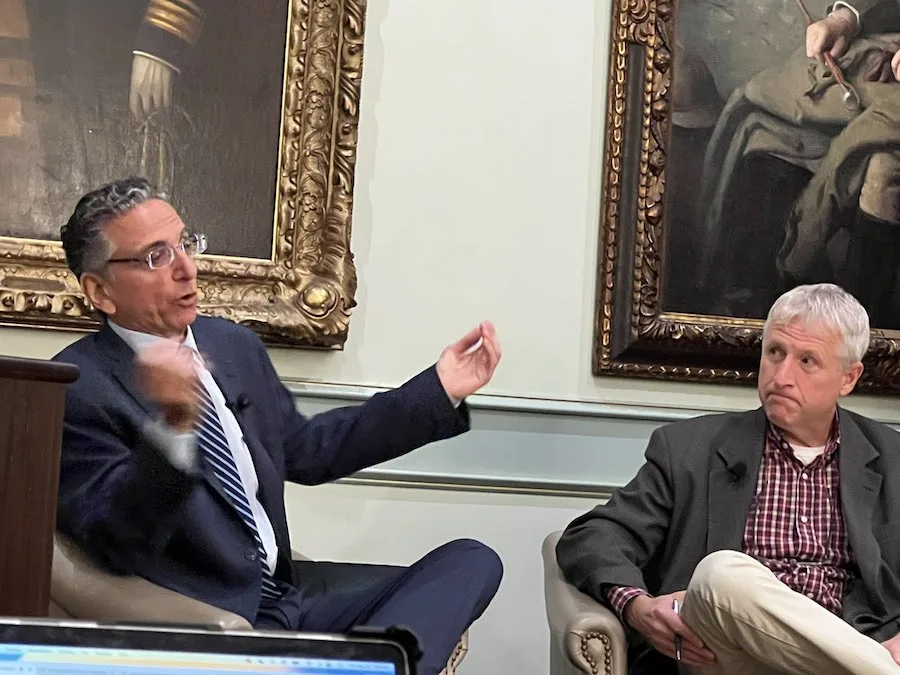
The following lecture was delivered on September 28, 2023 at the Army & Navy Club in Washington, D.C. Full text of the lecture appears below the video. Downloadable audio in podcast form is also available below via the IRD SoundCloud account.
IMAGE: PARLIAMENT
We’re in London, in the House of Commons, June 18, 1940. Great Britain is at war.
The British Prime Minister is about to deliver a speech that will help to determine the fate of democracy and freedom in the West.
This is the speech that will save Western Civilization.
That claim will sound outrageous to many of you.
How could one man’s speech rescue a civilization from disaster?
How could a man’s words prevent the ultimate catastrophe?
Is such a thing possible?
Let’s find out.
IMAGE: CHURCHILL
The Chamber is filled to capacity, on June 18, 1940, when Prime Minister Winston Churchill rises to address the House and the nation.
The day before, on June 17, France had surrendered to Nazi Germany.
France, which had given its lifeblood to counter German aggression in the First World War.
France, which possessed the largest army on the continent at the start of the war — France succumbs.
The defeat of France was the culmination of a series of defeats for the Western democracies.
IMAGE: HITLER
Germany had already absorbed the states of Austria, Czechoslovakia, Poland, Denmark, Norway, Belgium, and Holland.
In May of 1940, German panzers pierced the Maginot Line in northern France.
Over 300,000 British and French troops were forced to evacuate the continent at Dunkirk. It was, in Churchill’s words, “a colossal military disaster.”
So, now, the Germans control every major European capital, they control the ports, they have mastery in the air.
IMAGE: CHURCHILL UP CLOSE
That is the geo-political situation when Winston Churchill addresses the House of Commons on June 18, 1940.
What this moment represents is a contest between civilization—the civilization of the West—and barbarism.
But the democratic leaders of the West are completely unprepared for this war.
The previous British government—led by Neville Chamberlain and guided by a doctrine of appeasement—had ignored The Gathering Storm.
British politicians are calling for an inquest to assess blame.
Winston Churchill will have none of it.
In his speech before the House, he condemns this impulse as “a foolish and pernicious process…Let each man search his conscience…I frequently search mine.”
And then he goes on: “Of this I am quite sure, that if we open a quarrel between the past and the present, we shall find that we have lost the future.”
A Quarrel with the Past
We’ll come back to Churchill’s speech before we’re done.
But I want to draw our attention to his warning to the House:
“If we open a quarrel between the past and the present, we shall find that we have lost the future.”
Something is happening today in the West, especially in the United States, which none of us have seen in our lifetimes.
IMAGE: ANCIENT ROME
We have opened up a fundamental argument with our past.
Our educators, lawmakers, filmmakers, journalists—the knowledge class—they have come to regard our inherited beliefs, traditions, and institutions as illegitimate.
Concepts like freedom of speech, freedom of conscience, equal justice, the rule of law, the concept of truth-telling, the nature of the human person—all of these ideas are under assault.
Western Civilization, we are told, is no better than any other civilization, and probably worse.
According to this view, our history is a story of unrelenting imperialism, racism, and oppression.
The United States, as the lead nation in the West, is largely a force for evil in the world.
The only values we export are capitalist greed and radical individualism.
These criticisms are coming not just from the political and social Left, but also from the Right. Both reject the moral legitimacy of the Western political project.
We have opened up a quarrel with our past, and if we don’t do something about it, we’re going to lose the future.
What follows is one man’s modest attempt to do something about it.
IMAGE: CS LEWIS AND JRR TOLKIEN
Let me suggest my own approach to all this by reflecting on a few lines from two Oxford professors and authors, J.R.R Tolkien and C.S. Lewis.
When he was asked about a possible encounter in outer space between humans and other life forms, C.S. Lewis grew somber.
“We know what our race does to strangers. Man destroys or enslaves every species he can. Civilized man murders, enslaves, cheats, and corrupts savage man. Even inanimate nature he turns into dust bowls and slag-heaps.”
But that’s not all that Lewis had to say about the West. He also made this confession to his friend, J.R.R. Tolkien:
“All my philosophy of history hangs upon a sentence of your own.”
What sentence?
A sentence from The Lord of the Rings, when Gandalf the Wizard explains to Frodo Baggins something of the ancient struggle for Middle-earth:
“There was sorrow then, too, and gathering dark, but great valor, and great deeds that were not wholly vain.”
A philosophy of history: Sorrow and darkness, but something else as well.
I am painfully aware of the failings of the West.
But let’s try to understand what sets us apart—the deeds of valor and sacrifice that have shaped the West, and our world, for the better.
But let’s start with a short-hand definition of Western Civilization.
Studio audience: what springs to mind when you hear the phrase Western Civilization? Give me some word associations.
Here’s a working definition:
Western Civ is the centuries-long interaction of Greek and Roman culture, transformed by the Jewish and Christian traditions, and transformed again by the democratic and technological revolutions of the 17th and 18th centuries.
Let’s reflect together on some of the achievements of our civilization.
We’re going to focus on three.
Reason in the Pursuit of Truth
First, the use of Reason in the pursuit of Truth.
We’re in a courtroom in Athens, 399 BC, where a seventy-year-old man is on trial for his life.
For nearly decades, he has dominated the intellectual life of Athens as a philosopher, an agitator, a provocateur.
IMAGE: SOCRATES
His name is Socrates.
Socrates is accused of “impiety” against the gods and of “corrupting the youth” of Athens.
How is he corrupting the youth of Athens?
He is teaching them to think.
He knows full well that if found guilty, he will be sentenced to death.
And yet Socrates doesn’t give an inch.
“Someone will say: ‘And are you not ashamed, Socrates, of a course of life which is likely to bring you to an untimely end?’ To him I may fairly answer: There you are mistaken: a man who is good for anything ought not to calculate the chance of living or dying; he ought only to consider whether in doing anything he is doing right or wrong—acting the part of a good man or of a bad…”
IMAGE: SOCRATES AND THE HEMLOCK
The jury of Athens deliberates—and they find Socrates guilty.
He is given a choice: permanent exile or death by poison.
He chooses death and drinks the hemlock.
What is the enduring legacy of Socrates?
His legacy is his willingness to die for an idea.
What idea?
The Right to Think: the use of Reason in the pursuit of Truth.
Human reason to discover truths about the natural world: This idea instigates one of the most important revolutions in the history of the world.
IMAGE: NEWTON
Yes, the Scientific Revolution.
There were other sophisticated societies, outside of the West, but they did not generate communities of scientists, or produce observations which qualify as science.
China was a very civilized culture relative to Europe for many centuries. Yet the Chinese, with their philosophy of Confucianism, failed to develop science.
Muslim scholars possessed most of the Greco-Roman scholarship. They made advances in mathematics.
But, under the influence of the Islamic worldview, they did not become scientists.
Science did not arise in India, Egypt, or in the Middle East.
Q: Why?
If science involves a rational effort to explain natural phenomenon, if it’s a process of developing theories and testing them, then this enterprise arose only once in the history of mankind.
The award-winning historian, Edward Grant, put it this way:
“It is indisputable that modern science emerged in the seventeenth century in Western Europe and nowhere else.”
Why?
An important part of the answer is simply this: the Bible.
Yes, the influence of the biblical tradition in the West.
A belief in the God of Abraham, Isaac, and Jacob.
A God who is rational and purposeful, who made the world out of nothing, distinct from Himself.
“Come, let us reason together,” God implores the Jewish people at a crisis moment in their history.
The early scientists of medieval Europe believed that God had written two books: the book of Scripture and the book of Nature.
And He is glorified by the study of both.
Here, and only here, science becomes a sacred calling.
Historian Richard Tarnas in his book, The Passion of the Western Mind, puts it this way:
“They perceived their intellectual breakthroughs as foundational contributions to a sacred mission,” he writes.
“Their scientific discoveries were triumphant spiritual awakenings to the divine architecture of the world, revelations of the true cosmic order.” They had the weight of centuries of thought behind them. There was the work of Aristotle in his exploration of the natural world, in his commitment to logic and man’s rationality. And there was Aquinas, who insisted that faith and reason—“the natural light of the human mind”—were allies in the pursuit of knowledge and truth.
The philosopher Alfred North Whitehead stunned his colleagues at Harvard in his 1925 lecture series.
He told them that Christianity was responsible for the scientific revolution in the West.
[and that non-Christian theologies had stifled the scientific quest everywhere else: “It is this instinctive conviction, vividly poised before the imagination, which is the motive power of research: that there is a secret, a secret which can be unveiled…]
“Remember that I am not talking of the explicit beliefs of a few individuals. What I mean is the impress on the European mind arising from the unquestioned faith of centuries.”
The Scientific Revolution of the 17th century depended, in part, on the intellectual breakthroughs of earlier generations of thinkers.
As Newton put it so beautifully: “If I have seen further than most, it is because I am a midget standing on the shoulders of giants.”
But men like Galileo and Newton and Copernicus had to go beyond them.
They had to be willing to challenge the conventional wisdom of their day. And that took courage.
The Scientific Revolution, launched in the West, has brought incredible blessings to the rest of the world: in medicine, in agriculture, in all of the technologies that have rescued countless millions of people from lives of squalor, disease, and despair.
“Plato is my friend and Aristotle is my friend,” Newton said. “But my greatest friend is truth.”
Natural Law and Natural Rights
So, the use of Reason in the pursuit of Truth.
Second, the concept of Natural Rights as the foundation for a political society.
Before we talk about natural rights, we have to talk about natural law.
Up until very recently, we used to take natural law for granted.
IMAGE: ARAGORN
Remember the exchange between Aragorn and Eomer, in The Lord of the Rings, as they are coming to grips with the growing threat of Mordor.
“How is a man to judge what to do in such times?” asks Eomer.
“As he has ever judged,” says Aragorn. “Good and evil have not changed since yesteryear, nor are they one thing among Elves and another among Men. It is a man’s part to discern them.”
That is Natural Law, the universal Moral Law, the Voice of Conscience.
This idea did not originate with J.R.R. Tolkien.
IMAGE: CICERO
Go back to Rome’s greatest statesman, Marcus Tullius Cicero.
As Cicero explained in The Republic, something other than the whims of the gods was at work in the world: a Moral Law, of divine origin, woven into human nature:
“There will not be one such law in Rome and another in Athens, one now and another in the future, but all peoples at all times will be embraced by a single and eternal and unchangeable law; and there will be, as it were, one lord and master of us all — the god who is the author, proposer, and interpreter of that law.”
[The doctrine of a divinely ordained natural law, accessible to everyone and demanding our obedience, informs the Ten Commandments of the Hebrew Bible. According to the Jews, God had a moral purpose for the human race—and Israel was the chosen actor in the historical drama. Belief in natural law lies behind the teachings of Jesus. Think about it: His parables, his challenge to repentance, would have been unintelligible to people with no sense of right and wrong, no sense that they had violated the Moral Law.]
A Medieval Synthesis
The concept of natural law will be important as the Catholic Church helps to build a new society upon the ruins of the Roman Empire.
IMAGE: THOMAS AQUINAS
Thinkers like Thomas Aquinas will help to transform the law and the culture of ancient Europe.
Beginning around the 13th century, the Golden Rule will be applied to political life: treat people as you want to be treated.
For the first time, individuals—regardless of their class, or tribe or ethnicity—will be protected under a new legal system.
But there are setbacks.
Medieval Europe, for all of its achievements, failed to protect the natural rights and freedoms of ordinary citizens.
And, by the sixteenth century, the overriding issue in Christendom is the right of individual conscience in matters of faith. Freedom of conscience.
The Rights of Conscience
IMAGE: LUTHER
This is Martin Luther’s most revolutionary act in his defiance at the Diet of Worms in 1521:
He elevates the individual believer — armed only with the Bible and his conscience — above any earthly authority.
“My conscience is captive to the Word of God. I cannot and I will not recant anything, for to go against conscience is neither right nor safe. Here I stand.”
The Protestant Reformation fundamentally transforms the relationship of the individual to the State.
Although Protestants could be as intolerant of dissent as their Catholic counterparts, the Reformation sets the template.
In Western Europe, in the seventeenth century, the sanctity of individual conscience—in the pursuit of truth—launches a series of debates over natural rights.
What are they, who has them, and how do we protect them?
Here, like nowhere else in the world, the concepts of natural law and natural rights will come together.
IMAGE: JOHN LOCKE
English philosopher John Locke will lead the revolution.
Locke’s breakthrough — unimagined even by Christian thinkers as formidable as Thomas Aquinas — is to insist that a political authority is only legitimate if it protects man’s fundamental rights.
Like no one before him, Locke combines the classical view of natural law with a biblical defense of natural rights.
In his Two Treatises of Government (1689), Locke identifies these rights as “life, liberty, and property.”
And by property, Locke means much more than our possessions: he means every good thing that we produce from the work of our hands and the creativity of our minds.
Locke draws from Cicero, as well as from the Scriptures, to argue that everyone was born “equal and independent…the workmanship of one omnipotent and infinitely wise Maker; all the servants of one sovereign Master; sent into the world by His order and about his business; they are His property…”
Created, called, and sent by God into the world—a divine calling that must be respected by the political authority, because we are God’s workmanship.
Locke knew his Bible and he knew his audience.
“For we are God’s workmanship, created in Christ Jesus for good works,” the Apostle Paul tells the Christians in Ephesus.
Here is a biblical basis for human freedom and political equality.
The fundamental purpose of government, Locke argues, is the equal protection of our natural rights, regardless of race or class or creed.
Any government that fails to protect our fundamental rights forfeits its legitimacy, according to Locke, “and puts itself at war with the people.”
Western Civilization Turns a Corner
Western Civilization turns a corner: Like nowhere else in the world, the foundation for liberal democracy, for government by consent of the governed, is being set.
IMAGE: PHILADELPHIA 1787
Here is the inspiration for the most consequential campaign for human freedom since the Reformation: the American Revolution.
Colonial Americans were educated in the political canon of the West.
They learned the lessons of ancient Greece and ancient Rome.
They studied the writings of Aristotle, Cicero, Plutarch.
They invoked the protections of the Magna Carta and the English Bill of Rights.
Their revolution was Lockean to the core.
They were fluent not only in the rhetoric of natural rights but also in the teachings of the Bible.
Herein lies the source of the majesty of the Declaration of Independence:
“We hold these truths to be self-evident, that all men are created equal, that they are endowed by their Creator with certain unalienable Rights.”
IMAGE: FRENCH REVOLUTION
By contrast, the French Revolution of 1789, though inspired by the Revolution of 1776, collapsed into violence and tyranny.
Why?
There are many reasons for the failure of the French Revolution, but chief among them was this:
The architects of this revolution, the Jacobins, swept away virtually all of the norms and traditions upon which Western civilization had been built, including the teachings of the Bible.
And they tried to implement a utopian vision of political life.
They called it the “dawn of universal bliss,” a vision that led to the guillotine and the Reign of Terror.
IMAGE: MADISON
The Americans at Philadelphia in 1787 took a different line.
They assumed the problem of selfish ambition and the Will to Power.
They viewed factions as being “sown in the nature of man,” and considered them “the mortal disease” of self-government.
The Founders designed a form of government that could manage human ambitions and passions while still preserving individual freedom.
“It is vain to say that enlightened statesmen will be able to adjust these clashing interests, and render them all subservient to the public good,” wrote James Madison. “Enlightened statesmen will not always be at the helm.”
The miracle at Philadelphia was to produce a constitution in which the entire structure of government was designed to protect the rights and freedoms proclaimed in the Declaration.
They gave us a republic, based on natural rights—a republic, if we can keep it.
This was a new idea in the history of ideas.
Yes, the scourge of slavery and racism was deeply embedded in the American experiment. It was not eradicated by the Founders at Philadelphia.
But the Declaration and the Constitution—together—like no other political documents, put the institution of slavery on notice all over the world: its days would be numbered.
IMAGE: MARTIN LUTHER KING
That’s why leaders like Abraham Lincoln, Frederick Douglass, and the Reverend Martin Luther King praised these founding documents as the promissory notes for a government based on human equality and human freedom.
As Dr. King put it, “the goal of America is freedom.”
So, this combination of political and religious doctrines—this bond between natural law and natural rights, between Reason and Revelation—it has produced the most successful democratic revolution in history.
God on a Rescue Mission
IMAGE: NY CITY
America remains the indispensable nation in the West.
Think about the influence of American and Western ideas around the globe: in the adoption of free-market economies, in education, in science, medicine, in the concept of self-government.
The norms of the West have become the norms of the world.
Even the autocrats and dictators in China, North Korea, and Russia claim to govern by the consent of the people.
In his book Civilization: The West and the Rest, British historian Niall Ferguson observes that the dominance of Western culture over the last 500 years is a stunning historical development that demands an explanation.
“It is the story at the very heart of modern history,” Ferguson writes. “It is perhaps the most challenging riddle historians have to solve.”
I don’t pretend to have solved this riddle.
But I want to emphasize one element in the story.
IMAGE: COUNTRY CHURCH
Virtually every major advance in the West owes a debt to the influence of the Bible.
I have suggested something of this influence in the scientific and political revolutions that have shaped our society.
Let me draw our attention to another aspect of this influence, a third distinctive of the West.
The Gospel and Western Civilization
I am talking now about the central teaching of the Bible: the concept of a loving God on a Rescue Mission for mankind.
We have all but forgotten how this belief has so thoroughly transformed our civilization.
IMAGE: BEACH
A few years ago, I took a trip to a little island off the coast of Naples, where my grandfather was born, Giuseppe Aiello, for whom I am named.
The island is called Ventotene.
The population of Ventotene is about 400 people, and I’m related to half of them.
IMAGE: PIAZZA
In the afternoons in Ventotene, the children take over the main piazza, with their families sitting all around them, watching them play.
The children ride bikes, play with their dolls, they play soccer.
One afternoon I watched a little group of them playing tag.
One of the children had a limp—some kind of handicap with his leg. He was struggling to keep up with them.
“Eduardo! Eduardo! Andiamo, andiamo, vieni qua!
Little Eduardo, with his limp: He is part of the game.
He isn’t excluded. He isn’t left out to die, as he would have been in the ancient world.
No, he is welcomed into that little community. He is brought in.
That is what the message of the Bible has done for our civilization: It has civilized it.
Think about it: Every person has value because every person bears the image of the Creator.
And God is on a rescue mission for humanity: a mission of forgiveness and redemption.
The effects of this message on our culture are so ubiquitous we no longer appreciate their impact.
IMAGE: BRAVES STADIUM
It’s still baseball season, so let me offer an example of this influence from that great American pastime.
We’re in the Atlanta ballpark, May 17, 2021, and the Braves are playing my beloved New York Mets.
IMAGE: KEVIN PILLAR
Outfielder Kevin Pillar is at the plate, facing the Braves pitcher, Jacob Webb, in the seventh inning.
Webb throws a 94.5 mile-per-hour fastball that strikes Pillar in the face.
It is a horrifying moment, with Pillar on the ground, his face covered in blood.
Pillar is Ok, but he is forced out of regular play for several weeks to recover from his injuries.
When he returns to the Mets ball club, he soon faces Jacob Webb again for the first time since their encounter in Atlanta.
All the buzz in baseball is about what might happen in this next meeting between the Mets and the Braves.
The mood at the stadium is tense and electric.
Kevin Pillar steps up to the plate, looks at Jacob Webb, and tips his hat and nods.
IMAGE: PILLAR NODS
Jacob Webb looks back at Kevin Pillar and touches his hat and nods in return.
IMAGE: WEBB NODS
There is no blood feud. There is no retribution. There is no rioting.
The past is done, and they have a job to do. And that job is baseball. It is their calling and their craft.
IMAGE: CONGRESS
We call this civility.
In our age of rage, we have nearly forgotten how important this quality is to our political life.
How did our civilization generate this kind of civility, so that it still permeates at least some of our institutions?
The answer, of course, is the Bible: from Genesis to the book of Revelation: the incredible value that God places on every human soul.
The influence of the Bible has made the West the most decent and just and humane civilization in the history of the world.
It is a place where forgiveness is possible, a place of refuge and welcome to the foreigner and to the least of these.
Voices on the political Left and the political Right—the modern-day Jacobins—have forgotten this profound truth about our civilization.
They have forgotten that the Bible is the story of God’s love for the lost, for the losers, for the undeserving.
IMAGE: PRODIGAL SON
When Jesus wanted to illustrate the relentless, undiscriminating love of God, he told three parables: the story of the lost sheep, the lost coin, and the lost son: the prodigal son.
Here, like nowhere else in the ancient world, the individual stands at the center of divine love.
Here, in the words of C.S. Lewis, we encounter “the weight of glory,” the staggering significance of every human life.
This has been the inspiration behind some of the most brilliant and noblest achievements of our civilization—in politics, art, music, philosophy, and literature.
Yes, the Humanities.
But the biblical teaching is not only about man’s worth: It is also about man’s shame, his Fall from Grace.
IMAGE: THE FALL
The God of the Universe entered into the human story, into our civilization, on a Rescue Mission—because we needed rescuing.
“Our God is a God who saves,” declares the Psalmist. “From the Sovereign Lord comes escape from Death.”
Here is the narrative arc of the Bible: a story of rescue.
God saves his chosen people, the Jews, from the slavery of Egypt and brings them into the freedom of the Promised Land.
This is what Os Guinness has called “the Sinai Revolution” and the “deepest vision of human freedom in history.”
IMAGE: JESUS
God goes on another rescue mission by becoming a man and bleeding for Adam’s helpless race.
His very name, Jesus, means “the Lord saves.”
Whatever you might personally believe about Jesus, he stands at the center of world civilization.
“I am a Jew,” confessed Albert Einstein, “but I am captivated by the luminous figure of the Nazarene.”
Of all the civilizations in human history, it is the civilization of the West that has been transformed by the life and teachings of the Nazarene.
Tom Holland, the best-selling British historian admits that he only reluctantly confronted this fact after years of studying the ancient world.
“So profound has been the impact of Christianity on the development of Western civilization,” he writes, “that it has come to be hidden from view.”
Courage to Resist Evil
The obligation to redeem the lost, to protect the weak, to resist evil: These are moral obligations that have sustained our civilization—especially at moments of crisis.
IMAGE: BATTLE OF BRITAIN
And this brings us back to that crisis moment in June of 1940.
This is a moment when the democratic West—still committed to the biblical concept of universal human rights—is fighting for its life.
When Winston Churchill rises to address the House of Commons, the Nazis are determined to subjugate, or destroy, Great Britain.
Their aim is to impose their racist, utopian vision upon the entire continent of Europe.
Almost no one in the United States, including the American president, seems to grasp what is happening.
Britain is alone.
Britain is the only force that stands between civilization and barbarism.
The Battle of Britain is about to begin.
CHURCHILL AUDIO [AT 3:34]
IMAGE: THE BLITZ
Great Britain, by itself, could not have won the war against Nazi Germany.
But Britain could have lost the war. And what would that have meant for the future of freedom in the West?
By standing firm, by being willing to sacrifice everything to resist evil, the British people bought for the West the most precious gift possible.
They bought us time—time to find our courage before it was too late.
IMAGE: NAZIS
It is a sobering thing to remember that fascism, a disease of the mind, originated from within our civilization.
Like a parasite, it sought to destroy the moral foundations of the West.
IMAGE: ORWELL
And now, today, the West confronts new forces of disorder, new dreams of a utopian future, new forms of perverted science, new assaults on biblical religion—and, once again, they are coming from within our civilization.
Can we stand up to them? Do we have the courage?
Do we care enough not only about the Soul of the West, but also about the soul of our neighbor?
What are we prepared to do?
We could begin by remembering.
The discipline of memory: this is the gateway to gratitude.
In Western civilization, we have inherited the most just, prosperous, and welcoming society in the history of the world.
We need a little perspective.
IMAGE: YEONMI PARK
We need to hear the voices of immigrants like Yeonmi Park, who escaped from North Korea at the age of 13, arrived in the United States and moved to New York City.
Ms. Park wanted to unlearn the habit of not being able to think for herself.
But what she found in America surprised her: a cancel culture marching to a drumbeat of self-loathing, from media outlets like the New York Times, National Public Radio, and from her NY friends.
“It wasn’t the education I received at Columbia, or following the American press, that helped me. I was reading the old books…There is a reason why the great books of Western civilization are all banned in dictatorships.”
IMAGE: SCHOOL AT ATHENS
Human freedom is one of the great gifts of the West to the world.
We need to remember what we have achieved. Otherwise, we can’t defend it—and it needs defending. Our civilization needs defending.
IMAGE: CROSS
If there is a loving God at the heart of the universe, then let me suggest that we are all invited to join His cause in the struggle against the Darkness.
We can choose to become part of the Resistance.
IMAGE: RIVENDELL
We can strive for the good of the City of Man, even as we long to live in the City of God, in the Far-off Country.
“A cleft has opened in the pitiless walls of the world,” wrote C.S. Lewis. “And we are invited to follow our Great Captain inside.”
May we find the strength and the courage to follow him wherever he leads.
The fate of our neighbor, and of our civilization, may depend on it.
***


Comment by Robert Landbeck on October 5, 2023 at 6:29 am
To presume that natural law is ‘ the universal Moral Law, the Voice of Conscience.’ and a gift of God is probably the greatest misinterpretation of scripture and reality that religion has ever made. Given the moral corruptions and spiritual limitations, now more self evident then ever, that natural law is heir too, it might be better to wonder if human nature, prisoner to the evolutionary, materialist paradigm of ‘natural law’ is not God’s punishment for that first original disobedience? What ever that might have been. And if that is indeed the case as I suspect it is, you can throw away any idea of Imagio Dei. For if such a condition ever existed it was most certainly lost at the Fall and impossible to conceive as any part of natural law!
Comment by David on October 5, 2023 at 11:53 am
The rise of modern science during the 17th-18th centuries was due to the rise of Humanism and the rejection of the Bible as the ultimate authority on the natural world. Heliocentrism was opposed by the Catholic Church famously in the case of Galileo, but also by the Protestants as it violated scripture. Sola Scriptura does not work in science.
” After the fourteenth century, the Arab world saw very few innovations in fields that it had previously dominated, such as optics and medicine; henceforth, its innovations were for the most part not in the realm of metaphysics or science, but were more narrowly practical inventions like vaccines. ..
But the Islamic turn away from scholarship actually preceded the civilization’s geopolitical decline — it can be traced back to the rise of the anti-philosophical Ash’arism school among Sunni Muslims, who comprise the vast majority of the Muslim world.
The Ash’ari view has endured to this day. Its most extreme form can be seen in some sects of Islamists. For example, Mohammed Yusuf, the late leader of a group called the Nigerian Taliban, explained why “Western education is a sin” by explaining its view on rain: ‘We believe it is a creation of God rather than an evaporation caused by the sun that condenses and becomes rain.’”
https://www.thenewatlantis.com/publications/why-the-arabic-world-turned-away-from-science#:~
Science is based on observed facts and not beliefs.
Comment by George on October 7, 2023 at 5:00 pm
Well said, Dr. Fauci.