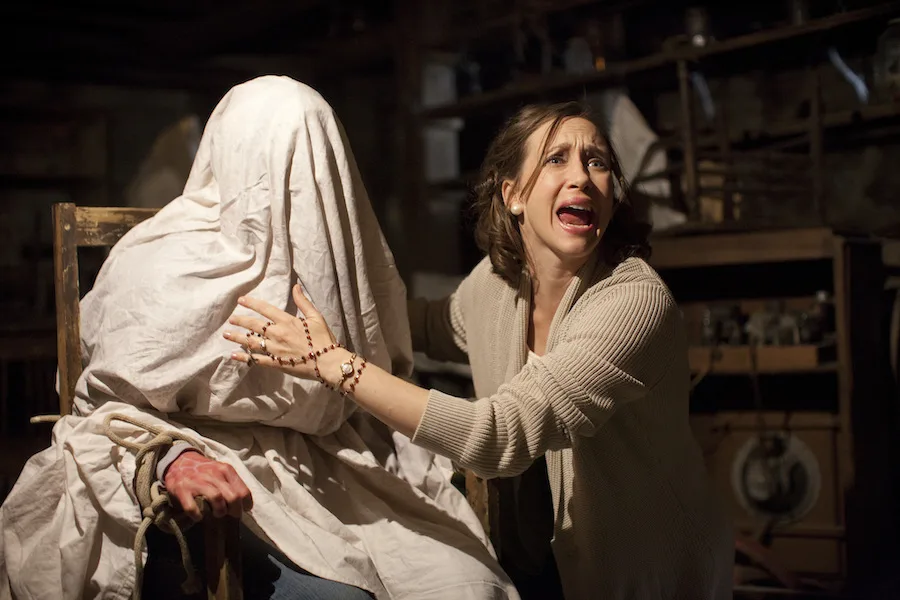

A few weeks ago, my wife went on a work trip leaving me unattended for a few days. To take advantage of the time alone, I did what any healthy, young millennial would do: I binge watched horror films. Two movies stuck out, 2013’s The Conjuring and 2006’s The Descent.
There are other, more frightening films than these cult classics. The two-minute trailer for Sinister, for example, left me more shaken than either of these films. This is because both The Conjuring and The Descent rely heavily on jump scares and reveal their scary monsters halfway through the film, dropping the suspense. Still, these films are nothing to shake a stick at.
Keeping the lights on, my dog close, and the Wikipedia synopses on my phone, I was tense throughout. But more important than the fright, these movies offered an illuminating contrast between horror films whose moral arc is based on religion and those whose redemption is more secular. The Conjuring, utilizing the former, was a much more compelling and even weirdly edifying film.
The Conjuring follows two famous paranormal investigators, Ed and Lorraine Warren, who help the Perron family, a married couple with five daughters who are being haunted and eventually possessed by a demon in a colonial farmhouse in New England. Based on a famous case the Warrens investigated in the 1970s, the film at times feels like an updated and more compelling Exorcist. The central conflict is decidedly spiritual. Ed and Loraine Warren, both in life and in the film, are pious Catholics (The New York Times review has them “hovering at the edge of fanaticism”) whose faith strengthens their resolve in the face of evil. This resolve is deliberately contrasted with the bruised timidity of the Perrons who, while very charming and committed, are not “a churchgoing family.”
The Perron’s lack of faith is conducive to possession, but so too is the financial stress they feel. Roger Perron is a truck driver supporting a family of seven during the early 1970s era of stagflation. Without the shoring effects of faith, this financial-induced stress places a target on the Perrons’ backs.
The role of the Warren’s faith in casting the demon back to hell is left open to interpretation. The Warrens perform an exorcism (something Catholic laity would never attempt), and their example inspires the Perron family to be generally more steadfast and less skeptical. Lorraine Warren is crucial in reminding the possessed Perron mother of the love she feels for her children just as the possessed mother is prepared to sacrifice her daughter. But in the decisive moment, the mother defeats the stranglehold of the demon by remembering the pure love she holds for her family, not by experiencing any sort of conversion.
In the end, there is no profession of faith nor do the Perrons start attending mass. Genuine faith is presented as sufficient but not necessary in overcoming evil. But still, the emphasis on familial love as an antidote to isolated darkness and the potential for religion to light a safe harbor is a strong message. And the model of that faith in the Warrens is inspiring.
This contrasts sharply with the other film that stood out during my reprieve. The Descent follows a group of female friends spelunking in an unexplored North Carolina cave system. Unbeknownst to the group, scores of humanoid creatures lurk in the depths of the cave and pick off each of the party until only one survives. The film is full of daring physical feats, literal pools of blood, and violence. It is also gripping, disgusting, and terrifying, and a film I regrettably enjoyed.
But the moral teaching of the film is muddy. Protagonist Sarah joins her friends a year after her husband and daughter die in a car accident. The cave trip is her first social outing and is meant to be something of a redemptive experience. By traversing a difficult cave, she can prove to herself that she is still strong and resilient even after tragedy. But her redemption manifests in another way (and I don’t mean by killing vampire goblins). In the cave, Sarah learns that her closest friend, Juno, is an awful person who left a member of their party alone to die and, in the past, had an affair with Sarah’s late fiancé. In the penultimate scene, she injures Juno, leaving her to be gobbled up by the vampire goblins while she crawls desperately to the sun-lit surface. It is not exactly a happy ending for Sarah, but with the sunlight bursting forth and the orchestra swelling, her ascent from the cave reads as a redemption.
What are we supposed to take from this film? The message lands somewhere between “you are enough” and “cut out (or cut down) toxic friends.” In this way, the 2006 movie anticipated early-2020s social media mantras. But Sarah did not undergo serious transformation, nor was she inspired by anything greater than herself. In fact, by trusting herself and only herself is she able to ascend. The Perrons, by contrast, found relief by trusting that some matters are beyond their control and embracing each other and the spiritually confident Warrens. When confronting evil, The Descent tells us simply to be strong and ask questions later. The Conjuring tells us to put our faith in God, family, or both and offers a more accurate account of what it takes to traverse the darker times in life.
If you are suspicious of this interpretation, ask yourself, would you rather be trapped in a cave with Sarah or with those fanatical Warrens?



Comment by David on September 11, 2023 at 11:06 am
Ever notice how it is only Catholic clergy that are helpful in the situations depicted? Protestant and Jewish leaders never seem to have the power to drive out demons. Of course, Catholics have apparitions of the Virgin Mary including at a park near me. Poor Protestants are not so divinely favored.
Comment by MikeB on September 11, 2023 at 9:35 pm
David,
I am quite grateful that your search keeps bringing you back here. If you look in your heart, God is definitely calling you to be here. Just like how the apostal Paul was fanatically against Christ, it was all part of God’s will to bring him to him.
Those of us who are saved in Christ have the holy spirit within us, we need fear no demons.
There are many protestant missionaries who continue to fight demons in many counties.
There are many demons here as well, if you have ever worked in a rehab or met with and fed the homeless or fentynal addicts you will realize that they are not just physically addicted, they are spiritually bound and their minds are not just their own.
Comment by George on September 11, 2023 at 10:16 pm
Well David, there may be hope for you yet. Why don’t you head down to “Our Lady of Good Intentions “ and have Father Sean O’Malley purge you of that demon you have been harboring in your derrière.
Comment by Pastor Mike on September 12, 2023 at 7:13 am
There are enough demons and strongholds in many person’s hearts without Hollywood inventing fake ones.
Comment by David on September 12, 2023 at 8:25 am
I have sat on the stone park bench where the Virgin Mary appears, so my derriere is purged of evil.
Comment by Mike on September 12, 2023 at 11:27 am
You wish, David.