

The United Methodist split has gotten much wider. Nearly 6,000 congregations have recently left the United Methodist Church, with more on the way. According to the official tracker, my home state of North Carolina has seen a total of 482 congregations depart either United Methodism’s Western North Carolina Annual Conference or its (eastern) North Carolina Annual Conference. Another 59 congregations are set to be approved to leave the latter this week (see page 92/95). Western North Carolina congregations have one last chance to disaffiliate, but only if they begin the process within the next two weeks!
Some of Tar Heel state United Methodism’s largest congregations are among those who have already disaffiliated (like Covenant Church) or are in the process of doing so (like Good Shepherd UMC).
This split has resulted from a liberal faction securing a takeover of the denomination’s governing bureaucracy, now steering the UMC in a much more liberal direction on a range of issues. The denomination keeping the name “United Methodist” is no longer the UMC we have known.
Western North Carolina United Methodists, your congregation has “a limited right” to also join the mass exodus from the new, liberalized United Methodism and keep your property—but only if your church council acts before the end of June!
(UPDATE: After this article was published, Western North Carolina United Methodist Bishop Ken Carter delivered a remarkable address to the Western North Carolina clergy session. Among other things, he characterized departures of disaffiliating non-liberals as “a kind of purging,” juxtaposed “exclusion” of non-celibate gay clergy with racism (twice), declared “We are not going back” from the UMC’s liberal new direction. What does this mean for faithful Western North Carolina United Methodists who cannot in good conscience support, submit to, and pay for this new, liberalized United Methodism? Carter actually said, “If you are called to depart, do so quickly.”)
While I do not recommend this, disaffiliating congregations have the option of becoming non-denominational. But disaffiliation does not require giving up Methodist connectionalism. Disaffiliating congregations have the option of remaining connected with like-minded believers around the world, with whom they have long been connected through the UMC, by joining the new, rapidly growing Global Methodist Church (GMC).
The GMC has become the denomination for theologically conservative United Methodists. It is committed to consistently upholding a core of historic, biblical doctrine, while having a less burdensome denominational bureaucracy. More than 400 North Carolina congregations have already been approved for disaffiliation from the UMC and joined or at least begun the process of joining the GMC’s new North Carolina Provisional Annual Conference. In North Carolina, there are already more Global Methodist or soon-to-be-GMC congregations than those affiliated with the African Methodist Episcopal (AME) Church, the Wesleyan Church, the Church of the Nazarene, and the Free Methodist Church combined!
Whether your congregation sticks with the liberalizing UMC or disaffiliates to explore other options, it is a major decision, either way.
To his credit, Western North Carolina United Methodist Bishop Ken Carter has slightly extended the deadline, by calling a disaffiliation-focused special session later this year.
But on the other hand, in the same statement, he imposed heavy-handed new restrictions against basic freedom of discussion among moderate and conservative Western North Carolina United Methodists interested in disaffiliation. For many congregations, what has been especially helpful has been inviting knowledgeable speakers, sometimes from the Wesleyan Covenant Association (WCA), and sometimes a balance of defenders and critics of the UMC’s liberal new direction. But Bishop Carter’s statement now decrees that “there shall no longer be meetings with WNCC churches where persons recruit members to depart from The United Methodist Church.”
WCA President Jay Therrell, who served as a district superintendent under Carter in the Florida Conference, has noted how Carter’s using his great power amounts to “silencing opposition” from honest, well-meaning critics of the UMC’s liberal new direction.
Elsewhere, the UMC allows congregations to invite outside speakers to promote and practice non-Christian religions in United Methodist sanctuaries. But Western North Carolina United Methodism is now apparently forbidding congregations from inviting completely Christian outside speakers, even fellow United Methodists, to share accurate information about an explicit “right” congregations have under the UMC Discipline to disaffiliate.
Why not simply ask congregations to hear different perspectives? Why not encourage checking for documentation on everything claimed, whether by conference staff, me, or anyone else?
We at IRD/UMAction have nothing to financially gain by any disaffiliation. We simply want you to be informed and to find what is best for your congregation, which may or may not be the liberalized new United Methodism.
Western North Carolina United Methodism’s suppression of free speech raises the question of if you really want to stay with a denomination of such heavy-handedness.
In any case, Western North Carolina United Methodists still have every right to read this article, check the documentation, share this link widely, and bring this before their church council before the upcoming deadline.
The Situation in Western North Carolina
What Western North Carolina United Methodist Congregations Can Do
Speaking of heavy-handedness, Western North Carolina United Methodists should know that under the UMC system, any bishop, acting together with annual conference officials under the alarmingly broadly worded UMC Discipline ¶2549.3.b, has the ability, “in their sole discretion,” to suddenly, permanently kick everyone out of your local church building and seize the property, with few effective checks and balances! Here is a recent case study of the liberal bishop in the neighboring eastern North Carolina Conference ambushing a self-sustaining conservative congregation in this way. Other examples could be cited. As long as your congregation remains United Methodist, this will always be a risk.
With the push for church celebrations of gay weddings, consider where this may lead, including how the conservative departures this provokes will shift the balance of what is left of the UMC.
It must also be remembered that even before this season of mass disaffiliations, American United Methodism was already a sinking ship, steadily losing members across the country as well as in Western North Carolina (see here, here, here, here, and here) year after year.
The UMC was already deeply divided on more foundational doctrine about Jesus Christ and the authority of Scripture. Yes, the UMC’s “on paper” doctrine is solid on such matters, and has not officially changed. But just as the UMC’s similarly “on paper” rules forbidding same-sex weddings and “self-avowed practicing homosexual” ministers are now widely disregarded in practice, the official “on paper” doctrine has not been consistently taught and enforced.
It is simply disingenuous for bishops and other “Stay UMC” advocates to emphasize carefully worded, technically true statements about either United Methodism’s on-paper doctrine about Jesus Christ and biblical authority or the denomination’s on-paper standards for sexual morality “not changing,” without acknowledging the de facto reality of how the UMC has in practice already moved far beyond both.
Even at the highest levels of leadership, United Methodist bishops remain in good standing after publicly rejecting such basic Christian truths as the bodily resurrection of Jesus Christ and the reliability of John’s Gospel (Joseph Sprague, former bishop of Chicago), or even Christ’s sinlessness (Karen Oliveto, a current UMC regional college of bishops president). Such doctrinal divides are also seen among Americans in United Methodist pews, with one recent survey revealing that 38 percent believe that “Jesus committed sins like other people” and only 29 percent cite Scripture as “the most authoritative source of their personal theology.” This is documented here.
Western North Carolina’s own Bishop Ken Carter cannot be unaware of these doctrinal divides. And yet in a newspaper interview last year, he said, “while I believe in our traditional, orthodox faith that’s rooted in the Scriptures, I also have always believed that we have to adapt our doctrine and our Scriptures to changing life circumstances that people have.”
Moderate and traditionalist United Methodists are alarmed by such talk from a top UMC leader of actually seeking to change the Bible and change doctrines, in response to outside pressures.
Furthermore, when Carter was president of the denomination’s global Council of Bishops, he was made aware of a complaint filed against Oliveto’s teaching that Jesus Christ was guilty of such sins as “his bigotries and prejudices” and having “made his life too small.” According to the UMC’s supposedly governing rulebook, the Book of Discipline, the Council of Bishops was required to convene a nationwide panel to address this complaint against Oliveto. However, under Carter’s leadership the Council evidently refused to do this, so that Oliveto was shielded from accountability! Read about that here.
Meanwhile, many liberal United Methodist leaders are pushing the denomination’s sexual revolution beyond gay weddings, with especially strong support seen for retracting church disapproval of pre-marital sex.
Top United Methodist officials are also promoting a more leftist approach to abortion than the nuanced, moderate position of the current UMC Social Principles.
With so many conservatives leaving, the restraints on these and other liberal agendas are being removed.
While the UMC’s official standards forbidding gay weddings and non-celibate gay clergy have not yet changed, these on-paper standards are increasingly meaningless in practice. The denomination now has two openly partnered gay bishops, Cedric Brideforth and the aforementioned Oliveto.
Jurisdictional conferences held across the country in November have already shifted the UMC denomination dramatically leftward.
The Southeastern Jurisdiction, which includes North Carolina, no longer stood apart as significantly more conservative. All five U.S. jurisdictions passed three largely identical liberal resolutions (you can read the versions submitted in the Southeast here). These included the so-called “Queer Delegates Resolution” on what the denomination should “center” in its life together: “Justice and Empowerment for LGBTQIA+ People.” That resolution derided maintenance of the UMC’s historic, biblical standards on sexuality as “harmful,” and encouraged bishops to block enforcement of related rules for clergy behavior. American United Methodist bishops still willing to uphold these standards, in the face of such pressure, are few and dwindling.
This resolution was adopted in the Southeast by apparently too overwhelmingly a hand vote to need an exact count (see page 56/62).
What sort of tolerance may be left for United Methodists who genuinely love self-identified members of the LGBTQ+ community but do not accept secular LGBTQ+ liberationist ideology? Here is what we have already seen:
- One prominent caucus leader has admitted that in November’s elections of new bishops, there was a nationwide “theological litmus test” barring anyone from such UMC leadership if they were not committed to LGBTQ+ “full inclusion” ideology. Even in the Southeastern Jurisdiction, a highly qualified, Hispanic candidate proved to be utterly unelectable, because he was unwilling to fully embrace secular LGTBQ+ liberationist ideology.
- Last year, in the neighboring (eastern) North Carolina Conference, Bishop Leonard Fairley and other top UMC leaders went out of their way to publicly undermine the ministry of a new congregation by issuing a groveling apology to leaders in its neighborhood for the conference having previously supported the planting of this congregation, because they found it unacceptably embarrassing that its young Latina pastor does not affirm same-sex marriages.
- A prominent moderate bishop warned in September of conservative as well as moderate United Methodists essentially being told, “You are welcome if you stay quiet and pay your apportionments.” Since then, such concerns have only grown.
- Shortly after her 2016 election as the UMC’s first openly partnered gay bishop, Karen Oliveto sought to very briefly visit every congregation in the Mountain Sky Conference. Oliveto used these visits to ominously note and remember those congregations under her thumb who were not enthusiastic about welcoming their new lesbian bishop and her wife. Other jurisdictions will face growing pressure to elect their own first non-celibate gay bishops.
The clear track record of the now-dominant liberal faction and the logical implications of their repeated equations of disapproving of gay weddings with the sin of racism show why non-liberal Western North Carolina United Methodists cannot count on indefinite toleration in the new UMC.
After your pastor retires, will there be any remaining theologically traditionalist Western North Carolina United Methodist ministers available to become your next pastor? These new trends will largely discourage traditionalists from even trying to pursue UMC ordination, while the few who do can expect discriminatory barriers.
If your Western North Carolina congregation remains United Methodist, you can expect that some future pastor appointed over you will have been spiritually formed by a typical United Methodist seminary. So you should know about the “woke,” left-wing political activism and theological radicalism being pushed in UMC seminaries, funded by apportionments taken every year from your offering plate.
Either choice involves financial costs. Disaffiliation requires a significant but one-time exit fee. However, loans are available to spread out payments. Congregations who transfer into Global Methodism are finding their one-time disaffiliation costs surpassed by long-term savings.
If your congregation remains United Methodist, this would require major yearly costs in perpetuity, to fund a bloated bureaucracy and controversial agendas about which you should be informed.
The Situation in Western North Carolina
For decades, the “trust clause” asserting the UMC’s rights over all local-church property has held congregations hostage.
But then the 2019 General Conference adopted Discipline Paragraph 2553, which gives congregations “a limited right” to disaffiliate from the UMC and keep their properties. This provision expires this year. So a unique window of opportunity is closing!
This provision’s opening section lists two reasons a congregation may have for disaffiliation:
- “reasons of conscience regarding a change in the requirements and provisions of the Book of Discipline related to the practice of homosexuality or the ordination or marriage of self-avowed practicing homosexuals as resolved and adopted by the 2019 General Conference”
OR
- “reasons of conscience regarding … the actions or inactions of its annual conference related to these issues which follow.”
Some UMC officials interpret this narrowly. But the second reason clearly applies to any Western North Carolina United Methodist congregation which disagrees with either or both of two “actions” the Western North Carolina Annual Conference session took in its 2019 session: the adoption of two homosexuality-related resolutions.
According to this official report, Western North Carolina United Methodism’s 2019 annual conference adopted, by a vote of 692 to 481, a resolution calling for the next General Conference to remove the decades-old official stance of the UMC “referring to the practice of homosexuality as ‘incompatible with Christian teaching.’” (See pages 172/174 and 303/305 of the 2019 Western North Carolina Annual Conference Journal.)
That same report also records how at another point, the 2019 Western North Carolina Conference session ultimately decided, by a vote of 564 to 328, to adopt another resolution, “Endorsing the Commitments of UMC Next and Supporting the Full Inclusion of All People.” This resolution endorsed several “commitments” of the liberal UMC Next caucus group, including stating, “We reject the Traditional Plan approved at General Conference 2019 as inconsistent with the gospel of Jesus Christ and will resist its implementation,” and “We will work to eliminate discriminatory language and the restriction and penalties in the Book of Discipline regarding LGBTQ persons.” (The demonized Traditional Plan sought to maintain and bring more effective enforcement of UMC rules forbidding gay weddings and non-celibate gay ministers.) The full text of this resolution can be read in both the news report and pages 174/176 – 175/177 and 304/306 of the 2019 Journal.
Any Western North Carolina United Methodist congregation who has reasons of conscience for dissenting from either of these resolutions (i.e., either of these “actions or inactions of its annual conference”) has a solid basis to disaffiliate under Paragraph 2553.
In all forms and communications with Western North Carolina United Methodist officials, it is safest to focus primarily on these two resolutions.
But some other actions of Western North Carolina United Methodist leaders are important to know.
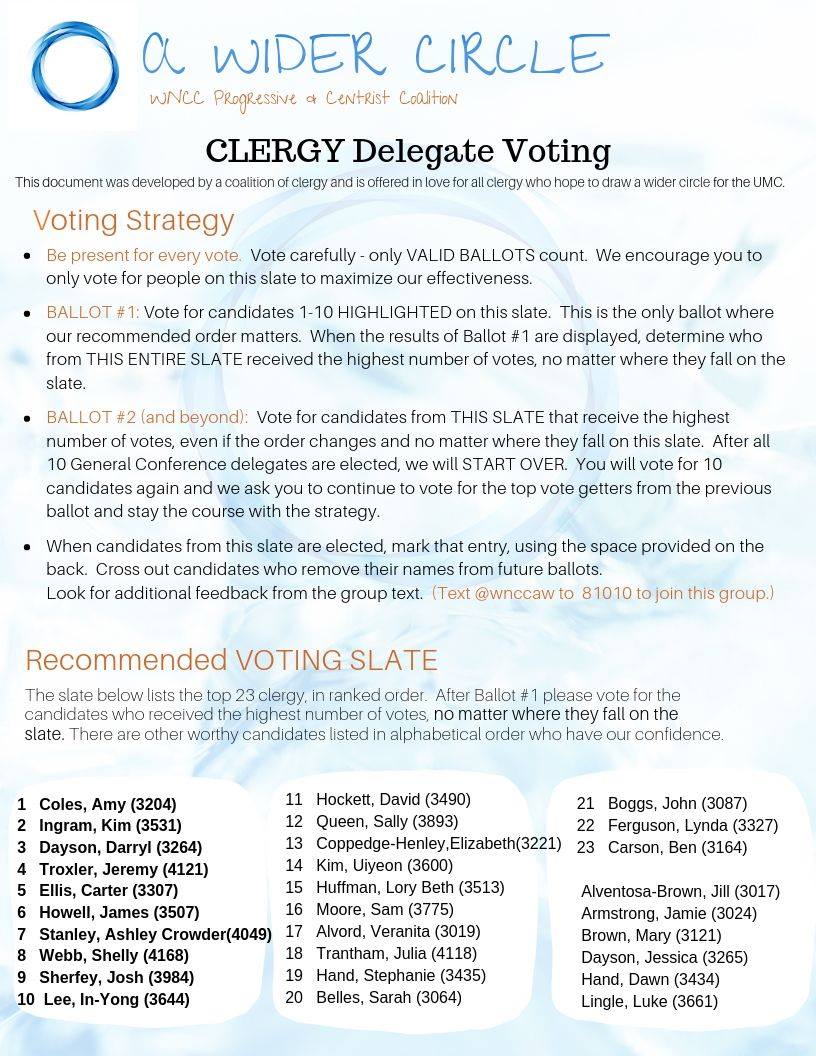
The conference made a major leftward shift in 2019, not only with the strong majorities supporting these resolutions. Just compare the list of General Conference delegates and (non-alternate) Southeastern Jurisdictional Conference delegates elected by Western North Carolina United Methodists that year to the list of those endorsed by a sort of political action committee devoted to “support[ing] the full rights of marriage and ordination for LGBTQIA+ persons” and electing opponents of the Traditional Plan (see here, here, here, and here). You’ll see that every single delegate elected, lay as well as clergy, was on the liberal slate.
As one Western North Carolina United Methodist pastor subsequently complained, non-liberal congregations being required to pay high denominational apportionments while non-liberals are so systematically excluded from leadership amounts to “taxation without representation.”
Among those Western North Carolina United Methodists elected to help rewrite church law at the next General Conference was Helen Ryde, a partnered lesbian and national staffer of the Reconciling Ministries Network (RMN) who uses “they/them” pronouns. RMN has long been the main unofficial caucus pushing the UMC to liberalize on sexuality as well as many other matters. Since 2016, Ryde’s work as an RMN staffer has enjoyed the official UMC affirmation, through Ryde being commissioned as a home missioner, under an office of what was then called United Methodist Women (see pages 95, 131, 146, 203 of the 2016 Western North Carolina Conference Journal).
The open opposition by denominational officials to biblical, historic, and still-official United Methodist standards is much wider.
Bishop Carter, like many other bishops across the country, has declared in Western North Carolina “an abeyance on charges related to LGBTQ clergy and same gender weddings.” According to our church law, bishops have no right to hold any complaint in abeyance, except “in the context of ongoing or imminent civil or criminal proceedings.” But that has not stopped Carter and other bishops from declaring such abeyances, anyway. This amounts to an open invitation for Western North Carolina United Methodist ministers to violate rules banning gay weddings and non-celibate gay clergy, now that Bishop Carter has assured them that they will face no accountability.
Some Western North United Methodists appreciate the willingness of bishops to bend and break the rules in order to advance what they see as justice.
But to become a United Methodist bishop, you must solemnly promise to God and the church that you will uphold the UMC Discipline. So others ask how they can trust a denominational system that does not follow its own rules.
Speaking of broken promises, Western North Carolina United Methodists should know about how Bishop Carter was part of a 16-member team of United Methodist leaders, representing every major region and faction, who negotiated details over several months and then in early 2020 published their consensus “Protocol” proposal for the next General Conference to enact an “amicable separation.”
In the Protocol negotiations, Carter and others extracted extraordinary, one-sided concessions for the exclusive benefit—financial and otherwise—of their liberal side. And yet after these concessions became effectively secure, Carter and other liberal Protocol Mediation Team members largely abandoned their end of the “Protocol” bargain. Such behavior hardly inspires trust.
Western North Carolina United Methodists should beware of any encouragements to “wait and see what the 2024 General Conference does.” The hard reality is that in the past year, we have seen no major liberal leader strongly, publicly advocate for the 2024 General Conference to adopt the Protocol or any other particular proposal to allow non-liberal congregations to leave with their properties.
This leaves Paragraph 2553 as the one clear option Western North Carolina United Methodist congregations have to continue in biblical faith without losing their buildings. And your congregation can only use it if you begin the process this month!
After the 2024 General Conference officially liberalizes sexual-morality standards, as is widely expected, congregations who choose to “stay UMC” should be prepared to face increasing pressure to affirm leftist LGBTQ+ liberationist ideology. If your future United Methodist bishop ever appoints you a non-celibate gay pastor, you can expect any resistance to be treated as being as shamefully unacceptable as racism.
What Western North Carolina United Methodist Congregations Can Do
For congregations who do not wish to be part of the UMC’s liberal new trends, Bishop Carter has made clear that Western North Carolina United Methodists have an urgent deadline to act before July 1!
Among other requirements, his statement declares, “Churches will need to submit their originating letter of intent by July 1, 2023, and hold their church conference by September 15, 2023, to be a part of this November 4 special session.”
If your congregation wants to preserve its right to disaffiliate from Western North Carolina United Methodism, then well before July 1, your church council must vote to pursue disaffiliation, with only a simple majority required.
The detailed requirements were outlined in this August 24 Western North Carolina United Methodist disaffiliation checklist, which was reportedly widely distributed by district superintendents.
After your church council votes, your congregation must write a letter, stating explicitly that this is your congregation’s “originating letter of intent” and that you desire to pursue disaffiliation from the United Methodist Church under Discipline Paragraph 2553 “for reasons of conscience regarding a change in the requirements and provisions of the Book of Discipline related to the practice of homosexuality or the ordination or marriage of self-avowed practicing homosexuals as resolved and adopted by the 2019 General Conference, or the actions or inactions of its annual conference related to these issues which follow.”
I understand that at some point after the aforementioned checklist was released, Western North Carolina United Methodist officials have changed the process to now (oddly) require, among other things, that these initial letters answer both of these questions:
1. What are your specific disagreements or concerns with the change in the requirements and provisions of the Book of Discipline related to the practice of homosexuality or the ordination or marriage of self-avowed practicing homosexuals as resolved and adopted by the 2019 General Conference?
2. What actions or inactions of your Annual Conference related to the change in the requirements and provisions of the Book of Discipline related to the practice of homosexuality or the ordination or marriage of self-avowed practicing homosexuals as resolved and adopted by the 2019 General Conference do you disagree with or have concerns with?
For the first, your letter can speak broadly about how you are “concerned and in disagreement with” (be sure to use such wording, following the wording of the question) how the changes to church law made by the 2019 General Conference resulted in greater denominational conflict while failing to resolve key problems. You may briefly cite examples from across the country of continued disobedience to the Discipline’s standards related to the practice of homosexuality, such as how Karen Oliveto faces no real discipline seven years after her election.
Remember that theological traditionalists did not agree with all actions taken by the 2019 General Conference. One key petition was #90079: “Modified Traditional Plan – Dunnam – Implementation Process – NEW Par. 2801.” It would have advanced the Traditional Plan’s accountability enhancements even further, by among other things placing financial embargoes on entire annual conferences if they chose to remain in open rebellion against the Discipline’s biblical moral standards, and providing to both sides more gracious exit options than Paragraph 2553. But this petition was voted down. So your letter can also state that you disagree with the decision of the 2019 General Conference to reject Petition #90079.
(For another perspective, Pastor Chris Ritter’s “Compendium” includes a 6-10-2023 entry sharing an example of how some theologically traditionalist congregations are addressing such a question.)
Answering the second question is a simple matter of citing both of the Western North Carolina United Methodist Annual Conference resolutions noted in the previous section (and it is better to cite both).
Obviously, your letter should only include statements that all of those signing genuinely believe.
Your letter must be signed by at least “2-3 church leaders.” Your pastor does NOT have to sign, and does not count towards your minimum of two signatures! Given how much trust has been shattered, it is safest to get more than three to sign, in case one is somehow invalidated. At a minimum, you should include at least one church council member (ideally the chair) and at least one trustee (ideally the trustees chair). Other “church leaders” who you may ask to sign are any members of the staff-parish relations and/or finance committees (ideally the chairs).
More signatures are better, but once you have at least four, it is not worth significantly delaying your submission.
Send your letter to your district superintendent (DS).
To be on the safe side, you should do all of the following:
- Scan or photograph your signed letter and email then email this electronic version to your DS. Be sure to set the email up to request “read receipts” (if you know how) and carbon-copy your DS’s administrator/assistant.
- Mail a hard copy via certified mail. Keep a record of confirmation that your mailing was received.
- If anyone from your church has time, they should also personally drive over to the DS’s office to deliver the letter in person.
Yes, this is a lot. But if you do all of these things, ideally well in advance of June 30, you should be at minimal risk of your disaffiliation process being blocked by someone claiming “we did not receive your letter by the deadline.”
If you have specific questions about requirements and deadlines for any stage of the process, you can reach out directly to your district superintendent.
In all disaffiliation-related communications with your DS or other conference staff, it is best to not rely solely on oral communication for any key fact, but rather to use emails and keep written records.
Remember, sending this letter is just a first step, and does NOT irreversibly bind your congregation to actually disaffiliate! The main decision comes later, with a vote of the whole congregation. Disaffiliation requires multiple steps over the next few months. The important initial step of sending the letter really serves to preserve the option of your congregation disaffiliating—an option that will be lost if you do not act soon.
Throughout this whole process, your congregation should engage in ongoing discernment about its decision, through town-hall meetings and other means, especially individual and collective prayer. Building as much consensus as possible, especially among leaders, is critical.
In your congregation’s internal discussions, it would be irresponsible to ignore the implications of disaffiliation on issues other than gay weddings, as are documented at www.umchoices.org.
However, every disaffiliation-related meeting or communication in your congregation should include at least some discussion of, in the words of Discipline Paragraph 2553, your “reasons of conscience regarding a change in the requirements and provisions of the Book of Discipline related to the practice of homosexuality or the ordination or marriage of self-avowed practicing homosexuals as resolved and adopted by the 2019 General Conference, or the actions or inactions of its annual conference related to these issues which follow.”
And you want to be sure to exclusively focus on these quoted words in all communications with your DS and other Western North Carolina United Methodist officials.
Elsewhere, congregations citing in writing any other reason for their disaffiliation have sometimes found their exit heavy-handedly blocked by UMC officials claiming that they did not qualify to use Paragraph 2553.
Let’s be honest. Major life decisions—where to pursue higher education, what career path to explore, etc.—are driven by multiple reasons.
Any decision on disaffiliation is influenced by multiple reasons. But this process requires you to only cite matters related to homosexual practice in all official forms and communications with the conference. This is just how the system is set up.
Western North Carolina United Methodists concerned for their congregations’ future should share this article with others in their congregation and make sure their church council discusses and acts on the matter before time runs out.

Comment by Palamas on June 15, 2023 at 2:37 pm
I served for nine years in the North Carolina Conference back in the 1980s and early 90s (including in the same district with now-Bishop Fairley, who was a good guy back then), but left because I could see the handwriting on the wall. It is sad to see the UMC decline into the same pit that has swallowed up the PCUSA, ELCA, Episcopal Church, etc. But reading this and other accounts, there is little doubt that the UMC is no longer a Christian organization in anything but name only. In every way that matters, it is nothing more than a political activism club for the sexually obsessed.
Comment by Jeff on June 16, 2023 at 12:52 am
But reading this and other accounts, there is little doubt that the UMC is no longer a Christian organization in anything but name only. In every way that matters, it is nothing more than a political activism club for the sexually obsessed.
Well said, Palamas. A hundred years ago, J. Gresham Machen postulated that deviating from sound Christian doctrine makes a body not “a different flavor of Christian”, but rather, “not Christian at all”. Machen wrote around the same time that the materialists perverted Methodist doctrine and began the process that inexorably led to our current state.
To John’s point: a hastily exiting congregation would do well to move to the GMC. From that safe harbor, you can, if necessary, move into an independent congregation in the future, without compromising your property ownership. Many UMC congregations are unprepared for the challenges of independence after so long in the Methodist connectional mindset.
Blessings in CHRIST!
Jeff
Comment by Karen on June 24, 2023 at 1:32 pm
Churches leaving the UMC take the name Methodist Church but remain independent. Where I attend we are adopting some of the UMC discipline Our goal is to take all political and worldly issues out. We come to worship the Lord our God. We are turning to God and His word the Bible for direction. We may look into and decide whether to join the GMO or others in the future. Christianity has been under fire for so many years and now it is worse. It breaks my heart because I do not think God wanted all the denominations anyway