A prominent progressive seminary has cut ties to a liberal Episcopal Church institution, leaving the latter formless and devoid of campus, faculty, and accreditation.
In a Friday afternoon news dump, New York City’s Union Theological Seminary announced discontinuation of its formal affiliation with Episcopal Divinity School (EDS). The latter was an independent seminary training students for ministry within the Episcopal Church until financial shortfalls forced the sale of its Massachusetts campus, faculty layoffs, and a functional affiliation with Union in 2017 that lasted a total of five years.
Readers will recall Union for its widely mocked 2019 chapel service during which participants confessed to plants. Union is among the most theologically progressive U.S. seminaries, known for political activism and various liberation theology expressions tied to identity. Originally established by Presbyterians, the independent seminary is officially non-denominational.
Episcopal Divinity School affiliated with Union as an Anglican studies program. Union also educates Unitarian Universalists and has Muslim faculty, among other religious traditions.
The move is part of a wider series of changes within Mainline Protestant seminaries forced to scale back programs, consolidate or shutter altogether. Other Episcopal Church seminaries including General Theological Seminary and Church Divinity School of the Pacific have announced the conclusion of residential programs in favor of hybrid remote learning.
Of the 10 Episcopal Church seminaries active at the time of the 2017 Union-EDS affiliation agreement, only four continue to offer residential programs: Virginia Theological Seminary of Alexandria, Virginia, Seminary of the Southwest in Austin, Texas, Nashotah House Theological Seminary in Wisconsin and Sewanee in Tennessee. A fifth seminary, Trinity School for Ministry of Ambridge, Pennsylvania, quietly concluded its relationship with the Episcopal Church in 2021 and continues as an evangelical seminary in the Anglican tradition.
Episcopal Divinity School is not a degree-granting institution and relied upon Union for its Master of Divinity and Master of Sacred Theology program. A December 2022 newsletter from Dean Kelly Brown Douglas listed a total cohort of 21 students.
Anglican Studies will still be offered at Union – independent of EDS. While the announcement characterizes the change as an “amicable agreement,” it appears that Union sees little loss in the conclusion of the relationship.
“Union is confident that this new direction for both institutions will have no effect on the academic progress of its students, who as always, are Union’s first priority,” the announcement read.
“We look forward to continuing to offer current and future students the ability to pursue Anglican studies at Union Theological Seminary and to continue to build on the relationship we have with the Episcopal Church,” Union Theological Seminary President Serene Jones stated in the March 31 announcement.
Douglas, a past canon theologian at Washington National Cathedral, appears to be headed out the door in the near future. The announcement states that she will “lead EDS as Interim President until a long-term leadership structure is in place.” Her academic work focuses on womanist theology, sexuality and the black church.
“EDS’ mission of dismantling racism and working for social justice has taken on greater urgency as we prepare to meet broader demand for Episcopal theological education,” said Douglas, identifying a “pressing need to continue supporting rigorous theological education, connecting with the global Anglican communion, and responding to the demand that the Episcopal Church expand its role in matters of racial and social justice.”
It is unclear how many (if any) seminarians EDS educates from the broader worldwide Anglican Communion. Without accreditation or an ability to grant degrees, the institution appears relegated to advocacy and loosely defined “continuing education.”
EDS appears to have existed in recent years only to espouse and promote heterodox views on Christian morals and ethics.
Douglas claimed that religious liberty is being “weaponized” by an “Evangelical, Christian nationalist” minority, hosted speakers promoting abortion and working against capitalism, instead of promoting evangelism.
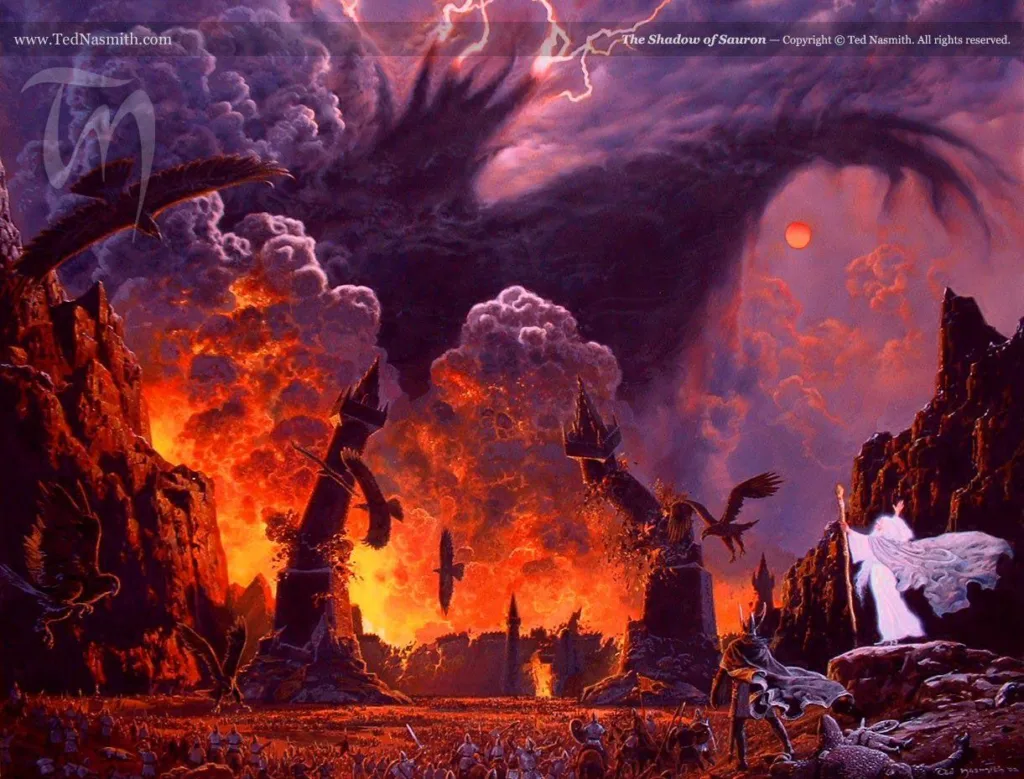
Readers may be reminded of J.R.R. Tolkien’s The Lord of the Rings in which the main antagonist, Sauron, is defeated:
“And as the Captains gazed south to the Land of Mordor, it seemed to them that, black against the pall of cloud, there rose a huge shape of shadow, impenetrable, lightning-crowned, filling all the sky. Enormous it reared above the world, and stretched out towards them a vast threatening hand, terrible but impotent: for even as it leaned over them, a great wind took it, and it was all blown away, and passed; and then a hush fell.”
EDS appears to at last be blown away, not in calamity, but a dismissive whimper.
UPDATE [04/07/2023]: I earlier reached out to the press contact for EDS to inquire about the status of their endowment ($53 million at the time of the 2017 affiliation with Union). Unsurprisingly, I received no reply (which is probably telling in and of itself).
Separately, I reached out to the press contact at Union to inquire about the status of EDS students at Union and of Dean Kelly Brown Douglas. In that case, I did receive a prompt response: the EDS Dean had already announced her retirement at the end of this academic year prior to the disaffiliation announcement and will not remain with either entity past her interim post. As for the EDS@Union cohort, “We are proud of our EDS@Union students and are committed to supporting them through this transition all the way through graduation,” Union Vice President of Communications & Marketing Afsheen A. Shamsi shared with me via email.




Comment by Loren J Golden on March 31, 2023 at 10:57 pm
One also might think of the demise of the once-great Wizard Saruman the White, whose staff Gandalf broke during a conversation with him on the steps of the Tower of Orthanc at Isengard. Divested of power, Saruman continued inhabiting Orthanc for several months, before departing it voluntarily, only to take up residence at Bag End in the Shire—Frodo’s own home—after having filled the Shire with thugs and other worthless men, who were terrorizing the Hobbits and laying waste the beautiful country.
Upon the return of Frodo, Sam, Merry, and Pippin, who set things to rights, they confronted Saruman on the doorstep of Bag End. The disgraced Wizard addressed them rudely and shamefully, for which Sam wanted to kill him, but the merciful Frodo admonished him,
“No, Sam! … Do not kill him even now. For he has not hurt me. And in any case I do not wish him to be slain in this evil mood. He was great once, of a noble kind that we should not dare to raise our hands against. He is fallen, and his cure is beyond us; but I would still spare him, in the hope that he may find it.”
Saruman responded with bitter respect, but he was willing enough to depart Bag End peacefully, with his servant, Grima Wormtongue, in tow, whom he treated most miserably, going so far as to kick him in the face as he was groveling. Wormtongue snapped at that, springing onto Saruman’s back and cutting his throat, after which he was made into a pin cushion by three Hobbit archers.
“To the dismay of those that stood by, about the body of Saruman a grey mist gathered, and rising slowly to a great height like smoke from a fire, as a pale shrouded figure it loomed over the Hill. For a moment it wavered, looking to the West; but out of the West came a cold wind, and it bent away, and with a sigh dissolved into nothing.
“Frodo looked down at the body with pity and horror, for as he looked it seemed that long years of death were suddenly revealed in it, and it shrank, and the shriveled face became rags of skin upon a hideous skull. Lifting up the skirt of the dirty cloak that sprawled beside it, he covered it over, and turned away.”
The Mainline Protestant Church is very much like Saruman. Like him, she was faithful for many years, particularly in proclaiming the Gospel. But just as Saruman was seduced by the lure of the One Ring, the Mainline Church was seduced by the social capital she had enjoyed when Western society was, for all intents and purposes, Christendom. And as the society drifted further and further from its Biblical moorings, the Mainline Church prostituted herself to the spirit of the age to maintain the social influence she had previously enjoyed. Biblical inerrancy was the first thing to go, followed by Biblical theology, and finally Biblical sexual morality. Today, the Mainline Church is a bitter, greedy miser, begrudging the property of Evangelical churches who, wanting nothing further to do with her, seek disaffiliation—much like Saruman ruining the Shire to spite the Hobbits who unwittingly became the agents of his downfall (who “were brought to Fangorn” by Saruman’s Uruk-hai, ”and their coming was like the falling of small stones that starts an avalanche in the mountains,” namely, the attack of the Ents on Isengard).
So, too, the divestment of the Episcopal Divinity School of its influence (and now of its relationship with Union Seminary) is rather like Saruman being evicted from Bag End and having its throat cut by its ally, set free from its decaying body to become a vapor that is blown away by the winds of change that it sought to weather by accommodating itself to them. And like Frodo, we look upon it with pity and horror at what it has degenerated into, but then we cover it up with its own cloak and turn away.
Comment by Jeffrey Walton on April 3, 2023 at 10:04 am
Excellent analogy, Loren.
Comment by Paul on April 1, 2023 at 9:35 am
This is a misreading of how this disaffiliation came about. It was at EDS’ initiative, not Union’s. EDS has discerned that they want to emphasize not-for-credit public programming and no longer to be degree granting. Union will continue to support Anglican studies students going forward.
Comment by Jeffrey Walton on April 3, 2023 at 10:09 am
Paul, I can understand how you would perceive it that way, but Union held all the cards: campus, accreditation from the Association of Theological Schools, the ability to grant degrees. EDS hasn’t had any of those since 2017. Union no longer had reason to continue in affiliation with EDS. And, as you note, their Anglican studies program predated their affiliation with EDS and continues after their disaffiliation from EDS. How is EDS a divinity school if it is without accreditation and grants no degrees?
Comment by David Virtue on April 1, 2023 at 11:04 am
Another nail in the coffin of TEC. As the seminaries closed and their woke teachings so too go the pulpits and with it emptying pews. TEC has only itself to blame when the whole church crumbles as surely it will. God will not allow apostasy to reign indefinitely. His judgement and wrath is inevitable. Great story Jeff. Well done.
Comment by David on April 1, 2023 at 4:28 pm
Loren J Golden Few parts of the Bible, and none of the Gospels, claim to be the “Word of God” in their texts. Given the denominational differences in what books are considered canonical, clearly, human and not divine activity is involved in this.
As the Bible gives contradictory accounts of things, how can it possibly be inerrant? Whether it is the creation story in Gen. 1 vs. Gen. 2 or the dismissal of an afterlife in Job vs. John 3:16, there are unresolvable conflicts. People should at least be honest with themselves and say they accept some things, but not others.
Comment by Thomas on April 2, 2023 at 10:41 am
“A fifth seminary, Trinity School for Ministry of Ambridge, Pennsylvania, quietly concluded its relationship with the Episcopal Church in 2021 and continues as an evangelical seminary in the Anglican tradition.” I hope the same will happen with Nashotah House. The Episcopal Church is now more than heretic, its apostate to the core. Any orthodox Christians are a moral duty to leave. In few decades it will be History. The Anglican Church in North America, by the opposite, will grow and is quietly taking the place that once was hers.
Comment by Loren J Golden on April 2, 2023 at 5:41 pm
“Few parts of the Bible, and none of the Gospels, claim to be the ‘Word of God’ in their texts.”
I am afraid, David, that you are quite mistaken. First, Moses and the Old Testament prophets often prefaced their declarations with the words, “Thus says the LORD,” a phrase that appears in the Old Testament over four hundred times.
As Moses wrote, “And the LORD said to me, ‘They are right in what they have spoken. I will raise up for them a prophet like you from among their brothers. And I will put my words in his mouth, and he shall speak to them all that I command him. And whoever will not listen to my words that he shall speak in my name, I myself will require it of him. But the prophet who presumes to speak a word in my name that I have not commanded him to speak, or who speaks in the name of other gods, that same prophet shall die.’” (Dt. 18.17-20) To say, “Thus says the LORD,” was a matter of grave consequence: To hear it from a genuine prophet and to fail to adhere to the message spoken by the prophet would render one accountable to God for failing to do what He said; and to presume to claim that one’s teachings were from the Lord, when in fact they were not, required the death penalty when one was proven to be a false prophet.
Second, the Apostles clearly regarded the Old Testament Scriptures as the Word of God. As the Apostle Peter wrote, “And we have something more sure (than God’s voice speaking audibly from heaven), the prophetic word (Gk. ὁ προφητικός λόγος), to which you will do well to pay attention, as to a lamp shining in a dark place, until the day dawns and the morning star rises in your hearts, knowing this first of all, that no prophecy of Scripture comes from someone’s own interpretation. For no prophecy was ever produced by the will of man, but men spoke from God as they were carried along by the Holy Spirit.” (II Pet. 1.19-21) They called them “the oracles of God” (Gk. τὰ λόγια τοῦ θεοῦ; Acts 7.38, Rom. 3.2, Heb. 5.12, I Pet. 4.11), “the sacred writings, (Gk. [τὰ] ἱερά γράμματα) which are able to make you wise for salvation through faith in Christ Jesus.” (II Tim. 3.15) And Paul wrote, “All Scripture is breathed out by God (Gk. πᾶσα γραφὴ θεόπνευστος) and is profitable for teaching, for reproof, for correction, and for training in righteousness, that the man of God may be competent, equipped for every good work.” (II Tim. 3.16-17)
Third, the Apostles recognized their own and one another’s writings as the Word of God, as authoritative as the Old Testament Scriptures. The Apostle Peter wrote, “Our beloved brother Paul also wrote to you according to the wisdom given him, as he does in all his letters when he speaks in them of these matters. There are some things in them that are hard to understand, which the ignorant and unstable twist to their own destruction, as they do the other Scriptures (Gk. αἱ λοιπαί γραφαί).” (II Pet. 3.15-16) Thus, Peter is calling Paul’s letters “Scripture.” Likewise, Paul wrote, “For the Scripture (Gk. ἡ γραφή) says, ‘You shall not muzzle an ox when it treads out the grain,’ and, ‘The laborer deserves his wages.’” (I Tim. 5.18) The first passage Paul quoted was from Deuteronomy 25.4 in the Old Testament, but the second is found only in Luke 10.7 (with a close parallel in Mt. 10.10) from the New. Thus, Paul here recognizes the Gospel accounts as “Scripture.” And do not forget that Paul also wrote to the Church at Thessalonica, “And we also thank God constantly for this, that when you received the word of God, which you heard from us, you accepted it not as the word of men but as what it really is, the word of God, which is at work in you believers.” (I Thess. 2.13)
Finally, the Gospel accounts record the words of the Lord Jesus, the eternal Son of God made flesh; thus everything He spoke were the very words of God. “If you believed Moses, you would believe me; for he wrote of me. But if you do not believe his words, how will you believe my words?” (Jn. 5.46-47) “When you have lifted up the Son of Man, then you will know that I am he, and that I do nothing on my own authority, but speak just as the Father taught me. And he who sent me is with me. He has not left me alone, for I always do the things that are pleasing to him.” (Jn. 8.28-29) “I came from God and I am here. I came not of my own accord, but he sent me. Why do you not understand what I say? It is because you cannot bear to hear my word. … But because I tell the truth, you do not believe me. Which one of you convicts me of sin? If I tell you the truth, why do you not believe me? Whoever is of God hears the words of God. The reason why you do not hear them is that you are not from God.” (Jn. 8.42-47)
“Given the denominational differences in what books are considered canonical, clearly, human and not divine activity is involved in this.”
David, the only “denominational differences in what books are considered canonical” is limited to those Old Testament books and portions of books that appear in the Greek Septuagint but not in the Hebrew canon. The thirty-nine books of the Hebrew Scriptures and the twenty-seven books of the Greek New Testament are considered canonical by the three primary divisions of the Christian Church—Eastern Orthodox, Roman Catholic, and Protestant. That you have the odd unbelieving scholar who denies the authenticity of one or more of the canonical books does not prove that “human and not divine activity is involved in this.”
“As the Bible gives contradictory accounts of things, how can it possibly be inerrant? Whether it is the creation story in Gen. 1 vs. Gen. 2 or the dismissal of an afterlife in Job vs. John 3:16, there are unresolvable conflicts. People should at least be honest with themselves and say they accept some things, but not others.”
I am sorry David, but once again you are mistaken: There are no “contradictory accounts” or “unresolvable conflicts” in the canonical Scriptures. The creation accounts in the first two chapters of Genesis are complementary, where the first takes in the whole sweep of God’s creation of the world, whereas the second focuses on His creation of humankind. And I do not know where you came up with this notion that Job was dismissing the existence of an afterlife. The author of Job was exploring the subject of God’s sovereignty in human suffering; there is nothing in the book to suggest that the soul ceases to exist upon death.
Comment by David on April 2, 2023 at 5:57 pm
Job 7:9 American Standard Version (ASV): “As the cloud is consumed and vanisheth away, So he that goeth down to Sheol shall come up no more.” This is consistent with traditional Judaism where the afterlife was rejected except for the Pharisees. The Gospels refer to this difference in belief.
Comment by David on April 2, 2023 at 6:06 pm
It might be noted that the Ethiopian Coptic Bible has a number of additional books than that found in Europe.
https://en.wikipedia.org/wiki/Orthodox_Tewahedo_biblical_canon#List_of_books_in_the_Orthodox_Tewahedo_Bible
Comment by Loren J Golden on April 2, 2023 at 7:28 pm
Job 7.9:
“As the cloud fades and vanishes,
so he who goes down to Sheol does not come up.”
Interpretation:
Job is not saying that there is no resurrection at the end of the world. He is merely observing that those who die are not resurrected in this life.
Conclusion:
Job 7.9 does not conflict with John 3.16.
“It might be noted that the Ethiopian Coptic Bible has a number of additional books than that found in Europe.”
Westminster Confession of Faith I.3:
“The books commonly called Apocrypha, not being of divine inspiration, are no part of the canon of the Scripture, and therefore are of no authority in the church of God, nor to be any otherwise approved, or made use of, than other human writings (Rev. 22.18-19, Rom. 3.2, II Pet. 1.21).”
The same applies to the books added to the version of the Bible used by the Ethiopian Orthodox Tewahedo Church.
Comment by Palamas on April 3, 2023 at 4:22 pm
Can’t help but wonder why a non-Christian like David has an interest in a website like this. Does he actually think he’s accomplishing anything by spreading Unitarian propaganda?
Comment by Jeff on April 3, 2023 at 9:47 pm
>> Does [David] actually think he’s accomplishing anything by spreading Unitarian propaganda?
His namesake explored this problem in Psalm 14: “The fool says in his heart, ‘There is no God.’ ”
Will the workers of iniquity never learn?
Comment by Ted on April 3, 2023 at 11:15 pm
I think David is just adhering to the old saying, “ignorance is bliss”.
Comment by David on April 4, 2023 at 9:34 am
“Then Jesus was approached by some Sadducees—religious leaders who say there is no resurrection from the dead.” Mark 12:18
The Gospels prove there was not a traditional Jewish belief in the afterlife. The Sadducees, or “priests and scribes,” were the biblical scholars of the day. Some people would rather hide themselves from this.
Comment by Jeff on April 4, 2023 at 2:14 pm
David:
[Act 23:7-8 KJV] 7 And when he had so said, there arose a dissension between the Pharisees and the Sadducees: and the multitude was divided. 8 For the Sadducees say that there is no resurrection, neither angel, nor spirit: but the Pharisees confess both.
That *some* of the Jews didn’t believe in the resurrection is not disputed. But you dissemble when you purport that *none of them* believed.
Comment by Search4Truth on April 4, 2023 at 7:19 pm
I am having difficulty understanding why anyone is answering David any longer. He has clearly demonstrated the old adage, a “little information in the hands of a fool is a dangerous weapon.” He has made it abundantly obvious that he has no ability to synthesize any information he has accumulated and no ability to understand or awareness of the fool he is presenting himself as.
Comment by Jeff on April 5, 2023 at 1:51 am
>> I am having difficulty understanding why anyone is answering David any longer.
You have a point; David’s disingenuity should simply be ignored by most of us. The problem: unanswered, he may influence the weak and ignorant. For that reason his lies must be exposed and opposed.
Comment by Search4Truth on April 5, 2023 at 6:37 pm
Jeff, sadly, I have to accept your wisdom here.