
Not normally given to depression, I felt depressed the other day after reading social media postings about United Methodism, disaffiliation, loss of unity and who are the bad guys. On the blog UM Insight, headlines read: “United Methodists On Alert for Dissidents ‘Poaching’ Members and Pastors;” “Misrepresentations Continue;” “’Poaching’ Questions Filter Downward;” “Not Real Schism: Four Years Later, UMC Exodus Less a Gush, More a Trickle.” A particularly ugly post featured a video chastising Texas Bishop Scott Jones (who labels himself a centrist) for associating with the Global Methodist Church, under the title “The GMC Should Have Received You; You Literally Wrote the Book.”
A lot of things need to be said for moderation, love, respect, acceptance and other Christian virtues at this point. I offer these comments on one of the issues that divide us: unity and division.
Recently I read that there are presently 40,000 different Christian sects, groups, and denominations in the world. This is scandalous for those committed to Christian unity but, if I may say so, “Christian Unity” is not faring well these days (if it ever has). At one General Conference I kept track of five bishops who preached on the theme of “Unity” during the conference, even as the conference’s sense of unity was disintegrating. Unity? Yes, but at what price?
Would the universal Church be weaker or stronger today if we had not had separations and divisions? What if there had not been a Reformation? Or if the Anabaptists had not divided from both Lutherans and Roman Catholics? Or if the Puritans had not divided from the Church of England, or, for that matter, if the Church of England had not divided from Roman Catholicism? Would the Church be stronger or weaker if Richard Allen had not left the Methodist Episcopal Church to form the African Methodist Episcopal Church, or if the Wesleyan Methodists, who believed radical things like ordination for women, abolition of slavery, temperance and abolishing of war, would not have split in 1844?
There is a lesson to be learned from American sectarianism: not all division is bad. I refer to the period in church history from 1800 – 1850. America had established churches before the Revolutionary War: Anglican, Congregational, Presbyterian, Reformed, Quaker, Roman Catholic and Baptist, but the nation never thrived religiously under the colonial churches. By the time of the Revolutionary War, only one of ten Americans was a church member. The religion of the founding fathers was – largely – deism.
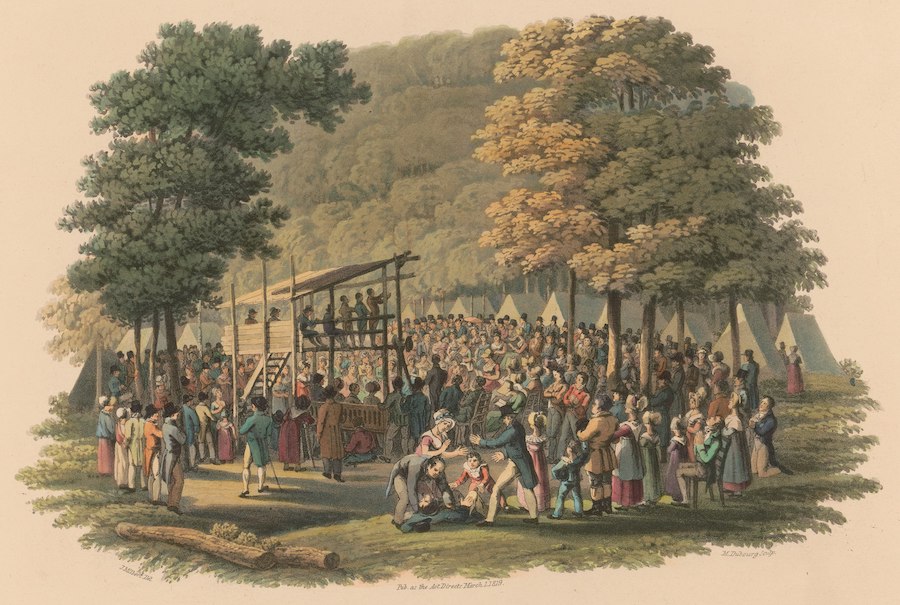
Enter the Methodists. While other leaders lamented the decline of Christianity in America, Francis Asbury, Methodism’s first bishop, at about the time of Methodism’s founding in America in 1784, proclaimed: “America, America, God will make it the glory of the world for religion.” What followed has been labeled by historians as the Second Great Awakening, or The Western Revival. The Methodists helped fuel this by the introduction of camp meetings and the mourner’s bench and altar calls and love feasts and indigenous folk spirituals and the circuit system. The Methodist camp meetings were one of the earliest social settings where blacks and whites met more or less on equal grounds.
By our standards today the Methodists were hardly “inclusive.” They were critical of those who did not live by Biblical standards as they understood those (as say, in our General Rules). They were convinced that Roman Catholics were not truly converted and harbored suspicions of Baptists and Presbyterians. What they were certain about is that the gospel was for all, and especially for the poor, the outcast, and for all races. Methodists may have been guilty of “racism” (by today’s standards) but they were basically the only group which reached black Americans, slave or free, for Christ.
Other religious groups in the West had their own differences—with other groups and also within their own ranks. Many of them accused Methodists of sheep stealing and uninhibited emotionalism. But they were more often battling within themselves. Indiana Baptists, for example, by 1850 could count ten different Baptist associations, almost all of them based on where they stood on the Five-Point Calvinist scale.
The result? I quote from R. Carlyle Buley’s massive two volume 1,300 page historical study. In the 70-page section on Western frontier religion he writes:
Although revivalism and the question of the freedom of the will precipitated sectarian difference there were really dozens of matters of dogma and church organization and government which caused fission. Denominations split along one line on one issue, along another line on another. So numerous and complex were the schisms and crossings over and so illogical were many of them that groups and sects not infrequently found themselves back in the fold where they had started. So confusing did the history of the Protestant sects become that no historian church or lay, has been able to make clear an organized presentation of its course. (vol. 2, p. 418)
The Old Northwest: Pioneer Period 1815 – 1840 (Indiana Historical Society, 1950)
Indiana is an example. In Indiana, besides Baptist splits, by mid-century Quakers had split into eight groups, the Presbyterians into four, the Brethren into eight, the Mennonites into six, Methodists into four, and various groups identifying with phrases like “Christian Union,” like the sand of the sea.
What was the result of this sectarianism and chaos? In Indiana between 1810 and 1850, the population grew 4,000% but Methodism increased by 9,000%. In the United States in those years the population increased less than 500%, but Methodism increased by 2,000%. In 1800 Methodists comprised 1.2% of the nation’s population. By 1850 that percentage was 5.4%. From the Revolutionary War to 1850 church membership in America grew from 10% of the population to about 33%. Of that, Methodism grew from 1.5% to about 33%. By 1850 it was reported that one out of every 10 children in Indiana were attending a Methodist Sunday School. By 1860, Methodism reported in the census 1,256 churches, or 40% of the total. In 1890, 8% of all Americans identified as Methodist (today less than 3% do). How did the colonial churches fare? Congregationalists, known for respectability and an educated clergy, by 1850 had established in Indiana a grand total of two churches.
Methodism accomplished this without stated missional priorities, boards of evangelism, curriculum resources committees or clever advertising slogans like ‘Open Arms.” Methodism also operated without seminaries and hardly any colleges. Methodism was a bottom-up and not a top-down religion. The classic historical study on all of this is Nathan O. Hatch’s The Democratization of American Christianity (Yale University Press, 1989).
In 20th century America, Methodism was characterized not by divisions but by grandiose calls for unity and mergers. The Evangelical Church merged; the United Brethren merged; the Evangelicals and United Brethren merged (EUB); the Methodist Episcopal Church, Methodist Episcopal Church South and Methodist Protestant Church merged; the Methodists merged with the EUBs. In the process Methodism fell from its market share of 8% of the American population (in the 1890s) to about 3% today. Instead of beliefs and practices that distinguished groups from one another, the merged bodies blended more and more into the prevailing secular culture. Are we to argue that we are today better off for all of this?
By the late 1990s, I was personally convinced that the United Methodist Church would be better off if it could provide a way for unhappy groups to be able to gracefully leave the institutional church. I presented a petition to that effect to our annual conference to be forwarded to the General Conference. It failed, of course. Plans like the “Protocol,” with the support of both progressives and evangelicals, offered much hope. It remains an option for the 2024 General Conference, but its prospects are weak since many progressives reneged on promises to support graceful separation.
For many of us, the low point in our life as United Methodists came after the 2019 General Conference. The church was in such disarray after the 2016 General Conference that the call went out to bishops to come up with a plan that would help us to overcome our differences, especially around issues related to human sexuality. The resulting One Church Plan suggested a sort of Let Everyone Do What They Want to Do, which basically was built on an assumption that we have no standards in the area of human sexuality. When the 2019 conference upheld the sexual standard of the historic church for faithfulness in marriage and celibacy in singleness, LGBTQ persons and their supporters expressed pain, anger and betrayal. After the conference LGBTQ supporters (including bishops) issued statements and took out space in newspapers to denounce the hatred and homophobia of traditionalists, the Discipline itself, and the General Conference. It was at this point that the idea of disaffiliation through a new paragraph 2553 was presented and approved by the conference. The idea of disaffiliation was to offer a way of gracious exit for those who wanted to be free to do ministry in a different way.
In a strange turn of events, the alienated group of today is not primarily the progressives but the traditionalists. How this happened is another story to be told. But let bygones be bygones. Whatever the case, can we find within ourselves the grace to pray for and encourage those who want to minister out of convictions different from our own?
Riley Case is a retired UM clergy member of the Indiana Conference who has for many years authored articles for the Confessing Movement. Since the Confessing Movement is phasing out of existence his articles will now be published in the Methodist Voices series appearing on Juicy Ecumenism, the blog of the Institute on Religion & Democracy.


Comment by The Rev. Dr. Lee Cary (retired UMC clergy) on February 2, 2023 at 11:24 am
Will the IRD ever undertake to address the rapid growth in the US of free-standing, independent, Christian congregations? Or, is that of no interest to its readers?
Comment by Jeffrey Walton on February 2, 2023 at 2:24 pm
Do you mean articles like this? https://juicyecumenism.com/2023/01/09/post-denominational-america/
Comment by PFSchaffner on February 2, 2023 at 3:14 pm
I’ve often thought that Christianity is inherently fissiparous: that it grows and expands and reproduces most naturally by schism, and that organizational unity is of little or no importance. Unity would not have been such a prominent theme in the New Testament if it were not that disunity was already prevalent. But prevalent does not necessarily mean problematic. Certainly I have sensed greater unity among unaffiliated churches (say between my three favorite congregations in the UK, one of which is Particular Baptist, one Baptist Union, and one an independent member of the Fellowship of Independent Evangelical Churches). And it doesn’t stop there: members of one of the Baptist churches are known to frequent the Minster for evensong; a former member of the Particular Baptist church became Archbishop of York; and so forth. There is a great deal of unity going on undercover.
Comment by Gary Bebop on February 2, 2023 at 4:55 pm
In the United Methodist context, appeals for unity function as cloaks for divagation from church law and aggregation of hegemonic power. I’ve not seen unity discussed as empowering those outside the inner ring.
Comment by Jeff on February 2, 2023 at 10:05 pm
PFSchaffner,
Excellent, excellent comment!
>> Certainly I have sensed greater unity among unaffiliated churches… there is a great deal of unity going on undercover.
Amen, and that “distributed unity” among believers who share a common Standard (the Word of GOD) and a common, biblical Christology and a common, unshakeable commitment to become, and then make, disciples — that is the true Ecclesia Jesus spoke of in Matthew 16:18.
As well as profiting from your comment, I learned from you a new word… fissiparous. 🙂
Thanks, and Blessings!
Comment by David Mu on February 2, 2023 at 11:37 pm
Yet, wanting to break for belief for a view of Scripture that is different – those that break will continue raging against those that did not go with them. Seems a rather poor place to be, but is clearly not what I would want. It is better to let go. But this will be another Anglican-type break with another group just unable (and unwilling) to make a new beginning for themselves.
But, this site has been useful to this writer. First to know that I am grateful for never be an member of the Methodist tradition, but second for realizing that for all the problems present – I shall remain within the Episcopal tradition. It seems an sounder place to stand on than to sup with those who will not make peace with themselves. And – it won’t end. There will be no let bygones be bygones. The struggle will go on and on…
Thankfully – without me.
Comment by Dudley Sharp on February 6, 2023 at 6:05 am
Riley:
Truly a wonderful historical review. Thank you.
The unity is in the love of Christ, no matter the separations of man.
Comment by David Gingrich on February 6, 2023 at 6:34 am
I believe that both the UMC and GBC are doomed. They are thoroughly top-down organizations. The UMC left the good people in their pews a long time ago. The GBC is doing it from the starting line.
Comment by Cal Skinner on February 6, 2023 at 10:04 am
My favorite course in grad school was organizational theory.
What fits like a glove in current events is the course’s basis tenaet :
organikzations do every thing they can to remain in existence.
In my extremely liberal Northern Illinois Conference, when a church closes, the sale price is funneled into operating money.
The ransom required for a congregation to leave the UMC with property certainly bears out what I learned in college.
Comment by Jeff on February 6, 2023 at 10:08 am
David,
Did you mean “GMC” rather than “GBC”?
If you really meant “GBC” — what does that stand for?
Thanks and Blessings!
(P.S. If you did mean GMC… I’m afraid I’d have to agree with you. Within a year the alphabet and woke heretics will be agitating within the GMC and seeking to overthrow its polity.)
Comment by Thomas Rightmyer on February 6, 2023 at 10:43 am
In Massachusetts and Connecticut from their beginnings until the 1820’s town taxes paid a town minister. He was always a Congregationalist. In the mid 18th century members of the Church of England were permitted to designate their taxes for the support of a Church of England minister if one lived in their town.
In Virginia from the early 17th century and in Maryland after 1629 the legislature established vestries for the Church of England to build churches, pay clergy, and relieve the poor. These vestries were authorized to collect a poll tax of about 30 pounds of tobacco (when a laborer could make between 1000 and 1500 pounds) so 2 to 3 percent. Adult male white men and all slaves were taxed. See Nelson Rightmyer, Maryland’s Established Church. The Church of England establishment ended at the Revolution. Similar programs in the Carolinas were not effective.
I know of no other legal establishments in America.