
Much has taken place in the Southern Baptist Convention (SBC) since this blog last examined controversies and questions that the SBC was facing. Then Guidepost Solutions, the group contracted by the SBC’s Sexual Abuse Task Force, had just released its 288-page report, concluding that survivors and reporters of abuse “were ignored, disbelieved, or met with the constant refrain that the SBC could take no action.”
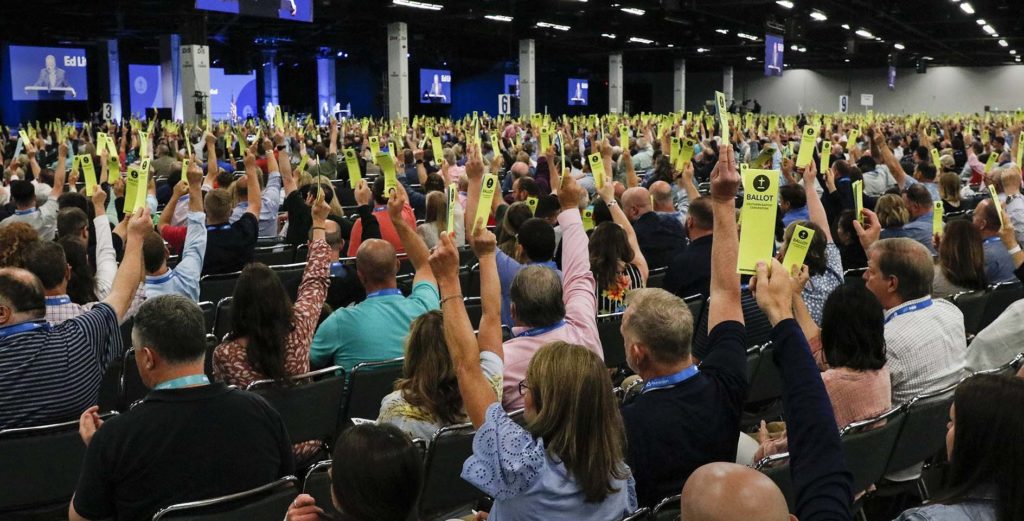
In the convention’s annual meeting in June, messengers overwhelmingly approved the formation of an Abuse Reform Implementation Task Force (ARITF). The members of the ARITF have since been appointed, and will be charged with studying the recommendations made by Guidepost Solutions and how best to implement changes. The ARITF also functions as a resource for Baptist churches on issues of abuse prevention and survivor care.
Additionally, messengers agreed to the creation of a database that will allow churches to track “pastors, denominational workers, ministry employees, and volunteers who have at any time been credibly accused of sexual abuse with past or present assocations with a cooperating Southern Baptist church or entity.” The ARITF will also oversee the establishment of a website for this database.
Newly elected SBC president Bart Barber noted that churches will ultimately have authority over and determine the efficacy of such measures. He said, “We can only be successful as we earn their confidence and supply their needs.”
Following a rare decision by former President Ed Litton not to seek a second term, Barber won a runoff election with 61% of the votes, compared to just 38% received by Tom Ascol, the candidate endorsed by the Conservative Baptist Network (CBN). According to the CBN, “The simplest and most incisive dividing line is represented in who messengers choose as their president: establishment versus non-establishment, or status quo versus change.” Indeed, messengers resoundingly repudiated the kind of institutional overhaul for which the CBN has called.
The biggest talking point from the SBC’s annual meeting was not the response to the Guidepost report, but was instead the question of whether churches with female pastors could participate in the convention. The Baptist Faith & Message clearly states, “While both men and women are gifted for service in the church, the office of pastor is limited to men as qualified by Scripture.”
Nonetheless, disputes persist over who exactly has the office of pastor, and over how closely a church must follow the Baptist Faith & Message to be in cooperation with the SBC. This controversy erupted at the SBC meeting with regard to Saddleback Church, one of the SBC’s largest churches. Pastor Rick Warren delivered what he termed a “love letter” to the convention, asking, “Are we going to keep bickering over secondary issues, or are we going to keep the main thing the main thing?”
Al Mohler, president of the Southern Baptist Theological Seminary, stated in contrast, “If we eventually have to form a study committee over every word in our confession of faith, then we’re doomed and we’re no longer a confessional people.” He added that in 2000 (when the Baptist Faith and Message was adopted), “we were told that ‘pastor’ is the most easily understood word among Southern Baptists for pastoral teaching leadership. I have to hope we still have that much clarity, and that churches that use the word ‘pastor’ mean it.”
Much work remains on the horizon for the SBC. For one, the search committee for the next president of the Ethics and Religious Liberty Commission (ERLC) is working with an active candidate, whose approval may come at this month’s ERLC trustee meeting.
While the SBC may hope to distance itself from scandal and headline news, another of the SBC’s largest churches has been in the spotlight as pastor Matt Chandler of the Village Church temporarily steps aside from preaching and teaching over an inappropriate online relationship. Chandler’s misconduct was not of a romantic or sexual nature, nor was it mishandled or covered up by others in church leadership. However, Chandler characterized it as “unguarded and unwise,” adding that it “revealed something unhealthy in me.”
Debates will certainly persist as to whether the SBC should identify itself with conservative political stances. Mohler will be speaking at the National Conservatism conference in the coming week, giving an address entitled “‘Your God Will Have Been Supplanted by an Idol’: The Dangerous Illusion of a Secular State.”
Most importantly, the SBC continues to support nearly 3,600 overseas missionaries and over 2,200 domestic missionaries, train more than 25,000 seminarians, and unite over 47,000 churches with more than 14 million members, baptizing 123,160 people every year. The SBC may make a multitude of headlines, often not for desirable reasons. However, what matters most is not the resolution of these stories and controversies, but the faithful perseverance of the SBC’s churches and missionaries.




Comment by David Gingrich on September 10, 2022 at 7:42 am
In essentials unity, in non-essentials liberty, in all things charity. Praying for the continued unity, liberty and agape’ love of the Christ-followers of the SBC.
Comment by Jane Smith on December 11, 2022 at 12:02 am
The heart of the downgrade of the SBC was the invasion of stealth Calvinism in traditional (SBC member) Southern Baptist churches. Whether you agree with their theology or not, and I don’t, it’s never right to facilitate and participate in a deception…a hoax if you will…against the church. I believe that once the seminaries were turning out young seminarians who lied (lie) to secure positions in Baptist pulpits across America, the continued downgrade of the Southern Baptist Convention, and its churches, was inevitable. Sin leads to more sin, as is now apparent with the embrace/teaching of the social justice concept called Critical Race Theory/Intersectionality. This is NOT Biblical, and just as John Calvin’s man made teachings confound and torture God’s word, so does what’s called the social justice gospel. Southern Baptists who are reclining in the pews (or twisting in their folding chairs) need to wake up, stand up and speak up before there is nothing there to support.