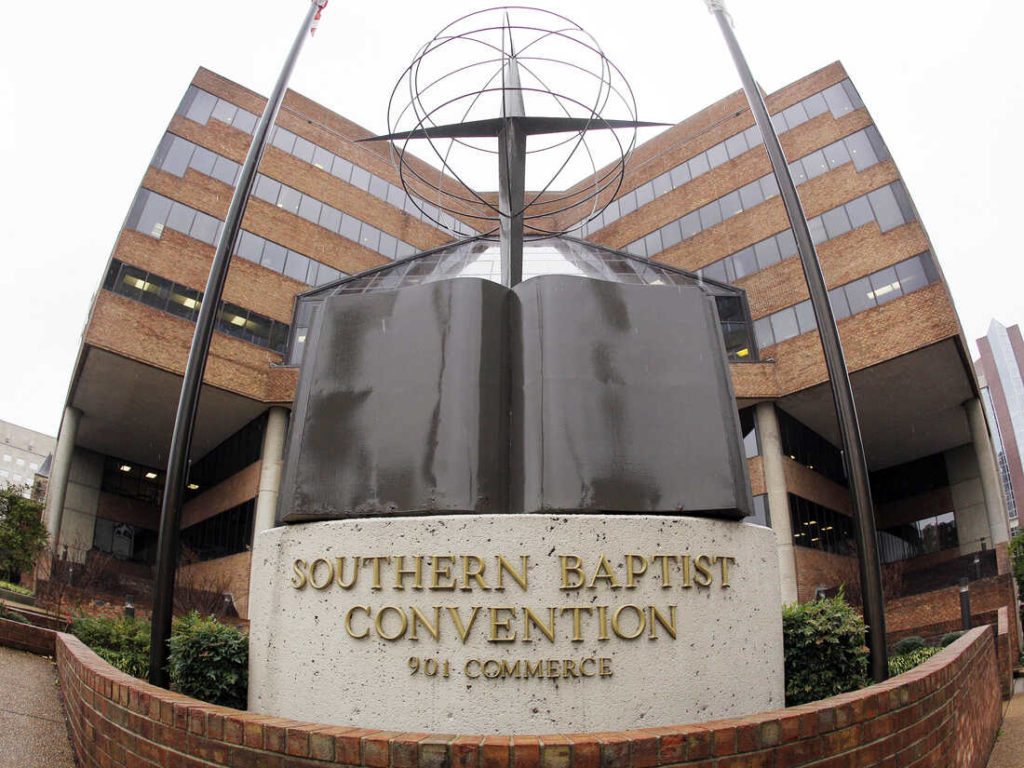

Yesterday Guidepost Solutions, the independent firm contracted by the Southern Baptist Convention (SBC) Sexual Abuse Task Force, released its 288-page report. The report concludes that a few senior Executive Committee (EC) leaders “closely guarded information about abuse allegations and lawsuits” and “were singularly focused on avoiding liability for the SBC to the exclusion of other considerations.”
As a result, survivors and other abuse reporters “were ignored, disbelieved, or met with the constant refrain that the SBC could take no action.”
According to the report, the driving forces behind the EC’s approach to abuse allegations were August “Augie” Boto, the EC General Counsel and later Interim EC President, and James Guenther, the SBC’s long-time outside counsel. In a particularly jarring revelation, Boto had assigned an EC staff member to compile a list of accused Baptist ministers, which most recently totalled 703 names – and was never once used to assess whether any were still in positions of authority at SBC churches.
The report also discussed examples of EC leaders denigrating abuse survivors. In an internal email, Boto described the work of two prominent survivors as “a satanic scheme to completely distract us from evangelism.”
Guidepost’s report lays out the case of Jennifer Lyell, a former executive at Lifeway (the SBC’s publishing division) who was sexually abused by a professor at Southern Baptist Theological Seminary (SBTS). Lyell recounted her story, which SBTS President Al Mohler corroborated, to Baptist Press, the SBC’s official news service.
However, after emails between EC staff and outside counsel which questioned the veracity of Lyell’s narrative, the Baptist Press story was abruptly changed to remove all use of “abuse” or “nonconsensual,” instead referring to a “morally inappropriate relationship.” Because of the impression that she had voluntarily participated in an affair, Lyell was subjected to verbal abuse, both to her face and online, and had to leave her job at Lifeway when new leadership was unsupportive.
Lyell repeatedly requested for the article to be corrected, but instead – again under guidance from EC staff – it was quietly removed. The article first appeared in March of 2019; no official retraction was made until October. The EC eventually made two legal settlements with Lyell, and did not inform EC trustees about either of them.
The report also contains new allegations against Johnny Hunt, who had formerly been president of the SBC and a senior vice president at the North American Mission Board (NAMB). An unnamed woman, whom Guidepost found credible based on conversations with Hunt and other witnesses, described how Hunt recommended she stay in a condo next to his, made inappropriate sexual comments, then groped and violently kissed her. After discussions with a counseling pastor at Hunt’s church, she was led to believe the encounter had been consensual, and she and her husband were warned not to discuss the matter. Hunt has resigned from his position with NAMB, although he denies the allegations.
It should be noted that the report presents many SBC leaders in a positive light. It commends the work of Ethics and Religious Liberty Commission leaders Russell Moore and Phillip Bethancourt in the Caring Well initiative, J.D. Greear’s focus on addressing sexual abuse, the supportive tone of most EC trustees toward survivors, and the willingness of many EC staff to be forthcoming in providing information. This seems to be a sad case of a few strategically situated people being able to perpetuate a systemic problem.
It is also important not to disregard the SBC’s unique structure, wherein it lacks the hierarchical or governing authority that the Roman Catholic Church and many other denominational bodies possess. Article IV of the SBC Constitution reads, “While independent and sovereign in its own sphere, the Convention does not claim and will never attempt to exercise any authority over any other Baptist body, whether church, auxiliary organizations, associations, or convention.”
Nevertheless, many SBC churches will ask themselves: If our congregational autonomy is simply going to be exploited as a justification for inaction, why associate with the SBC in the first place?
Guidepost makes various recommendations for the SBC, including the establishment of an administrative entity to oversee reforms, a voluntary self-certification program for churches, provision of comprehensive resources, and more. Such recommendations will undoubtedly be fodder for discussion not just among the Sexual Abuse Task Force, but also at the upcoming Convention meeting in Anaheim.
Yet no proposals or committee formations will bring meaningful resolution to this moment for Southern Baptists, or detract from its shame and gravity. Russell Moore perhaps said it best, “I was wrong to call sexual abuse in the SBC a crisis. Crisis is too small a word. It is an apocalypse.” He adds, “It’s even more than just a crime. It’s blasphemy. And anyone who cares about heaven ought to be mad as hell.”




Comment by David on May 24, 2022 at 6:32 am
Can one imagine the reaction in these pages had this happened in a liberal denomination?
Comment by Steve on May 24, 2022 at 11:26 am
I imagine you’d be here defending the liberal denomination.
Comment by Steve2 on May 24, 2022 at 2:13 pm
In Conservative or liberal denominations, sex abuse has been a problem in the church that needs to be addressed. Changing theology based on “sex” or “gender” does not help the situation. Just keeps the church distracted from the gospel.
Comment by David Gingrich on May 28, 2022 at 8:08 am
The report is a large step in the right direction. I am very thankful for the people who worked to get the SBC to this point. Much work to be done, hopefully in faithfulness and love.