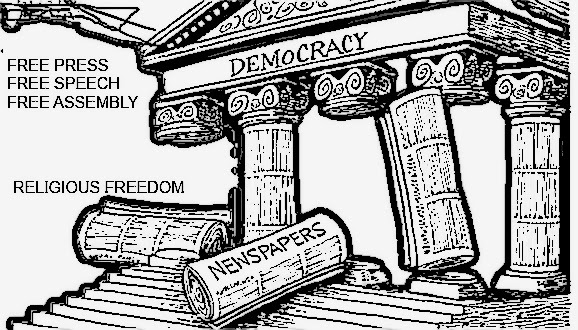
A recent article discussed Western world’s cultural/political collapse (which really impacts the whole world). Clarke Scheibe, Director of the L’Abri Fellowship in Victoria, British Columbia, discussed reasons behind the collapse at the recent L’Abri conference. He observed first that after the collapse of communism, people believed that liberal democracy had emerged victorious against all global rivals. The totalitarianism of both the Right and the Left – fascism and communism – had been defeated globally. Liberal democracy and capitalism would be the basis for global civilization from now on, it was thought. This was classically expressed in Francis Fukuyama’s book The End of History and the Last Man.
But Scheibe said that not all were satisfied with this outcome. He cited Jacques Derrida, one of the founders of postmodernism, who attacked liberal democracy as “the ideal of human history” by claiming enormous injustices of “oppression” and “exclusion.” Derrida called for political action to address such problems, although the idea of state action to cover all of life and its problems were precisely what was defeated at great cost of human life and treasure in the twentieth century. This in turn has led to “encroaching authoritarianism.” Depending on one’s perspective, the threat is from “fascism” or “communism.” However, citing Trump and Biden, Scheibe said that what actually exists, are American leaders who are in fact still within the bounds of classical liberalism, and its commitment to individual rights, multiparty democracy, and limited government. “Trump is a conservative liberal, because he is for the free market … Biden is a progressive liberal, because of certain stands he takes on social morals.”
Scheibe said that some consider the current difficulties of liberal democracy to be the result of an external cause, while others hold that liberalism itself is the problem. The problem is now apparent after many generations working itself out into a consistent form. Still others hold that classical liberalism is in difficulty because “of the loss of its Christian roots.” Scheibe discussed these viewpoints in turn.
A proponent of the first, Ann Applebaum, is a journalist widely published in such outlets as the Spectator, the Washington Post, and the Atlantic. She believes that personal attacks and the resulting hurt feelings have made people irrational. This causes them to be illiberal and favor authoritarianism. Essentially, however, she blames nationalism for the attacks on classical liberal democracy, attacks based on a desire for the cultural uniformity the past. If people would only “calm down” and accept rational, secular liberal democracy and liberal internationalism, the threat to liberal democracy would subside.
Scheibe disagreed, however, that irrational fear is the problem. Applebaum “fails to appreciate people’s real concerns.” These include (from the Left), fear of “racism,” and from the Right “the pressure on religious organizations having to concede on sexual mores because of what government policies do, the pressure of economic inflation and disparity, of packing courts of justice with partisan judges, [and] of technological manipulation” of the flow of ideas. Scheibe believes Applebaum “gives assurance of peace when there is no peace” (Jer. 6:14).
The second diagnosis, “faulty foundations from within,” is held by Patrick Deneen, Professor of Political Science at Notre Dame University. He holds that the problem with classical liberalism is in its foundation, and is now apparent after many generations of working itself out. Lockean liberalism is based on a false anthropology, Deneen believes. Human beings are “embedded into a social history, in a culture, within a family, within natural constraints.” People are not “free-floating” individuals, independent of nature and society. Instead, people should aim at cultivating virtue. To be “in virtue” is to be free. Scheibe said this viewpoint is in agreement with Christianity.
But in modern liberalism, political bonds are the only binding ones, anything else must be freely chosen, according to “rational self-interest.” The state confers many rights, but these individual rights all increase the power of the state, which must now police the rights it has granted, taking away the right of individuals to act on their own discretion. Local cultures are devastated, as a central government imposes its uniform rules. Marriages are easily dissolved in the interest of individual liberty. Amazon and Walmart replace small businesses. Eventually, sexual identity is seen as constraining, and becomes arbitrary, and the abolition of sex is enforced by the state. The more rights that are granted, the more the state moves to policing all of life. In this way, liberal freedom leads to totalitarianism.
As a case in point, Scheibe cited the imposition of same-sex marriage in Canada. It aimed to give LGBT identifying persons all the rights and protections of marriage. But in so doing, it replaced the family and its network of natural relations with a legal construct, which can be altered from time to time in whatever way the government wishes. Scheibe said that from Deneen’s standpoint, when such changes contrary to divine and natural order happen, they are not the result of a “Marxist agenda,” but the result of “unmoored liberalism.” Deneen advocates decentralization and empowering local communities as at least part of the solution to the consequences of the regime moral autonomy and the state control it has imposed. Turning to nature and tradition will also help properly orient people.
Scheibe sees a problem, however, with the exhortation to turn to nature. Power prevails in nature, and “might is right” was a rule in the ancient world. He cited the atheist Yuval Noah Harari’s materialist revision of the Declaration of Independence, which says that “all men evolved differently, that they are born with certain mutable characteristics, and that among these are life and the pursuit of pleasure.”
Scheibe clearly favored the third answer as to why modern liberalism is in trouble, namely the loss of Christian consensus. Scheibe said that Francis Schaeffer showed how Christianity affected all of culture in ancient Rome, “politics, economics, legality, and art.” But “it was a belief in a comprehensive Christian worldview that enabled those changes.” He referred to Schaeffer’s “Roman bridge” analogy, in which a Roman bridge, symbolizing the structures built by the Christian consensus, endures for centuries. But in modern times, subjected to a “two ton truck,” it will collapse. The pressures of the modern world against these structures are great. Another – totalitarian – system will replace it if “it gives us what we want.” But humanity and freedom will not be among those things if totalitarianism prevails.
Scheibe cited the book Inventing the Individual, by Larry Siedentop to say that its thesis is that classical liberalism really began with the apostle Paul. The incarnation of Jesus Christ reconciled us to God, and this was “amazing news to anybody, it wasn’t just to the elite.” The unity of humanity was declared. This “revolutionized society.” It led to a “grass-roots” society. “It destroyed fate, it destroyed the ancient family,” which was a despotism under a dominant male. But all in early Christian society were “equal in dignity before Jesus.” The new family relationships were not justified by reference to nature, but were “created, endowed.” All were united in their “fealty to Jesus.” People did not use freedom for their desires but were free to serve one another. The apostle Paul said “serve one another in love” (Gal. 5:13). He noted the Siedentop held that the election of bishops was the beginning of popular vote. It involved “looking for people of character.” But without Christian conviction, Scheibe said, this respect for individual and organizational freedoms collapses, and society turns toward authoritarianism.
Scheibe quoted Schaeffer as saying that “no truly authoritarian government can tolerate” Christians “who have absolutes by which to judge its arbitrary absolutes, and who speak out and act upon that absolute. This was the issue with the early church in regard to the Roman Empire. And though the specific issue will in all probability take a different form than Caesar worship, the basic issue of having an absolute by which to judge the state” will precipitate conflict. “To make no decision with regard to the growth of an authoritarian government is already a decision.”
It seems to this writer that while the Christian consensus is the source of much in classical liberalism, and can strongly support it, in practice it is not absolutely necessary for democracy. Japan and India have been flourishing democracies for decades. Unable to get what it wanted electorally, the Left has spearheaded identity politics as a nonnegotiable moral imperative overriding religious freedom, freedom of speech, and any other freedom that would stand in the way of its agendas. Classical liberalism is failing because its tenants are being violated.
Traditional Christians can live comfortably in a classical liberal state; the real meaning of their lives lies elsewhere. Many other persons can simply go with the flow, but for those among them who want meaning and value to their lives, there must be a substitute for God, and that is found in their doctrines of liberation and the state which implements them. It must cover all of life, to give the righteousness and security that God does. With no higher authority, the state must be totalitarian. The end result is a power struggle, as it is today. Christians cannot decline the struggle, or a secular totalitarianism will supervene. But in this conflict, and to the extent we lose, we must always remember that our overriding duty is to obey God, regardless of secular law or its consequences. Our absolute love and loyalty must be to God, and our eternal life and security are beyond this world.




Comment by td on March 26, 2022 at 11:05 am
I think it is true that when people don’t have anything to believe in beyond themselves they more likely tend to expect the government to validate and enforce their own personal belief system.
While this is only partially to blame for our political and societal dysfunction, i do think it is a major component. And it also contributes to them being attracted to authoritarian governance of all persuasions.