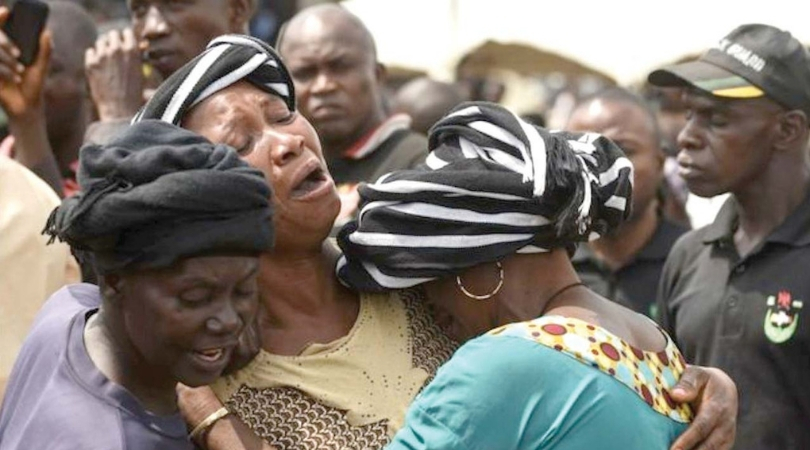
Two earlier articles reviewed the deteriorating situation in Nigeria, in which Christians in Nigeria’s northern and “Middle Belt” (or central states) are being targeted with impunity by various Muslim terrorist groups, principally militant Fulani herdsman, but also Boko Harm and others for death, and destruction and/or dispossession of their property. As explained in the articles, the current Nigerian government of President Muhammad Buhari is doing nothing to stop this, and in some cases appears complicit in it.
One of the persons featured in the earlier articles, Robert A. Destro, formerly Assistant Secretary of State for Democracy, Human Rights, and Labor at the end of the Trump Administration and currently Professor of Law at the Catholic University of America, was also interviewed in a discussion hosted by the Religious Freedom Institute on December 16. Interviewed as well was Nina Shea, Senior Fellow and Director of Religious Freedom at the Hudson Institute. Additionally, in a video clip, Bishop Stephen Dami Mamza of the Catholic Diocese of Yola in northeastern Nigeria answered common questions about the crisis from the perspective of a Christian leader living through it. Eric D. Patterson, RFI Executive Vice President moderated discussion.
Patterson said that the terrorist groups, which are Sunni Muslim, have killed other Sunni Muslims and Shia Muslims as well as Christians. But he said that in the “Middle Belt” of Nigeria, between north and south, “the plight of Christians is dire. Last year over four thousand Christians were killed, this year four thousand Christians will be killed, and they’re targeted largely because they’re Christians.” To cite an example, Patterson pointed to a group of Islamic terrorists who “burst into an Evangelical church, dragged out five young men, and then took a video while they executed them.” The terrorists claimed in the video that the reason they were killing the young men was that they were Christians. Against the claim that the killing is due to “ethnic rivalries” or “climate change,” or “political oppression” or “competition for scarce resources” he said that “over and over, those who perpetrate the violence use religious justifications that justify their behavior and who they target.”
Bishop Mamza explained that nearly half of the territory of his northeastern Nigerian diocese was occupied by Boko Haram in 2014-2015. Additionally, many people came into the diocese “looking for shelter because they had been sacked out of their communities by the Boko Haram. By 2016, a good number of the IDPs (internally displaced persons) started moving back, so we had to support them also in order for them to come back to their original homes. But unfortunately, before they went back, their homes were already completely destroyed, and then there were landmines on the farms, even in their houses. It was not easy. Some of them had to come back because they had nothing to hang on to. They had no food, they had no shelter, so they had to come back … a lot of people were traumatized. And so many people were also killed, it is difficult to find out any family that has not lost at least one person. Even I myself, my younger brother was killed in the war and then my cousins and my uncles. So almost everybody in my family has been affected in one way of the other.”
Mamza said that the violence against Christians in Nigeria is escalating, as the different Islamic terrorist groups (Boko Haram, ISWAP, and the others) “are now working together to attack Christians.” On the claim that the conflict is essentially economic, he said that the terrorist groups are acting “under the cover of Islam.” If the conflict were truly over resources, “why should they go during the night to go and attack a house and kill everybody in the household? That is not a farmers’ or herders’ crisis … There is no economy that they have a conflict over. It is just that, because they are Christians.”
Regarding the U.S. State Department’s decision to remove Nigeria from the list of Countries of Particular Concern, Mamza said that “since the United States has de-listed Nigeria from the Countries of Particular Concern, what we would like to hear from the United States now is for them to explain to us, give us the data. How is it that Nigeria is different from Nigeria of two years ago. Because we that are living in Nigeria, when it comes to discrimination, when it comes to persecution of Christians, we are feeling it, and we are still experiencing it. How is it, that the Secretary of State, that lives outside, he doesn’t live in Nigeria, and has not had any contact with us. He has not met us and asked us questions. We have not interacted and then all of the sudden we hear that Nigeria has been de-listed. I think this is really disheartening, and all Christians in Nigeria are feeling very bad about it. So, we want to know, we are now patient to hear, because they can’t just de-list without explaining.”
“If they have statistics, probably the discrimination against Christians and the persecution against Christians has become less than what it used to be in the past. We want to hear. But as far as we are concerned here in Nigeria, the persecution is more intense now than ever.”
Asked about whether the Nigerian government is responding to the need to stop the persecution of Christians, Mamza said that “in Nigeria, we are experiencing more violence that ever, especially under this administration of Buhari. I think this is the worst administration that we have ever had in this country.” Asked what his message would be to the world, he said that “my message to my dear brothers and sisters, Christians all over the world, is that we want you to support us in your prayers. We want you to pray for us. Because we are living in a very, very difficult situation. Without your prayers, we may not be able to survive it. Whatever way you can support us in order to strengthen our faith, so that our faith will not fail, I think we will be very, very appreciative, and definitely God himself will bless you, because we are ready in order to die for our faith. And whatever possible can be done in order to strengthen our faith to support us, I think we appeal for that.”
Shea called Bishop Mamza’s statement “extraordinary” and “brave.” On the other hand, she observed that Assistant Secretary of State for Africa Molly Fee has said that Nigeria was de-listed because of “legal reasons.” Specifically, that Nigeria did not meet the criteria for designation, namely, that the Nigerian government either engaged in religious persecution or even tolerated it. But Shea said that when the CPC status was given Nigeria late in the Trump Administration, then U.S. Ambassador for Religious Freedom, Sam Brownback, testified that the Buhari government had done “little or nothing to stop the violence.” Shea added “indeed, he hasn’t.” He has in fact appointed northern Muslims to all the major posts in the government to “ensure that there would be impunity” for the killings and persecution. This means that “there is no accountability for this kind of violence.” The State Department simply doesn’t address the obvious fact that the Buhari government “hasn’t taken action.” She added that the Biden Administration also ignored the recommendation of the U.S. Commission on International Religious Freedom that Nigeria’s CPC status be maintained.
Shea said that “militant Fulanis” appear to be the greatest perpetrators of the current violence in Nigeria. These groups shout “Allahu Akbar” on entering villages, which they then proceed to slaughter. The point of this is “basically to clear the area of Christians.” Boko Haram, the Fulani, and criminal gangs appear to be working together to perpetrate violence. The State Department “explains this through this Marxian analysis, that there are these two world socioeconomic classes clashing over scarce resources. And overlaid on that is the climate change argument.” She said that “what this does is exculpate those who are committing the crimes, and let Buhari off the hook.” He is not responsible for climate change or the conflict of social classes, and thus his toleration of mass killings and mutilation is not a violation of religious freedom, meriting CPC status. Shea also said that journalists who report on the persecution are at risk of prosecution by the government in Nigeria; an Epoch Times reporter has been arrested and imprisoned for doing so.
Shea maintains that there is now “a growing, spreading, bloody disintegration of Northern Nigeria across many states.” This despite Nigeria being “America’s most important partner in Africa.” The current collapse will “de-stabilize,” “radicalize,” and “create incalculable human misery” in Nigeria. It will also “affect the rest of the continent.” Shea believes this represents “a national security threat” (apparently to the United States, and resulting from a destabilized Africa). The Nigerian situation “shows the interconnection of religious freedom and national security in our own interest, as well as our highest ideals.” She said that the Biden Administration’s policy is “a betrayal of all of that.” She hopes that the Biden Administration “will revisit this, speak to Christian leaders; they did not do so before the CPC [de-]designation.” They should look particularly at Buhari’s “utter failure” to prosecute perpetrators of violence. She said that there is “every indication he is acting to please his base,” which is the northern Muslim tribes.
Destro said that when Nigeria was put on the list of Countries of Particular Concern late in the Trump Administration, “there was no question in our minds [i.e., Destro, former Secretary of State Mike Pompeo, former ambassador Brownback, and former Ambassador to the Sahel J. Peter Pham], that Nigeria richly deserved to be put on the list of CPC.” He said they heard “exactly the same argument” about legal definitions. While to common sense the Buhari government is tolerating (and even complicit in) religious persecution, Destro said the CPC designation is not “a legal question” but a political act. It’s only “a legal question if we go to court.” Otherwise, “it’s a political question.” But the current administration, he said, will stick with the economic rather than religious narrative “come hell or high water.” There in fact is a history of the northern Muslim tribes dominating Nigeria, and they are re-asserting that dominance now, Destro said.
Since Christian communities are as a matter of fact being targeted for slaughter and destruction, how does anyone deny that this is religious persecution? Destro said that the claims of religious persecution are dismissed as “Islamophobia.” This is despite the fact that Boko Haram, the Turks, and the Emiratis are playing an important role in supporting the violence which is happening. He said that “you always know there’s going to be a human rights problem where there are certain things you’re not supposed to look at, and this is one of them.” At the end of the Trump Administration, the State Department was developing a plan to measure the violence in Nigeria, investigating “ten or twelve local government units, trying to get a sense of what’s happening there.” But “the first thing the incoming Biden Administration did was cancel the project.” This shows that “they don’t really want to know.” What Bishop Mamza “is talking about complicates the narrative.” Supporters of Nigerian religious freedom “need to come to grips with the fact that the State Department is hostile territory, the Buhari Administration owns the embassy hook line and sinker, and I don’t think they’re giving serous attention to what the United States’ geostrategic interests are in the region.”
Patterson then observed that many people in western capitals are “watching this. What should be done,” he asked, if “western governments in particular were energized for action?”
Shea pointed out that CPC designation gives the U.S. government a range of possible responses to address violations of religious freedom, as little as simple diplomatic rebuke. Withdrawal of the designation allows the administration to do nothing. The current policy “is inexcusable, this is a false, phony excuse” (presumably the legal justification of denying the toleration of religious persecution by the Nigerian government) for not giving Nigeria CPC status.
Shea believes that the most important thing that can be done now to address the persecution is “to document exactly what’s going on with the villages, these Christian villages, that are relentlessly, continuously, and severely being assaulted with atrocities by armed Fulani herdsmen.” There should be documentation of what the Nigerian government has done about these atrocities. She pointed to a five-day attack in August, for which there was “total impunity.” Each incident should be “carefully” documented, and the U.S. government should be pressed to do the same. This should be kept before the public, she said. Even Christians in the south of Nigeria can be unaware of what is going on in the Middle Belt and the north due to the effective shutdown of reporting on the crisis. She also said that the U.S. should “stop funding the Nigerian government.”
Destro said that he supported documentation of what is going on, but doubted it would be effective with the Biden Administration. However, the battle can be taken to “private sector companies that are working in Nigeria.” He said that “with the Buhari government, this is all about money.” Similarly, in dealing with Congress, he suggested it would be most effective “to go directly to the Appropriations Committee.” This, he said, is where foreign aid is formulated. He said that “body counts are well known to people in the State Department,” but it is explained away in their own narrative (economics/climate change). But the State Department’s narrative does not explain the involvement of the Muslim governments mentioned earlier, Destro maintains.
Patterson highlighted the appeal to prayer in dealing with the atrocities in Nigeria, but also recommended contacting government officials (i.e., congressmen and the State Department) to say that “Nigeria matters to me. The plight of Nigeria’s citizens, its Christians and others, it matters to me. And it would sure be nice if western governments saw the long-term peace and stability of Nigeria rather than the short-term working with this government.” He believes that if there were a change in the attitude and actions of western governments, other west African governments might be moved to take an interest in the crisis in Nigeria, and pressure Nigeria to change. “So often, the bottom line is where the buck is.”
No comments yet
Leave a Reply