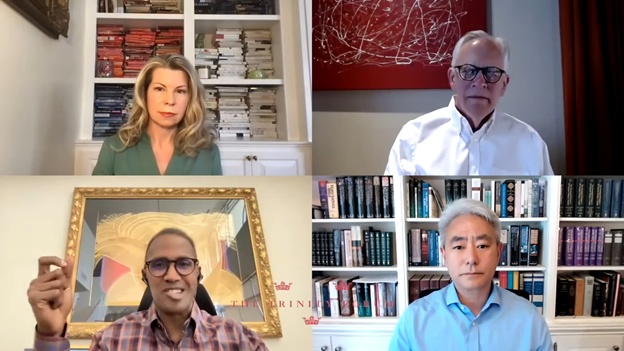
“How do we live faithfully in a world often skeptical to or even hostile to our loves and deepest convictions?” asked Cherie Harder, president of the Trinity Forum, as she introduced a panel discussion on Public Faith in Polarized Times. The August 13 conversation is the second in a three-part webinar series, the first being a conversation on Christian nationalism.
The Trinity Forum, along with the American Enterprise Institute’s Initiative on Faith and Public Life, and the Center for Public Justice, welcomed Mark Labberton, president of Fuller Seminary and Presbyterian minister; Claude Alexander, senior pastor at The Park Church in Charlotte, North Carolina; and Walter Kim, president of the National Association of Evangelicals (NAE) and Presbyterian minister to discuss this timely topic.
As the U.S. contends with deep polarization in the public square, Harder noted that the church is not immune to such divisions. Labberton offered one explanation for the problem: a “very deep confusion” about Christian identity.
“Our identity hasn’t really, it seems to me, been fundamentally formed by the gospel nearly so much as it’s been formed by our sociology, and the sociology is by definition incredibly polarized and diverse,” Labberton assessed.
Kim also pointed to the pluralistic nature of American culture as a reason for confusion.
“We all begin with different cultural and therefore conversational starting points,” Kim argued. The NAE official recounted the time he was deciding whether to leave the medical field for ministry work. When he asked his Caucasian Christian friends, they asked him questions such as: “What do you feel called to do?”; “What gives you joy and passion?” When Kim asked his Asian American Christian friends, they responded with, “What do your parents think?”
“Each of those were deeply formed by a biblical worldview, one shaded toward the notion that God has given each of us gifts, the other shaded toward the notion that God has placed us in community,” Kim explained.
“I think what we’re encountering is that in moments of stress, complexity comes forward and we don’t know how to deal with it so we seek to simplify because that’s what humans do in order to face a complex, challenging, and endangering moment. And because our culture has sought to simplify the politics by creating a couple of tribes and categorizing people in those tribes, what is an underlying, extremely complicated issue now—just by virtue of self-preservation—is reduced to simplified terms in order to help us navigate it… Not only have we compromised the notion of human existence in its complexity, we’ve compromised our notion of the complexity of Christian identity itself.”
At the same time, Kim noted that a pluralistic society has “promise” in addition to problems. “It’s the most fertile opportunity to present Christ in a fresh way to an audience that increasingly does not have the baggage of a cultural Christianity and are asking fresh questions of, ‘What is it that Christianity really is all about? Because I don’t know.’ What a unique moment in the American church’s life,” he said.
Labberton echoed Kim’s sentiments in underlining the need to rethink the role of the church. “There’s really some fundamental substructure that is showing itself to be largely absent in the life of the church,” Labberton said. “We haven’t allowed it [the church] to do its work of deep personal and interpersonal and communal transformation.”
While the missing substructure is hard to fully define, Kim pointed towards the Old Testament as a model for changing the way Christians understand public faith today. “When you think about the Old Testament laws and the breadth of the Old Testament laws, you’re envisioning the ways that faith is working out in every sector and domain of life, so the gospel no longer becomes this narrow vision of personal and characterological transformation, which it is including, but it also encompasses this very expansive vision of the implications of faith for every sector of human existence and endeavor,” he explained.
Alexander expanded on Kim’s point by drawing a distinction between the personal and the private. “The Christian faith is deeply personal, but not private,” he said. “We are called to be public witnesses… We are called to be light and salt. That’s not private.”
Living out a public faith does not just mean handing out Bibles on the street. For Kim, liturgy and worship are not just about what you say on Sundays, but also what you do in your everyday life.
“What do you do when you’re on the subway commuting to work? What are the habits that form you in that experience? What do you do when you first come home from work? What’s the habit that is forming you?” he asked.
Kim warned that in today’s world, “media news feeds have become our liturgies.” He challenged believers to “replace that with the broad, biblical diet that encompasses all of Scripture, most of which will be very challenging to the ways that we go about life.”
No comments yet



Leave a Reply