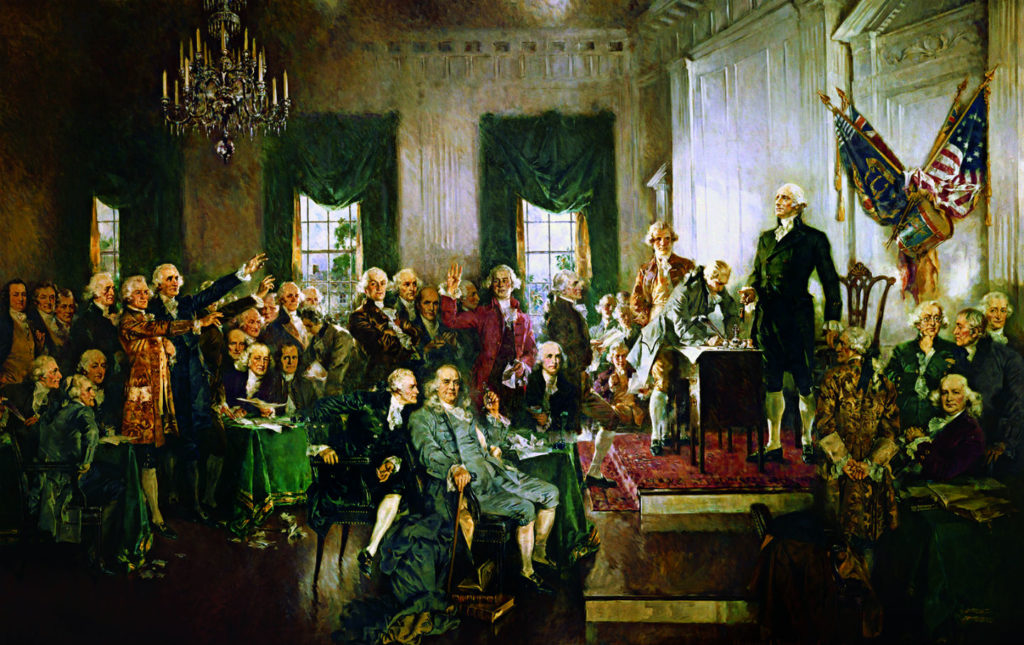

In a recent discussion at the Catholic Information Center Dr. Michael Breidenbach, Chair of History at Ave Maria University, outlined the premise of his new book: Our Dear Bought Liberty: Catholics and Religious Toleration in Early America. He was joined by Dr. Chad Pecknold, a professor of political theology from the Catholic University of America. Breidenbach’s book outlines the surprising Roman Catholic connection to the creation of our first liberty of religious freedom.
According to Breidenbach, American Catholics enjoy much more religious toleration today than they did early in U.S. history. Throughout early America, Catholics were “presumed dangerous until proven loyal.” This played out in many of the most important ideas and laws of colonial America and the later Republic.
For example, one of the five protested “intolerable acts” against the British was the Quebec Act which allowed for the toleration of Catholics in the nearby province. American Colonists thought this toleration unacceptable so much so that it was among the reasons for the Revolution.
Similarly, in John Locke’s Letter Concerning Toleration, he gave one of the most influential arguments for tolerating those with different beliefs. The problem is he did not advocate toleration of all religious beliefs. Infamously, Locke excluded both atheists and Catholics. Locke feared that Catholics were untrustworthy because they were “loyal to a foreign potentate” (i.e. The Pope).
This intolerance created an often tenuous existence for the Catholic faith in early America. In this context, some of the early arguments for religious toleration outlined in the U.S. Constitution’s First Amendment emerge. By fighting for their own toleration, early Catholics serve as a catalyst for extending that toleration to others.
Breidenbach asserts that to enter the colonies Catholics were often compelled to take oaths that “swear against certain papal authorities.” These oaths violated the conscience of many Catholics leading George Calvert, an influential Catholic in the colonies, to work out a tacit agreement between London and Rome. He struck a compromise where Catholics in his home colony could excise the objectionable parts of the oath. Eventually, Maryland law incorporated the edited version of the oath. This allowed Catholics to take the oath in good conscience and participate in the colonial project.
Calvert, born Catholic, was coerced to conform to the Church of England. He made his way through the ranks becoming the first Secretary of State to King James I. However, at the height of his career and power in Britain, he reverted to Catholicism and lost his status as a result. Breidenbach explains that in this context George Calvert sought to found an American colony that would be a “Christian ecumenical kind of colony. One where Protestants and Catholics could live side by side openly without discord and with toleration.” This vision came to fruition when his son Cecil Calvert, another Catholic revert, enshrined Maryland as a haven for religious toleration.
Catholics continued to play an important role in the furthering of religious liberty in the early republic. Daniel Carroll, the cousin of the only Catholic to sign the Declaration of Independence, “stands up and speaks unambiguously and positively on behalf of Madison’s amendments.” He was an avid supporter of the First Amendment.
Breidenbach recently uncovered correspondence between Carroll and Madison that shows the key role Carroll played in the founding. In their correspondence, they “strategize ways in which they can appease the Anti-Federalists, those who are against ratifying the constitution as it stood.”
The debates about the First Amendment were also recorded and preserved solely by a Catholic named Thomas Lloyd leading Breidenbach to assert that “Catholics wrote the first history of the First Amendment.”
However, Breidenbach argues that this assimilation into American culture did not come without intellectual sacrifice on the part of some Catholics. Only Catholics that subscribed to a specific conciliar theology coming from 13th-century theologian John of France were acceptable in the U.S. This was because one could not openly emphasize papal primacy without facing immense distrust and intolerance.
Many Catholics embraced this theology honestly and openly as it was an acceptable theological framework at the time. However, it is no longer acceptable today since the definition of the dogma of papal infallibility 1870. Papal infallibility means that in certain rare and defined circumstances the Pope can declare a doctrine binding on the whole Church.
The full discussion can be accessed on the Catholic Information Center’s website here and more information about Breidenbach can be found on his website here.


Comment by David on July 1, 2021 at 9:47 am
“Justice therefore forbids, and reason itself forbids, the State to be godless; or to adopt a line of action which would end in godlessness-namely, to treat the various religions (as they call them) alike, and to bestow upon them promiscuously equal rights and privileges.” — Libertas, encyclical of Leo XIII (1888).
Comment by Corey Gunter on July 1, 2021 at 11:09 am
David,
The passage you quoted is from 1888 and does not have any relevance to the question of what role Catholics played in the development of religious liberty in early America.
I also don’t think this one passage shows the full context of Catholic teaching on religious liberty. Though I don’t know enough to have a solid opinion, it does appear that the reality is more complicated. In addition to the encyclical you quoted, one also has to consider the fact that religious freedom was promoted in Dignitatis Humanae, the Second Vatican Council, and the latter’s historic roots going back to 1613. I would recommend Thomas Pink’s First Things article “Conscience and Coercion” and his distinction between doctrine and policy for a more nuanced and accurate view.
Comment by David on July 1, 2021 at 5:59 pm
While Catholics may have supported religious freedom in the US, I doubt that this was done with the blessing of their church. The objection to JFK was that he belonged to a group that did not support religious freedom at the time.