Once part of the bipartisan international order consensus, the promotion of human rights in U.S. foreign policy has come under acute scrutiny in recent years. This is perhaps most notably from left-wing politicians and activists. Influential progressive politicians including Sen. Bernie Sanders (I-VT) and Alexandria Ocasio-Cortez (D-NY) advocate for U.S. decision makers to look inward and focus on a domestic agenda as they condemn U.S. foreign policy as hypocritical.
Biden Administration officials face a choice between appeasing the Democratic Party’s activist base and abandoning America’s traditional role and values around the world.
A decision to disregard human rights in U.S. foreign policy would come at the expense of millions living under oppressive regimes. Religious minorities would be especially vulnerable if the U.S. were to abandon our commitments.
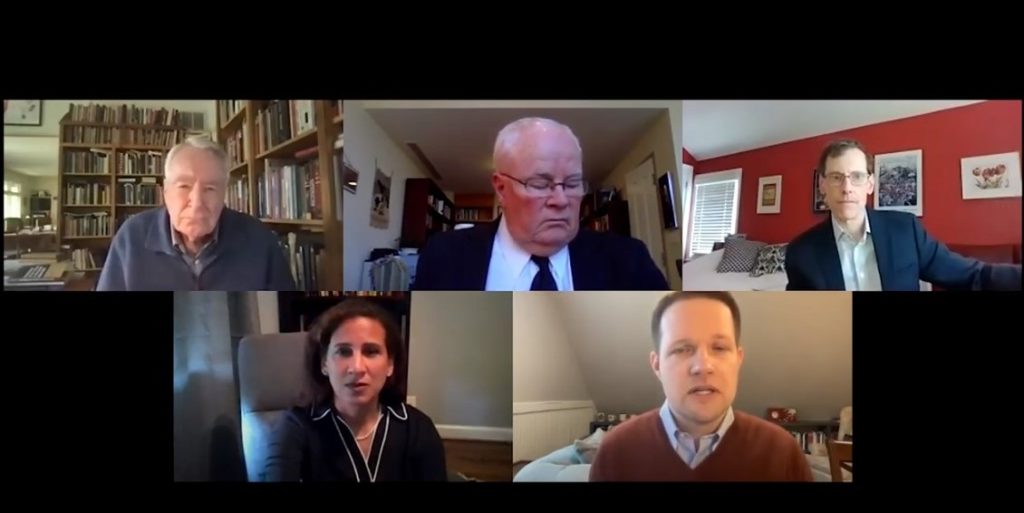
Thankfully, the Biden Administration doesn’t seem to be yielding to its left flank, and it shouldn’t, either. Last month, a panel of experts in human rights and international affairs gathered through Georgetown’s Berkley Center for Religion, Peace, and World Affairs to discuss America’s necessary commitment to human rights around the globe — and the humble confidence that should propel us in promoting them.
The Berkley Center’s Judd Birdsall served as event moderator, while David Little of the Berkley Center, Georgetown Professor David Hollenbach, Freedom House Executive Vice President Nicole Bibbins Sedaca, and Mark Lagon, chief policy officer at Friends of the Global Fight Against AIDS, Tuberculosis and Malaria, served as experts on the panel.
One of the principal questions the panel sought to address was whether the United States now has reputational challenges when it comes to promoting human rights and democracy internationally, given the tumultuous year domestically for the U.S. in 2020, including social upheaval and a contentious presidential election.
Sedaca, a former diplomat and professor at Georgetown, insisted that the U.S. should approach the promotion of human rights abroad with “humbled confidence.”
We must have the “humility to say we have had a really difficult history, we have some challenges at home, and we will be humble and honest about that, but be confident that the principles and the values upon which our country was founded and that we are living into and will continue to live into do not change because we have fallen short of them,” emphasized Sedaca.
“We don’t serve the world well by being silent about the Uyghurs or being silent about Syria because we’re waiting for us to get it together,” the Freedom House official continued. “That’s even worse than us saying that we have it all right in the first place.”
Sedaca further highlighted the “marriage” between democracy and human rights, and she reminded viewers that democracy is the only system that enshrines the protection of human rights and includes built-in self-correcting mechanisms.
Little and Hollenbach focused on the conceptual challenge of human rights, namely the criticism (increasingly seen on the left) that the protection of human rights is “Western ideological imperialism.”
Little emphasized the fact that the Universal Declaration of Human Rights (UDHR), drafted in the aftermath of World War II, involved “perspectives from a variety of cultures and backgrounds.”
“These were drafters from all over the world who had experienced in one way or another this particular worry” over fascism, according to Little.
The UDHR intended to protect individuals against collective domination, not push a particular political ideology, a purpose which “is fundamental still to the world the United States faces today,” Little asserted.
The Georgetown professor emphasized the UDHR’s “spirit of brotherhood,” which he declared the Biden Administration should use in defense of allegations that the UDHR and international law moreover are “anti-community.” This claim is purported often by China, as the CCP asserts that international human rights norms go against communitarian Confucian ideas.
Hollenbach further pointed out that the vice chair of the UDHR drafting committee was a Confucian thinker from China.
The UDHR does “not deny the respect for individual dignity,” but enshrines that “one achieves individual dignity in community,” Hollenbach continued.
Lagon, former ambassador-at-large for the Office to Monitor and Combat Trafficking in Persons (TIP) at the U.S. Department of State, noted that despite growing domestic political polarization, the U.S. has typically “had this special island of issues where there is bipartisanship.” He highlighted protection of human rights, such as combatting human trafficking, as one of these special issues.
“My fear now is that bipartisanship on even these core issues has begun to crumble,” Lagon lamented. He continued that the Biden Administration would be “making a mistake” if it were to think it can’t build on these islands of issues.
Lagon furthermore insisted that U.S. citizens and politicians need a “memory jog” on why these special issues, including human rights advocacy, are essential to our foreign policy.
He is exactly right, and despite perceived domestic shortcomings or erosion of our own democracy and political fabric, citizens and policymakers alike should remember why there has long been a bipartisan consensus around human rights advocacy in U.S. foreign policy.
When there’s not — or adversaries see the consensus eroding — it’s the world’s most vulnerable populations, like religious minorities living under autocratic regimes, who suffer most.




Comment by Phil on May 19, 2021 at 4:23 pm
You didn’t seem concerned when a Republican presidential candidate adopted the campaign slogan “America First” and began ignoring human rights abuses in Syria, Yemen, Myanmar, and the Philippines, just to name a few. Isolationism has been growing fastest among conservatives, not progressives. You need to deal with the isolationist voices in your own party if you’re serious about maintaining bipartisan humanitarianism abroad.
Comment by Jeff on May 19, 2021 at 10:47 pm
“You didn’t seem concerned bla bla bla”…
“You need to deal with yadda yadda”…
Wow, that’s kinda strident authoritarian-speak there, Lord Phil. Who exactly is this “You” to whom you are referring? The author, who is simply reporting on a panel discussion? The panelist(s)? Some straw man conservative you fabricated and demonized all by yourself?
Or maybe you’re talking at the persona of President DJT, who apparently is living rent free in your head. ROFL!
Comment by Phil on May 20, 2021 at 10:27 am
Jeff,
Which part of my statement exactly are you disputing? The fact that Trump did embrace the rhetoric of “America First” in his campaign? That his administration’s record on human rights both at home and abroad left much to be desired? The fact that isolationism has been creeping into the GOP in reaction to the failed neoconservative policies of the second Bush Administration for the past decade and been taken up such diverse figures as Steve Bannon and Rand Paul? Or the fact, that the IRD sees itself as an extension of the same religious and political conservative movement fueling the Republican Party? I saw a bunch of Republicans (let’s not pretend for a minute this group is non-partisan or bi-partisan by any stretch of the imagination) accusing the left of being too inward-thinking in their politics and found the accusation laughable after 4 years of Trump.
Comment by Jeff on May 20, 2021 at 6:08 pm
I didn’t “dispute” anything, Phil, I asked a question. And, in the three hyperventilating ProgMeth paragraphs of your reply, you STILL didn’t answer it! LOL!
Yup, The Donald and those conservative demon straw men you built ARE living in your head! Rent free. Kinda like a 24/7 Trump rally you carry around with you! I feel compassion, it must be tough to be both blind & obsessed.