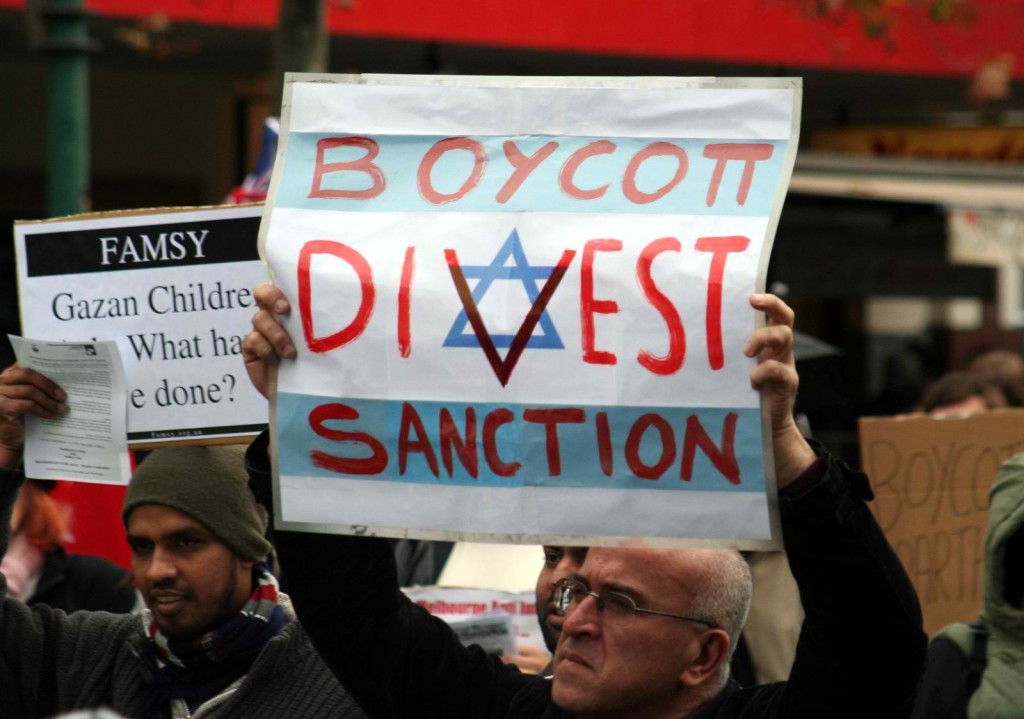

The Methodist Federation for Social Action (MFSA) and United Methodist Kairos Response (UMKR), two prominent Christian left supporters of the Boycott, Divestment, Sanctions (BDS) movement against Israel, recently hosted a webinar in which panelists outlined “new opportunities” for BDS and other anti-Zionist actions in the new 117th Congress and Biden Administration.
One panelist, Mark Harrison, the director of UMC Peace with Justice programs, gloated that activists such as those from MFSA and UMKR had “successfully moved the Democratic party” away from the American Israel Public Affairs Committee (AIPAC).
This recent event, titled “A New Congress, A New Administration: New Opportunities for Palestinian Rights!”, commenced with a welcome from Bridget Cabrera, the executive director of the MFSA. John Wagner, co-chair of UMKR, then gave an address, reminding viewers that “divesting from companies and entities who support the occupation of Palestine” is the goal of UMKR.
Harrison served as a panelist alongside Kyle Cristofalo, senior director of advocacy and government relations of Churches for Middle East Peace (CMEP). Cristofalo’s speech mainly addressed Congress and lobbying, as he outlined which new members of Congress seem “sympathetic to Palestinian rights” according to the groups’ criteria, and which members of Congress will hold key committee positions relevant to Israel and Palestine this session.
He addressed the Democratic primary election defeat of Congressman Eliot Engel (D-NY), the former House Foreign Affairs Committee Chairman and vocal advocate of a strong U.S.-Israel alliance. Engel lost to now-Congressman Jamaal Bowman, and Cristofalo asserted that “Israel-Palestine played a role in the primary defeat” in the heavily Democratic New York district which covers parts of the Bronx and Westchester County.
One “opportunity” that Cristofalo sees in the new Congress is on the House Appropriations Subcommittee on State & Foreign Operations, under new Chairwoman Rep. Barbara Lee (D-CA). Lee was a cosponsor of H.R.2407 “Promoting Human Rights for Palestinian Children Living Under Israeli Military Occupation” in the 116th Congress. The author of H.R.2407, Rep. Betty McCollum (D-MN), is now the Chairwoman of the House Appropriations Defense Subcommittee, which Cristofalo cited as another “opportunity.”
McCollum’s hometown newspaper called her “one of the strongest critics of Israeli policy in Congress” in a summer 2019 headline.
According to Cristofalo, the new Democratic-controlled Senate “will probably not be very relevant to Israel-Palestine policy.” Cristofalo, however, cited Rep. Cori Bush (D-MO), Rep. Marie Newman (D-IL), and aforementioned Rep. Bowman (D-NY) as “new members to watch” on this issue.
Harrison spoke less about Congress and instead focused on the Biden Administration’s policies towards Israel and Palestine. He stated, “The question before us is: ‘How can I make President Biden do the right thing?’” meaning, support BDS and the additional advocacy goals of UMKR, MFSA, and other Christian Left voices on Israel and Palestine. “We need to remember that policy on Israel and Palestine is made in the White House.”
He continued, describing the lobbying feat of moving the Democratic party to change its platform regarding Israel and Palestine, which as of 2020 includes language that opposes annexation and supports Palestinian rights. Many progressive advocates were dissatisfied that the platform change did not include language on the occupation, and Harrison echoed this feeling.
“We need to get language reinstated that there is occupied territory and the occupied territory is illegal,” insisted Harrison.
He, however, asserted that it isn’t enough for activists to persuade Democratic elected officials. “We need to engage Republicans,” stated Harrison. He also addressed the “problem” of Christian Zionism and its influence on American foreign policy towards Israel. “We need to think about strategy wise how to combat it [Christian Zionism] … It is the Christian Zionists who are driving debates among Republicans,” he asserted.
During the panel, Cristofalo referenced a December letter that was sent to the Biden-Harris transition team by 17 Christian denominations and faith-based organizations. The letter includes six requests regarding future policy towards Israel and Palestine under the Biden Administration. The final request states: “Make clear that criticism of Israel, including support for boycotts, divestment and sanctions actions, is protected and legitimate speech.”
Signatories of the letter include Churches for Middle East Peace, Presbyterian Church (USA), The Episcopal Church, Evangelical Lutheran Church in America, and The United Methodist Church’s public policy arm, the General Board on Church and Society (GBCS). All signatories of the letter can be found here.




Comment by SenecaGriggs on January 28, 2021 at 6:22 am
With progressive religionist; it’s never actually about the good news: Christ died for your sins that you might be in a relationship with God, it about POLITICS. It’s all politics all the time. sigh
Comment by Palamas on January 28, 2021 at 11:10 am
The anti-Semite caucus thinks it’s relevant again. Time for supporters of Jewish self-determination to stand up to the “river to the sea” crowd.
Comment by David on January 28, 2021 at 7:15 pm
Is criticism of the Saudi Arabian government’s actions anti-muslim? If not, then similar criticism of Israel is not anti semitic.
Comment by Paul on January 29, 2021 at 11:10 pm
I suppose an acceptable response would not be:
“United Methodist Church …Boycott, divest, sanction….”
If theirs is an acceptable method to respond to those whose actions they do believe are fair, seem to abuse their position and power, to those they disagree with on a philosophical level, then should it be an acceptable response to those who we disagree with who will not obey the decisions of General Conference 2016 and 2019, especially those in leadership who abuse their power and influence to thwart the will of the only body who speaks for the United Methodist Church?
Comment by John Wagner on January 30, 2021 at 2:04 pm
Thanks for including so many quotes and links. It makes makes our arguments clearer to your readers, and therefore more reasonable I suspect, even if they disagree.
As for “Anti-Israel Christian Left” I would ask that in the future you or your editors use something like “Pro-Palestine Christians” or something more neutral. For one thing, while we all call ourselves Christians not all of us call ourselves leftists, which implies that ideology is the driving force of our activism. For most of us it’s more about what we’ve personally witnessed in the Holy Land. Also, some of us are political moderates and a few are indeed conservatives. Secondly, just as those who oppose abortion prefer “Pro-life” to “Anti-Abortion” or “Anti-Choice” we would like to be known more for what we are for than what we are against. It’s also more accurate. We are opposed to Israeli policies not Israel as such or the Israeli people (as you indeed quoted Kyle and Mark as saying in your article. )
I hope you will continue to cover our webinars.
Thanks,
John Wagner
Comment by Dee Poujade on January 30, 2021 at 3:33 pm
How can so-called “Christians” not only accept but applaud the Israeli government’s treatment of the Palestinians in its “care” as they continue their illegal (under International law) occupation of the Palestinian territories? And how can the US be an “honest broker” for peace when it continues to give Israel $3.2 million + a year and ignores its human rights violations? And when will good Christians understand that advocacy for BDS is not “Anti-Semitic” – it is opposition to a government and its policies, NOT a religion!
Comment by Kathy K. on January 30, 2021 at 4:32 pm
As a United Methodist, I was pleased and proud to hear that GBCS was a signer of that letter to Biden and Harris. Regarding other comments, it seems strange to criticize a church agency (GBCS) or two church-based groups (MFSA and UMKR), all of which were created for the express purpose of social action and political engagement, for being “about politics.” The IRD, in its name and so much of its work, also is about the intersections of religion, politics, and society: things we all should be concerned about.
Comment by Wayne on January 31, 2021 at 10:07 am
Thank you for this article. Many denominations in the U.S.A are Replacement Theology churches which believe the church has replaced Israel. Our own UMC is one of these denominations that believe this:
https://www.umc.org/en/content/book-of-resolutions-opposition-to-israeli-settlements-in-palestinian-land
I teach vehemently against this in my local UMC. I HIGHLY recommend two books to understand this better. “Which Christians Should Care About Their Jewish Roots” by Nancy Petrey (a very quick short and easy read” and “Eye to Eye Facing the Consequences of Dividing Israel” by William Koenig.
God WILL NOT allow a palestinian state in the Covenant land! It is that simple and we must adhere to Gods’ promises to Israel in the Bible. I would urge readers of to incorporate these books into their Sunday School lessons and teachings. Genesis 12:3 “I will bless those who bless you and curse those who curse you”. If we try to take God’s Covenant land away from the Hebrew people, we are cursed.
Comment by Wayne on January 31, 2021 at 10:08 am
Sorry, I meant “Why Christians Should Care About Their Jewish Roots” not which. 🙂
Comment by Dean Blake on February 7, 2021 at 5:19 pm
Treating Palestinians like children incapable of steering their own destiny is colonialistic misdirection. They’ve made a lot of poor decisions in the past, all with the well meaning help of Christian NGOs, EU and USA. Stop helping the mess!!! I read here people who try to distinguish Israeli policies from Jewish people and religion (Wagner). MYOB!!! Who says these governments (PA and Israeli) don’t represent people’s and majority religious views? External meddlers all. Peace is in everyone’s interests and I do not see Methodists helping. I’m Jewish. MYOB