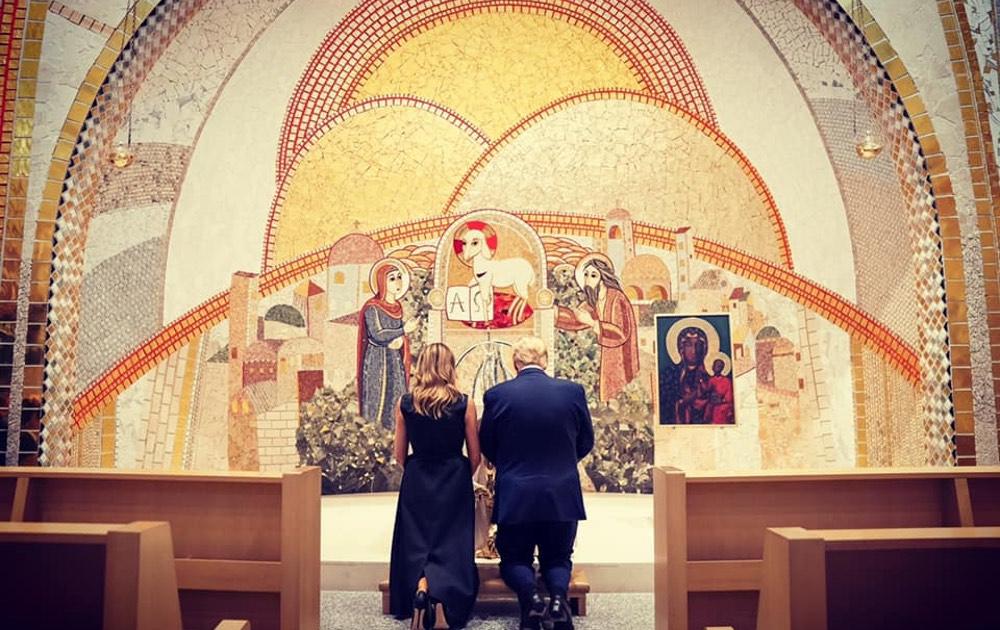
On Tuesday, June 2, President Trump issued an executive order “Advancing International Religious Freedom.”
IRD’s International Religious Liberty Program commends the President for his ongoing commitment to defend persecuted Christians and other religious believers around the globe, and the actions he has taken to demonstrate that commitment.
The Institute on Religion and Democracy has been exposing the persecution of Christians around the world and mobilizing American Christians to advocacy since our founding in 1981 when the biggest threat to Christians was the Marxist Leninist ideology of the Soviet Union and its appeasers in the mainline churches.
We and other religious freedom/human rights defenders have had a greater or lesser degree of support on this, depending on the year and the Administration. But the Executive Order provides a new level of support we have not seen before. It prioritizes the defense of people persecuted for their beliefs in a way that had been lifted as an ideal in the past, but never given this particular set of teeth to be put into practice.
Here is a breakdown on the Executive Order’s content, followed by my personal take on its significance.
The order’s 7 sections range from Policy to Economic Tools. It states that the United States sees international religious freedom as a foundational principle of our foreign policy. The provisions in the order will further solidify that principle by making international religious freedom a priority throughout foreign policy and foreign assistance.
Within 180 days of President Trump signing the Executive Order, the Secretary of State is tasked with developing “a plan to prioritize international religious freedom in the planning and implementation of United States foreign policy and in the foreign assistance programs of the Department of State and USAID.”
In terms of funding, the order states that the US government will provide at least $50 million per fiscal year for programs that advance international religious freedom. It continues:
Such programs shall include those intended to anticipate, prevent, and respond to attacks against individuals and groups on the basis of their religion, including programs designed to help ensure that such groups can persevere as distinct communities; to promote accountability for the perpetrators of such attacks; to ensure equal rights and legal protections for individuals and groups regardless of belief; to improve the safety and security of houses of worship and public spaces for all faiths; and to protect and preserve the cultural heritages of religious communities.
While funding will be used to support the important programs described above, other economic tools provided in the order include increasing the funding for religious freedom programs, realigning foreign assistance “to better reflect country circumstances,” and using economic sanctions against those who tolerate and perpetrate religious violence.
These tools will especially be used in countries of particular concern, countries on the Special Watch List, countries in which there are entities of particular concern, and any other countries that have engaged in or tolerated violations of religious freedom. (Entities of particular concern are groups that persecute for religious reasons that are not state-sanctioned — at least not officially — like the Taliban, ISIS, al-Nusra, al-Qaeda, and Boko Haram, for example).
All of these economic tools will help bring perpetrators to justice and hold nations accountable for the way they treat their religious minorities. Many of these tools and other provisions in this executive order have been long desired, but never actuated. That is why I say that this is new territory for U.S. government policy.
My Take on the Executive Order on Advancing International Religious Freedom:
In my 27 years of working at the Institute on Religion and Democracy in advocacy for persecuted Christians and others whose religious freedom is violated, I have never seen an initiative of this sort before.
I participated in the DC-based coalition to pass the groundbreaking 1998 International Religious Freedom Act (IRFA). And it was indeed groundbreaking. But some of the important teeth in that bill were knocked out (or maybe I should say surgically extracted) in order to make it more palatable. And others remained, but implementation was rare.
The most recent re-authorization of the Public Law created by IRFA, the Frank R. Wolf International Religious Freedom Act, returned some of those teeth. In fact, the Executive Order references the reauthorized act in another key provision, to expand the mandatory training on international religious freedom to more US federal officers.
Within 90 days of the signing of the Executive Order “the heads of all agencies that assign personnel to positions overseas shall submit plans to the President, through the Assistant to the President for National Security Affairs, detailing how their agencies will incorporate religious freedom training “into the training required before the start of overseas assignments for all personnel who are to be stationed abroad, or who will deploy and remain abroad, in one location for 30 days or more.”
This is a particularly important provision of the order. US foreign service officers and other federal officers working overseas have frequently denied or downplayed the importance of religion. In any case, they have not been well-versed in the challenges faced by Christians and other minority religious believers. That was why this particular provision was originally included in IRFA 1998.
There has been some real ignorance of religion, (even of the importance of religion to other people regardless of how you yourself feel about it as a foreign policy elite!). For instance, working on the 1998 IRFA bill we discovered that a US Ambassador to China had never heard of a house church! Currently there may be as many as 130 million Christians in China. There was a healthy number of Christians — many in house churches — in 1998, as well.
Another significant example of the ignorance and/or cavalier attitude towards Christians by federal officers came during the Iraq War. When we attempted to speak up for the Christians there, we got word that a top level diplomat thought that Christianity must be quite inconsequential in Iraq. After all, it’s a Western religion!
Yes, we really need to have expanded training and education of foreign service and federal officers on religious freedom!
The US Commission on International Religious Freedom (USCIRF), which was created as a result of the 1998 IRFA, welcomed the Executive Order. One of the commissioners said, “This order codifies the things we believe into law so that they will be long lasting.” The commissioner described the effect the order would have as the Administration now “looking at US foreign policy through a religious freedom lens.”
Ambassador-at-Large for International Religious Freedom Sam Brownback enthused about the Executive Order to both EWTN and CBN television networks.
In the order, President Trump declares “our Founders understood religious freedom not as a creation of the state, but as a gift of God to every person and a right that is fundamental for the flourishing of our society.” Ambassador Brownback believes that as well. He is working with President Trump, Vice President Pence, Secretary of State Pompeo, and others to advance international religious freedom.
Ever since coming to office, President Trump has been an ally of both domestic and international religious freedom and a defender for the persecuted church around the world. During last year’s meeting of the United Nation’s General Assembly, not the friendliest place for persecuted religious believers, President Trump hosted an unprecedented Global Call to Protect Religious Freedom.
The Administration has partnered with organizations around the world to provide assistance to persecuted religious minorities and the President signed an Executive Order establishing the White House Faith and Opportunity Initiative to support America’s faith-based organizations. The Administration also has hosted two religious freedom Ministerials, bringing together hundreds and hundreds of government and religious leaders from around the world committed to fighting against religious persecution.
This week’s Executive Order is another step in the direction of protecting and advancing religious freedom internationally. As International Religious Liberty Program Director at IRD, as well as co-leader of the Anglican Persecuted Church Network and the GAFCON Suffering Church Network, I look forward to discovering how the provisions of the Executive Order Advancing International Religious Freedom will lighten the burden — and more importantly, save more lives — as we work with the Administration and partner organizations on behalf of the persecuted.



Comment by JR on June 5, 2020 at 10:53 am
How do you justify the obvious conflicts between this executive order and Executive Order 13769 and it’s subsequent variants?
Comment by Faith McDonnell on June 5, 2020 at 12:52 pm
That is about terrorism. There is not religious freedom to commit terrorist acts. This has to do with advancing international religious freedom.