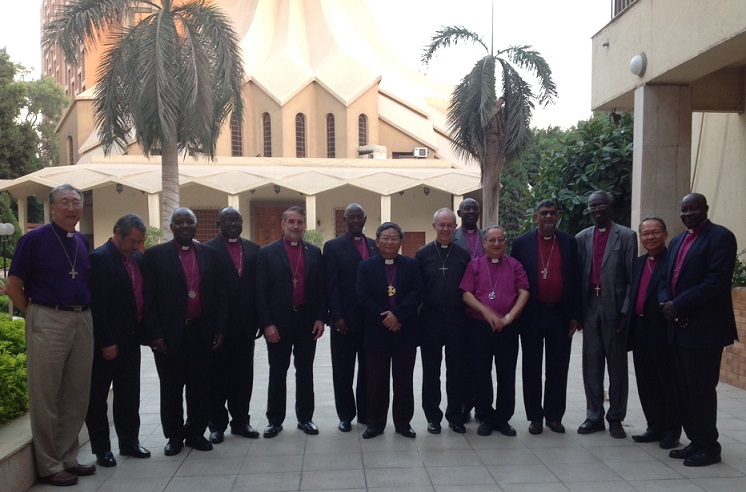
Although you likely didn’t see many headlines, the past two weeks have been significant. Biblically faithful Anglicans are witnessing encouraging developments on the global, provincial and local levels. I’ll outline three of them for you here.
First, there is increasing international recognition and support for the Anglican Church in North America (ACNA). The Global South, a grouping of 24 out of 38 provinces in the worldwide Anglican Communion, formally voted to recognize ACNA as a partner province and extended an invitation for ACNA to join the group with both voice and vote.
While ACNA has long had strong support from the leaders of the Global Anglican Future Conference (GAFCON), the Global South includes additional primates representing provinces like Burundi, the Indian Ocean and the Middle East and North Africa. Separately, the synod of the Anglican Diocese of Sydney, Australia passed a motion declaring itself “in communion” with ACNA. These orthodox allies recognize that ACNA is a partner in Gospel mission and has staying power.
Anglicans also have continuing dialogue with ecumenical partners in the Lutheran, Orthodox and messianic Jewish traditions, among others. A formal invitation by the Russian Orthodox Church for a visit by ACNA leaders early this autumn was testament to increasing common ground between the churches.
We can expect all of these developments to have an impact on the primates’ gathering that Archbishop of Canterbury Justin Welby has proposed for this coming January. You’ll recall that Welby has also issued an invitation to ACNA Archbishop Foley Beach to participate, a first for the new province.
Secondly, the Episcopal Church recently released its 2014 membership data. The top-line summary continues to be that the Episcopal Church (TEC) maintains an alarming membership and attendance decline unbroken since the early 2000s. Even more alarmingly, Episcopal Church baptisms have dropped by almost half in the last decade, boding poorly for the future.
We can be encouraged that a false gospel presented in some Episcopal churches is failing to gain traction. But make no mistake: this is not a zero-sum situation. Whenever I report on Episcopal Church decline, I need to qualify that the places where the ACNA has met with much success – Texas, the Carolinas, the Washington, D.C. metropolitan area – are all places where the Episcopal Church has seen minimal decline. Meanwhile, those places where TEC is in absolute freefall – northeastern dioceses like Vermont, Rhode Island, and predominantly rural areas like the Dioceses of Northern Michigan and Eastern Oregon – have a sparse ACNA presence (if any at all).
I cite this information because Anglicans need to understand that the reports of TEC diminishment (what I have termed ‘decline porn’) are only that: confirmation of TEC failure. When a long-declining TEC parish shutters in a small town, there will be no further Anglican presence in that community for a long, long time. Young pastors will plant new congregations in major metropolitan areas and college towns, but few seem drawn to communities where TEC is in steep decline. It’s something for us to think and pray about as we attempt to reach communities across North America: ACNA is not an escape from the problems plaguing Episcopalians, it is an opportunity to minister to the lost in a way that we were sometimes hindered from doing in TEC.
Thirdly, but perhaps most importantly, awareness of and interest in Anglican Christianity continues to grow. Archbishop Beach spoke this morning at Asbury Theological Seminary’s chapel service as part of the inauguration of the Asbury Anglican Fellowship. The Evangelical seminary is hosting a day-long series of discussions and lectures, “exploring ancient Christian practices and priorities retained within the Anglican tradition and their relevance to the mission of the Church today.” Asbury is one of several Evangelical institutions, including Regent College, Gordon-Conwell Theological Seminary and Beeson Divinity School, which have responded to increasing student interest in Anglicanism by launching programs. Of course, the three Anglican seminaries producing ACNA-affiliated graduates, Reformed Episcopal Seminary, Nashotah House Theological Seminary and Trinity School for Ministry, all continue to attract new interest.
This is a good season for Anglican Christians in this country. As Anglicans strive to be faithful to the Gospel and responsive to the Holy Spirit, labors are bearing fruit and God is opening up unexpected opportunities. We’ve inherited the gift of a remarkable tradition, and we should steward it with care.




Comment by Whatever on October 23, 2015 at 9:57 am
I’m glad the ACNA is growing and the Episcs continue to shrink. I’m not all that concerned that there are areas of the country that will lack an “Anglican presence.” Some other denomination, or a nondenominational church, will fill in the gap. I think most Americans, especially the young, are post-denominational, and I think that’s a good thing. The mainlines’ numbers would be even lower right now if not for the elderly who still cling to the churches they were raised in.
Comment by Jeff Walton on October 23, 2015 at 4:46 pm
That’s a good point: I’d much rather see someone being fed good “spiritual food” at a faithful church of another tradition than be stuck in a dead-end congregation within my own tradition. I happen to like denominations that don’t play down their distinctiveness, but denominational affiliation is always a secondary matter.
Comment by Wild Child on October 23, 2015 at 5:15 pm
C. S. Lewis’s analogy was that “mere Christianity” was like the main hallway in the building, whereas the denominations (or “traditions”) were the individual rooms.
Comment by the_enemy_hates_clarity on October 26, 2015 at 10:31 am
That is a great analogy. Liberal christianity is not a room branching off the main hallway. It is in a separate building.
In Christ,
The enemy hates clarity
Comment by Matt Gobush on October 23, 2015 at 2:17 pm
As a faithful Episcopalian and committed Christian Democrat, I always bristle at debates about the strength of various mainline denominations including my own based primarily on membership numbers. Notwithstanding the name of this institute, votes may be good metrics for democracies, but not necessarily religions. I think the strength of a church’s ministry and witness are often better testaments to its vitality. And the recent election of The Very Rev. Michael Curry as Presiding Bishop of the Episcopal Church – the first African-American leader of one of our country’s oldest Christian denominations – speaks to my church’s vitality and strength of spirit.
Comment by Jeff Walton on October 23, 2015 at 4:41 pm
“Sending Capacity, Not Seating Capacity” is the term I often hear used when referring to the vibrancy of a church. Numbers do matter, but they aren’t the only thing that matters. Here’s hoping that Bishop Curry’s evangelistic language proves to be more than inch-deep.
Comment by Wild Child on October 23, 2015 at 5:13 pm
LOL
Your church has NO vitality at all, unless you count the speed with which your numbers are declining. My own church has some ex-Episcs, they shook the dust off their feet long ago and are glad of it.
You chose a black as presiding bishop for the same reason you chose a woman last time: that’s tokenism, and it has nothing to do with vitality. “Look at us, we are so INCLUSIVE!” Yeah, that sounds like a winning slogan, but it just doesn’t work, does it? Btw, the Southern Baptists elected a black guy as their head several years ago, so even in tokenism you’re behind that curve.
A church that looks just like the world cannot save the world. Your church doesn’t even believe in salvation any more. A church without God dies.
Comment by George on November 6, 2015 at 11:31 pm
All true. I like the idea of your closing statement. A church that looks just like the world also has nothing different to offer the world. No wonder the world pays it no attention.
Well spoken.
Comment by LatinLiberty on October 26, 2015 at 4:36 pm
As a young church leader, by Episcopal demographics, I’ve been fighting an uphill battle to revitalize my church, make God prominent in the church and bring the Great Commission to life. Sounds odd to say.
The decline is reflected in every aspect of the church. Mission work is outsourced to third party organizations, the church space doesn’t reflect Anglican/Episcopal teachings or religious views, religious symbols are absent, and the church exterior looks like a billboard for every social justice cause in town.
To many older members are content with the status quo which discourages potentially new and younger member from joining or taking an active role. Why join an aging congregation in spirit and deeds?
My church sits in an active multi-diverse community in Queens, NY. It is surrounded by Christian churches which are bursting on Sundays and active 7-days a week with variety of programs that cut across ethnic and generational lines. Not the 3 Episcopal churches within 1.5 miles of each other. One is in such disrepair that the surrounding neighbors have filed complaints with the city, complained to the local press, and sent nasty letters to the Long Island diocese. Why it remains open with its 10 members is a mystery.
And the other 2 are barely holding on though they think they’re succeeding because as one commentator below wrote: “‘Look at us, we are so INCLUSIVE!’ Yeah, that sounds like a winning slogan, but it just doesn’t work, does it?”
The whole church seems to deny the trend or believe the numbers will stabilize with the influx of new immigrants. Well, I my community is 65% 1st generation immigrant and I can tell you they’re not flocking to the Episcopal church in any numbers.
Comment by Aron on October 26, 2015 at 5:15 pm
Thanks for sharing that. Many people have observed that churches that constantly tout how “inclusive” they are never seem to attract people. You’d think they’d figure it out: There’s got to be something going on here – like maybe FAITH, spiritual energy – besides being “inclusive.”
Comment by Xerxesfire on October 31, 2015 at 1:32 am
Good points LL. Inclusive typically means anything goes, except for the gospel message. God bless you in your new role. If things don’t work out with TEC, there’s always the Anglicans – they could surely use someone like you to help influence youth and young adults for Christ.
Comment by Edwin Woodruff Tait on November 13, 2015 at 2:10 pm
As an Episcopalian, I appreciate the moderation of this piece and the rejection of “decline porn.” The point about ACNA typically being strong in places where TEC is relatively strong has occurred to me before, and I appreciate seeing it stated so candidly from the ACNA side.