
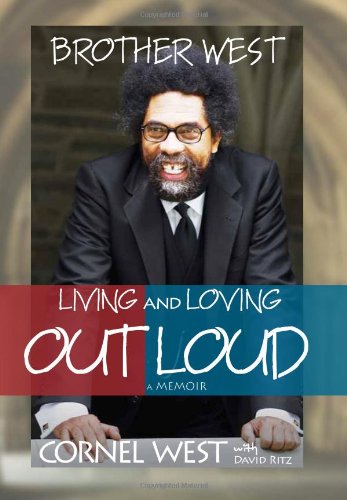
Well, Robert George is at it again. On September 3rd, he took to his First Thoughts blog to once again defend his deep friendship with Cornel West. For those of you unfamiliar with the bond these two men share, you have been missing one of the great puzzles of our age. Dr. Cornel West is, in my humble opinion, the archetypal liberal intellectual. Dressed in his black three-piece suit, capped by a small Afro and sporting a smile which could give an orthodontist an aneurism, West has made a name for himself as the pre-eminent American philosopher on race. His book Race Matters, rose to the bestseller list ofPublishers Weekly, but more importantly has become a book of biblical importance for Cultural Studies Departments in the back waters of academia. Two years ago, in the Fall of 2011, West came to Minnesota State to give a public lecture. The chair of the African American Studies Department rented a white tuxedo, with a floor-length coat, the entirely of which was bedazzled with fake jewels, for the event. When the time for questions came, he quoted Race Matters back to the man who wrote it, 17 years ago.
Upon hearing the man talk, I came to a conclusion, which Leon Wieseltier came to in his essay for the New Republic. The thought of Cornel West, his books and his lectures is “almost completely worthless.” Wieseltier, whom I have no reason to like, given his leftist stance on everything, carefully dismantles West and his canon of work filled with philosophical sophistry, head churning distortions of the English language, and constant affirmations of the West’s own integrity and humility. West wants to the world to think he’s both brilliant and humble. It’s very hard to sell both stories without being either one.
Robert George on the other hand, is as conservative as they come. Educated at Oxford by John Finnis, George has emerged as a true public intellectual, who has managed to earn high praise, even from those with whom he disagrees. His 1995 book, Making Men Moral, which tackled the question of private versus public morality and the laws that govern both, was written well enough that Joseph Bottum cited it as evidence that George as a thinker could also write, while the political philosopher Jeffrie Murphy, took to the pages of the Arizona State Law Review to say that Robert George “has made me nervous about my commitments to liberalism.” The New York Times, no friendly publication to conservatives, calls George the “country’s most influential conservative Christian thinker.” Their article ebbs and flows between bewilderment at the radical conclusions George comes to (life is sacred at all stages, marriage is between a man and a woman…) and the rigor of thought used to reach them.
Wiseltier was more or less inclined to agree with West, but found himself needing to scold West publically for being such a slippery philosopher. The New York Times is definitely inclined to disagree with George, yet they wrote an article that praises him. How could two thinkers of such difference interest and caliber become such great friends? West, before a group of black students in the south, called George a “white skinned brother”, and then invited George to comment on the current controversy surrounding the ‘n’ word. And George has reciprocated the public display of affirmation, with the blog post cited above.
These types of friendships, between ideologically and intellectually divergent men, have been befuddling me for the past two weeks. This little essay is nothing more than an invitation to join in my confusion and test for yourself my hypothesis. I will come to that presently, but first we must attended to a friendship found a long time ago in an empire far, far away…
Most people are unaware that G.K. Chesterton wrote The Man Who Was Thursday under threat of torture. The Irish socialist and agnostic George Bernard Shaw had written letters to Gilbert insisting that he abandon his work as an essayist, novelist, and author of non-fiction, to instead produce a play. Shaw, in his letters to Chesterton, threatened to publically shame his writing ability, while privately, Shaw threatened to seduce Chesterton’s wife. The correspondence between Francis Chesterton and Shaw contains the threat of torture, wherein Shaw muses that Gilbert will only be persuaded to write a play, if he has pins driven into his side. When the play was finally written, it earned high praise on both sides of the Atlantic, cementing Chesterton’s reputation as a literary (as well as literal) giant.
Despite the unpleasant tone of Shaw’s threats to Chesterton, the two were tremendous friends. In stature as well as in disposition, they were polar opposites. Shaw was a thin man; a firm breeze or a decent sneeze could topple his delicate figure. Whereas, Chesterton was somewhat of a tailor’s nightmare. His rotund figure and soaring height, combined to create an imposing presence, which could block out the sun to those near him on the sidewalk. But this difference was not lost on either of them, as Chesterton once commented at the sight of Shaw, “I see there has been a famine in the land.” To which Shaw replied, “And I see the cause of it.”
Their philosophical differences came down to their view of the role of rules. Shaw is famous for his assertion that “The golden rule is that there are no golden rules.” This principle was laid out in Shaw’s work The Quintessence of Ibsenism. Chesterton’s criticism of it first came in the provocatively titled Heretics and later at more length in George Bernard Shaw. Shaw himself referred to the book bearing his name as “the best work of literary art I have yet provoked.”
It is interesting that neither of them really moved philosophically in the direction of the other. Shaw was remarkably consistent, a trait which the Heretics chapter pays particular attention to. Chesterton converted to Catholicism later in his life, which if anything was a step even farther from Shaw. Yet despite their differences, they were often seen in each other’s company at a pub, usually laughing over the ruthless public debate they had just finished.
Lastly, there is a spoiler alert to mention. The man who said the following,
“I am absolutely convinced that the main source of hatred in the world…is organized religion. I think it should be treated with ridicule and hatred and contempt. And I claim that right.”
…also said this about a Christian apologist:
“If everyone in the United States had the same qualities of loyalty and care and concern for others that (he) had, we’d be living in a much better society than we do.
The Christian apologist was Larry Taunton, founder and executive of the Fixed Point Foundation . The atheist who spoke so warmly of him: Christopher Hitchens. Hitch (as he is endearingly called by friends and enemies alike) became know for, among other things, his ability to deliver memorable, biting criticisms of religion in general and Christianity in particular. In what became know as a “HitchSlap”, Christopher would deliver lines such as:
“This (Christianity) is nonsense. It can not be believed by a thinking person.”
-or-
“All of this may be part of plan. There is no way an atheist can prove it is not. But it’s some plan isn’t it? With mass destruction, pitiless extermination, annihilation, going on all the time, and all of this set in motion on a scale that’s absolutely beyond our imagination…in order that the Pope can tell people not to jerk off.”
Strangely enough, a man who could so eloquently mock believers gained quite an admiring group of opponents. Ross Douthat rightly called him, after his passing, “The Believer’s Atheist”. Douthat points out, as does Larry Taunton in this interview, that more was going on with Hitchens than met the eye.
Taunton met Hitchens when the latter burst into the former’s hotel room saying:
“The Archbishop of Canterbury has effectively endorsed the adoption of Sharia law. Can you believe that? Whatever happened to a Church of England that believed in something?”
“‘Believed in something?’” asked Taunton, “Why, Christopher, you sound nostalgic for a church that actually took the Bible seriously.”
“Indeed. Perhaps I do.”
In the years since that encounter, Hitch and Taunton of course debated, going as far as Billings, Montana to pursue the big questions. But they also did a Bible study of the Gospel of John and took a road trip to Yellowstone together. They were friends by mutual public admission. What was going on with Hitchens, was that in practice he could see an agreeable human being, even in those he was supposed to dislike. One might say he had a keen perception of human dignity. Taunton was himself more than happy to accept the offer of camaraderie with the world’s most eloquent atheist.
But Larry did make one mistake. In his eulogy for Hitch, Larry mistakenly named Christopher’s favorite whiskey as Red Label Johnny Walker. Hitch, and most other respectable people, will only drink Black Label.
But here is my suspicion, and my hypothesis. I doubt very much that any pre-Christian philosophy or religion, can account for the bizarre phenomenon of ideological enemies who are still friends. Aristotle split friendships up into three categorizes, ascending to the highest form, which may be such that the friends see themselves as one soul in two bodies. A soul divided against itself cannot stand. Therefore I doubt, but am open to correction by better philosophers, that the classical understanding of friendship could not account for Hitchens and Taunton or George and West.
Furthermore, and this one is a little foggier to me, I don’t think a compelling case can be made for these friendships based merely on the Old Testament. The ideological enemies of Israel almost always suffered the sword. It isn’t until God visits his people that the Gospel is spread to the Gentiles.
Most simply though, is that were the atheistic conception of the world true, these friendships I have here highlighted, would not be metaphysically possible. If we truly are the most complex creatures in the whole of existence, then we are also the most interesting. But, there is then no standard above ourselves with which we can judge our fellow man. My preferences, my skills, my ideas, my worldview become the standard for all I encounter. I also doubt very much that persons who lived in a truly atheistic world would be able to shed the belief, found rampant among the youth, that sexual expression is a reason to reject friends and coerce co-eds. Seriously, in a world without God, where reproduction is the sole end of the species, the amount of sexual tension found on at middle school dance should rip the world clean in two.
It is simply the point that in a world where God has himself stooped to become man, friendships are impossible to predict. Because he who is Lord of all has created us, we cannot judge each other merely by those things which we ourselves have created. Our worldview, however close to the truth it may be, is still stained with original sin and does not contain the whole story. It is in our fallen-ness that we can step back for a second to see a fellow creature of God, even in the most superficial public intellectuals.
Perhaps the point can be illustrated by an experience that has reoccurred in my life, gaining frequency in my college years, wherein a friend will be reminded by a particular tick in my mannerisms of another friend. Then comes the declaration: “John, you really should meet so-and-so. He is just like you.” A picture is shown. I balk at the resemblance. But on those rare occasions where I actually meet my supposed twin, whom I am assured to like, I find myself disappointed. Indeed, in meeting these clones of myself, I usually encounter an incredibly boring, self-aggrandizing, intellectually simplistic and superficially sophisticated moron. Our mutual acquaintance could not, in fact, predict our friendship. But then again perhaps I should be a bit more modest. Since, if Robert George and Cornel West ended up as friends, who knows who I might befriend in this crazy Christian world?
No comments yet


Leave a Reply