Transsexuals who have had sex change operations were featured at the annual convocation for Reconciling Congregations, a caucus working to overturn United Methodism’s official disapproval of homosexuality. Among them was the Rev. Drew Phoenix, formerly female and now professing to be male.
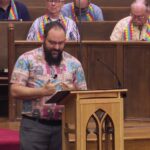
“God spoke to me: ‘Listen, man. Listen, man, you can’t travel any farther away,’” recalled Phoenix. “Immediately, the question among questions arose in my mind: Who am I?” With this line, Phoenix, the first openly transsexual United Methodist minister, drew boisterous applause at the Sunday morning service of the Reconciling Ministries Network’s “Convocation 2009: Justice & Joy.” Phoenix explained the transition to life as a man after being a woman named Ann Gordon and presented this journey as an analogue to Jesus’ “baptismal coming out.”
Referring to God’s revelation to Moses in Genesis, Phoenix argued for a fluid concept of gender, asking, “How could we possibly fit ‘I am who I am’ into binaries?” Phoenix then declared, “God’s self-declaration to Moses became my declaration, and your declaration.” Aptly summarizing the sermon, Phoenix closed by leading the audience in declaring: “I was who I was. I am who I am. I will be who I will be. If you can become, then we can become. We will become who we will become; together the beloved community.”
According to its Mission Statement, the Reconciling Ministries Network (RMN) is dedicated to mobilizing “United Methodists of all sexual orientations and gender identities to transform our Church and world into the full expression of Christ’s inclusive love.” Integral to this mission is the goal of a “renewed and vibrant Wesleyan movement that is biblically and theoretically centered in the full inclusion of God’s children,” with “inclusion” defined as full participation in church service and leadership.
Specifically, RMN urges deleting United Methodism’s requirement that clergy be celibate if single and monogamous if married, with marriage understood to be a union of man and woman. In recent years, RMN has advocated a wider agenda that affirms trans-sexuality, including sex change procedures. During the conference, RMN provided “Transgender Etiquette” guidelines to all participants: “Please do not assume anyone’s gender, even people you may have met in the past. A person’s external appearance may not match their internal gender identity. You cannot know the gender or sex of someone by their physical body, voice, appearance or mannerisms…When you are unsure of a person’s gender identity and you don’t have an opportunity to ask someone what words they prefer, try using that person’s name or gender neutral phrases like ‘the person in the red shirt,’ instead of ‘that woman or man.’”
This year was RMN’s 25th annual conference, which was held at the YMCA in Estes Park, Colorado over Labor Day weekend. The event included worship services, three plenary sessions and numerous workshops. Bible study for the weekend was led by Dr. Elaine Heath, Assistant Professor of Evangelism at Perkins School of Theology and director of the Center for the Advanced Study and Practice of Evangelism at Southern Methodist University. In her teaching, Dr. Heath focused on John 17: 1-26 which, as Jesus’ longest prayer, she argued should “shape our theology.”
The first plenary, entitled “Intersections,” focused on how to move away from ethnocentrism and toward “ethno-relativism.” This goal, as explained by Rev. Barbara Isaacs, entailed eschewing all “isms” and learning to lovingly accept “the other.” Isaacs is Associate General Secretary of the United Methodist General Commission on Religion and Race based in Washington, D.C. In her view, loving others requires shaking off the strictures of tradition and pursuing a multicultural perspective of Biblical truth.
Marriage “equality” for same-sex couples was featured in a panel discussion during the next plenary. The respondents assessed the current state of the fight for same-sex marriage and identified upcoming battles in Maine, New York, New Jersey, and Washington, D.C. As the panelists forthrightly conceded, these battles will determine the future course of their fight. Success in these contests, they argued, would greatly increase the viability of a federal resolution expanding the definition of marriage to include homosexual couples.
The final plenary dealt with the international dimensions of LGBTQ (lesbian-gay-bisexual-transgender-questioning) issues. The main themes of this session were the activities of conservative Christians in Africa and the future of the UMC’s relationship with the central province (read more here). Particularly salient was the desire for a new U.S. only regional conference, so as to remove African opposition to church approval for homosexual practice.
In addition to these plenary sessions participants attended workshops divided into four categories: “Transforming Our Congregations,” “Equipping for Social Change,” “Engaging Intersections: Towards Wholeness” and Arts & Storytelling.” Among the workshop leaders was Melany Burrill, author of All God’s Children – Teaching Children About Sexual Orientation and Gender Diversity. Burrill’s class, “Teaching Children About Sexual Orientation and Gender Diversity,” stressed “the importance of teaching even very young children about sexual orientation and gender diversity” and taught “specific ways to model affirming attitudes about sexual orientation and gender difference with children.”
The climax of the weekend was Sunday night’s award ceremony, in which Rev. David Weekley received the “Voice in the Wilderness” award for “taking risks, despite isolation in a wilderness, to proclaim the rightness of inclusion for all people in the church, and for standing against injustice despite that lack of support.” In late August, Weekley, an ordained United Methodist minister for over 27 years, came out to his bishop as a transsexual more than 30 years after his sex change. Weekley joins Phoenix as one of two openly transsexual United Methodist ministers. In acceptance, Weekley said, “I decided to hide in the wilderness to be effective until God said it was okay to come out. And it’s good to come out…I’m really glad to be home.”
Although a request for interviews with nine speakers was submitted, none was granted. However, Anthony Hebblethwaite, Communications/Technology Manager, did agree to answer questions regarding RMN’s mission. While acknowledging diversity of opinion among its members, Hebblethwaite characterized RMN as “theologically progressive,” which he defined as a socially active theology that incorporates political causes.
When asked what would constitute a successful convocation, he identified three goals: fellowship and networking for like-minded pastors, lay people, and advocates; training and educating members, especially on transgender issues; and successfully launching the “Believe Out Loud” campaign, “in which United Methodists will gather in fifty Annual Conference teams to tell their stories and join the movement for full inclusion of people of all sexual orientations and gender identities.”
Since its formation in 1984, the Reconciling Ministries Network has grown to 280 reconciling churches (out of over 34,000 United Methodist congregations), 80 reconciling communities, and 35 campus ministries. It is RMN’s hope that Convocation 2009 will precipitate an increase in these
No comments yet

Leave a Reply