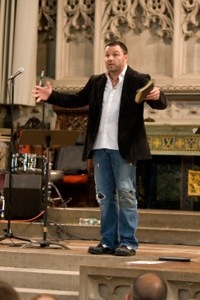
This blog is NOT about the plagiarism charges against Seattle pastor Mark Driscoll, pictured above, whose impressive effectiveness as teacher and evangelist for orthodox Christianity especially among young people in a very secular region deserves admiration and replication. His Mars Hill Church’s recent acquisition of a majestic former Methodist sanctuary in Seattle, a congregation that had liberalized and withered, having previously sold their stately 1300 seat church to a developer, vividly illustrates how counter cultural faith is far more dynamic than the cultural conformity of dying once Mainline Protestantism.
But this blog is about the photo that has accompanied some stories about the plagiarism charges. Why is an intelligent, serious pastor and spiritual leader of a multiple congregational movement appearing in a sanctuary wearing ripped jeans?! Why is his shirt not tucked in?! Where is his tie? Why does a pastor want to look almost like a vagrant?
In fairness to Driscoll, his pastoral dress is not entirely unusual in the evangelical world, although I have not seen many preachers in church with holes in their jeans. Maybe dressing down is effective outreach for audiences unaccustomed to church formality. But most in these same audiences probably still dress up for weddings, funerals, graduations and events they regard as significant. Evidently worship no longer counts as that significant to merit respectful dress.
It once was a redeeming quality for traditional once Mainline Protestant churches that, whatever their other deficiencies, they offered a respectful, traditional worship atmosphere, with clergy and parishioners dressed formally. Increasingly this seriousness is less and less common, and I sometimes see worshippers dressed similar to Driscoll in this photo. Usually I see only a handful wearing a coat and tie at my own church and other Methodist churches where I attend, a big shift from just a few years ago. Recently I was asked to be an usher at a church I visited, my only apparent virtue as a stranger apparently being that I was among the very few in a suit.
An elderly woman in my church has recalled that her father, when pastor of the church in the 1940s, had been the last minister to appear in the pulpit wearing a frock coat and not a robe. Apparently not until well into the 20th Century did Methodist clergy start wearing robes, previously wearing dark suits. Francis Asbury, founding bishop of American Methodism, was famous for crisscrossing the American frontier in his dark suit, which naturally got frayed. John Wesley reputedly preached often to outdoor crowds in the robe of an Anglican clergy.
The largest church in the neighborhood of my church is an historic black Baptist congregation. Their traffic creates a small traffic jam on Sunday mornings. And as I pass their parishioners walking from their parked cars they are always formally dressed, men and women, all ages. This particular church is pretty well to do. But as a black seminary president recently explained to me, historically black people who were not well off saw church as their most important experience of the week and dressed accordingly. I’ve noticed that worshippers at immigrant Hispanic evangelical churches are often dressed very formally, probably for similar reasons.
Shouldn’t church be the most important event of the week for everybody, at least as important as a wedding or other celebration?
English politician and thinker Daniel Hannan, in his excellent new book Inventing Freedom: How the English-Speaking Peoples Made the Modern World, notes the English aren’t known for any distinctive folk costume because their dress, the men’s business suit, became the global norm for formal wear. He also notes that American jeans became the global norm for casual wear.
The dark business suit was refined in the Victorian era. Its serious sobriety displaced the colorful plumed foppery that had for centuries characterized men’s clothing, at least for upper classes. It was the product of Victorian piety, itself the descendant of 18th Century Wesleyan revivalism, and the 17th Century’s Puritans, themselves known for dark, understated apparel. The suit was the great equalizer, as it was worn by tenant farmers and kings, conveying equal respectability and seriousness for all.
One of the great photos is of JFK famously addressing the Houston Ministerial Association in 1960, standing before an auditorium filled with clergy in dark suits and white shirts. The imagery conveys depth of purpose that a crowd of jeans and tee shirts could not.
Of course, we don’t really know how the early church or Apostles dressed in worship. But the Apostles did call for orderliness and respectfulness that was conducive to solemnity and holiness.
There is somewhat of a trend in evangelical Christianity towards greater liturgy and formality of worship. Maybe that trend will include more formal attire in worship. If so, it will convey a growing maturity for the evangelical world that is both sartorial and at least subliminally spiritual.
I hope Mark Driscoll has many decades of fruitful preaching ahead that will also include his tucking in his shirt and putting on a tie!




Comment by Sky McCracken on December 10, 2013 at 2:59 pm
I dunno Mark…. clerical dress styles come and go. While I personally wouldn’t dress down as much as Driscoll, I also know that context and milieu have a lot to do with manner of dress. As a DS, it took me about a year to learn the congregations and their accustomed dress – but that first year, I was often overdressed and stood out.
Clergy facial hair for men comes and goes too. Spurgeon thought beards were natural, scriptural, and manly.
I think given the state of the Church these days, this is a minor, not a major.
Pax,
Sky+
Comment by Trey Harris on December 10, 2013 at 4:01 pm
One reason people come and keep coming to our church plant (6yrs old) is casual dress. Most men don’t wear suits to work anymore many don’t own a suit. Your comments belie an ignorance for contextual ministry. If you’re on 5th Ave NYC or DC a suit is probably appropriate. But a community of blue collar plant workers would b better served by clergy in more casual dress. However, I understand you have to write about something.
Comment by John Haroldson on December 10, 2013 at 7:16 pm
Lutheran Congregations in Mission for Christ (LCMC), one of the splinter groups that broke away from the ELCA, now sells clothing. Check it out on their website at http://www.lcmc.net/blog/lcmc-apparel-available/a474.html .
I suppose they reasoned that, if LCMC doesn’t sell clothing, there would be no Lutheran clothes on the market.
The point of my comment is that the newer alternatives to the ELCA are unlikely to grow because their leadership is just as foolish as that of the ELCA.
Comment by Robert on December 11, 2013 at 1:14 am
For me the dressing down has become a new form of fake.
The mussed up hair, the scruffy beard, the high tech accessories, the intentional mix of designer clothes and thrashed out poverty gear – another fashion statement.
It’s to say, “I’m so authentic – not like your parents – or the people at the legalistic church you heard about.”
I mean if that is really all the clothes he could afford, of if he just got back from his secret agent, super hero gig and his clothes got all beat up while saving the world, then okay.
But otherwise it’s a show. And a childish one at that.
Comment by Adrian Croft on December 11, 2013 at 9:50 pm
Ditto everything you said. Being “authentic” is so 1960s, and besides, being an authentic SLOB is just not what I like on Sunday morning. I like Mark Driscoll, but I’d love to grab him by the collar and shake him and say “I do NOT want to see my pastor’s knees, especially in the sanctuary, now go put on a suit or at least a pair of dress pants with no holes in them.”
Then again…. if this is what it takes to get people in to the pews, so be it. But I don’t have to like it.
Comment by Michelle on December 13, 2013 at 3:30 pm
I balk at this. Granted, my husband and I serve at a church that is comprised of 75% college students, so context is very important.
My husband has always been casual in his attire to church (and to work, and to special events – I’m always urging him to not wear khakis or casual shoes to events like funerals or weddings).
But the idea that everyone who dresses down is being falsely authentic is ignorant. Many people (such as my husband) have little to no concern with what others’ think of their image. My husband is an internal person – what matters to him is the state of his heart before our Almighty. He is literally the most mature person our age I have ever met.
I understand the importance to many of the outward reflecting the inward, but you must recognize the importance of the Lord guiding us to what’s important to him, as well as the issues He wants to work on in our lives.
So, to boil that down: what’s important in your relationship with God is not necessarily what God considers important in others’ relationships with him. If it is, I’m certain the Holy Spirit will illuminate our hearts and minds in his perfect timing.
The idea that people dress differently from you when they worship because they desire to keep up a facade is strange and sad to me.
[That being said, I also have no desire to see my pastor’s skin under his pants. 🙂 ]
Comment by Byron on December 11, 2013 at 5:39 am
I think Driscoll dresses that way, to help hide his pot belly while still trying to maintain an image of being “hip”.
Comment by Dressler Downs on December 11, 2013 at 8:41 am
Personally, I wear a suit – I am most comfortable that way and I tend to think that the occasion demands it. But I don’t get as upset as I used to.
Yes, the dark suit has its origins in piety – an attempt to be modest and understated, not flash. But can’t the very same thing be said for those who “dress down”? The irony is that a “modest” designer dark suit can cost a bundle and, for that matter, so can so can a “modest” pair of designer ripped jeans. The vogue today is to be pretentiously unpretentious.
Comment by kate on December 11, 2013 at 10:32 am
I have mixed opinions on this. I recognize the importance of aesthetic meaning in our dress, and I also see the importance of trying to relate to those we are ministering to and welcoming people no matter their economic situation. Our pastor dresses with a coat and tie but there is no dress code for the boys and girls who extinguish the candles during the benediction. I kind of like it. As I said I have mixed thoughts on this. Plus I have very little respect for Mark Driscoll as a preacher and leader so his lack of respectable dress doesn’t surprise me.
Comment by Joseph on December 11, 2013 at 11:41 am
This is an issue to be pondered theologically, not simply dismissed as a matter of style.
Serious questions present themselves, including: “Does overly informal pastor and worship-leader dress convey to a congregation, even if unintentionally, a casualness on the part of leaders toward the weighty matters of worship and the proclamation of gospel?”
My wife and I moved a year ago (from one city to another), and we have visited many churches since relocating. We’ve found the wearing of t-shirts, flip flops, and ragged jeans among church leaders in worship services (and, of course, among the congregation) to be widespread.
At first, it didn’t bother me too much. After all, we all want to make church services “approachable” for people who have few of this world’s goods. But I am now persuaded that the deliberate dressing down on the part of leaders is undermining, however unintentionally, the attitude of reverence that should characterize worship.
I find it odd that people will dress down for corporate worship God but dress up for things they consider “important,” such as a business appointment or social gathering.
Thanks, Mark, for raising this issue, and for helping us think a bit about respect, tone, and appropriateness as we gather to worship the Most High God.
Comment by Jerry Fannin on December 11, 2013 at 7:00 pm
I thought God looked at the heart not the Hart, Shaffner & Marx. But what do I know? I’m just a sinner saved Grace.
Comment by Forgiven Sinner on December 11, 2013 at 11:20 pm
As a wise, old Sunday School teacher once told me – “We get dressed up for the things that are important to us.” The “come as you are” pitch that many churches use to attract visitors often causes the reverence and seriousness of worship to be lost. Some churches look more like a giant youth group, and the tone of their worship often reflects that – immature, surface level and anything but serious and reverent. The fact that many adults dress formally for work – then casually for church – says a great deal about how we view God.
Comment by Bill on December 12, 2013 at 10:20 am
Its the message that counts, even if the outerwear is in question. Jesus was so nondescript in his clothing that Judas had to kiss him to show the Roman guards which one He was. Something to think about.
Comment by Tonda on March 16, 2014 at 1:40 pm
Bill, Judas had to kiss Jesus because it was the middle of the night-dark-no streetlights or such. Besides, it was just a regular day for Jesus, out and about His business. I am pretty sure He dressed up for respectful occasions, like attending temple for worship. Though He was probably never pretentious, I bet he did observe most of the traditions of His culture, like dressing up when the occasion called for it.
Comment by Francis on December 13, 2013 at 10:57 am
I agree with your argument that clothing is important, but I think your conclusions on worship are too narrow. There is sometimes a strong missional rational behind the way a pastor or minister dresses. As far as I can see worship and mission are not easily separated. John Piper once said “Missions exist because worship doesn’t.” So every worship service should be missional and every missionary task should be for the ultimate glorification of God, which is worship. In a recent survey of unchurched people in the poorest areas of cities here in the UK, many felt alienated by middle class churches by the way the congregation and pastors dressed. In their mind, a suit and tie expresses superiority, education, wealth and they feel they have nothing in common. They said that they could relate to a pastor who dressed like the and spoke like them. Charles Spurgeon was often criticised in the newspapers of the time for the ‘vulgar way’ he spoke and presented himself, but the ordinary working class people of London flocked to hear him. Contextualisation of the gospel has always been controversial as it was in Spurgeon’s day and ours. Mark Driscoll has his flaws as we all do, but I wonder if there is something we are missing in the whole debate about him. Could it be that Mark Driscoll is just a very skillful missionary, and that he has tapped into blue-collar America that few others have been able to do?
Comment by Tim on December 13, 2013 at 12:21 pm
There is more theology going on in dress styles than has been permitted in conversations about church. It has been easy to overlook how important a role dress has in the Bible because of a “gnosticizing” of the Bible (especially cutting out the Old Testament, and making the N.T. only “spiritual”). Robert [above] hit on one important point about dressing down as a new “fake authentic.” Much of the “contemporary” movement has merely succeeded at replacing high formalism with low formalism. Robert Pattison hit the nail on the head in his book on rock music titled “The Triumph of Vulgarity.” The vulgar (rooted in low romanticism) is the standard of the new legalism.
It is connected to views about what “authentic” means and requires. It is connected to the rise of “the unhindered self” as the center of life and worship. Of course there is talk about God being the center, but if there are no standards, and no ability to communicate reverence, except for words, it becomes indistinguishable from self being the center.
Of course words are under attack also and show signs of giving way to the fate of everything based on “tradition” (is there anything more based on tradition than a dictionary?) and words too submit to personal preference.
I don’t find the “cultural relevance” argument persuasive. Suits, ties, elegance are still major components in OUR culture. They still communicate taking things seriously. What has changed and become accepted is the lack of seriousness and reverence for nearly everything. There are moments that still command respect and not doing our own thing (e.g. Court rooms, some funerals, some weddings, the few weeks of cultural respect and moderation after 9/11, etc.)
There is little concern for displaying respect if self is the center and the “grace” of God bends to our our self before signs of reverence. Theologically it is dangerous to let “come as you are” really mean “stay as you are” because you really are the standard.
Comment by Doug Nichols on December 14, 2013 at 12:30 am
Speaking in church in Manila of 5000 and the next Sunday church of 6000. Will need to free up both Sundays. Just a question, “Who is Mark Driscoll?”
I see articles about him but never see him quoted by anyone.
Comment by Doug Nichols on December 14, 2013 at 12:31 am
Not free up but dress up.
Comment by Dedra Duty on December 14, 2013 at 10:50 am
I did not realize that people were still stuck on this issue. I think it is irrelevant what you wear to church. Some people can not afford nice clothing, so come as you are. I personally like to dress up, but could care less what everyone else is wearing, including the Pastor.
Comment by John C. Edwards on December 19, 2013 at 11:29 pm
How do you feel about those young girls who come to church in very tight skin-revealing casual clothes? (The kind that turns the heads of all the married men and has all the young boys panting with lust?)
Comment by Robert on December 19, 2013 at 9:11 am
To use the contextualization argument is hard to swallow, given that John MacArthur’s (and I don’t necessarily agree with all if his theology) church flies in the face of contextualization. Located in California where secularism is growing at an alarming rate, yet a vast majority of members wear formal dress. Additionally, if someone argues from that perspective then why stop at the attire why not incorporate secular songs and “christianize them”? Would that not violate the RPW? I think the author is speaking on someone’s view of the church that will necessarily have other implications; such as dress.
Comment by Keith Cox on December 19, 2013 at 10:08 am
I don’t think Jesus wore a suit and tie, but I think the Pharisees would have criticized it.
Comment by Douglas White on December 19, 2013 at 10:29 am
And yet no comment on Driscoll and his ‘prophetic visions’? I’d think that is much more important to the church at large. But I definitely agree that church leadership should be dressed more formally on Sunday Worship services, but that is my culture and what I expect. I can’t necessarily force that on others.
Comment by Steven on December 19, 2013 at 10:49 am
If you only worship God once or twice a week then maybe you should dress up but worship is called to be a 24/7 deal and if you believe you need to dress up for worship you better keep your Sunday’s best on all week.
Comment by Paul S on December 19, 2013 at 11:18 am
This is more cultural than theological. Suits and ties are on the decline. Look closer at the 40 year old and below crowd at wedding and funerals. These days, there are not as many suits and ties as you suggest. Suits are costly. Ties are miserable. While pastors should check their hearts on why they dress the way they dress (i.e. cool factor, fit in factor, etc.); your “suit and tie” desire for pastors/worshipers seems a bit silly and an example of straining knats to me.
Comment by Paul S on December 19, 2013 at 11:18 am
make that “gnats.” 😉
Comment by Rod on December 19, 2013 at 11:58 am
Today’s millennials are very complex and are struggling about who they are and who they want to be. Especially in Christian circles, it is thought to be “cool” to show disrespect or act as though one is invincible based on their outward appearance. Therefore, many will fall into the trap of feeling that it is an acceptable behavior to be rude or disrespectful to the older generation by dressing down in ripped jeans and untucked shirts. Millennials are among those who have inner turmoil about how to gain their independence and present themselves as “cool” to their peers while feeling good about themselves. It is an internal battle, and someone is going to lose, most likely previous generations.
Comment by j on December 19, 2013 at 1:50 pm
The amount of scripture you guys use to back up your position is great! oh wait………………..
Comment by Ian Columba (@IanColumba) on December 19, 2013 at 3:44 pm
It’s not about what you wear, it’s about why you wear it (theology).
http://iancolumba.com/dressing-for-worship/
Comment by Dan Trabue on December 19, 2013 at 7:42 pm
Mark said…
Why does a pastor want to look almost like a vagrant?
You ever hear of John the Baptist?
Mark…
But most in these same audiences probably still dress up for weddings, funerals, graduations and events they regard as significant. Evidently worship no longer counts as that significant to merit respectful dress.
Who gets to decide what counts as “respectful dress…”?
Of course, Jesus and his disciples didn’t wear dark business suits. In fact, Paul teaches us not to overdress (no wearing fancy gold jewelry, etc). Why is this an issue today? This isn’t the 1950s.
~Dan Trabue
Comment by David Pettengill on December 20, 2013 at 10:24 am
My thoughts exactly Dan!
Comment by Matt on December 19, 2013 at 9:54 pm
Can’t believe I just waisted 3 min of my life reading this stupid article and ignorant responses.
Both confirm the calloused hearts of those fighting to save church all while losing the battle to save the lost.
Foolish people. May God soften your hearts to his lost children and allow you to see that if you spent half the time seeking them that you spend critiquing others, the world would be a better place.
1 Samuel 16:7
Comment by Michael on December 20, 2013 at 12:43 am
When I hear someone at a church care what people are wearing, I run the other way as fast as I can…their focus is on the wrong thing.
Comment by Jeff Mortenson on December 20, 2013 at 6:29 am
Wearing a suit and tie to church is not important, getting a person into church is. Legalism is what has put the evangelical church into the situation they are in – dying. The emerging church is growing by leaps and bounds because the message is about Jesus and not how a person dresses or the appearance of wealth.
Comment by Cathy on December 20, 2013 at 9:30 am
Being raised in the formal Methodist tradition, I understand your points. However, the “requirement” of suit and tie for men, nice dresses and hats for women can be a reason that people don’t attend church. In affluent churches or areas, this is not a problem. In other areas, the money that a family has is spent on paying bills and clothing needed for work and school. In these cases, the attitude of “required” dress can be enough to put people off and cause them not to attend church. I understand that you feel that “dressing down” shows a lack of respect for God. On the other hand, since God looks on the heart (I Samuel 16:7), I would venture to say that attire is more important to the humans in this equation than to the God we serve.
Comment by Paul Grubb on December 20, 2013 at 11:10 pm
THIS is what I think of when I think of legalism. This idea that God is somehow impressed or pleased with how fancy my clothes are when I attend “church” in a building that is often referred to (and improperly I might add) as “the house of God” is unscriptural. I have yet to have anyone convince me scripturally with merit that God wants us to wear “our best” or fancy clothes, or a suit and tie. I do see that we are to be modest – I think we can all agree that is clearly taught in scripture. I will say that modesty, or the lack thereof, is a MUCH BIGGER problem, or should I say sin, that is hardly EVER dealt with or even spoke of in most church cultures. I would even argue that this “dressing up for church” has SO often led to immodesty in the church. That’s just one problem I have with this idea. Another one is this idea of “dressing up for God” compared with James chapter 2. I have been in church since I was 9 months in the womb. I have many times seen preference given to those “dressed up” for church, while the POORly dressed (and yes, I mean can’t afford “fancy dress up” clothes) shunned, ignored, and even CONFRONTED (hearing of that incident made me want to punch whoever did the “confronting” – yes, I know, that was my flesh reaction). I am convinced that this “dressing up” or “dressing up in our best for God” idea almost always leads to a direct contradiction to what James 2 is telling us not to do (showing favoritism). How we as Christians can think that we can somehow earn favor with God or even our fellow Christians by dressing up when God freely gave up His Son for our salvation, not of OURSELVES, but completely and only through what JESUS DID FOR us is hard to fathom….Now, on to the article, I think it is ironic that the article quotes no scripture, none. Yes, the author made a reference to orderliness and respectfulness, but that vague reference they are referring to certainly makes no articulation of how we should dress in worship, as the author tries to imply. Even if the author was not implying this when referring to orderliness and respectfulness, that’s a huge jump from what I believe that passage was referring to (I’m assuming he’s referring to Paul’s teaching on how to use tongues in a worship service). Anyway, I don’t disagree that orderliness and respectfulness should be present in church, I just don’t see how not “dressing up” has anything to do with that….I think the first sentence in the fourth paragraph of the article speaks VOLUMES to what is wrong with the idea of “dressing up for God” – “It was once a REDEEMING quality for traditional….with clergy and parishioners dressed formally.” WOW! Do I need to say that JESUS REDEEMS us NOT how we dress?!?! Wowza, my heart got pumping fast when I read that line!…..I’ll end with this – I have seen, in our church, people ignored because, quite frankly, they look like me (I have long hair and a huge beard, wear jeans and a tshirt). I have seen people of a different race COMPLETELY ignored at a meal that was intended to get to know/fellowship with another church. When my wife and I went to speak with them (2 different families), we discovered that one of the families had actually been attending OUR church and were not from the “visiting” church. Favortism! Isn’t it awesome? (insert sarcastic eye here) But hey, at least we’ll look good in our suit and tie when we’re disobeying the Scriptures.
Comment by Teresa Benson on December 22, 2013 at 7:28 pm
When I worked in a blue-collar job in the early 80’s, many of my coworkers didn’t own dress clothes appropriate for church. (I did, because I went to a church where, like most churches, everyone dressed up.) Among my co-workers, even funerals and graduations didn’t warrant the purchase of a suit or nice dress– they just wore the best they had. Imagine my sadness when one of my co-workers wanted to go to church with me, but I realized that she’d either have to buy new, nice clothes, or else would feel terribly out of place. I couldn’t think of a tactful way to explain the situation, so I ended up never inviting her to my church. I switched churches shortly thereafter, to one where I could bring anyone regardless of what clothes they had.
Comment by Chris on December 24, 2013 at 1:08 pm
For years, our family attended church in our “Sunday best”. The services were formal as was the congregation. Today, we attend church where the dress and congregation is casual or come as you are, but the Gospel is serious and souls are being awakened by the Holy Spirit. I caution those who are overly critical to not attempt to classify the reverence and missionary impact of covenantal churches by the dress code they adhere to. I don’t find this kind of article to be helpful in any way. In fact, it appears to try and highlight differences that have nothing to do with our Great Commission and if nothing else, cause strife for no reason.
Comment by Garry Moes on December 26, 2013 at 2:00 pm
One of the lingering legacies of the social revolution which reached its zenith in our country during “The Sixties” is the denigration of noble excellence. The revolution’s ideal of class leveling has become thoroughly ingrained within our cultural norms, though few now recognize its socialist origins. From the French Revolution on, egalitarian leveling has always occurred at the lowest common denominator — the thought being that since the poor have not the means to reach the levels of the aristocracy, aristocrats, in the interest of equality and fraternity, must level downward. This ideal achieved profound moral stature during The Sixties, and, once it became a moral issue, it was embraced warmly by much of the church, which by then had become disposed toward all manner of leftist mores.
Perhaps nowhere was this disposition more obvious than in the trend among churchgoers to dress commonly while attending worship services. Whereas once on a Sabbath morn we happily donned our “Sunday best,” many now found great moral virtue in coming to worship in the uniform garb of the counterculture — tattered jeans, holey T-shirts, dirty sneakers and even more weird trappings of the revolutionary times. Much of this was driven by a sense of guilt which the socialists successfully instilled within the middle and upper classes. God’s regard for the underclass and our solidarity with them somehow now required that we look like bums in His presence. It was all so humble.
James Rutz, in his popular book of a few years ago, The Open Church, approved of this movement toward “come as you are” worship. He offered a rationale based on his own dubious historical analysis which claimed that the practice of dressing up for worship had its origins in the Middle Ages when aristocrats sought to distinguish themselves in attendance at the great cathedrals from the rabble who were building them.
The trend toward downward social leveling remains with us, and while substantial voices are beginning to be raised decrying the deterioration of decency and standards of civility, the church remains a bastion of cultural banality. Visit many middle class churches today and you will find street clothes the norm — even the moral ideal. In some, even the (disgusting) extremes of style and “grooming,” such as body piercing and gang fashion, are accepted.
All of this flies in the face of historic Judeo-Christian perspective and biblical standards. From the beginning, God has required our highest and best — especially in the context of worship. Indeed, He has always demanded that He be approached only with spotless perfection. The sacrifices in Old Testament worship were to be taken from the best of the flocks and herds, animals without blemish — the prefigurement of the Lamb Without Spot or Wrinkle, Holy and Without Blemish (Ephesians 5:27). The New Testament’s continuity with this spirit of the sacrificial system is set forth in such places as Romans 12:1, where St. Paul calls on Christians to offer themselves “as living sacrifices, holy and pleasing to God” — their “spiritual worship.” To which Paul immediately adds, “Do not conform any longer to the pattern of this world” (vs. 2). He calls for a renewing mental transformation which will distinguish and approve of God’s good, pleasing and perfect Will. That Will includes setting as our cultural ideal all such things as are “noble,” “lovely,” “admirable,” and “praiseworthy” (Philippians. 4:8). As hymnwriter Howard B. Grose put it, “Give of your best to the Master … Give Him the best that you have.”
Marla McCrorie, writing on this subject a few years ago in the teen-age girls’ magazine Brio, published by Focus on the Family, anticipated the usual objection: “…the Bible says ‘Man looks at the outward appearance, but the Lord looks at the heart!'” (I Samuel 16:7). McCrorie responded: “But what does your heart look like? And how does your clothing reflect the attitude of your heart?”
She offered a test of beauty and modesty with the following questions:
• Is my heart set on glorifying God? (I Corinthians 10:31)
• Does my heart honor God as King? (Psalm 95:3,6)
• Is my heart humble (Micah 6:8) enough to make me dress to the glory of God and not the things of earth?
• Does my heart identify with other Christians rather than the world? (Ephesians 4:25)
• Is my heart filled with love for God? (Deuteronomy 6:5)
Sadly, Brio’s editor blunted this excellent article with a note adopting the old misclaim that God loves us just as we are … that God “loves you just as much in a dirty T-shirt and sweat pants.” Well, maybe … or maybe not. The scriptural fact is He despises us as we were and sacrificed Himself to ensure that we did not remain as we were — dressed in the filthy rags of our unrighteousness. He redeemed us that we would be transformed into the likeness of His perfection and glory.
Comment by Karl on June 16, 2014 at 1:43 pm
Nice job with the genetic fallacy of telling us where dressing down came from thus we must reject dressing down. You further poised the well with references to socialism. Next you employ several false analogies to represent our heart and redemption are somehow directly related to our dress. Wow,can’t even point to even proof texts for that position.
Thanks again for your tour de force refresher on logically fallacious reasoning.
Comment by Sydney on December 28, 2013 at 7:44 pm
People, ask yourselves how you would dress if you were visiting royalty. Now contemplate that you are visiting the King of Kings. Perhaps your idea of dressing up isn’t a coat and tie-fine-but do you think “come as you are” is appropriate? If you are a hippie-groovey-but would it not be appropriate to wear your best hippie shirt and sandals and not the grungy ones?
Comment by Carolyn on December 30, 2013 at 8:57 am
Our church has several worship service each week. One of them is a shorter, “come as you are” service that is regularly attended by a core group of folks who like getting all the basic liturgy, a few hymns and a great message. We also offer a contemporary service once a month. No one seems to be too concerned about what everyone is wearing, but everyone has the option to attend whichever service they are comfortable with. The message is always the same… God’s love, Jesus’ teachings, and the Great Commission.
Comment by Jesse on January 28, 2014 at 4:39 pm
Jesus doesn’t care about what we wear, but what’s in our hearts. You know that.
All this talk of ‘maturity’ is subjective. Me wearing a t-shirt and jeans to church shouldn’t signify a lack of maturity.
Comment by Linda on April 4, 2014 at 7:56 am
When did people in the world start dressing down to go to church? When I was in the world I enjoyed dressing up for church. The church leaders started this change in dress.
Comment by Karl on June 16, 2014 at 10:37 am
Suits do not begin to take seriously Christ’s higher calling. We all should be wearing the professorial robes that Luther wore.
Congratulations on continuing to narrow the gate so that not only non-Christians would never dare enter your church but most Christians would not be able to conform to your set of rules. Hmm wonder where we find an example of someone adding a list of things Christians need to do in order to become more formal, serious-minded Christians.
‘Unless you are circumcised according to the custom of Moses, you cannot be saved.’ . . . It is necessary to circumcise them and to order them to keep the Law of Moses.”
You seem to have a lot in common with the Judiazers in Acts. Jesus dealt with a group of teachers in his day that were always interested in appearance and what men wore.
Matthew 23 has some applications to this discussion.
4″They tie up heavy burdens and lay them on men’s shoulders, but they themselves are unwilling to move them with so much as a finger. 5″But they do all their deeds to be noticed by men; for they broaden their phylacteries and lengthen the tassels of their garments. 6″They love the place of honor at banquets and the chief seats in the synagogues,…
26″You blind Pharisee, first clean the inside of the cup and of the dish, so that the outside of it may become clean also.
We live in a post-Christian culture that is largely secular. We can cloister ourselves away from that culture by creating a strong boundary of customs and theological necessities. We can also eschew the trappings of the outwardly religious and unconditionally love the lost where they are at. And accept Christians wherever they are in their journey to be conformed to Christ despite their appearance.
Comment by Karl on June 16, 2014 at 11:30 am
If individuals in Fundamentalist churches took their walk with Christ as seriously as their appearance in a church service 2 hours a week, we would still be a Christian, rather than secular culture. Substituting appearance (at least in front of other fundamentalist) is much easier that taking up the cross of Christ. My fundamentalist friends make a mockery of Christ’s ambassadorial calling. Always adding to the two great commandments. Weekly, I am undoing the misrepresentations of who Jesus is by Fundamentalist.
I engage people in bars, and smoke shops, on airplanes and hotel lobbies, at work and in my neighborhood. I do wear appropriate clothing for each event but dress down at church to convey that my appearance is Not a sign of respect for the seriousness of the Christian calling, my transformed life, transparency and love for my fellow man represents my seriousness for Christ’s calling (especially out of church when no one is looking).
Have you not read of Christ’s encounter with the Sumaritan woman at the well? John 4 stands in stark contrast to the core misrepresentations of Christ by Fundamentalist. Do you really think you will escape judgement of these false actions. I tell you the truth, you have stumbled many and made it almost impossible for them to ever come to Christ.
Have you not read 1 Corinthians 13? What good are all your rules and theology if they don’t demonstrate Christ’s love?
Have you also not read the Olivet discourse in Matt. 25?
41 “Then he will say to those on his left, ‘Depart from me, you who are cursed, into the eternal fire prepared for the devil and his angels. 42 For I was hungry and you gave me nothing to eat, I was thirsty and you gave me nothing to drink, 43 I was a stranger and you did not invite me in, I needed clothes and you did not clothe me, I was sick and in prison and you did not look after me.’
On this pericope, fundamentalists may not just be disgraced at the Bema seat judgement, but may actually be sent to Hell!
Finally, less someone think my motivation for this post is for my love for Driscoll, or more appropriately his choice of outfits, I don’t know of him or his ministry. I also don’t own any jeans with holes in them. Just tired of 38 years of fundamentalist damage control with non-believers to whom I’m reaching out.
Comment by Deesker on August 4, 2014 at 12:44 pm
I’m just seeing this blog. I couldn’t agree with you more! I have some Christian channels on my cable t.v. and every time I go to them, there is always a minister dressed down in a long sleeved shirt hanging over his jeans. It disgusts me. They look ridiculous. Thank you for your insights. It’s good to know that class still exists with certain people.
Comment by Rob Wagner on April 18, 2019 at 12:39 pm
Churches (especially mainline churches) are growing older, smaller and closing their doors at record pace and we’re concerned about what a pastor (who is reaching younger, unchurched people) is wearing on the platform. As long as the Gospel is not being compromised why are we still having this conversation?
Comment by Mike Fincham on April 29, 2019 at 2:36 pm
EXACTLY!!
Comment by Mike Fincham on April 29, 2019 at 2:34 pm
I’m 70. Been in traditional churches for most of those yrs. I’ve noticed that people obsessed with a suit and tie..trying to tie it to “dress your best”… don’t have the book of James as their favorite book! just sayin…
Comment by Indy Jones on October 23, 2021 at 10:54 am
Several commenters are confusing the laity with the pastor. No, there shouldn’t be, nor is there, a dress requirement for attending church. However, you are coming to the Lord’s House. One would hope you would attend in more than your pajamas.
As for the preacher, though, how can he convey the seriousness and solemnity of the subject matter wearing teenage-rebellion clothes? Look at the walls behind Mr. Driscoll in that picture. They are not the walls of the local pub. Dress appropriately, (although, I would put forth that torn clothing is never appropriate for anything).
With the same breath, many condemn the secularity of the times and ok the laxity of the preacher’s attire. Why should I consider him a leader or authority if church -the worshipping of the Great Creator- is equal to mowing the grass or working on the car? How important can this “religion thing” be, then?
The phrase “dressing for something important” came up. What is more important than worshipping Him who created us? No, it does not have to be done in your “Sunday Best”, but if the preacher is trying to sell me on how great God is, he probably should dress the part. That would be dependant on his surroundings and again, I say look at Mr. Driscoll’s surroundings in that picture.
Comment by R, Dailey on September 2, 2023 at 3:50 pm
Paul’s injunction to the Roman’s, 12:1, is still valid and not changing with the course of this ever changing world. People love change. Does God change? Aren’t we supposed to be more like Him? or the world? If you don’t dress UP for the worship service, who do you dress up for? The worship service should reflect the people of God!