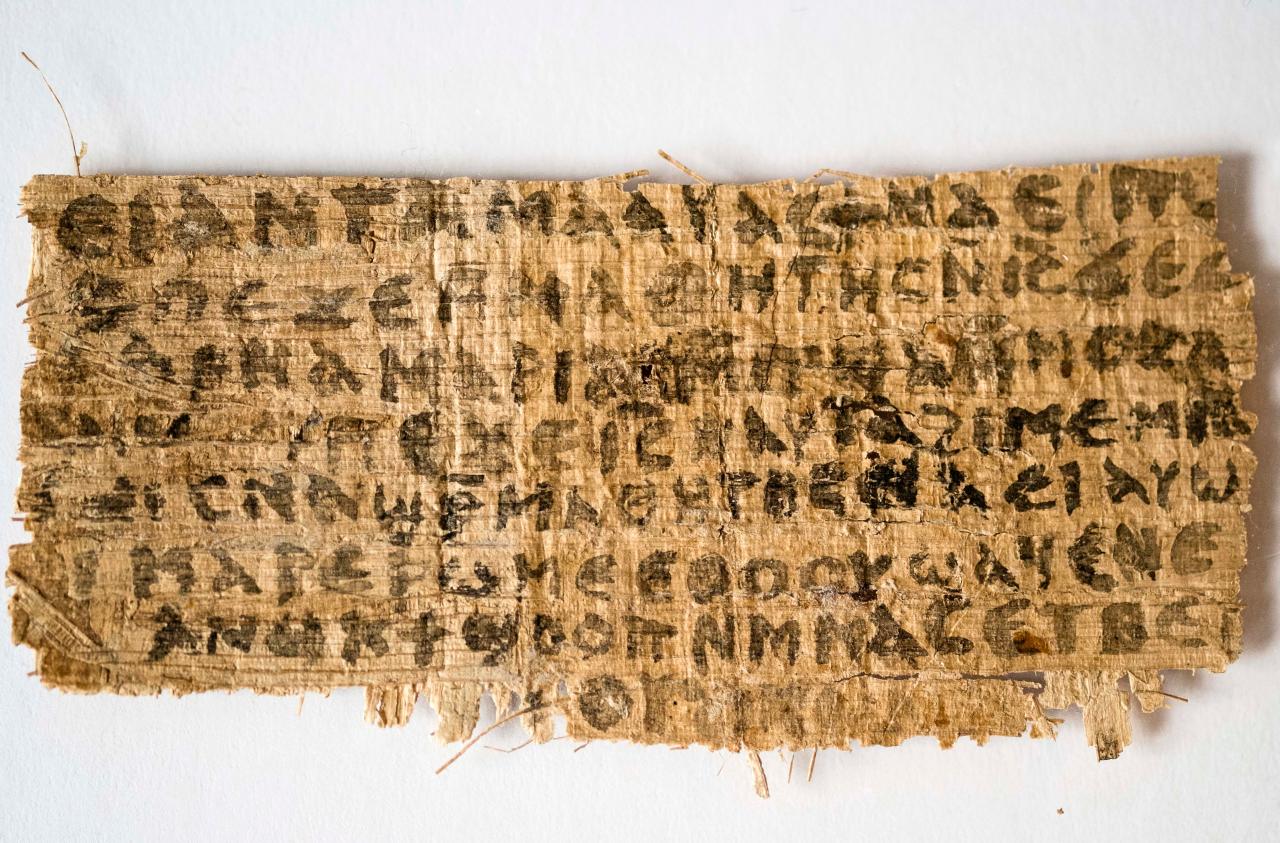
If the secular media had their way the recent discover of a business card sized fragment of papyrus that supposedly has Jesus saying, “My Wife,” would finally be the end of all things Evangelical. You see, Evangelicals have this belief that the Bible is the inerrant Word of God and is thus an authoritative revelation on the life of Jesus and how God would have us order our lives. Those who have rejected God and instead have determined the governing authorities for their lives is no higher that their base bodily impulses and wanton desires would love to show Jesus was just a man like us. Fortunately, the old media is not the only media. Within minutes of the announced discovery of the Gospel of Jesus’ Wife, the old media’s celebration was met with new media mockery. Here are a few humorous examples:
Matt Kennedy, rector of Anglican Church of the Good Shepherd in Binghamton, NY (the church that had their property confiscated and sold to become an Islamic education center) noted on his Facebook,
“Finding a 4th century document referring to Jesus’ wife is like finding a 21st century document referring to George Washington’s gay lover…and should be treated with the same confidence.”
Twitter also lit up with a great hashtag #Jesuswifequotes


On a more serious note though, it is evident in the later epistles of John, Peter, and Jude, that the church was already encountering false teaching and were being warned against it. Furthermore, throughout the history of the Church there have always been those who seek to inject falseness for truth and claim unrighteousness for godliness. As Al Mohler noted on the affinity with heterodoxy that certain scholars promote,
“Several ambitions drive this effort. Feminists have sought to use the Nag Hammadi texts to argue that women have been sidelined by the orthodox tradition, and that these Gnostic texts prove that women were central to the leadership of the early church, perhaps even superior to the men. Others have used the Nag Hammadi texts to argue that Christianity was diverse movement marked by few doctrinal concerns until it was hijacked by political and ecclesiastical leaders, who constructed theological orthodoxy as a way of establishing churchly power in the Roman Empire and then stifling dissent. Still others argue that Christianity’s moral prohibitions concerning sexuality, and especially homosexuality, were part of this forced orthodoxy which, they argue, was not the essence of true Christianity. More than anything else, many have used the Nag Hammadi texts as leverage for their argument that Christianity was originally a way of spirituality centered in the teachings of a merely human Christ — not a message of salvation through faith in a divine Jesus who saves sinners through the atonement he accomplished in his death and resurrection.”
Even The Atlantic, not known for its conservatism, was able to discern that Jesus often referenced “his wife”. Associate Editor Eleanor Barkhorn writes, “The Bible itself refers to Jesus’ wife, repeatedly. Only that wife is not Mary Magdalene or any other earthly woman. It’s the church. Christ calls himself a bridegroom throughout the New Testament.”
Part of our role at the IRD is to illuminate the false teachings that are being promoted through our churches. While we don’t get involved with many theological debates, we confront those who fundamentally reject the biblical and historic teachings of the church. Whether it be issues of life, sexuality, or religious liberty we will continue to speak boldly so that the true Bride of Christ, the church, will be found faithful to the end. We welcome you to stand with us.




Comment by Dan Trabue on September 20, 2012 at 4:10 pm
I am no scholar or archeologist to have a huge opinion about this fragment of 1600 year old parchment, as to its sound-ness in referring to a wife of Jesus, but neither do I get the problem with it. The Gospels never say that Jesus had a wife, but neither to the aver that Jesus was not married, not that I can think of, anyway.
What in the world difference would it make to the Gospel if Jesus DID have a wife?
I understand it would be a blow to tradition and cultural understanding, but a “false teaching…”?? How could that possibly be so?
If they could prove with 100% authority that Jesus had a wife… what difference would it make to the gospel teaching of salvation by grace through faith in Christ?
I don’t get the uproar.
Isn’t the reasonable (and biblical) position to hold one that says, “This is one fragment of an ancient gospel. It is neither proof that Jesus was married, nor is it evidence that Jesus wasn’t married. Certainly, we have no way of determining with any certainty either position. Regardless, the possibilty of a wife of Jesus in no way takes away from the notion that we all are in need of love, grace and salvation…”
No?
Comment by dover1952 on September 20, 2012 at 11:03 pm
You make a good point, but I think the rejoinder would be that if Jesus did have a wife (known as a “significant other” by some), this other would have been significant enough to be mentioned as his wife in the New Testament.
Being a liberal Christian whose thoughts on many things tend to be somewhere about 300 light years to the left of Karl Marx, the historical sexual hangups of orthodox Christians would make it impossible for them to believe that Jesus could have been married—and worst of all have engaged in sex with a woman. My mother, God rest her soul, was the most fully blossomed flower of that orthodox tradition. Once upon a time, she said to me quite seriously and frankly, “I just don’t know how a loving God could have created something so awful and nasty as sex.” It was held in the same high esteem as the contents of an unflushed toilet. Because Jesus is viewed as the personification of holiness and cleanliness, it would be impossible to place him in a mental or cultural context inhabited by such “filth.” As one Christian fundamentalist once remarked:
“People don’t understand how a loving God could send a person to a state of eternal torture so vile and painful that one could not even imagine Charles Manson doing that to a biting dog. That’s because you don’t understand how utterly and totally clean God is. If you can bring your mind to understand the depth of the cleanliness, then the depth of the torture becomes obvious and easy to understand and acccept.”
Of course, from my perspective, that is sort of like saying that Hannibal Lechter gets a free pass to kill and eat someone just so long as he took a long, soaky bath first. Did I mention that I am not a Christian fundamentalist or conservative evangelical? Well, I am not—thank the Lord.
No offense intended. This is just an honest statement of how I feel. When a serious writer includes a quote from Al Mohler, in my mind it guts their argument, and getting past the quote makes my skin feel like crawly things are moving around on it. Please try to avoid that in the future.
Comment by Dan Trabue on September 21, 2012 at 7:37 am
this other would have been significant enough to be mentioned as his wife in the New Testament.
How many other major NT/early church/disciples’ spouses are mentioned?
Of the dozens of characters in the NT, are there, what? One? Two?
Comment by Ben Welliver on September 21, 2012 at 11:22 am
I heard they found Jesus’ birth certificate – turns out he was born in Kenya.
Comment by Dan Trabue on September 21, 2012 at 3:05 pm
Oh, is that why he was crucified? Some things never change!
What do you think, Ben? Is the suggestion that Jesus had a wife in any way a big deal, scripturally, morally or logically speaking? If you found out Jesus had a wife, would that throw your idea of Christianity in the garbage in some way?
Comment by J S Lang on September 21, 2012 at 4:30 pm
Ben, you’re thinking of that OTHER Messiah, the one with the power to lower the ocean levels.
Comment by Luke Moon on September 21, 2012 at 5:51 pm
Ben and JS, well played.
Comment by Dan Trabue on September 22, 2012 at 2:49 pm
So, Luke, while admiring their “well-played” joke, would you address a question that rises from your writings?
You said…
Part of our role at the IRD is to illuminate the false teachings that are being promoted through our churches. While we don’t get involved with many theological debates, we confront those who fundamentally reject the biblical and historic teachings of the church.
Are you suggesting that suggesting that MAYBE Jesus had a wife is – beyond being just not provable or a probably mistaken guess – somehow a “false teaching” and part of “fundamentally rejecting” biblical teachings?
Isn’t the claim that “Jesus had a wife” more like the claim that “Jesus was left-handed,” or “Jesus smoked hashish…”? An interesting claim that is not provable and really neither here nor there as far as church tenets go?
One problem that I have with you all is you seem to want to raise EVERY disagreement to the level of “heresy” and make those who have unprovable hunches that disagree with your unprovable hunches to be “false teachers” “Heretics” and “not Christian…”
The level to which you raise this issue just seems a bit silly over something that you simply can’t prove and that is wholly inconsequential to serious Christian living.
You don’t truly find this to be a problematic teaching do you and, if so, on what possible basis?
Comment by Luke Moon on September 22, 2012 at 11:22 pm
There are two issues at stake with the claim that Jesus had a wife. One is that the entire orthodox history of the church rejected the idea that Jesus was married. The only ones pushing the idea were in fact heretics. The Gnostics in the first few centuries were rightly labeled false teachers. So if the ancient church declared an idea heredical you should expect the IRD to conclude likewise.
The second issue is motive. What is the motive of the scholar who has declared Jesus had a wife? Well, if you look at her published works she is feminist who has fought against the Catholic churches restriction concerning ordination. So it should not surprise anyone that she found a fourth century scrap of parchment to say what she wanted said.
Comment by Dan Trabue on September 24, 2012 at 4:57 pm
Thanks for the thoughts, Luke. A couple of questions…
1. HAS the “entire orthodox history of the church” held an opinion about whether Jesus was married or not? If so, where? I am wholly unfamiliar with “the church” holding an opinion on Jesus’ marital status.
2. On what basis would the church hold this opinion with any fervor? Sure, the canonical books of the Bible never suggest it and I, myself, find no great reason to suspect Jesus was married, but neither do I care one way or the other.
3. The bible, in fact, tells us that “Jesus did many other things as well. If every one of them were written down, I suppose that even the whole world would not have room for the books that would be written.” (John 21). It is entirely possible, it seems to me, that Jesus was married. That would only emphasize his human nature (Jesus being completely God AND completely human, after all) and make his sacrifice all the more amazing, it seems to me.
4. Regardless, it seems like a spectacular non-issue. I just can’t see how the question is in any way essential to orthodox Christianity.
You say, “if the ancient church declared an idea heredical you should expect the IRD to conclude likewise.” What are your sources that points to some segment of the ancient church holding a strong opinion on Jesus’ marital status?
Thank you, good sir.
Comment by Dan Trabue on September 24, 2012 at 4:59 pm
As to motive of an individual making a claim, well, that can always be dealt with on a case by case scenario. Maybe this person does and maybe she doesn’t have an agenda. But that would seem like a separate issue over against the question of “Does the church hold a strong opinion about Jesus’ marital status and why in the world does it matter?”
Comment by Dan Trabue on September 25, 2012 at 9:51 am
Should I take the silence as a “No, there is not a single bit of evidence that the historic orthodox church has established a position on Jesus’ marital status. Not one shred of evidence. Nothing. My apologies for making a mistaken claim. Of course, there is nothing heretical about the suggestion that Jesus may have been married.
My apologies…”?
Or does it just mean you haven’t had time. If the latter, no problem. If the former, I’d hope you’d have the moral wherewithal to admit a simple misstatement and to print a retraction of the false statement.
Comment by Luke Moon on September 25, 2012 at 12:03 pm
Dan,
Against my better judgement, because I don’t have time and it would satisfy you anyways, here is what Dr. Timothy Paul Jones has to say on the subject:
“The earliest Christian writer to refer explicitly to the singleness of Jesus seems to have been Clement of Alexandria. Clement was a theologian who began teaching in Alexandria around A.D. 180. In the closing years of the second century, Clement wrote against false teachers who had declared marriage taboo; these false teachers had claimed that “marriage is the same as sexual immorality.” While arguing against these heretics, Clement commented that Jesus “did not marry” (Stromata 3:6:49).
About the time that Clement was writing against false teachers who regarded marriage as immoral, a lawyer named Tertullian became a Christian and quickly turned his rhetorical skills toward defending the Christian faith. In a treatise urging monogamy, Tertullian of Carthage mentioned that Jesus, a lifelong celibate, had made God’s kingdom accessible to those who—like Jesus—never engaged in sexual relations (“… ipso domino spadonibus aperiente regna caelorum ut, et ipso spadone, quem spectans et apostolus…,” De Monogamia 3). Later in the same treatise, Tertullian termed Jesus “entirely unmarried” and “voluntarily celibate in flesh” (“innuptus in totum…spado occurrit in carne,” 5).”
Comment by Dan Trabue on September 25, 2012 at 1:07 pm
Luke, thanks for the response. Interestingly, you said…
Against my better judgement, because I don’t have time and it would satisfy you anyways
You made an assertion. I had zero awareness of the claim (that the early church would have held the suggestion that Jesus had been married to be heretical). I asked you if you had any historical support for the claim.
Why would it be against your better judgment to support your claim?
As to your claim, you have offered quotes from three non-biblical sources. Clement, you say, commented that “Jesus was not married.”
Okay. The Bible never makes that claim, but Clement did 100 years after the fact. I wonder what he based that on? Just word of mouth in the early church community/their collective memory?
You assert that Tertullian claimed Jesus to be celibate (noting that the Bible does not say this, but it is Tertullian’s claim based upon… what? Not that I think Jesus WASN’T celibate, it just seems to be an unsupported claim, as far as I am aware).
Tertullian later claims that Jesus was not married (“entirely unmarried”) and celibate.
Okay.
Let us concede that at least these two fellas 100 years after the fact believed Jesus to have been celibate and never married. Let us further concede that this was the opinion of the church.
We all together thus far?
Given that, how do you get from “the 2nd Century church’s memory of Jesus was that he was not married” to “the claim that Jesus WAS married is heretical…”?
I mean, if the early church claimed that Jesus was left-handed or blue-eyed or that he liked barbecue and later, someone suggested that Jesus was RIGHT-handed, BROWN-eyed and a vegetarian… how is ANY of that consequential to church teaching?
Aren’t these mere opinions about unprovable characteristics that have no serious impact on essential teachings of the church?
I’m not asking you, Luke, if some 2nd Century church folk thought Jesus was single, I’m asking you on what basis do you make the jump from “they thought this” to “to disagree with 2nd Century opinions on non-essential matters rises to the level of heresy or false teaching?”
If you have an answer to THAT question, I’d be open to hearing it. I can be taught, but you have to present evidence.
On the other hand, if you have ZERO evidence to support this rather outlandish claim, don’t you think you ought to back up a bit, apologize for overstating your point and clarify that you were just reacting to some of the OTHER claims being made by some people?
I mean, it is entirely okay to misstate a point. What is more disagreeable is an unwillingness to admit a mistake.
What of it, brother Luke?
Comment by Luke Moon on September 25, 2012 at 2:48 pm
Dan,
It is unlikely that anything I write at this point would satisfy you. If you have spend any time studying the gnostics you would know that there were both ascetics and antinomians. While the ascetics taught against all marriage and procreation, the antinomians thought the opposite-indulge thyself. The ascetic gnostics were rebuked by those mentioned above, while there were others who saw Mary as a source of special knowledge because of her intimate relationship with Jesus. The teachings of the gnostics from Peter to present have been rejected as false teaching and heretical.
It is obvious that you have a lot of time on your hands and I would encourage you to study the gnostics for yourself. I stand by my statements.
Comment by Dan Trabue on September 25, 2012 at 3:00 pm
Perhaps I’m not the wizened scholar that you are, my good brother, but I am at least generally aware of the gnostics. I know that some were ascetics and some antinomians.
I don’t see how that, in any way possible, means that suggesting “Jesus may have been married…” is in any way heretical. I would think one as learned as yourself could explain it to me in simple terms that even I could understand. You know, like this…
“It is heretical because suggesting Jesus MAY have been marrried conflicts with the biblical and Christian teaching that…”
And fill in the blank.
For instance, suggesting that sex is wrong, THAT could be addressed like this…
“It is contrary to sound Christian and biblical teaching because sex is something to be honored and celebrated in the pages of the bible. We have many examples of Godly men and women living a fulfilled marriage relationship and, obviously, taking part in sexuality. Beyond that, it is evident to our own experience that a healthy sex life can improve a marriage relationship and, thereby, strengthen the community…”
Like that. Just explain how it is in any way contrary to good Christian teaching.
I believe in you, Luke. I believe that IF there were ANY Christian reason to call this suggestion “heretical” that you could explain it, even to one as simple-minded as myself.
The absence of ANY support or attempt to defend this leads me to think NOT that you are incapable of doing so, but that simply, you are mistaken and perhaps too embarrassed to admit it.
If you ever DO have an attempt an explanation, I’ll be glad to listen and learn at your feet. But you can’t reasonably say, “Believe this because I say it’s right” and expect people to buy it. Defend your position or back off from it.
Even I can recognize the wisdom in that.
Comment by Dan Trabue on September 27, 2012 at 10:26 am
And, I repeat, The absence of ANY support or attempt to defend this leads me to think NOT that you are incapable of doing so, but that simply, you are mistaken and perhaps too embarrassed to admit it.