
When John Wesley sent his Sunday Service of the Methodists in North America to the newly independent United States in the Fall of 1784, he included a number of items with his revision of the Prayer Book, including a letter sent to “Our Brethren in America.” In fact, he sent more than just a letter, for as Randy Maddox notes, this letter “was published as a two-sided flyer, so that Coke, Vasey, and Whatcoat could carry copies of it when they departed from King’s Road, Bristol, on Sept. 18, 1784” on their way to the United States (The Works of John Wesley, 30:268).
The letter is fascinating on several points. First of all, it’s a justification for Wesley’s actions earlier that month when he ordained these three men, two as elders and one as superintendent for the American work. He argues that it was “Lord King’s Account of the Primitive Church,” a book published in 1691, that gave him the idea even if he took King’s revisionist approach and applied his own further revisionism upon it. He also described the U.S. at the time as not having “any parish ministers,” which was also a stretch (Works, 30: 269). But the letter doesn’t start with his justifications for irregularity but rather a begrudging acknowledgement of American independence.
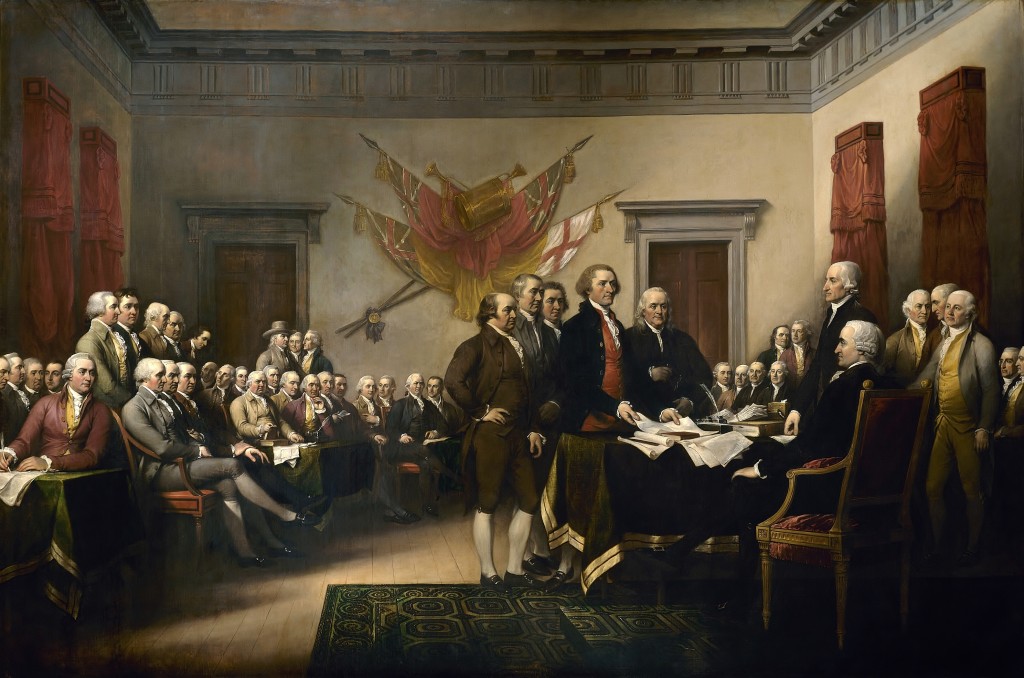
Wesley wrote that, “By a very uncommon train of providences many of the provinces of North America are totally disjoined from their mother country and erected into independent states” (Works, 30:268). The concept of providence runs throughout Wesley’s writings. He was more than convinced that God was intimately involved in the outworking of history. In his 1783 sermon “On the Education of Children,” he mocks the concept of “chance” as something unbefitting of a Christian worldview (Works, 3:353). God is involved in everything, even if we don’t always understand it.
We shouldn’t read this, however, as though Wesley liked this “uncommon train of providences” in and of themselves. He believed that providence always worked for ultimate good, but that providence can also imply a negative experience that is meant to turn someone, or some nation, to repentance.
During the second Jacobite rebellion in 1745, Wesley went to Newcastle where he preached to the Hanoverian troops. Even if his mother was a Jacobite and perhaps his oldest brother, Wesley was not. And so, he preached to these men, trying to turn them from their wicked ways, fearful that by the providence of God the Jacobites would be victorious and impose Roman Catholicism on England as punishment. From this viewpoint, providence would guide the unfolding of history in order to call the faithful—and Wesley meant Protestants here—back to their first love, even using a Catholic dynasty to do it.
To grasp this approach, simply look at the Old Testament prophets. Over and over again, the prophets call Israel to faithfulness in order that God, by his providential hand, would not allow opposing nations to defeat Israel. Scholars have identified a “Deuteronomic history” within portions of the Old Testament where the overarching theme is that God will maintain Israel if it remains faithful. And if not, he will use the enemies of Israel to remind them of their calling. It is through this lens that Wesley saw the War of Independence, or rebellion, depending on how one viewed it.
Not all Methodists in America were against the revolution.
Continue reading at Firebrand here.
Ryan N. Danker is director of the John Wesley Institute, Washington, DC and a member of the Firebrand lead team.


Comment by Salvatore Anthony Luiso on June 30, 2026 at 4:16 pm
Thank you for this article. I agree that we Christians of today can learn from how John Wesley regarded the movement for American independence and how he reacted to it.
I find it odd that the although the author discussed Wesley’s being a member of the Church of England that he did not say anything about what Wesley thought about how American independence could or would affect his relationships with Americans who, as long as the colonies remained colonies, were also members of the Church of England.
Do we have no record of what Wesley thought of that? Did he think that these Americans might not only no longer consider King George III to have ecclesial authority over them, but also the rest of the hierarchy, including even Wesley himself?
I also wonder: How did Americans, and American Methodists in particular, react to Wesley’s opposition to American independence? Did his opposition cause any problems within Methodism? (As far as I can tell, it didn’t, as he was greatly admired and loved by many Americans in the 19th Century.)
Comment by Wilson R. on June 30, 2026 at 5:03 pm
Salvatore, I’ve done some reading on this. The issue of slavery in America affected Wesley’s stance on independence and how he was perceived by Americans.
Wesley had visited the South in the 1730s and seen slavery up close. The experience hardened his position against it. I believe that was part of the reason he opposed American independence. Great Britain was steadily moving toward abolition, and had the American colonies remained part of the empire, slavery here likely would have ended sooner and with less bloodshed.
But Wesley’s opposition to independence hindered the effectiveness of Methodists in America during the Revolution. People saw him as siding with their oppressor. Many of Wesley’s preachers had to be recalled to England.
The retrenchment of Methodists during the Revolution took them out of the national conversation over the future of slavery here. Before the Revolution, the Methodists (like the Baptists) were opposed to slavery. After the Revolution, they generally dropped their opposition because they could not otherwise win white converts in the South.
Comment by Salvatore Anthony Luiso on July 1, 2026 at 1:12 am
Wilson R.:
Thank you for your comment in reply to my comment.
Comment by Thomas on July 5, 2026 at 6:55 pm
Interesting fact: the Jacobites were both Roman Catholics and Anglicans (called Episcopalians in Scotland). They had promised religious tolerance if they won, but most Scottish never supported them.